RESEARCH LETTER
Intralesional Corticosteroid Versus Cryotherapy for Alopecia Areata: A Systematic Review and Meta-analysis
Yu-Cheng LIU1,2#, Kai-Wen CHUANG3# and Hua-Ching CHANG3–5* 
1Department of General Medicine, Taipei Medical University Shuang Ho Hospital, New Taipei, Taiwan; 2Department of Dermatology, Wan Fang Hospital, Taipei Medical University, Taipei, Taiwan; 3Department of Dermatology, Taipei Medical University Hospital, Taipei, Taiwan; 4Research Center of Big Data and Meta-Analysis, Wan Fang Hospital, Taipei Medical University, Taipei, Taiwan; 5Department of Dermatology, School of Medicine, College of Medicine, Taipei Medical University, Taipei, Taiwan. *E-mail: hc.chang@tmu.edu.tw
#These two authors contributed equally to this study.
Citation: Acta Derm Venereol 2025; 105: adv44435. DOI: https://doi.org/10.2340/actadv.v105.44435.
Copyright: © 2025 The Author(s). Published by MJS Publishing, on behalf of the Society for Publication of Acta Dermato-Venereologica. This is an Open Access article distributed under the terms of the Creative Commons Attribution-NonCommercial 4.0 International License (https://creativecommons.org/licenses/by-nc/4.0/).
Submitted: Jul 20, 2025; Accepted after revision: Aug 22, 2025 Published: Sep 4, 2025
Competing interests and funding: The authors have no conflicts of interest to declare.
To the Editor,
Alopecia areata (AA) is a common T-cell-mediated nonscarring hair loss. The global prevalence of AA is approximately 0.1–0.2%. AA tends to affect the younger population and is equally likely among male and female individuals (1). Intralesional corticosteroid injection is the first-line treatment for patchy AA, and its common side effects include injection pain and cutaneous atrophy (2). Cryotherapy has been proposed as a therapeutic option for AA due to its local reactive vasodilation and immune modulation effects (3). Several studies have compared the therapeutic efficacy of these 2 modalities, but the study design has been highly variable. Hence, we conducted a systematic review and meta-analysis to elucidate the clinical efficacy of intralesional corticosteroid therapy vs cryotherapy for AA.
A systematic review was conducted. On 25 February 2025, we searched PubMed, Web of Science, Embase, and Cochrane Library databases (Table SI). The search protocol was registered on PROSPERO (CRD420251001120), and no language restriction was applied. We included studies comparing hair regrowth in patients with AA after treatment with intralesional steroid or cryotherapy. The quality of the included studies was assessed using version 2 of the Cochrane risk-of-bias tool for randomized trials or Risk Of Bias In Nonrandomized Studies of Interventions tool for randomized controlled trials (RCTs) or non-RCTs, respectively. The primary outcome was the clinical response of hair regrowth, categorized into 3 groups – mild, moderate, or complete response – on the basis of definitions in the included articles. The pooled estimates are reported as risk ratios (RRs) with 95% confidence intervals (CIs) and were obtained using a random-effects model. Heterogeneity across the included studies was assessed using χ2 and I2 tests, and publication bias was measured using Egger’s test; p < 0.05 indicated statistical significance. All analyses were conducted using Comprehensive Meta-Analysis version 3.0 (Biostat, Englewood, NJ, USA).
We included 2 RCTs and 3 non-RCTs in the final quantitative analysis (Fig. S1) (4–8); these studies involved 510 patients with patchy AA. The basic characteristics and risk of bias of the included studies are listed in Table I and Table SII. A single intervention was applied to different patient groups in 3 studies, and different treatments were applied to independent AA lesions in the same patients in the other studies. Patients undergoing cryotherapy received superficial liquid nitrogen for 2–5 s for 1 to 4 cycles every 1–6 weeks. The treatment protocol for intralesional steroids was injection with triamcinolone acetonide at a concentration of 5–13 mg/mL every 2–6 weeks. Follow-up durations ranged from 12 to 24 weeks. Pooled estimates revealed no significant difference in overall hair regrowth between the intralesional steroid and cryotherapy groups (RR = 1.222, 95% CI = 0.581–2.570, p = 0.597, Fig. 1). Subgroup analysis based on different levels of response revealed similar trends for mild and moderate response. The intralesional steroid group had a significantly higher complete response rate than did the cryotherapy group (RR = 2.524, 95% CI = 1.753–3.633, p < 0.001, Fig. 1). Significant heterogeneity was discovered across the studies. No significant publication bias was detected.
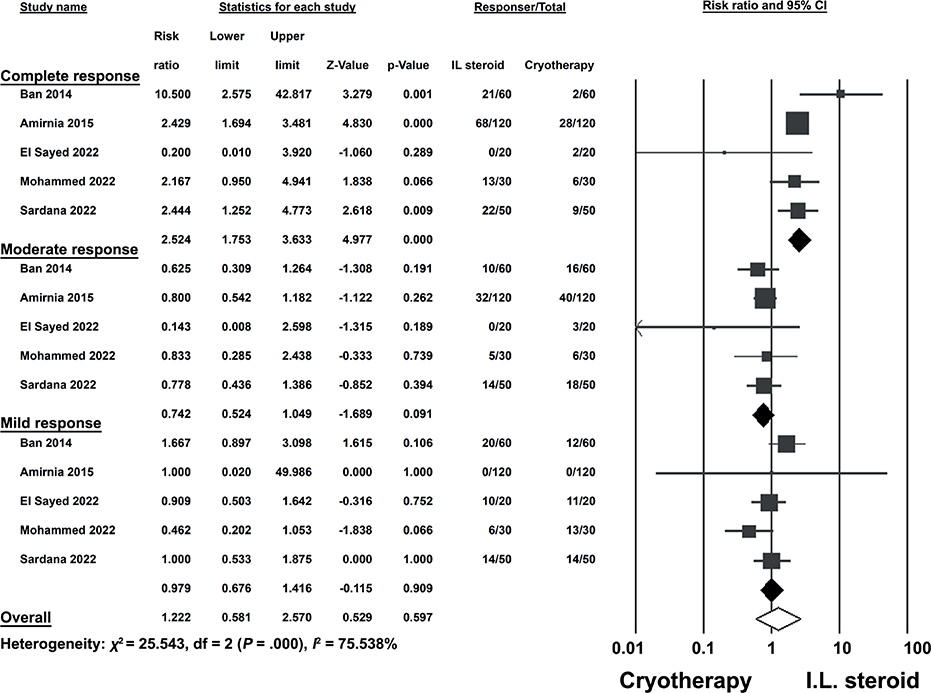
Fig. 1. Forest plots comparing different levels of hair regrowth response in patients with AA undergoing intralesional (IL) steroid therapy or cryotherapy.
A recent study conducted using an intrasubject split-lesion treatment design discovered a significant improvement in hair regrowth percentage after cryotherapy in which the skin’s surface temperature was kept at 0°C for two 20-s cycles but no significant improvement after cryotherapy lasting 10 s per cycle. This study suggests that precise temperature control and cryotherapy of a certain duration are crucial for the effective treatment of AA (3).
Limitations of the present study include the variability in the definitions of treatment response, heterogeneity among intervention protocols, and interstudy differences in the timing of outcome assessments.
In summary, cryotherapy is less potent than intralesional steroid injections in treating AA but remains a viable therapeutic option, particularly for patients unable to tolerate injection pain or with steroid phobia.
ACKNOWLEDGEMENTS
IRB approval status: No IRB was required for systematic review and meta-analysis.
REFERENCES
- Strazzulla LC, Wang EHC, Avila L, Lo Sicco K, Brinster N, Christiano AM, et al. Alopecia areata: disease characteristics, clinical evaluation, and new perspectives on pathogenesis. J Am Acad Dermatol 2018; 78: 1–12. https://doi.org/10.1016/j.jaad.2017.04.1141
- Yang CC, Chen CC, Lin TK, Lin MH, Lin SJ, Chi CC, et al. Taiwanese Dermatological Association consensus on the diagnosis and management of alopecia areata. Dermatologica Sinica 2025; 43: 26–35. https://doi.org/10.4103/ds.DS-D-24-00188
- Lee H, Lee JW, Park S, Park H, Kim GH, Kwon O. Comparative analysis of temperature-controlled cryotherapy versus intralesional triamcinolone acetonide injection for alopecia areata: an intrasubject split-lesion pilot study. J Eur Acad Dermatol Venereol 2025; 39: e505–e507. https://doi.org/10.1111/jdv.20464
- Ban HZ, Qi HY, Feng XQ. Observation on the efficacy of three methods for treating alopecia areata. J North Pharmacy 2014; 11: 51–52.
- Amirnia M, Mahmoudi SS, Karkon-Shayan F, Alikhah H, Piri R, Naghavi-Behzad M, et al. Comparative study of intralesional steroid injection and cryotherapy in alopecia areata. Niger Med J 2015; 56: 249–252. https://doi.org/10.4103/0300-1652.165034
- El Sayed MH, Ibrahim NE, Afify AA. Superficial cryotherapy versus intralesional corticosteroids injection in alopecia areata: a trichoscopic comparative study. Int J Trichology 2022; 14: 8–13. https://doi.org/10.4103/ijt.ijt_130_20
- Mohammed AIA, Farag AS, Hafiz HS. Superficial cryotherapy versus intralesional corticosteroid injection in alopecia areata: a comparative clinical and dermoscopic study. Egypt J Hosp Med 2022; 86: 211–217. https://doi.org/10.21608/ejhm.2022.211050
- Sardana S, Goyal T, Kushwaha P, Jha P. A prospective study to compare the efficacy of cryotherapy versus intralesional steroid in alopecia areata. J Cutan Aesthet Surg 2022; 15: 175–178. https://doi.org/10.4103/JCAS.JCAS_166_20