RESEARCH LETTER
Successful Treatment of Subcorneal Pustular Dermatosis with Abrocitinib
Zirui CHEN, Jiahui ZHAO and Hang LI*
Department of Dermatology, Peking University First Hospital, National Clinical Research Center for Skin and Immune Diseases, Beijing Key Laboratory of Molecular Diagnosis on Dermatoses, NMPA Key Laboratory for Quality Control and Evaluation of Cosmetics, Beijing, China. *E-mail: drlihang@126.com
Citation: Acta Derm Venereol 2025; 105: adv44512. DOI: https://doi.org/10.2340/actadv.v105.44512.
Copyright: © 2025 The Author(s). Published by MJS Publishing, on behalf of the Society for Publication of Acta Dermato-Venereologica. This is an Open Access article distributed under the terms of the Creative Commons Attribution-NonCommercial 4.0 International License (https://creativecommons.org/licenses/by-nc/4.0/).
Submitted: Jul 30, 2025. Accepted after revision: Aug 11, 2025. Published: Sep 1, 2025
Competing interests and funding: The authors have no conflicts of interest to declare.
To the Editor,
Subcorneal pustular dermatosis (SPD) is a rare neutrophilic dermatosis characterized by sterile, relapsing pustules in flexural areas. Current treatments include dapsone, corticosteroids, tetracyclines, retinoids, ultraviolet radiation, TNF-α inhibitors and methotrexate, etc. Here, we present the first reported case of SPD successfully treated with abrocitinib, a selective Janus kinase 1 (JAK1) inhibitor.
A 34-year-old male with a 30-year history of allergic rhinitis and food allergies (milk, eggs, wheat) presented with a 6-month progressive eruption. Initial erythematous patches appeared in the bilateral inguinal folds, later involving the popliteal fossae, waist, elbows, and neck. He was diagnosed with atopic dermatitis and treated with topical corticosteroids, oral antihistamines, and 7 subcutaneous dupilumab injections (300 mg biweekly). While leg lesions partially regressed, new pustular plaques appeared on the neck, waist, and trunk, accompanied by pain (Fig. 1). Topical tacrolimus and clobetasol provided no relief.
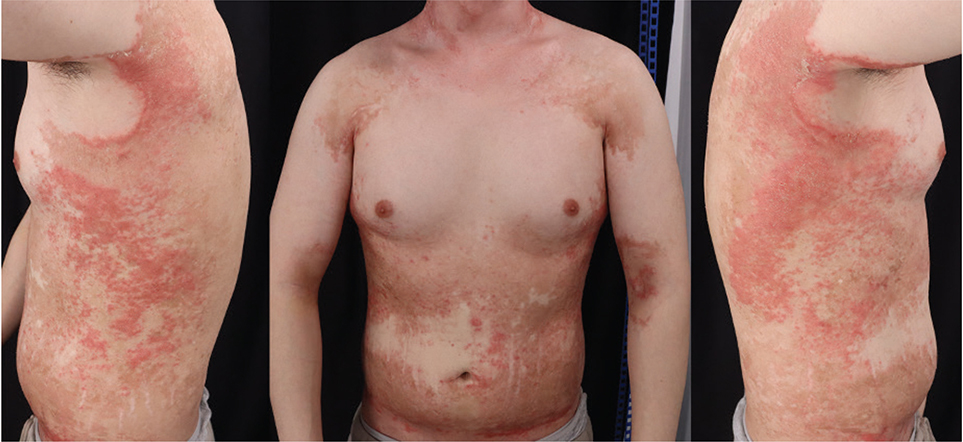
Fig. 1. Clinical presentation. Patellar erythema with clear boundary was observed in the trunk, papules and thin plaques were observed within the erythema, and densely distributed rice-sized pustules were seen in the bilateral lumbar erythema.
Dermatological examination revealed extensive, well-demarcated erythematous plaques with scaling on the shoulders, neck, elbows, abdomen, back, inguinal regions, buttocks, and thighs. Pustules and crusts were prominent on the lateral waist and right shoulder. Systemic physical examination was unremarkable. Laboratory tests showed elevated C-reactive protein (20.89 mg/L) and total IgE (809 kU/L), with positive specific IgE to multiple foods and inhalants. Bacterial and fungal cultures and Epstein–Barr virus testing were negative. A biopsy from the right waist pustule showed parakeratosis, confluent stratum corneum, subcorneal neutrophilic abscesses, and perivascular lymphocytic infiltration in the superficial dermis. Numerous fragmented neutrophils were present in the papillary dermis, confirming SPD (Fig. 2).
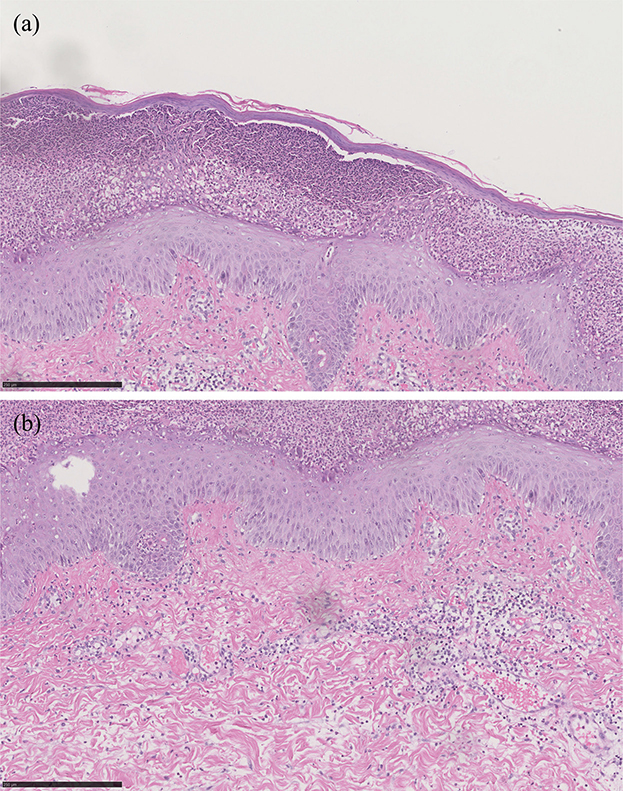
Fig. 2. Histopathological findings. (A) Parakeratosis, subcorneal neutrophilic pustules (HE×100; scale bar= 250 μm). (B) Perivascular lymphocytic infiltration in the superficial dermis, and numerous neutrophilic nuclear debris in the papillary dermis (HE×100; scale bar=250 μm).
The patient declined dapsone, corticosteroids, and biologics due to safety concerns. After minimal improvement with intravenous compound glycyrrhizin and vitamin C, abrocitinib 200 mg daily was initiated. Within 4 weeks, pustules resolved and erythema darkened. The dose was reduced to 100 mg daily, resulting in complete clearance by 8 weeks, leaving only post-inflammatory hyperpigmentation. All treatment was discontinued after 3 months, and the patient remained lesion-free throughout 12 months of follow-up.
The aetiology of SPD remains unclear, but its pathogenesis involves dysregulated neutrophil recruitment (1). Studies have demonstrated elevated levels of neutrophil chemoattractants such as tumour necrosis factor-alpha (TNF-α), interleukin-8 (IL-8), and complement fragment C5a in the pustules or serum of SPD patients (2,3). Abrocitinib is a selective JAK1 inhibitor approved for atopic dermatitis. JAK inhibitors are small-molecule drugs that block the JAK/STAT pathway, thereby interfering with the signalling of multiple cytokines (including IL-2, IL-4, IL-6, IL-12, IL-23, IFN-γ, etc.), and playing a significant role in the pathogenesis of inflammatory and autoimmune skin diseases. In recent years, JAKi have been investigated for neutrophilic dermatoses such as pyoderma gangrenosum, Behçet’s disease, and hidradenitis suppurativa (4, 5). Schell et al. reported significantly elevated mRNA expression of JAK and STAT in the epidermis of patients with hidradenitis suppurativa. Treatment with JAKi reduced the secretion of inflammatory cytokines and chemokines (TNF, IL-6, IL-8, IL-1β, CXCL3) from keratinocytes (5). A plausible mechanism by which abrocitinib treats SPD may involve inhibiting keratinocyte production of pro-inflammatory cytokines such as IL-6, IL-1β, and specific chemokines (e.g., IL-8/CXCL8), as well as potentially reducing TNF-α expression.
The use of dupilumab for an initially misdiagnosed condition could have contributed to SPD progression – a phenomenon potentially linked to immune deviation. By targeting the interleukin-4 receptor α-chain (IL-4Rα), dupilumab suppresses Th2-associated cytokines (IL-4/IL-13), thereby disrupting the Th1/Th2/Th17 balance. This shifts Th2-cell differentiation toward Th1/Th17 lineages, amplifying Th1/Th17 pathway activity and associated cytokines (IL-17, IL-23, TNF-α)(6). Such dysregulation may trigger neutrophilic chemotaxis and epidermal migration, ultimately forming subcorneal pustules characteristic of SPD. This proposed mechanism aligns with observations by Hall et al., who documented a dupilumab-triggered SPD case (7).
To our knowledge, this is the first reported case of SPD successfully treated with abrocitinib. The rapid and sustained remission observed suggests that JAKi may represent a promising therapeutic option for SPD. Nevertheless, further studies are needed to confirm its efficacy and safety.
REFERENCES
- Watts PJ, Khachemoune A. Subcorneal pustular dermatosis: a review of 30 years of progress. Am J Clin Dermatol 2016; 17: 653–671. https://doi.org/10.1007/s40257-016-0202-8
- Tagami H, Iwatsuki K, Iwase Y, Yamada M. Subcorneal pustular dermatosis with vesiculo-bullous eruption: demonstration of subcorneal IgA deposits and a leukocyte chemotactic factor. Br J Dermatol 1983; 109: 581–587. https://doi.org/10.1111/j.1365-2133.1983.tb07683.x
- Grob JJ, Mege JL, Capo C, Jancovicci E, Fournerie JR, Bongrand P, et al. Role of tumor necrosis factor-alpha in Sneddon-Wilkinson subcorneal pustular dermatosis: a model of neutrophil priming in vivo. J Am Acad Dermatol 1991; 25: 944–947. https://doi.org/10.1016/0190-9622(91)70290-I
- Koken Avsar A, Demirci Yildirim T, Sari I. Tofacitinib therapy for severe pyoderma gangrenosum in a patient with enteropathic arthritis: a case-based review. Rheumatol Int 2024 2024; 44: 2227–2237. https://doi.org/10.1007/s00296-024-05560-1
- Schell SL, Cong ZY, Sennett ML, Gettle SL, Longenecker AL, Goldberg SR, et al. Keratinocytes and immune cells in the epidermis are key drivers of inflammation in hidradenitis suppurativa providing a rationale for novel topical therapies. Brit J Dermatol 2023; 188: 407–419. https://doi.org/10.1093/bjd/ljac096
- Grolleau C, Calugareanu A, Demouche S, Nosbaum A, Staumont-Salle D, Aubert H, et al. IL-4/IL-13 inhibitors for atopic dermatitis induce psoriatic rash transcriptionally close to pustular psoriasis. J Invest Dermatol 2023; 143: 711–721 e717. https://doi.org/10.1016/j.jid.2022.10.015
- Hall S, Chew CY, Kovitwanichkanont T, Ip KH, Cahill J, Gin A, et al. Subcorneal pustular dermatosis induced by dupilumab: a novel case. Australas J Dermatol 2024; 65: 74–76. https://doi.org/10.1111/ajd.14190