The aim of this study was to estimate the economic burden of palmoplantar pustulosis, a chronic relapsing skin condition commonly occurring in combination with psoriasis vulgaris. Using data from the Swedish National Patient Register and Swedish Prescribed Drug Register for 2015, the study estimated all-cause and palmoplantar pustulosis-specific healthcare resource use (inpatient stays, physician visits and drug use) for 14,715 patients with palmoplantar pustulosis, and compared these both with matched controls from the general population and with patients with psoriasis vulgaris (without palmoplantar pustulosis). Mean annual direct costs for a patient with palmoplantar pustulosis was higher compared with costs for the general population (3,000 vs 1,700 Euro, p < 0.001). Compared with psoriasis vulgaris, more patients with palmoplantar pustulosis had inpatient stays, but fewer had physician visits and psoriasis-related drugs; the overall costs were similar. Only a small fraction of the costs of physician visits and inpatient stays for patients with palmoplantar pustulosis were attributable to specific palmoplantar pustulosis problems, indicating a clear comorbidity burden in palmoplantar pustulosis.
Key words: palmoplantar pustulosis; healthcare resource use; economic burden; healthcare register; population-based; epidemiology.
Accepted Nov 17, 2022; Published Jan 9, 2023
Acta Derm Venereol 2023; 103: adv00843.
DOI: 10.2340/actadv.v103.4501
Corr: Marcus Schmitt-Egenolf, Department of Public Health and Clinical Medicine, Dermatology, Umeå University, Umeå, Sweden. E-mail: marcus.schmitt-egenolf@umu.se
SIGNIFICANCE
This study showed that Swedish patients with palmoplantar pustulosis used more healthcare and drugs than the general population, resulting in higher costs. The costs of palmoplantar pustulosis were similar to those of psoriasis vulgaris. However, in palmoplantar pustulosis, only a small proportion of the costs of physician visits and inpatient stays were related to palmoplantar pustulosis-specific problems, indicating a significant comorbidity burden.
INTRODUCTION
Palmoplantar pustulosis (PPP) is a chronic relapsing skin condition characterized by crops of sterile pustules together with redness and scaling on the palm and/or soles (1, 2). The disease mainly affects women, and smoking is a well-established risk factor (3). Traditionally, PPP has often been classified as a subgroup of psoriasis, and between 14.2% and 61.3% of patients with PPP have co-occurring psoriasis vulgaris (4, 5). Studies have reported that, in psoriasis populations, the PPP subgroup comprises between 3% and 10% (6–9).
Due to its critical location on the palms and soles, PPP may generate societal costs due to healthcare use and work loss (10). In a recent US study by Hanna et al. (11), based on claims data, total medical costs (direct medical use and drugs) for patients with PPP were found to be 4 times higher compared with the general population (per patient and month: $2,057 vs $483), but comparable to those for patients with plaque psoriasis ($1,952). A Japanese study, which described healthcare and drug use in patients with PPP based on national claims data, reported poor persistence and adherence in patients with PPP and concluded that improved management of PPP may reduce resource use and costs. To date, to our knowledge, there are no studies from outside the US and Japan on the economic burden of PPP. As PPP has been associated with several comorbidities (12–14), it is also of interest to investigate the relative allocation of costs to PPP itself and to comorbidities.
This study investigated the economic burden of disease in patients with PPP. Using longitudinal population-based register data and matched control groups, the all-cause healthcare resource use (including physician visits, inpatient stays and drugs) was estimated, and associated costs in patients with PPP were compared with both the general population and with patients with psoriasis vulgaris. The healthcare resource use and direct costs attributable to specific PPP problems were also estimated.
MATERIALS AND METHODS
Palmoplantar pustulosis population
During 2004 to 2015 (12-year period) all cases with a primary or secondary diagnosis of psoriasis in the Swedish National Patient Register (NPR), which covers inpatient care and secondary outpatient care, were identified. The NPR contains diagnostic codes (International Classification of Diseases 10th revision; ICD-10) and admission/discharge dates from both private and public caregivers. The NPR has been described in detail elsewhere (15). From this national cohort of patients with physican-confirmed diagnosis of psoriasis (ICD-10 code L40.0-L40.9) cases (all ages) with a diagnosis of PPP were selected. The patients in the cohort were identified by at least 1 ICD-10 code (L40.3) of PPP as primary or secondary diagnosis irrespective of concomitant psoriasis diagnosis. The first year within the study period with registration of L40.3 was identified as the index year. The same PPP population has previously been described in a study evaluating the prevalence of PPP in Sweden (16).
Population-based control population
A population-based control population was created from the Swedish Total Population Register (TPR) by matching 5 controls on year of birth, sex and residential area for each included patient. The TPR is the civil registration of vital events (e.g. births, deaths) of all Swedish inhabitants, administrated by the Swedish Tax Agency. The register is continuously updated and used for a variety of purposes by healthcare providers and medical researchers (17). In the TPR, all citizens are identified by a unique personal identification number (PIN). By law, all healthcare provided must be registered by the patient’s PIN, which is automatically assigned to all residents. The controls were required to have no history of registered healthcare use or drug use consistent with psoriasis in the NPR (registration of diagnostic code L40.0-L40.9) or the PDR (ATC codes: D05AX02, D05AX52), respectively, during the period 2004 to 2015.
Psoriasis vulgaris control populations
From the national psoriasis cohort identified in the NPR, a psoriasis vulgaris control population was also created. For each PPP case, 3 patients with a diagnosis of psoriasis vulgaris were matched for year of birth, sex, and index year. To be defined as a psoriasis vulgaris patient, the requirement was at least 1 registered ICD-10 code of L40.0 or L40.9 as primary or secondary diagnosis in the period 2004 to 2015. The psoriasis vulgaris controls were required to have no history of registered healthcare consistent with PPP or generalized pustular psoriasis (GPP). The first year within the study period with registration of L40.0/L40.9 (or L40.3 for PPP cases) was identified as the index year.
Analyses of resource use and associated costs
Individuals included in the healthcare resource use and cost analyses consisted of patients and controls who were still alive and living in Sweden at the end of 2014. Direct costs, usually representing costs associated with healthcare resource utilization (e.g. inpatient stays, outpatient physician visits and pharmaceutical services) were analysed.
Data on physician visits and inpatient stays were collected from the NPR for the year 2015. Diagnosis-related groups (DRG) codes and the main diagnosis were used to assign cost to hospital-based care, pricing all NPR healthcare contact in 2015 using contact-specific weights from the Nordic Diagnosis-Related Group (NordDRG) nomenclature (18) and the national price for a DRG weight in 2015 (19).
Data on filled prescriptions were collected from the Swedish Prescribed Drug Register (PDR). The PDR is a national individual-level data register where all dispensed prescribed drugs to the entire Swedish population are registered since 1 July 2005, with estimated national coverage close to 100%. The PDR includes information on dispensed items according to the Anatomical Therapeutic Chemical (ATC) classification dispensed amount, PIN, age, sex, date of prescribing and dispensing, and costs. Drugs administered at hospital settings and nursing homes as well as over-the-counter drugs are not included in the register.
The healthcare resource use attributable to PPP was investigated separately. Resource use presumed to be attributable to PPP were physician outpatient visits and inpatient stays identified in the NPR with registration of the ICD-10 code L40.3 and prescriptions attributable to psoriasis (according to the drug list in Table SI). As PDR does not hold information about treatment indication (20), it was assumed that the drugs classified as psoriasis-related drugs were indicated for PPP and not for any other disease subtype within psoriasis for the PPP population. In addition, the consequences of PDR lacking information on treatment indication is also that the general population, required to have no registration of a psoriasis diagnosis, can have use of psoriasis-related drugs, but for another indication than psoriasis. Healthcare resource use and associated direct costs, both all-cause and PPP-related, were calculated for the year 2015. All costs were converted from Swedish kronor (SEK) to Euro using currency conversion rate for 2015 of 1 Euro=11.7995 SEK obtained from Sweden’s central bank (https://www.riksbank.se).
Subgroup analysis
In a subgroup, patients with PPP who also had a registered psoriasis vulgaris diagnosis (1 primary diagnosis of L40.0 or L40.9) in the NPR 2004–2015 were excluded. The rationale for the analysis of patients with PPP without the presence of psoriasis vulgaris was to exempt the analyses from possible effects of psoriasis vulgaris on resource use within the PPP group. A subgroup analysis was performed only for the PPP cases compared with the matched psoriasis vulgaris population.
Statistical analysis
Descriptive statistics were used on demographic variables. Differences between groups were tested by χ2 test for categorical data, and Student’s t-test or Mann–Whitney U test for numerical data, as appropriate. Analyses were performed using STATA Statistical software, version Stata/IC 14.2 (College Station, TX, USA).
Ethics approval
The study was conducted according to the Declaration of Helsinki and approved by the Regional Ethical Review Board at Umeå University (Dnr: 2010-194-31M, Dnr: 2011-286-32M and Dnr:2016-126-32M).
RESULTS
Characteristics of the study population
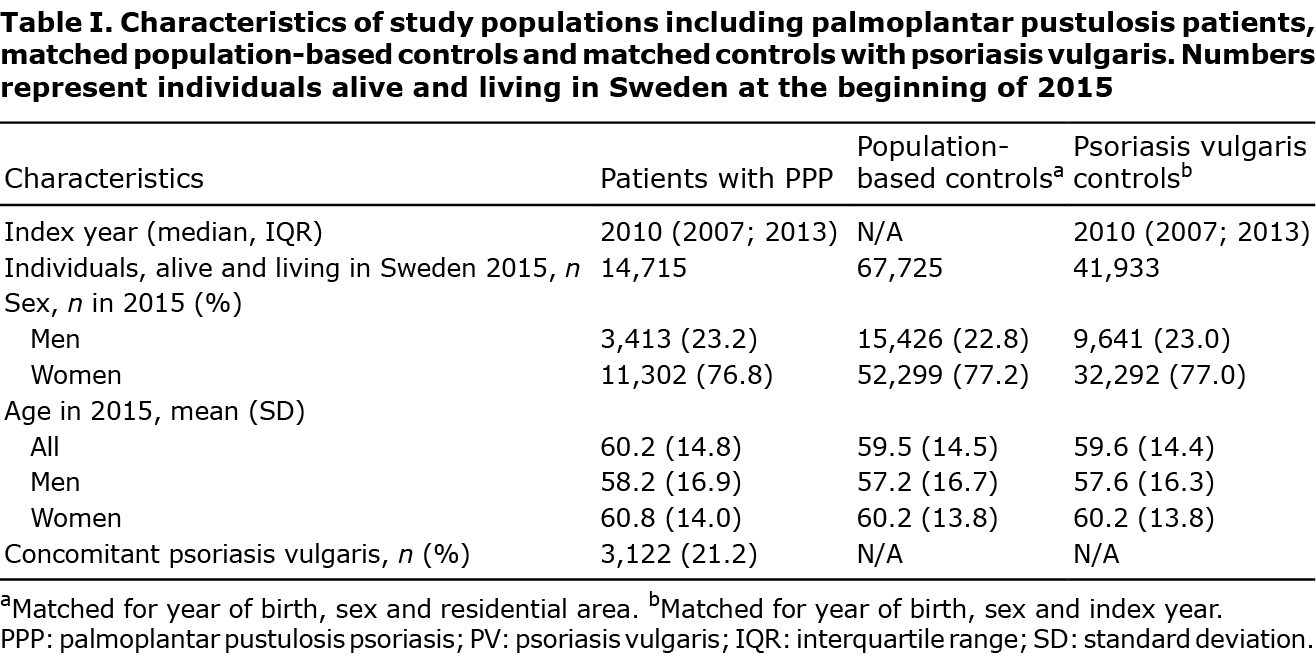
During the study period (2004 to 2015) 15,654 patients who fulfilled the inclusion criteria for PPP were identified. Out of those patients, 14,715 (94%) were still alive and resident in Sweden at the start of 2015 and could be included in analyses of healthcare resource use and associated costs (Table I). For these patients, there were 67,725 matched controls from the general population and 41,933 matched psoriasis vulgaris controls. Mean ages and sex distributions were similar between patients with PPP and control groups.
Physician outpatient visits and inpatient stays
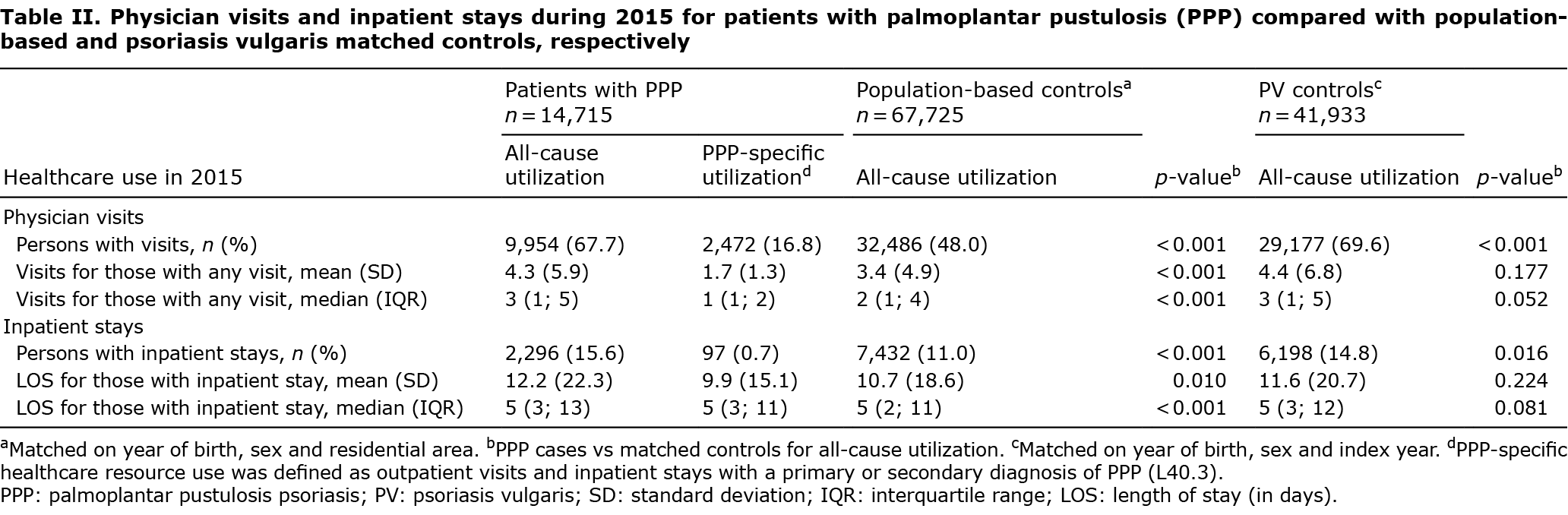
A significantly larger proportion of PPP cases had all-cause physician visits and inpatient stays in 2015 compared with population-based controls (Table II). Compared with psoriasis vulgaris controls, inpatient stays were more common among patients with PPP, whereas the opposite was found for physician visits. Among individuals with visits, the mean and median number of visits for patients with PPP were similar compared with psoriasis vulgaris controls, but significantly higher (1 more visit per year) compared with population-based controls. For individuals with inpatient stays, the length of stay (LOS) for patients with PPP was significantly higher compared with population-based controls, but not compared with psoriasis vulgaris controls. PPP-specific physician visits and inpatient stays (i.e. diagnostic code of L40.3 as primary or secondary diagnosis) were found in 17% and 0.7% of patients with PPP, respectively.
Drug use
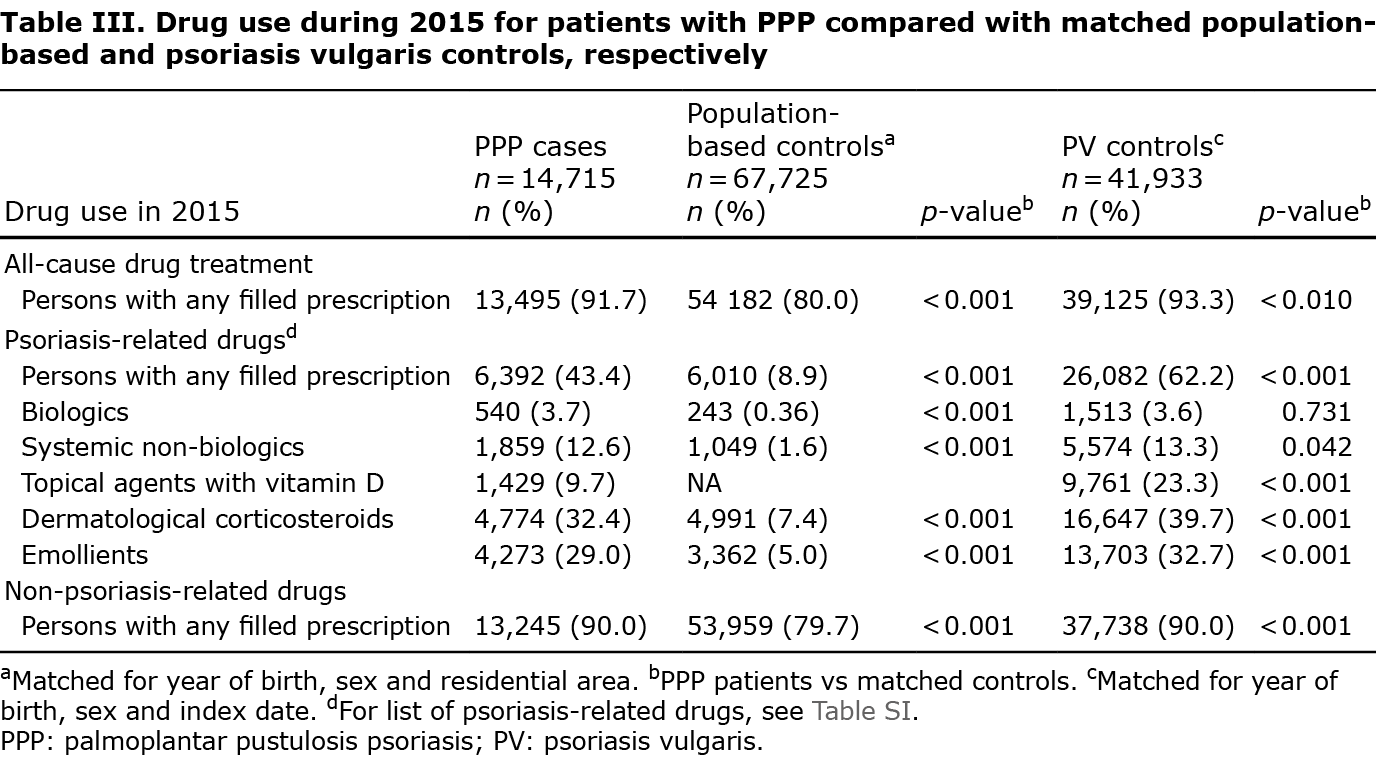
The proportion of people who used any prescribed drug during the follow-up period was significantly higher for patients with PPP compared with population-based controls (Table III). Not surprisingly, the largest difference was observed for psoriasis-related drugs, which were used by 43% of patients with PPP, but only 9% of the general population. In contrast, compared with psoriasis vulgaris controls, the overall use of psoriasis-related drugs was less common among patients with PPP. Except biologics, a higher use among psoriasis vulgaris controls was observed for all types of psoriasis-related drugs and was particularly evident for topical agents with calcipotriol.
Direct costs
The total mean annual direct cost was approximately 1.8 times higher for patients with PPP compared with population-based controls (2,969 vs 1,680 Euro, p < 0.001; Table SII) and with the exception for non-psoriasis-related drugs, the higher costs for patients with PPP were significant across all cost components (Fig. 1, Table SII). Although no significant difference in total mean annual direct costs was observed between patients with PPP and psoriasis vulgaris controls (2,969 vs 2,921 Euro, p = 0.458), the costs of inpatient stays were significantly higher for patients with PPP (1,253 vs 1,124 Euro, p = 0.006) and the costs of psoriasis-related drugs were significantly higher for psoriasis vulgaris controls (421 vs 376 Euro, p = 0.011) (Fig. 1, Table SII). Costs due to all-cause inpatient stays represented the highest percentage of total costs for all 3 groups, with the largest share (42%) observed for patients with PPP.
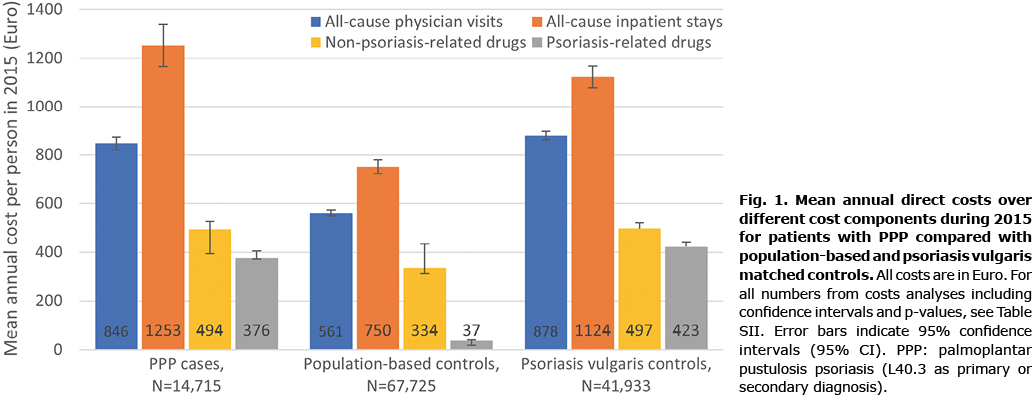
The annual mean psoriasis-related drug cost represented 13% (biologics 11%) for the PPP cases and 14% (biologics 11%) for psoriasis vulgaris controls. The corresponding figure for population-based controls was 2% (biologics 1.8%).
For patients with PPP, costs identified as attributable to PPP-specific problems represented 16% (468 Euro/2,969 Euro) of total costs (Table SII). Of the different cost components, costs of drug treatment had the highest proportion of costs (43%) attributable to PPP-specific problems. In contrast, for physician visits and inpatient stays, only 7.1% and 2.5% of costs, respectively, were PPP-specific.
Subgroup analysis
Out of the 14,715 patients with PPP included in the study, 11,593 with no registration of a psoriasis vulgaris primary diagnosis of L40.0 or L40.9 in the NPR 2004–2015 were identified. For these patients, mean age in 2015 was 60 years and 78% were women. To this population, 33,084 psoriasis vulgaris controls (mean age in 2015=59; 78% women) were matched for year of birth, sex, and index year (Table SIII).
Excluding patients with PPP and psoriasis vulgaris reduced the total direct cost for patients with PPP by approximately 230 Euro (Tables SIV–VI). Except all-cause drug treatment, which remained unchanged, small reductions were observed across all cost categories. The largest reduction (100 Euro, 27%) was observed for psoriasis-related drugs and represented small decreases in costs for all types of drugs in this category (compare Tables SII and SVI).
DISCUSSION
This large nationwide population-based register study found an elevated burden of disease in terms of healthcare resource use and associated direct costs for patients with PPP compared with controls from the general population. The study also found that the overall economic burden of disease was similar for patients with PPP compared with psoriasis vulgaris controls. Removing PPP patients with psoriasis vulgaris from the subgroup analysis did not change these costs notably, indicating that they were not largely influenced by concomitant psoriasis vulgaris.
In addition to all-cause healthcare costs, this study also investigated the proportion of costs that were attributable specifically to PPP. These analyses showed that only a minor part of the costs of physician visits and inpatient stays were due to specific PPP problems, which indicate a relative high comorbidity in these patients. For drug treatment costs, the relative proportion allocated as PPP-specific was relatively high (43%); however, since the PDR does not hold information about the indication for treatment and all psoriasis-related drugs were allocated as PPP-specific, this proportion may be overestimated. A considerable proportion of these drugs were presumably prescribed for concomitant psoriasis subtypes, including psoriasis vulgaris, as suggested by sensitivity analyses in which the costs of psoriasis-related drugs decreased for patients with PPP after those with concomitant psoriasis vulgaris were removed. Moreover, several drugs, in particular systemic agents, classified as psoriasis related in this paper, are also indicated for treatment in rheumatic diseases, a category of conditions with an occurrence of approximately 17% in our population of patients with PPP.
Because of differences in cost perspective, methodologies, and healthcare systems, comparison between resource use and cost studies should be made with caution. To our knowledge, there are no European studies on the economic burden of PPP. The conclusions from the recent US study by Hanna et al. (11) were overall in line with this study. Both studies found that the total costs were considerably higher for PPP compared with the general population, reflecting a higher healthcare resource use, whereas costs were comparable between PPP and psoriasis vulgaris. However, whereas Hanna et al. (12) showed that patients with PPP had a significantly higher resource use of both inpatient and outpatient healthcare compared with psoriasis vulgaris, in the current study, patients with PPP had a higher use of only inpatient stays. There was also a difference between the 2 studies in how the total health care costs for PPP were distributed between different costs components, with a considerably larger proportion allocated to pharmaceuticals (~67%) in the US study compared with all-cause drug treatment (29%) in the current Swedish study. A recent claims-study investigated resource use and costs of 5,000 patients with PPP in the Japan Medical Data Centre, with a follow-up of 6 months after the first PPP claim (21). Among those patients, 14% had an inpatient stay and 99% had an outpatient visit during follow-up. Among the patients with at least 1 outpatient visit, the mean number of visits was 3 per month. Non-biologic systemic treatment was used by 47% of the patients and the corresponding figure for biologics was 0.4% (biologics was not used for treatment of PPP patients during the investigation time frame according to the authors). Compared with our findings in Swedish patients with PPP, the Japanese study (21) indicates a higher resource use of outpatient visits for patients with PPP in Japan, whereas inpatient stays and drug use appeared more comparable.
Strength and limitations
An apparent strength of this study is the large population-based register used for analyses of economic burden in patients with PPP. Of value was the use of NPR data on inpatient and outpatient specialist care visits covering the whole Swedish population for an extensive period. The information about resource use came from a large register source with routinely collected data from clinical practice, which decreased the risk of recall bias that can occur in studies based on self-registration.
This study has some limitations. The validity of the PPP diagnosis has not been examined. As there is no standard case definition of the diagnosis of PPP in Sweden, the current study case definitions were based on coded diagnoses of PPP and not on classification criteria or validation through medical record review, and, thus potentially, subject to misclassification. In the NPR, the current study required 1 visit in specialized care or inpatient stay with a diagnostic code of L40.3 to be classified as a PPP case, which is a similar method used in the Japanese study by Miyazaki et al. (21).
Another weakness is the lack of cost calculations stratified for disease severity, which would have added valuable information regarding the economic burden of patients with PPP. Unfortunately, the current study administrative data did not contain this information. Moreover, the study lacked detailed information on hospital-based drug use and associated costs as the drug resource component is incorporated in the cost for the contact-specific NordDRG weights that we used. An implication may be an underestimation of costs due to drug use in patients with PPP requiring hospital-based intensive dermatological drug treatments. Finally, since this study has a healthcare payer perspective, neither patients’ out-of-pocket expenses, nor indirect costs due to work loss were included. Thus, the full economic burden of the disease was not captured.
Conclusion
This study indicates a worse economic burden for patients with PPP compared with the general population. Compared with patients with psoriasis vulgaris, the total economic burden was similar for patients with PPP; however, the results indicate that there may be a difference in the distribution of costs between different healthcare resources. Only a small fraction of the costs was attributable to PPP problems, which corroborates that there may be a high degree of comorbidity in patients with PPP.
ACKNOWLEDGEMENTS
The authors would like to thank Gunnar Brådvik, data analyst, for valuable data management, and Karin Wahlberg, medical writer, for writing and editorial support. Both are at The Swedish Institute for Health Economics (IHE).
This research is the result of a research platform, which has received financial support from AbbVie, Boehringer Ingelheim, Eli Lilly, Janssen Cilag, Leo Pharma and Novartis. This study’s design and analysis was funded by Boehringer Ingelheim. The authors did not receive payment related to the development of the manuscript. Boehringer Ingelheim was given the opportunity to review the manuscript. Sponsors had no access to data. The authors had full independence regarding study design, data collection, analysis, result interpretation and decision to publish.
Conflicts of interest: MSE is responsible for dermatology in the project management for the national guidelines for psoriasis at the Swedish Board of Health and Welfare. JMN and SL have been involved in the health economic analyses of the national guidelines for psoriasis at the Swedish Board of Health and Welfare. The authors have no further conflict of interest to declare.
REFERENCES
- Noe MH, Wan MT, Mostaghimi A, Gelfand JM, Agnihothri R, Armstrong AW, et al. Evaluation of a case series of patients with palmoplantar pustulosis in the United States. JAMA Dermatol 2022; 158: 68–72.
- Olazagasti JM, Ma JE, Wetter DA. Clinical features, etiologic factors, associated disorders, and treatment of palmoplantar pustulosis: the Mayo Clinic experience, 1996–2013. Mayo Clin Proc 2017; 92: 1351–1358.
- Brunasso AMG, Massone C. Recent advances in palmoplantar pustulosis. Fac Rev 2021; 10: 62.
- Andersen YMF, Augustin M, Petersen J, Hagenstrom K, Mallbris L, Burge R, et al. Characteristics and prevalence of plaque psoriasis in patients with palmoplantar pustulosis. Br J Dermatol 2019; 181: 976–982.
- Brunasso AM, Puntoni M, Aberer W, Delfino C, Fancelli L, Massone C. Clinical and epidemiological comparison of patients affected by palmoplantar plaque psoriasis and palmoplantar pustulosis: a case series study. Br J Dermatol 2013; 168: 1243–1251.
- Lee JY, Kang S, Park JS, Jo SJ. Prevalence of psoriasis in Korea: a population-based epidemiological study using the Korean National Health Insurance database. Ann Dermatol 2017; 29: 761–767.
- Schäfer I, Rustenbach SJ, Radtke M, Augustin J, Glaeske G, Augustin M. Epidemiologie der Psoriasis in Deutschland – Auswertung von Sekundärdaten einer gesetzlichen Krankenversicherung. Gesundheitswesen 2011; 73: 308–313.
- Na SJ, Jo SJ, Youn JI. Clinical study on psoriasis patients for past 30 years (1982–2012) in Seoul National University Hospital Psoriasis Clinic. J Dermatol 2013; 40: 731–735.
- Yan D, Afifi L, Jeon C, Cordoro KM, Liao W. A cross-sectional study of the distribution of psoriasis subtypes in different ethno-racial groups. Dermatol Online J 2018; 24: 13030.
- Kharawala S, Golembesky AK, Bohn RL, Esser D. The clinical, humanistic, and economic burden of palmoplantar pustulosis: a structured review. Expert Rev Clin Immunol 2020; 16: 253–266.
- Hanna ML, Singer D, Valdecantos WC. Economic burden of generalized pustular psoriasis and palmoplantar pustulosis in the United States. Curr Med Res Opin 2021; 37: 735–742.
- Becher G, Jamieson L, Leman J. Palmoplantar pustulosis – a retrospective review of comorbid conditions. J Eur Acad Dermatol Venereol 2015; 29: 1854–1856.
- Misiak-Galazka M, Wolska H, Galazka A, Kwiek B, Rudnicka L. General characteristics and comorbidities in patients with palmoplantar pustulosis. Acta Dermatovenerol Croat 2018; 26: 109–118.
- Trattner H, Bluml S, Steiner I, Plut U, Radakovic S, Tanew A. Quality of life and comorbidities in palmoplantar pustulosis – a cross-sectional study on 102 patients. J Eur Acad Dermatol Venereol 2017; 31: 1681–1685.
- Ludvigsson JF, Andersson E, Ekbom A, Feychting M, Kim JL, Reuterwall C, et al. External review and validation of the Swedish national inpatient register. BMC Public Health 2011; 11: 450.
- Löfvendahl S, Norlin JM, Schmitt-Egenolf M. Prevalence and incidence of palmoplantar pustulosis in Sweden: a population-based register study. Br J Dermatol 2021; 185: 945–951.
- Ludvigsson JF, Almqvist C, Bonamy AK, Ljung R, Michaëlsson K, Neovius M, et al. Registers of the Swedish total population and their use in medical research. Eur J Epidemiol 2016; 31: 125–136.
- National Board of Health and Welfare. [Instructions for NordDRG-Swedish version 2015] (in Swedish) (personal communication).
- Swedish Association of Local Authorities and Regions. [Reference weights for inpatient and outpatient groups, NordDRG, 2015] (in Swedish). Available from https://skr.se/skr/halsasjukvard/ekonomiavgifter/kostnadperpatientkpp.1076.html.
- Wettermark B, Hammar N, Fored CM, Leimanis A, Otterblad Olausson P, Bergman U, et al. The new Swedish Prescribed Drug Register – opportunities for pharmacoepidemiological research and experience from the first six months. Pharmacoepidemiol Drug Saf 2007; 16: 726–735.
- Miyazaki C, Sruamsiri R, Mahlich J, Jung W. Treatment patterns and healthcare resource utilization in palmoplantar pustulosis patients in Japan: a claims database study. PLoS One 2020; 15: e0232738.
 1,2, Jenny M. Norlin