ORIGINAL REPORT
Successful Treatment of Refractory Hailey-Hailey Disease with Narrow-Band Ultraviolet B Light: A Case Series
Longfei ZHU1, Mengyao YI1 , Yichen HAN2, Bin PENG1 and Songmei GENG1*
1Department of Dermatology, The Second Affiliated Hospital of Xi’an Jiaotong University, Xi’an, China, and 2Department of Dermatology, Xi'an Ninth People’s Hospital, Xi’an, China
Corr: Songmei Geng, Department of Dermatology, The Second Affiliated Hospital of Xi'an Jiaotong University, No. 157 Xiwu Road, Xi'an, Shaanxi, 710004, China. *Email: gengsongmei73@163.com
Key words: Hailey-Hailey Disease(HHD); Chronic familial bullous disease; Narrow-band ultraviolet B.
Citation: Acta Derm Venereol 2026; 106: adv-2025-0173. DOI: https://doi.org/10.2340/actadv.v106.adv-2025-0173.
Copyright: © 2025 The Author(s). Published by MJS Publishing, on behalf of the Society for Publication of Acta Dermato-Venereologica. This is an Open Access article distributed under the terms of the Creative Commons Attribution-NonCommercial 4.0 International License (https://creativecommons.org/licenses/by-nc/4.0/).
Submitted: Nov 10, 2025. Accepted after revision: Dec 2, 2025.
Published: Jan 13, 2026.
Competing interests and funding: This work was supported by the funding: “Key Industrial Innovation Chain of Shaanxi Province (Social Development Field)” (Program No.2024SF-ZDCYL-01-14).
The data that support the findings of this study are available from the corresponding author upon reasonable request.
The patients in this manuscript have given written informed consent to the publication of their case details.
The authors have no conflicts of interest to declare.
To evaluate the efficacy and safety of narrow-band ultraviolet B (NB-UVB) in treating refractory Hailey-Hailey Disease (HHD), four HHD patients (36–68 years old, disease duration 5–20 years) were included. NB-UVB was administered twice weekly, with initial doses 0.300–0.500 J/cm² and 0.050 J/cm² increments per session, and some patients received concurrent topical medications; follow-up lasted 1.5–53 months, with outcomes assessed via lesion body surface area (BSA) and Visual Analog Scale scores (disease severity, Refractory Visual Analog Scale, pruritus). Onset time was 0.25–4 months: 2 patients achieved complete lesion clearance, the other 2 had 60% and 87.5% BSA reduction, and the longest remission was 18 months; only 1 patient reported moderate irradiation-site pain, with no severe adverse events. NB-UVB shows satisfactory efficacy and good safety in refractory HHD and may serve as a viable treatment option.
Hailey-Hailey disease (HHD), also known as chronic familial bullous disease, is an autosomal dominantly inherited skin disorder triggered by a mutation of the ATP2C1 gene located on chromosome 3q22.1 (1). The ATP2C1 gene encodes the human secretory calcium/manganese ATPase isoform 1 (hSPCA1), which transports calcium ions (Ca2+) to the Golgi apparatus (2, 3, 4). Dysfunction of the hSPCA1 protein results in elevated cytoplasmic calcium levels that weaken keratinocyte intercellular junctions and lead to bullous symptoms. In practice, topical and systemic medications (acitretin, prednisone, antibiotics, naltrexone, etc.), photodynamic therapies, and surgical procedures have been used to treat HHD, although the effects have remained uncertain in case reports (5, 6, 7). In addition, the side-effects of corticosteroids and immunosuppressants are of particular concern to patients. Narrow-band ultraviolet B (NB-UVB) light has been used in a few case reports in the treatment of HHD and has produced good results (8). Here, we report 4 patients successfully treated with NB-UVB and topical medications, representing the largest sample case series.
SIGNIFICANCE
Narrow-band ultraviolet B (NB-UVB) for refractory Hailey-Hailey Disease (HHD) has limited prior data. This 4-patient study adds evidence, showing satisfactory efficacy (complete clearance/body surface area reduction, long remission) and good safety. It supports NB-UVB as a viable option, addressing the gap in refractory HHD treatment.
METHODS
Selection of the study patients
This is a retrospective observational study conducted in the Department of Dermatology at the Second Affiliated Hospital of Xi'an Jiaotong University in China. The study population comprised 4 patients with refractory HHD who received NB-UVB therapy between 2017-2022. All patients had a confirmed diagnosis of HHD and a history of poor response to prior standard treatments (e.g. topical corticosteroids, antibiotics, or herbal wet dressings). The demographic and clinical characteristics of the patients, including age, sex, disease duration, family history of HHD, and involved skin sites, were collected from electronic medical records.
Inclusion criteria
Patients were included if they met the following criteria: (i) confirmed diagnosis of HHD by skin biopsy or dermatopathology examination; (ii) classified as refractory HHD, defined as insufficient symptom control (lesion area or pruritus reduction ≥50%) despite at least one course of standard treatments, such as topical therapies including corticosteroids, antibiotics, or compound berberine wet dressings; (iii) age ≥18 years; (iv) ability to comply with NB-UVB treatment schedule and follow-up; and (v) provision of informed consent for treatment and data collection (in accordance with ethical standards).
Data collection
Data were extracted from standardized electronic medical records and treatment logs. Collected variables fall into four categories:
Demographic data: age, sex, and family history of HHD.
Clinical baseline data: disease duration, involved skin sites (including axillae, groins, abdomen, and breasts), lesion body surface area (BSA), and Visual Analog Scale (VAS) scores — specifically VAS for disease severity, refractory VAS (R-VAS), and VAS for pruritus. Each score ranges from 0 to 10, with higher scores indicating more severe symptoms.
Treatment-related data: NB-UVB irradiation parameters (initial dose, incremental dose, maximum dose, and total number of sessions) and concurrent topical medications (including corticosteroids, antibiotics, and antifungals).
Outcome data: onset time (the time required to achieve ≥50% symptom relief), post-treatment BSA and VAS scores, duration of remission (the time from treatment completion to the first recurrence of lesions), and adverse events (including skin pain, pigmentation, among others).
Treatment protocol
All patients received NB-UVB therapy using an Ultraviolet Series Phototherapy Equipment (3 Series 311–48, DAAVLIN CO., USA), which emits UV radiation with a peak wavelength of 311 nm. The treatment regimen was standardized as follows:
Irradiation frequency: twice weekly;
Initial dose: 0.300 J/cm² for Patient 1 and 0.500 J/cm² for Patients 2–4;
Dose increment: 0.050 J/cm² per session until the patient reported mild skin discomfort (including slight erythema) or reached the dose (range: 0.700–2.200 J/cm² across patients);
Concurrent medications: 3 patients (Patients 1, 3, 4) received topical medications during NB-UVB therapy (including compound Phellodendron amurense wet dressing, fusidic acid cream, halometasone triclosan cream), while Patient 2 refused topical drugs due to a prior poor response (details are given in Table I).
Table I. Patients’ characteristics and outcomes
| Sex | Age of treatment initiation (y) | Time from onset (y) | Family history | Areas of involvement | NB-UVB | Onset time (m) | Longest remission period after treatment (m) | Total observation time (m) | Adverse events | Combination therapy | ||
|---|---|---|---|---|---|---|---|---|---|---|---|---|
| Dose | Frequency and number | |||||||||||
| 1 | F | 68 | 20 | Y | Abdomen, armpits, breasts, and groins | At an initial irradiation dose of 0.300 J/cm², the dose was increased by 0.050 J/cm² at each visit and reached 0.700 J/cm² | Twice weekly, a total of 7 treatments | 0.5 | 1.5 | 2 | Pigmentation of skin | Compound Phellodendron amurense liquid, fusidic acid cream, and compound ketoconazole cream |
| 2 | F | 65 | 5 | N | Abdomen, armpits, breasts, and groins | At an initial irradiation dose of 0.500 J/cm2, the dose was increased by 0.050 J/cm² at each visit and reached 1.400 J/cm² | Twice weekly, a total of 20 treatments | 0.25 | 12 | 33 | N | N |
| 3 | F | 36 | 9 | N | Abdomen, armpits, breasts, and groins | At an initial irradiation dose of 0.500 J/cm², the dose was increased by 0.050 J/cm² at each visit and reached 2.2 J/cm² | Twice weekly, a total of 113 treatments | 4 | 18 | 53 | N | 0.1% rivanol solution, recombinant human epidermal growth factor gel, compound P. amurense liquid, and halometasone triclosan cream |
| 4 | M | 39 | 10 | Y | Ampits and groins | At an initial irradiation dose of 0.500 J/cm², the dose was increased by 0.050 J/cm² at each visit and reached 1.000 J/cm² | Twice weekly, a total of 66 treatments | 2 | 2 | 42 | Skin pain | 0.1% rivanol solution, compound P. amurense liquid, and compound clotrimazole cream |
|
NB-UVB:narrow-band ultraviolet B. |
||||||||||||
Statistical analysis
Descriptive statistics were used to summarize the demographic, clinical, and treatment data. Continuous variables (including age, disease duration, BSA, VAS scores, and follow-up time) were presented as mean±standard deviation (SD) or range (minimum–maximum), as appropriate. Categorical variables (including sex, family history, and adverse events) were presented as counts and percentages. No inferential statistical tests were performed due to the small sample size (n=4). All statistical analyses were conducted using SPSS Statistics 26.0 (IBM Corp., Armonk, NY, USA), with a two-tailed p-value<0.05 considered statistically significant (not applicable here due to the descriptive design).
RESULTS
Patient outcomes
A total of 4 patients with refractory HHD were included in this study, with ages ranging from 36 to 68 years and disease durations from 5 to 20 years. All patients received NB-UVB therapy, and their post-treatment outcomes (including symptom improvement, onset time, remission duration, and adverse events) are detailed below.
Patient 1. A 68-year-old woman with a 20-year HHD history and positive family history (mother and 2 sons affected) achieved complete clearance of lesions after treatment. At baseline, her lesion BSA was 14%, with disease severity VAS score 7, R-VAS score 6, and pruritus-VAS score 7. After 2 weeks of NB-UVB therapy (initial dose 0.300 J/cm², maximum dose 0.700 J/cm², total 7 sessions) combined with topical medications (compound P. amurense wet dressing, fusidic acid cream, compound ketoconazole cream), her BSA decreased to 4%, and all VAS scores dropped to 1. By week 6, BSA and all VAS scores reached 0. The onset time (time to relieve ≥ 50% symptom) was 0.5 months. During 1.5 months of follow-up, no lesion recurrence was observed; the only adverse event was mild skin pigmentation.
Patient 2. A 65-year-old woman with a 5-year HHD history and no family history achieved complete clearance after treatment. Baseline assessments showed BSA 7, disease severity VAS score 10, R-VAS score 5, and pruritus-VAS score 7. She received NB-UVB monotherapy (initial dose 0.500 J/cm², maximum dose 1.400 J/cm², total 20 sessions) due to prior poor response to topical drugs. After 10 weeks of treatment, BSA and all VAS scores decreased to 0, with an onset time of 0.25 months. During 33 months of follow-up, the longest lesion-free remission period was 12 months, and no adverse events were reported.
Patient 3. A 36-year-old woman with a 9-year HHD history (symptoms worsened during pregnancy) and no family history achieved partial remission. At baseline, her BSA was 5, with disease severity VAS score 9, R-VAS score 9, and pruritus-VAS score 7. She received NB-UVB therapy (initial dose 0.500 J/cm², maximum dose 2.200 J/cm², total 113 sessions) combined with topical medications (0.1% rivanol solution, recombinant human epidermal growth factor gel, etc.). After 16 weeks of treatment, BSA and all VAS scores reduced to 2, with an onset time of 4 months. During 53 months of follow-up, the longest remission period was 18 months, and no adverse events were noted.
Patient 4. A 39-year-old man with a 10-year HHD history and positive family history achieved partial remission. Baseline evaluations showed BSA 8, disease severity VAS score 10, R-VAS score 10, and pruritus-VAS score 10. He received NB-UVB therapy (initial dose 0.500 J/cm², maximum dose 1.000 J/cm², total 66 sessions) combined with topical medications (0.1% rivanol solution, compound P. amurense wet dressing, etc.). After 25 weeks of treatment, BSA decreased to 1, and disease severity VAS, R-VAS, and pruritus-VAS scores dropped to 2. The onset time was 2 months, and skin pain (a major symptom at baseline) was relieved. During 42 months of follow-up, the longest remission period was 2 months; the only adverse event was moderate pain at the irradiation site.
Among the 4 patients, 2 (Patients 1 and 2) achieved complete clearance (BSA=0, all VAS scores=0), and 2 (Patients 3 and 4) achieved partial remission (BSA reduction of 60% and 87.5%, respectively). The mean onset time was 1.69 months (range: 0.25–4 months), and the mean follow-up duration was 32.38 months (range: 1.5–53 months). The longest remission period across all patients was 18 months. Adverse events were mild to moderate (pigmentation, irradiation-site pain) and well-tolerated, with no severe events leading to treatment discontinuation (details are given in Fig. 1).
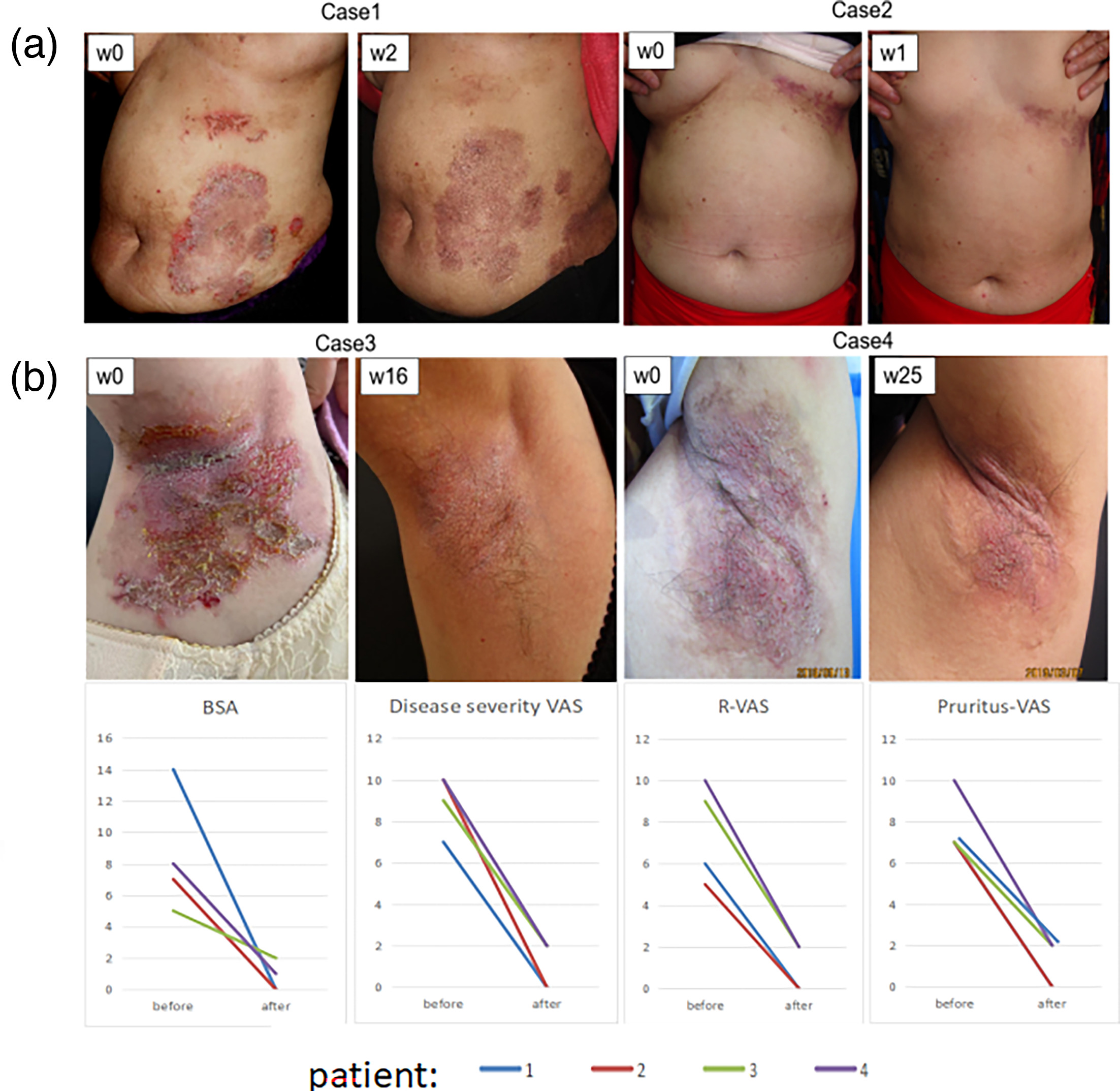
Fig. 1. (a) shows the clinical manifestations before and after treatment in the 4 patients; (b) shows the body surface area of lesion, disease severity Visual Analog Scale (VAS) score, refractory-VAS score, and pruritus-VAS score decreased significantly after narrow-band ultraviolet B treatment.
DISCUSSION
In HHD, mutations in ATP2C1 cause impaired calcium pump action, which leads to increasing intracellular calcium concentration (2, 9). Elevated cytoplasmic calcium may play a role by changing the post-translation modification of proteins (such as protein kinase C, which can lead to the phosphorylation of desmoplakin and the disruption of desmosomes) (10) and inducing the gene expression (such as keratinocyte calcineurin in keratinocytes) (11). The above conditions may induce epidermolysis of HHD. There is no unified treatment guideline for HHD due to the lack of randomized controlled studies. Many treatment options have been used for the treatment of HHD with varying outcomes, such as topical corticosteroids, calcineurin inhibitors, and antibiotics. Moreover, some other treatments, such as botulinum toxin type A, lasers and light therapy, UVB therapy, radiofrequency surgery, and electron beam radiation, were used in HHD therapy in recent years.
We retrieved 5 case reports of HHD treated with NB-UVB treatment from PubMed (see Table II for details). Toshihisa Hamada et al. first reported a generalized case of HHD with NB-UVB combined with oral retinoic acid (Avia ester) in 2013 (8). Although the skin lesions were not completely relieved, the degree of skin lesions was greatly improved. In 2014, K. A. Vanderbeck et al. successfully treated an HHD patient with twice-weekly NB-UVB treatment combined with oral retinoid. The patient used 30 times of NB-UVB therapy, and the longest remission time was 3.5 months (12). The side-effect was residual rubor from UVB burns. In 2014, Kana Mizuno et al. successfully treated a case of HHD with weekly NB-UVB therapy, combined with oral (etretinate 50 mg/day and antibiotics) (13). The patient used 8 times of NB-UVB therapy, and the longest remission time was 6 months. In 2018, Abaca M C et al. successfully treated a case of generalized HHD with NB-UVB therapy, combined with topical (1% isoconazole and 2% mupirocin cream) and oral (minocycline 100 mg/12 h, fluconazole 150 mg/D, and prednisone) therapy (14). The patient used 12 times of NB-UVB therapy, and the longest remission time was 12 months. There was no side-effect. In 2019, Tatiana Lapa and Maksym Breslavets successfully treated HHD with NB-UVB (three times per week with an increment of 0.020 J/cm2 per session) for 3 months. The longest remission time was 1 month (15).
Table II. Summary of reported cases
| Author | Year | Case number | Sex | Age (y) | Time from onset (y) | Family history | Areas of involvement | NB-UVB regimen | Longest remission period after treatment (m) | Total observation time (m) | Adverse events | Combination therapy | ||
|---|---|---|---|---|---|---|---|---|---|---|---|---|---|---|
| Dose | Frequency and number | |||||||||||||
| 1 | Toshihisa Hamada et al. | 2013 | 1 | F | 40 | 0.5 | N | Flexural areas of the inguinal, perineal, and perianal areas | At an initial irradiation dose of 0.100 J/cm2, the dose was increased by 0.020 J/cm2 at each visit and reached 0.200 J/cm2 | 2–3 times/week, maintain it for a long time at the frequency of every second week | 0 | 8 | NA | Oral: etretinate 20 mg daily |
| 2 | Kaitlin A Vanderbeek et al. | 2014 | 1 | F | 64 | 37 | Y | Arms, neck, back, abdomen, popliteal regions, and oral mucosa | 0.200J/cm2 with an initial exposure, and the dose was increased by 0.020 J/cm2 each visit until a dose of 0.294 J/cm2 was reached | Twice weekly and was to be continued until a total of 30 treatments | 3.5 | 4 | Residual rubor from UVB burns | Oral: retinoid agent known as tocino (30 mg per os daily) |
| 3 | Kana Mizuno et al. | 2014 | 1 | F | 45 | More than 2 years | NA | Axillae and groins several years ago, which extended to the trunk, arms, and thighs | With an initial dose of 0.300 J/cm2 per week. The dose increased by 0.050 J/cm2 at each subsequent visit until 0.500 J/cm2 | Per week, a total of 8 treatments | 6 | 8 | NA | Oral: etretinate 50 mg/day; antibiotics; topical: antibiotics and dapsone |
| 4 | Abaca M C et al. | 2018 | 1 | M | 41 | 13 | Y | Neck, armpit, and groin | Starting from the dose of 0.300 J/cm2, increase by 0.050 MJ/cm2 once a week | Twice weekly, a total of 8 treatments | 12 | 12 | NO | Topical: 1% isaconazole and 2% mupirocin cream; oral: minocycline 100 mg/12 h and fluconazole 150 mg/D for 7 days; prednisone |
| 5 | Tatiana L et al. | 2019 | 1 | M | 59 | 34 | Y | Both flanks, axillae, under the breasts, and the mid and lower back | Starting with 0.100 J/cm2, with the increment of 0.020 J/cm2 | Three times per week, a total of 8 treatments | 1 | 3 | NA | Oral: acitretin 25 mg daily |
|
NB-UVB:narrow-band ultraviolet B. |
||||||||||||||
We retrospectively analyzed the effect of NB-UVB treatment in four patients with HHD in our center. Their ages ranged from 36 to 68 years. The course of the disease was from 5 to 20 years, with an average of 11 years. The most affected sites were the abdomen, axillae, breasts, and groin, which are also typically affected in HHD. Two of the 4 patients had a family history. The initial therapeutic radiation dose from NB-UVB is 0.30 J/cm2, and the dose is increased by 0.05 J/cm2 at each visit until the patient experiences mild skin pain. Three patients used topical medications, and 1 patient was treated with NB-UVB only (Table I). The patients were treated with an average of 51.5 times (7–113 times) NB-UVB, and the onset time was from 0.25 to 4 months, with an average of 1.69 months. Lesions were cleared in 2 of the 4 patients, and BSA decreased by 60% and 87.5% in the other 2 patients, respectively (Fig. 1b). The longest remission time was 8.38 months (1.5–18 months).
In conclusion, our series and previous literature reports showed that NB-UVB combined with topical or oral drugs had satisfactory efficacy. The side-effects can be tolerated, including residual rubor from UVB burns, pigmentation, and pain. We expected more research to confirm the role of NB-UVB in the treatment of HHD in the future.
REFERENCES
- Li H, Chen L, Mei A, Chen L, Xu Y, Hu W, et al. Four novel ATP2C1 mutations in Chinese patients with Hailey-Hailey disease. J Dermatol 2016; 43: 1197–1200. https://doi.org/10.1111/1346-8138.13407
- Hu Z, Bonifas JM, Beech J, Bench G, Shigihara T, Ogawa H, et al. Mutations in ATP2C1, encoding a calcium pump, cause Hailey-Hailey disease. Nat Genet 2000; 24: 61–65. https://doi.org/10.1038/71701
- Sudbrak R, Brown J, Dobson-Stone C, Carter S, Ramser J, White J, et al. Hailey-Hailey disease is caused by mutations in ATP2C1 encoding a novel Ca(2+) pump. Hum Mol Genet 2000; 9: 1131–1140. https://doi.org/10.1093/hmg/9.7.1131
- Li X, Zhang D, Ding J, Li L, Wang Z. Identification of ATP2C1 mutations in the patients of Hailey-Hailey disease. BMC Med Genet 2020; 21: 120. https://doi.org/10.1186/s12881-020-01056-4
- LeBlanc KG Jr, Wharton JB, Sheehan DJ. Refractory Hailey-Hailey disease successfully treated with sandpaper dermabrasion. Skinmed 2011; 9: 263–264.
- Campuzano-García AE, Torres-Alvarez B, Hernández-Blanco D, Castanedo-Cázares JP. Hailey-Hailey disease improved by fractional CO2 laser. J Cosmet Laser Ther 2015; 17: 213–215. https://doi.org/10.3109/14764172.2015.1007063
- Lobefaro F, Gualdi G, Andreassi G, Amerio P. Sequential treatments of Hailey-Hailey disease with photodynamic therapy, botulinum toxin type A and dapsone: a case report. Dermatol Ther 2022; 35: e15841. https://doi.org/10.1111/dth.15841
- Hamada T, Umemura H, Aoyama Y, Iwatsuki K. Successful therapeutic use of targeted narrow-band ultraviolet B therapy for refractory Hailey-Hailey disease. Acta Derm Venereol 2013; 93: 110–111. https://doi.org/10.2340/00015555-1390
- Leinonen PT, Hägg PM, Peltonen S, Jouhilahti EM, Melkko J, Korkiamäki T, et al. Reevaluation of the normal epidermal calcium gradient, and analysis of calcium levels and ATP receptors in Hailey-Hailey and Darier epidermis. J Invest Dermatol 2009; 129: 1379–1387. https://doi.org/10.1038/jid.2008.381
- Amar LS, Shabana AH, Oboeuf M, Martin N, Forest N. Involvement of desmoplakin phosphorylation in the regulation of desmosomes by protein kinase C, in HeLa cells. Cell Adhes Commun 1999; 7: 125–138. https://doi.org/10.3109/15419069909034396
- Berth-Jones J, Smith SG, Graham-Brown RA. Benign familial chronic pemphigus (Hailey-Hailey disease) responds to cyclosporin. Clin Exp Dermatol 1995; 20: 70–72. https://doi.org/10.1111/j.1365-2230.1995.tb01290.x
- Vanderbeck KA, Giroux L, Murugan NJ, Karbowski LM. Combined therapeutic use of oral alitretinoin and narrowband ultraviolet-B therapy in the treatment of hailey-hailey disease. Dermatol Rep 2014; 6: 5604. https://doi.org/10.4081/dr.2014.5604
- Mizuno K, Hamada T, Hashimoto T, Okamoto H. Successful treatment with narrow-band UVB therapy for a case of generalized Hailey-Hailey disease with a novel splice-site mutation in ATP2C1 gene. Dermatol Ther 2014; 27: 233–235. https://doi.org/10.1111/dth.12125
- Abaca MC, Flores L, Parra V. Narrowband UV-B phototherapy in the treatment of generalized Hailey-Hailey disease. Actas Dermosifiliogr (Engl Ed) 2018; 109: 924–927. https://doi.org/10.1016/j.ad.2017.11.011
- Lapa T, Breslavets M. Treatment of Hailey-Hailey disease with narrowband phototherapy and acitretin: a case report. SAGE Open Med Case Rep 2019; 7: 2050313X19845221. https://doi.org/10.1177/2050313X19845221