SHORT COMMUNICATION
“Election Nail” – A Nail Providing Electoral Integrity Mechanism
Marta SZEPIETOWSKA1,2, Shyam VERMA3, Andrzej K. JAWOREK1 and Jacek C. SZEPIETOWSKI4,5*
1Department of Dermatology, Jagiellonian University Medical College, Cracow, Poland, 2Doctoral School of Medical and Health Sciences, Jagiellonian University Medical College, Cracow, Poland, 3Nirvan Skin Clinic, Vadodara, India, 4Division of Dermatology, Venereology and Clinical Immunology, Faculty of Medicine, Wroclaw University of Science and Technology, Wroclaw, Poland, and 5Department of Dermato-Venereology, 4th Military Hospital, Wroclaw, Poland. *Email: jacek.szepietowski@pwr.edu.pl
Citation: Acta Derm Venereol 2026; 106: adv-2026-0323. DOI: https://doi.org/10.2340/actadv.v106.adv-2026-0323.
Copyright: © 2026 The Author(s). Published by MJS Publishing, on behalf of the Society for Publication of Acta Dermato-Venereologica. This is an Open Access article distributed under the terms of the Creative Commons Attribution-NonCommercial 4.0 International License (https://creativecommons.org/licenses/by-nc/4.0/).
Submitted: Jan 6, 2026. Accepted after revision: Feb 25, 2026.
Published: Mar 12, 2026.
Competing interests and funding: The authors have no conflicts of interest to declare.
The data that support the findings of this study are available from the corresponding author upon reasonable request.
Fingernail marking using indelible ink is a long-established procedural mechanism employed in electoral processes to prevent multiple voting and to safeguard the integrity of elections (1). Although it has a long tradition in some countries, common knowledge on “election nail” within the international dermatology seems to be limited.
Therefore, we decided to showcase of “election nail”, its morphology, discuss the safety profile and differential diagnosis of this procedure, which leaves an indelible mark on the nail that disappears over a period of numerous weeks.
CASE PRESENTATION
A 63-year-old Indian man presented with discolouration of a single fingernail. He was in good general health and reported no recent drug exposure. On clinical examination, the left index fingernail exhibited a reddish-brown discolouration involving the majority of the nail plate, with only small lateral portions remaining unaffected. He gave a history of the pigmentation decreasing in the lateral portion of the nail, which had resolved spontaneously over the past 1 week. The discolouration was nonhomogeneous, characterized by a thin dark band in the proximal portion of the nail plate as well as darker pigmented areas in the distal part. A careful examination revealed that the proximal nail plate adjacent to the cuticle was normal, indicating that the discolouration was moving distally with nail growth (Fig. 1). Further anamnesis disclosed that approximately 20 days prior to presentation, the patient had participated in the 2024 Indian General Election (Lok Sabha election) by voting.
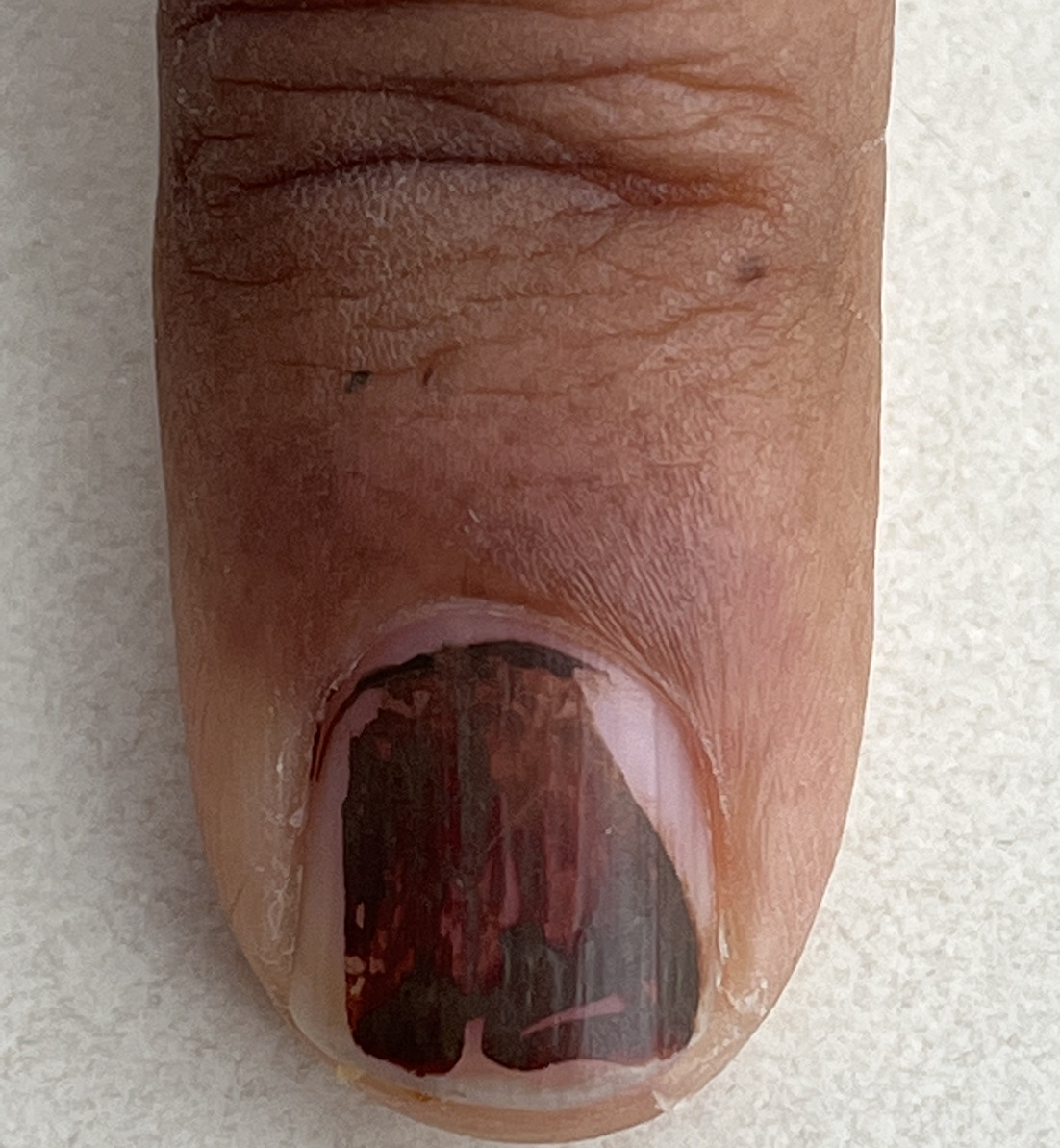
Fig. 1. Election nail due to fingernail marking with indelible ink.
DISCUSSION
The practice of fingernail marking consists of applying a semi-permanent ink mark to a voter’s fingernail, most commonly the left index fingernail, immediately after the individual has cast the vote in the ballot. In India, the standard fingernail marking procedure involves the application of indelible ink primarily to the nail plate. In contrast, in some other countries, the ink may be applied more extensively, covering both the nail and the surrounding skin of the distal phalanx. The visible and durable nature of the nail mark enables election officials to rapidly verify whether a person has already participated in voting, thereby functioning as a low-cost, highly scalable deterrent against electoral fraud (2).
Historically, one of the earliest and most influential large-scale implementations of fingernail marking occurred in India, where the method was introduced during the 1962 general elections (1, 2, 3). The innovation emerged in response to the logistical challenges of administering elections in a country with a vast electorate, uneven access to formal identification documents and high voter turnout. Over time, the procedure became institutionalized within India’s electoral administration and served as a model for numerous other democracies facing similar constraints. The visibility of the inked fingernail also acquired symbolic significance, often being interpreted as a public marker of civic participation. In India, the ink was developed by the National Physical Laboratory (NPL) and later manufactured under authorized supply arrangements. For contemporary Indian elections, the literature review describes Mysore Paints and Varnish Limited (MPVL) (a government-owned entity in Karnataka) as the authorized producer for domestic supply, operating under the guidance and specifications associated with India’s election administration (1).
From a technical perspective, the effectiveness of fingernail marking depends on both the site of application and the chemical properties of the ink. The nail plate is composed primarily of keratin, a dense structural protein that slows the removal of stains compared to skin alone (4). Consequently, election officials typically apply the ink across the cuticle and nail plate, ensuring prolonged visibility even if superficial skin layers regenerate or are washed. The application is generally performed using a small brush or applicator pen to achieve consistency and to minimize waste (2).
The chemical foundation of most indelible election inks is silver nitrate (AgNO₃). In solution, silver nitrate is initially colourless. When applied to nail or skin, Ag+ ions bind to chloride and proteinaceous substrates (including keratin), and exposure to UV radiation reduces silver ions to metallic silver or other dark photoproducts, producing a dark purple, brownish or black stain. This photochemical mechanism explains both the delayed darkening of the mark after application and its resistance to ordinary cleaning agents. Although formulations may vary, silver nitrate remains the principal active ingredient due to its reliability, affordability and ease of storage. The stain may remain visible for days to weeks, depending on formulation, exposure (sunlight/UV) and skin turnover. Description of India’s ink notes persistence on skin and nail on the order of ~2 weeks under typical conditions; however, it can easily last up to the month after the application (2).
While generally the used ink is intended to be safe for mass use, medical literature has documented adverse reactions in some cases (e.g. irritant or contact dermatitis), emphasizing that “indelible” does not imply biologically inert for all users. In 2025, the authors discussing indelible election ink in India highlight the long-standing use and draw attention to potential irritant contact dermatitis and partial-thickness chemical burns following repeated or prolonged exposure (1, 5, 6). Typically, the ink contains approximately 10–18% silver nitrate (5). Specific conditions, including accidental spillage, occlusion or evaporation of volatile components, may increase the concentration of silver nitrate, raising its potential for irritant reactions. Additionally, although the detailed composition of the ink is not publicly disclosed for security reasons, it is known to contain other components such as dyes, photosensitive pigments and possibly aromatic substances. These additives, while necessary for durability and visibility of the mark, may act as irritants or sensitizers in susceptible individuals (1, 5, 6).
When evaluating pigmentary changes of the nail due to ink application, the following differential diagnoses should be considered in the first inspection: other pseudochromonychias – nail discolouration caused by other external substances, such as dyes, chemicals or metals; true melanonychias – e.g. nail matrix nevus or subungual melanoma; subungual haemorrhage – red, purple or black discolouration with a well-defined margin caused by trauma, commonly associated with pain; argyria – prolonged systemic or localized exposure to silver compounds may lead to greyish-blue discolouration of skin and nails; onychomycosis – certain fungal infections can cause brownish discolouration of the nail plate, however usually accompanied by nail thickening, subungual hyperkeratosis and nail plate dystrophy (7, 8, 9, 10, 11).
The use of fingernail marking is not confined to a single geographic region. Beyond South Asia, the method has been adopted in parts of Southeast Asia, the Middle East, Africa, Latin America and the Caribbean. Countries such as Indonesia, Iraq, Kenya, Nigeria, Mexico and several Caribbean states have employed indelible ink at various points in their electoral histories. In some cases, the practice has been discontinued as biometric voter identification systems or centralized electronic voter rolls became widespread; in others, it remains a critical component of election-day procedures (1, 2).
Despite its advantages, fingernail marking is not without limitations. As discussed above, it may lead to some cutaneous complications (5, 6). In specific political contexts, the visibility of the mark may expose voters to social pressure or intimidation, particularly in polarized or conflict-affected environments.
In conclusion, fingernail marking with indelible ink represents a scientifically grounded, historically resilient and globally utilized electoral integrity measure. The knowledge on “election nail,” including the clinical manifestation and procedural technique, seems to be of importance for dermatologists worldwide dealing with nail abnormalities in their daily clinical practice.
REFERENCES
- Abraham A, Roga G, Thomas N. A pilot study: nailing Indian elections with the indelible ink mark. Indian J Dermatol 2015; 60: 562–565. https://doi.org/10.4103/0019-5154.169126
- Election Ink. Wikipedia, the free encyclopedia. 2025. [cited 2025 December 29]. Available from: https://en.wikipedia.org
- Nandwani S, Jain S, Sonkusale P, Yadav A. Indelible election ink: not so safe. Indian Dermatol Online J 2025; 16: 634–636. https://doi.org/10.4103/idoj.idoj_473_24
- de Berker D. Nail anatomy. Clin Dermatol 2013; 31: 509–515. https://doi.org/10.1016/j.clindermatol.2013.06.006
- Mishra SK, Agrawal K, Kumar S, Sharma U. Indelible voters’ ink causing partial thickness burn over the fingers. Indian J Plast Surg 2014; 47: 472–473. https://doi.org/10.4103/0970-0358.146691
- Gupta S, Chopra D. A rash election: partial thickness burns secondary to inadvertent use of indelible voters’ ink. Dermatol Ther 2022; 35: e15861. https://doi.org/10.1111/dth.15861
- Singal A, Bisherwal K. Melanonychia: etiology, diagnosis, and treatment. Indian Dermatol Online J 2020; 11: 1–11. https://doi.org/10.4103/idoj.IDOJ_167_19
- Tosti A, Piraccini BM, de Farias DC. Dealing with melanonychia. Semin Cutan Med Surg 2009; 28: 49–54. https://doi.org/10.1016/j.sder.2008.12.004
- Rodríguez-Cerdeira C, Martínez-Herrera E, Cortés-López PN, Guzmán-Montijo E, Sánchez-Cárdenas CD, Arenas R, et al. Fungal melanonychia: a systematic review. Microorganisms 2024; 12: 1096. https://doi.org/10.3390/microorganisms12061096
- Lopes M, Jordão C, Grynszpan R, Sodré C, Ramos-E-Silva M. Chromonychia secondary to chemotherapy. Case Rep Dermatol 2013; 5: 163–167. https://doi.org/10.1159/000351874
- Putek J, Pacan P, Kaczmarski T, Szepietowski JC. Argyria: clinical features to consider. Pol Arch Intern Med 2025; 135: 17127. https://doi.org/10.20452/pamw.17127