ORIGINAL REPORT
Comparison of the Burden of Acne Vulgaris in China vs Globally: Insights from the Global Burden of Disease Study (2021) and Projections to 2050
Rui YUAN1, Haibo LONG2, Tian LI3* and Aijun CHEN1*
1Department of Dermatology, The First Affiliated Hospital of Chongqing Medical University, Chongqing 400016, China, 2Department of Neurosurgery, Chongqing City Hospital of Traditional Chinese Medicine, Chongqing 400021, China, and 3Tianjin Nankai Hospital, Tianjin Medical University, Tianjin 300100, China
Corr: Aijun Chen, Department of Dermatology, The First Affiliated Hospital of Chongqing Medical University, Chongqing 400016, China and Tian Li, Tianjin Nankai Hospital, Tianjin Medical University, Tianjin 300100, China. *Emails: chenaijun@hospital.cqmu.edu.cn; fmmult@foxmail.com
Key words: Acne vulgaris; Public health; China; Global; Burden.
Citation: Acta Derm Venereol 2026; 106: adv-2025-0131. DOI: https://doi.org/10.2340/actadv.v106.adv-2025-0131.
Copyright: © 2026 The Author(s). Published by MJS Publishing, on behalf of the Society for Publication of Acta Dermato-Venereologica. This is an Open Access article distributed under the terms of the Creative Commons Attribution-NonCommercial 4.0 International License (https://creativecommons.org/licenses/by-nc/4.0/).
Submitted: Oct 27, 2025. Accepted after revision: Apr 9, 2026.
Published: Apr 28, 2026.
Competing interests and funding: The authors have no conflicts of interest to declare.
The study was supported by the Key Project of Chongqing Medical and Pharmaceutical College (ygz2024102).
The data supporting the findings of this study are publicly available from the Global Health Data Exchange GBD Results Tool (https://vizhub.healthdata.org/gbd-results/).
Acne vulgaris poses a significant health challenge in China, adversely affecting patients’ quality of life and mental health. Updated evidence on acne burden in China integrating temporal trends, China–global comparisons, change-point patterns and future projections remains limited. This study aimed to provide an updated assessment of acne vulgaris burden in China, including temporal trends and future projections, and to clarify its public health implications. Using data from the 2021 Global Burden of Disease study, estimated annual percentage changes for acne vulgaris were calculated for China and globally, while change-point patterns were assessed using joinpoint regression. An age–period–cohort analysis was subsequently performed, followed by Bayesian age-period-cohort projection of China’s acne vulgaris burden to 2050. From 1990 to 2021, the prevalence, incidence and disability-adjusted life years associated with acne vulgaris in China exhibited sustained increases, outpacing global rates. Age–period–cohort analysis revealed a peak incidence at ages 10–14 years. Overall, the main burden was concentrated in adolescence. Bayesian age-period-cohort projections indicated that China’s acne vulgaris burden will continue to rise from 2022 to 2050, with a disproportionately greater impact on females. These findings support prioritising evidence-based prevention, early recognition and management strategies for adolescents and for females in China.
Significance
The burden of acne vulgaris in China has increased over the past 3 decades, with a faster rise than the global average and a continued increase projected through 2050. Adolescents bear the main burden, and females are more affected than males. These findings highlight the need for earlier recognition and better long-term management for adolescents and for females.
Acne vulgaris (AV) frequently leads to post-inflammatory erythema (PIE), hyperpigmentation and scarring, significantly impacting both physical appearance and overall well-being (1). Although it is classified as a nonlethal disease, its substantial effects on health-related quality of life, psychological health and socioeconomic burden warrant serious consideration (2). A steady rise in AV-related disability-adjusted life years (DALYs) has been observed, underscoring its emergence as a priority on national and global health agendas (3).
Prior Global Burden of Disease (GBD)-based work has described long-term acne burden trends in China and reported age-period‒cohort (APC) patterns based on data up to 2019 (4). What remains unclear is whether China’s trajectory shows distinct change points, whether the timing and direction of these change points differ from those in global estimates, and what these trends imply for future burden in China. China’s unique demographic and environmental characteristics may influence acne incidence trends. The country’s vast population base and distinctive age structure transitions—particularly adolescent population fluctuations—create special epidemiological conditions. Furthermore, urban‒rural lifestyle disparities (including Westernized dietary patterns) combined with air pollution exposure could contribute to acne burden patterns that diverge from global averages (5, 6).
Therefore, using GBD 2021, we characterised AV incidence, prevalence and DALYs in China from 1990 to 2021 and compared these trends with global estimates. We quantified temporal change points using joinpoint regression, examined APC patterns in China and projected China’s burden to 2050 using a Bayesian age-period-cohort (BAPC) model.
METHODS
Study population
AV, as defined by the GBD project, was collected for both sexes across all age categories and from 1990 to 2021 and for both the global population and China.
Case definition and severity levels
In GBD 2021, AV is defined as a chronic inflammatory disease of the pilosebaceous unit associated with increased sebum secretion and is mapped to ICD-10 code L70 (excluding L70.4). For nonfatal burden estimation, GBD 2021 applies predefined acne severity levels mapped to disfigurement levels 1–3, each with a corresponding disability weight (DW); these are combined with the severity distribution to quantify YLDs/DALYs. Across severity levels, DWs range from 0.011 (mild) to 0.405 (severe). The acne-specific severity levels, severity distribution and DWs used in GBD 2021 are summarised in Table SI (7).
Data sources
Age-standardized prevalence (ASPR), incidence (ASIR) and DALY rates (ASDR) for AV—together with their 95 % uncertainty intervals (UI)—were directly extracted from the GBD 2021 Results Tool. These age-standardized rates (ASRs) are computed in GBD using the GBD standard population (7). No additional re-standardization was performed in this study. The locations selected were Global and China. No subnational analyses were conducted for China.
Trend analysis
The analysis of trends across a defined time interval was conducted through linear regression of the logarithmically transformed ASR, represented by the equation y = α+βx+ϵ, where y=ln (ASR) and x=calendar year. The estimated annual percentage changes (EAPC) was calculated as 100 × (exp(β) – 1), and its 95 % confidence interval (CI) was obtained from the regression model. The ASR was considered to increase when both the EAPC and the lower bound of its 95% CI exceeded zero, decreased when both the EAPC and the upper bound were less than zero, and stabilized otherwise. Temporal inflection points in AV trends for China and globally were identified via the Joinpoint Regression Program (version 5.2.0). Log-linear segmented models with up to five joinpoints were evaluated, and the final model was selected using the data-driven weighted Bayesian Information Criterion (BIC). Annual percentage changes (APCs) and their 95 % CIs were calculated using the Empirical Quantile method with 5,001 resamples.
APC analysis
APC model was applied to disentangle temporal, demographic and generational influences on the AV burden. The overall trend, quantified as net drift, denotes the yearly proportional shift in incidence over time. The segment-specific change, captured by local drift, reflects the annual proportional variation within each age stratum across the observation window. Period rate ratios and cohort rate ratios were calculated as relative risks with 95% CI for each period and cohort, respectively, using the midpoint period (2004.5) and midpoint birth cohort (1952) as references. All estimates are reported as point estimates with 95 % CIs. A trend or effect was considered statistically significant if the 95% CI excluded 0 (for net drift and local drifts) or 1 (for rate ratios).
BAPC model for projections
The BAPC model was applied to project the AV burden in China from 2022–2050. This approach employs integrated nested Laplace approximations (INLA) to perform fully Bayesian inference, providing a coherent framework for long-term forecasting. For each projected estimate, uncertainty was quantified from the posterior predictive distribution and reported as 95 % credible intervals (CrI), defined by the 2.5th and 97.5th posterior percentiles.
All the statistical computations and visual representations were executed via R version 4.4.2, with significance declared at p<0.05.
RESULTS
AV burden in China and worldwide
Spanning 1990–2021, China and worldwide populations alike demonstrated sustained increases in ASPR, ASIR and ASDR of AV, with China consistently maintaining higher levels than the global average. In China, the AV ASPR increased from 3166.6 (95% UI 2844.6–3522.4) per 100,000 population in 1990 to 3742.2 (95% UI 3380.3–4152.5) in 2021, with an EAPC of 0.55 (95% CI 0.54–0.56). The ASIR rose from 1632.4 (95 % UI 1445.7–1843.8) per 100,000 to 1915.8 (95% UI 1694.7–2182.0), with an EAPC of 0.53 (95% CI 0.52–0.54). The ASDR increased from 68.2 (95% UI 42.5–107.2) per 100,000 to 80.7 (95% UI 50.5–126.6), with an EAPC of 0.56 (95% CI 0.55–0.57). Globally, the ASPR rose from 2800.5 (95% UI 2555.3–3115.1) per 100,000 in 1990 to 3142.5 (95% UI 2867.0–3500.6) in 2021, with an EAPC of 0.37 (95% CI 0.36–0.39). The ASIR rose from 1442.9 (95% UI 1286.9–1634.5) per 100,000 to 1645.2 (95% UI 1459.7–1878.2), with an EAPC of 0.43 (95% CI 0.41–0.45). ASDR increased from 59.9 (95% UI 37.5–94.0) per 100,000 to 67.2 (95% UI 42.3–105.8), with an EAPC of 0.38 (95% CI 0.37–0.39). Comparative analysis revealed that although the global acne burden has increased overall, China has experienced more rapid growth, with higher EAPCs across all three metrics (prevalence, incidence and DALY rates) than the global average (Table I, Fig. 1).
Table I. AV burden in China and globally, 1990 vs 2021, with EAPC, 1990–2021
| Location | Measure | All age number of cases (95 % UI) | ASR (per 100,000) (95 % UI) | EAPC (95% CI) | ||
|---|---|---|---|---|---|---|
| 1990 | 2021 | 1990 | 2021 | |||
| China | Prevalence | 42619852.506 (38256909.006–47529057.931) | 39458444.564 (36080237.838–43300753.979) | 3166.569 (2844.555–3522.447) | 3742.196 (3380.305–4152.453) | 0.55(0.54,0.56)* |
| Incidence | 20793408.848 (18565209.561–23388070.290) | 19912141.329 (17768188.006–22495197.982) | 1632.411 (1445.724–1843.790) | 1915.806 (1694.741–2182.023) | 0.53(0.52,0.54)* | |
| DALYs | 917927.901 (572154.207–1443296.374) | 849659.138 (530715.479–1331378.171) | 68.196 (42.462–107.195) | 80.743 (50.479–126.619) | 0.56(0.55,0.57)* | |
| Global | Prevalence | 166623285.560 (151390613.904–186063111.506) | 239665793.265 (218962319.059–266545356.987) | 2800.549 (2555.333–3115.102) | 3142.467 (2866.958–3500.616) | 0.37(0.36,0.39)* |
| Incidence | 85586350.634 (76228677.056–97067128.179) | 124266429.809 (110490151.999–141551957.341) | 1442.917 (1286.878–1634.517) | 1645.241 (1459.691–1878.222) | 0.43(0.41,0.45)* | |
| DALYs | 3563944.988 (2229878.704–5590742.327) | 5125473.489 (3225014.362–8069826.906) | 59.867 (37.467–93.951) | 67.229 (42.299–105.838) | 0.38(0.37,0.39)* | |
|
*: p < 0.05. ASR:age-standardized rate; AV:acne vulgaris; CI:confidence interval; DALYs:Disability-adjusted life years; EAPC:estimated annual percentage change; UI:uncertainty interval. |
||||||

Fig. 1. AV burden and temporal trends: China vs the globe. (A) ASPR, (B) ASIR and (C) ASDR in China and globally, and EAPC comparisons for (D) prevalence, (E) incidence and (F) DALYs. China showed consistently higher rates and larger EAPCs than the global average across all three measures. Shaded areas indicate 95 % UIs, and error bars indicate 95 % CIs. ASPR: age-standardized prevalence rate; ASIR: age-standardized incidence rate; ASDR: age-standardized DALY rate; DALY: disability-adjusted life years; EAPC: estimated annual percentage change; UI: uncertainty interval; CI: confidence interval.
Join-point regression analysis of the AV burden
The joinpoint regression analysis revealed that while China and worldwide groups exhibited continual upward trajectories in the AV burden, their respective growth patterns and inflection points demonstrated notable differences. Across the 1990–2021 interval, China showed continuous growth in ASPR, ASIR and ASDR. Three significant inflection points were identified in 2006, 2009 and 2019. The period from 1990 to 2006 was characterized by steady growth across all indicators. Between 2006 and 2009, the growth rate peaked, reaching its highest annual percentage change. Between 2009 and 2019, the growth rate gradually decelerated. The most recent period from 2019 to 2021 showed minimal increases (Fig. S1).
Globally, the AV burden also continuously increased in ASPR, ASIR and ASDR between 1990 and 2021. For incidence, the period between 1990 and 2006 showed relatively stable growth, followed by the fastest acceleration between 2006 and 2014. The growth rate then declined from 2014 to 2019, with a slight rebound observed from 2019 to 2021. For prevalence and DALY rates, the global pattern showed moderate growth from 1990 to 2011, the most rapid acceleration between 2011 and 2014, followed by a gradual slowdown from 2014 to 2021 (Fig. S1).
Comparative analysis demonstrated that China experienced its most rapid acceleration from 2006 to 2009, whereas the global incidence showed peak growth from 2006 to 2014. Notably, while China’s growth stabilized from 2019 to 2021, the global incidence modestly rebounded during this period, although no similar rebound was observed for the global prevalence or DALY rates. (Fig. S1).
APC effects on AV incidence
The age-effect curve showed a unimodal pattern: fitted incidence increased sharply from ages 5–9 to 10–14 years, peaked in the 10–14 year age group (midpoint 12.5 years; 6306.25 per 100,000 person-years, 95% CI 6223.14–6390.48), remained comparatively elevated at ages 15–19 years and then declined progressively with increasing age. At the 50–54 year age group (midpoint 52.5 years), the fitted incidence was 240.50 per 100,000 (95% CI 237.16–243.89) (Fig. 2B).

Fig. 2. APC analysis of AV incidence in China. (A) Local drift was positive across all age groups and generally higher at younger ages; the horizontal dashed line indicates a positive net drift, suggesting a modest overall increase in incidence during the study period. (B) The age effect showed a unimodal pattern, peaking at ages 10–14 years and declining thereafter. (C) Period effects increased gradually over time. (D) Cohort effects were higher in more recent birth cohorts. APC: age-period-cohort.
Using 2004.5 as the reference (RR=1.00), period effects demonstrated a progressive increase in relative risk from 0.96 (95% CI 0.92–0.99) in 1994.5 to 1.07 (95% CI 1.01–1.13) in 2019.5, with intermediate values of 0.98 (95% CI 0.96–1.00) in 1999.5, 1.03 (95% CI 1.01–1.05) in 2009.5 and 1.05 (95% CI 1.01–1.09) in 2014.5 (Fig. 2C).
The cohort effect analysis using the 1952 birth cohort as a reference (RR=1.00) revealed lower disease risk (RR<1 with 95 % CIs entirely below 1) for earlier birth cohorts (1917–1947), whereas progressively higher risks (RR>1 with 95 % CIs entirely above 1) were observed in cohorts born after 1957, reaching a peak relative risk of 1.38 (95% CI 1.36–1.40) in the 2012 birth cohort (Fig. 2D).
Local drift varied by age, with relatively higher annual increases in younger age groups (approximately 5–39 years) and progressively smaller increases at older ages (Fig. 2A). The maximum local drift occurred in the 5–9 year age group (midpoint 7.5 years; 0.57 % per year, 95% CI 0.54–0.60). The net drift was 0.46 % per year (95% CI 0.11–0.81), indicating a modest overall increase in incidence over the study period (Fig. 2A).
Age and sex distribution patterns in China (2021)
In 2021, age-specific incidence, prevalence and DALY rates of AV in China were concentrated in the 10–14 and 15–19 year-old groups. Incidence rates peaked in the 10–14 year-old group in both sexes and were higher in females (10,835.9 per 100,000; 95 % UI 8,049.4–14,366.0) than in males (6,264.5 per 100,000; 95 % UI 4,516.3–8,257.4). Prevalence rates peaked at 15–19 years in both sexes and were higher in females (18,432.2 per 100,000; 95 % UI 15,388.2–21,905.8) than in males (12,408.0 per 100,000; 95 % UI 10,165.4–14,902.1). DALY rates also peaked at 15–19 years, with higher rates in females (398.1 per 100,000; 95 % UI 241.1–646.0) than in males (269.0 per 100,000; 95 % UI 163.9–436.7). These rates declined with increasing age beyond their peak groups and remained higher in females than in males (Fig. 3).
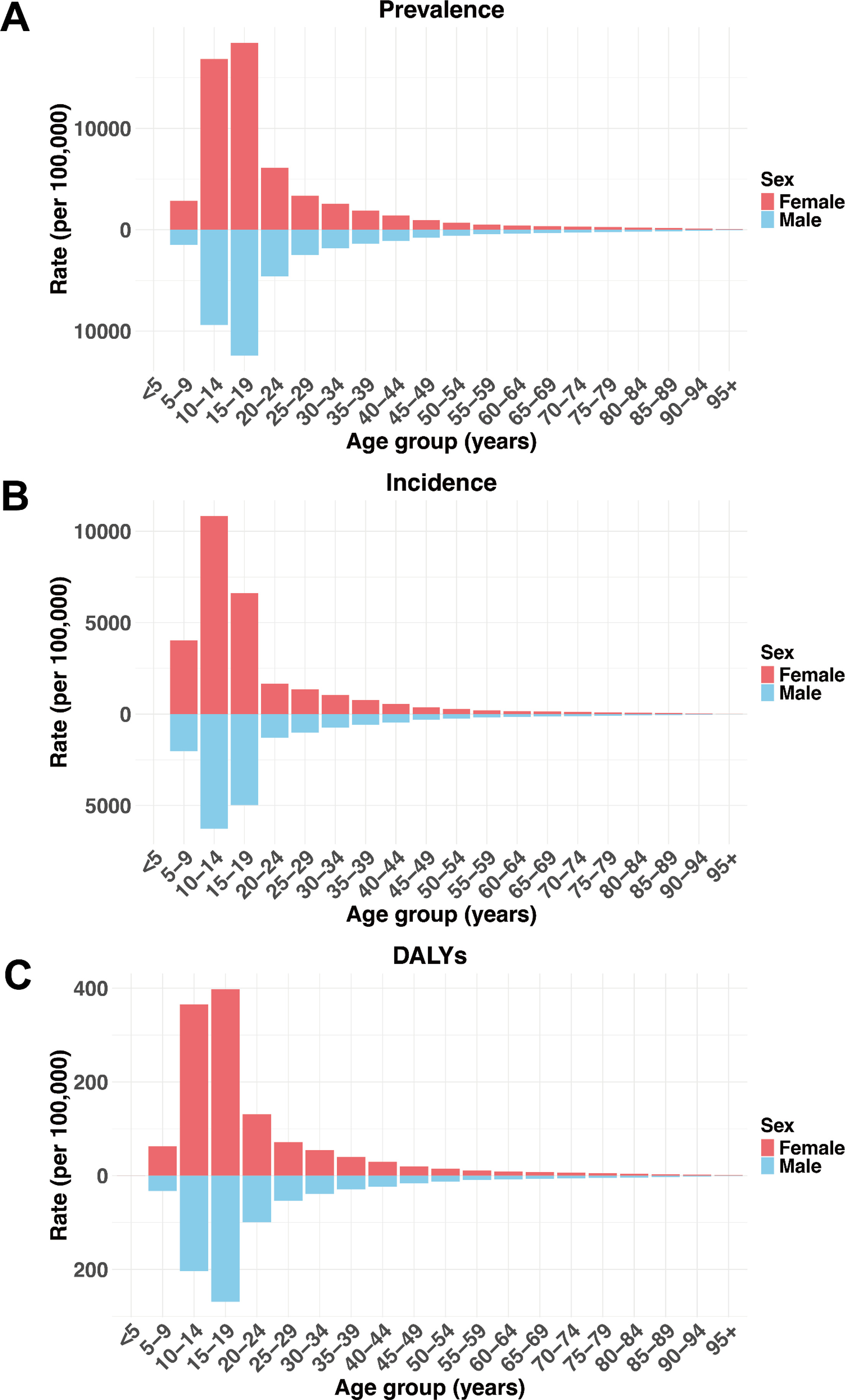
Fig. 3. Age- and sex-specific AV burden in (China, 2021). (A) Prevalence rates, (B) incidence rates, and (C) DALY rates are shown by age and sex. Prevalence and DALY rates peaked at 15–19 years in both sexes, whereas incidence rates peaked at 10–14 years and declined thereafter. All three measures were consistently higher in females than in males. DALY: Disability-adjusted life year.
BAPC for projecting the AV burden, 2022–2050
BAPC model projections indicate a persistent upward trajectory for AV incidence, prevalence and DALY rates in China, with anticipated levels by 2050 substantially exceeding current estimates. National projections estimate an incidence of 2371.63 per 100,000 (95% CrI 1816.73–2926.53), a prevalence of 4603.34 per 100,000 (95% CrI 3720.41–5486.27) and a DALY rate of 99.77 per 100,000 (95% CrI 76.73–122.81). Sex-stratified projections showed consistently higher rates among females than males. By 2050, female incidence is projected to reach 3005.06 per 100,000 (95% CrI 2,208.00–3,802.12), compared with 1726.19 (95% CrI 1311.17–2141.21) in males. Similarly, female prevalence (5769.92; 95 % CrI 4584.29–6955.54) and DALY rates (123.75; 95 % CrI 92.80–154.71) exceed those of males (prevalence 3436.27; 95 % CrI 2769.71–4102.82; DALY rate 75.77; 95 % CrI 57.61–93.93). Credible intervals widened over the projection horizon, indicating increasing uncertainty in long-term forecasts. (Fig. 4).
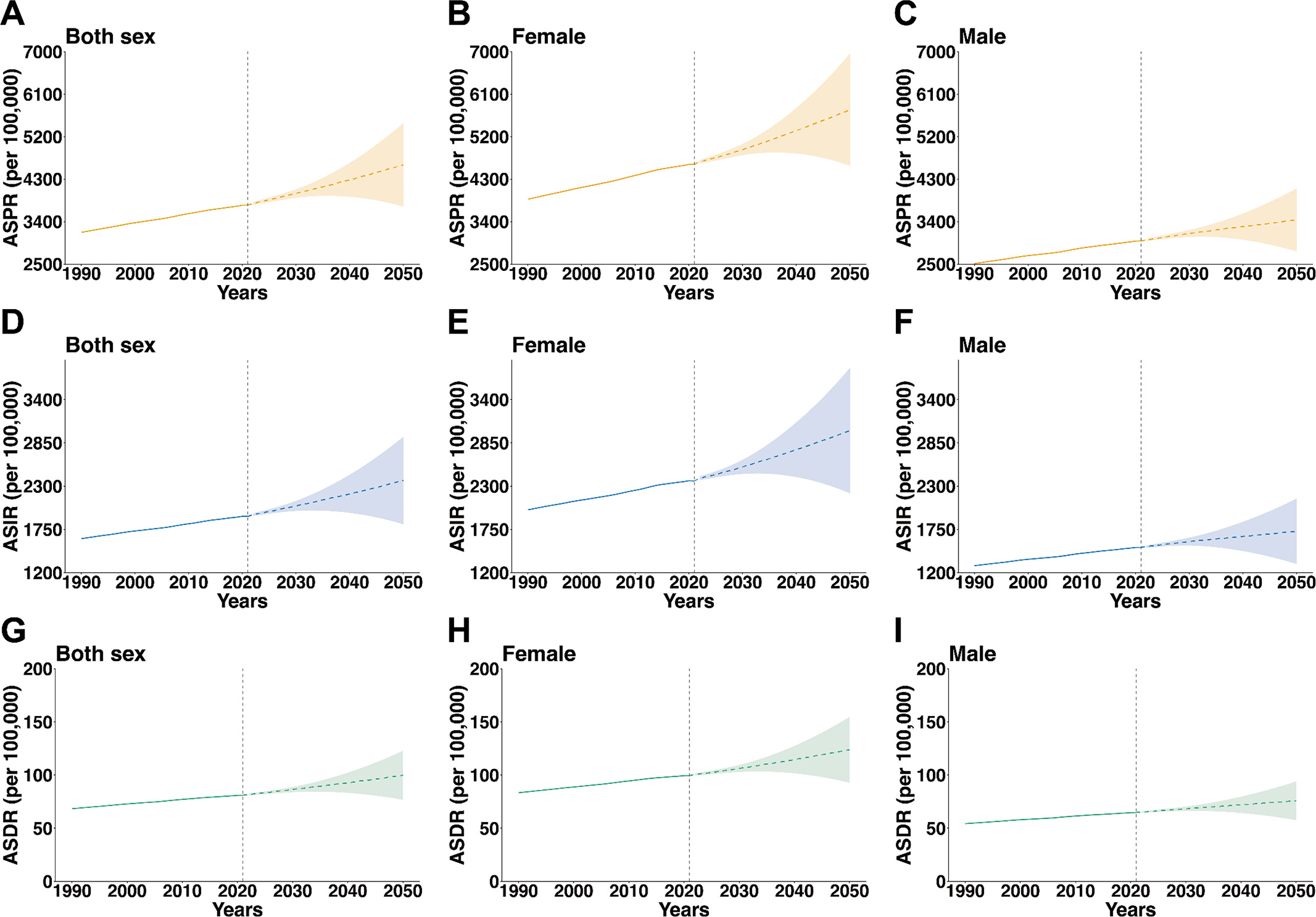
Fig. 4. Projecting of AV burden in China, 2022–2050. (A) ASPR, (D) ASIR and (G) ASDR of both sexes; (B) ASPR, (E) ASIR and (H) ASDR of females; and (C) ASPR, (F) ASIR and (I) ASDR of males. All three rates were projected to increase, with consistently higher levels in females than in males. Dashed lines indicate projections (2022–2050), and shaded areas indicate 95 % CrIs, which widened with longer projection horizons. ASPR: Age-standardized prevalence rate; ASIR: Age-standardized incidence rate; ASDR: Age-standardized DALY rate; DALY: Disability-adjusted life year; CrI: Credible interval.
DISCUSSION
Interpretation
AV frequently results in PIE, hyperpigmentation and scarring. Clinical data show that approximately 37 % of affected individuals report heightened cutaneous sensitivity, and 3–7% experience permanent scarring. These sequelae significantly impact both physical appearance and overall health status (1). Our analysis revealed consistent upward trends in the ASIR, ASPR and ASDR for AV in both China and globally across the 1990–2021 interval. China’s AV burden has consistently exceeded global averages while demonstrating more rapid progression, with an EAPC of approximately 0.55 in China compared with 0.37 globally. Joinpoint analysis revealed distinct segmented trajectories between China and global averages. Age-pattern analyses indicated that the main burden of AV in China was concentrated in adolescence, with females consistently showing higher rates than males. Projections further suggest that this burden will continue to increase through 2050, with a greater impact on females.
Our analysis revealed that the burden of AV in China was consistently higher and increased more rapidly than the global average from 1990 to 2021 across age-standardized incidence, prevalence and DALY rates. This faster long-term increase may be understood in the context of China’s rapid urbanization over the past decades (8, 9), a process accompanied by substantial changes in the urban environment and lifestyle patterns (10). Prior literature suggests that specific urban environmental exposures may be relevant to both AV prevalence and clinical severity (5, 11). Dietary Westernization – a prominent manifestation of these lifestyle shifts, characterized by higher glycaemic loads and increased dairy consumption – may also be relevant, given its overall association with elevated AV risk (12, 13). In addition, the observed increases may also partly reflect changes in case ascertainment, healthcare access and the availability of underlying epidemiological data (14).
While both China and the global population experienced a continuous rise in AV burden, our joinpoint analysis revealed distinct segmented trajectories between the two. In China, the periods with the highest annual percentage changes for incidence, prevalence and DALY rates were temporally aligned during a concentrated window (2006–2009). By contrast, the global trajectory was more prolonged and staggered, with incidence accelerating from 2006 to 2014, followed by lagged peaks in the growth of prevalence and DALY rates (2011–2014). This contrast may be understood in the context of China’s more compressed socioeconomic transition (15, 16), alongside potential changes in acne recognition and clinical management (14). A further divergence was observed in incidence-rate annual percentage changes during 2019–2021: they declined in China but rebounded modestly globally. This period coincided with the COVID-19 pandemic. In China, this interval was marked by strict public health measures and documented reductions in routine outpatient visits for non-urgent dermatological conditions (17, 18). The observed attenuation may therefore partly reflect pandemic-related disruptions in healthcare utilization and reporting, rather than a true short-term reduction in AV risk.
In China, the main burden of AV is concentrated in adolescents aged 10–19 years. The APC age-effect curve showed that fitted incidence peaked at 10–14 years. This peak is consistent with pubertal timing in Chinese children, as recent national data indicate median ages of 9.65 years for Tanner stage 2 breast development in girls and 10.65 years for testicular volume ≥4 mL in boys (19). In the 2021 age-specific analysis, incidence peaked at 10–14 years, whereas prevalence and DALY rates peaked at 15–19 years in both females and males. The later peak in prevalence is broadly consistent with previous epidemiological evidence from China showing that acne prevalence rises through adolescence and is highest in the 15–19 year age group (1). These findings show that AV burden in China spans the full adolescent period, with early adolescence carrying the highest incident burden and older adolescents bearing the heaviest burden in terms of prevalence and DALYs.
In China, females consistently bore a higher burden of AV than males. Prior literature has described several factors that may be relevant to this sex disparity, including hormonal influences such as hyperandrogenic states (20, 21, 22), cosmetics- and skincare-related exposures (23), and sex-related differences in disease perception and treatment uptake (1, 24). Women with acne may also experience greater psychosocial consequences, including impaired self-image, anxiety and depressive symptoms (25, 26). These findings highlight the importance of strengthening timely treatment, education and psychosocial support for female populations with AV.
BAPC projections suggest that the burden of AV in China will continue to increase through 2050, with females remaining more heavily affected than males. Viewed together with the age-specific patterns observed in this study, these findings highlight the need to strengthen early recognition, timely access to care and evidence-based management, particularly for adolescents and female populations. Practical strategies may include improving acne literacy, promoting appropriate skincare practices and providing psychosocial support for patients with more persistent or severe disease. Such measures may help reduce longer-term consequences, including scarring and quality-of-life impairment.
Importantly, these interpretations should not be taken as evidence of causation. Because this study was based on population-level GBD estimates and temporal trend analyses rather than individual-level exposure data, it can identify epidemiological patterns and associations but cannot establish causality. The factors discussed above should therefore be interpreted as plausible contextual correlates supported by prior literature rather than confirmed determinants.
Limitation
Mild acne is associated with low rates of medical consultation, which may lead to under-ascertainment in administrative and clinical data sources and thus underreporting of cases. Heterogeneity in case definitions, diagnostic practices and ICD coding across data sources may also introduce misclassification, particularly for milder disease. Accordingly, findings should be interpreted as trends in GBD-estimated burden, and cross-setting comparisons may be affected. Furthermore, the GBD framework does not incorporate certain individual-level determinants (e.g. cosmetic and skincare practices), which may contribute to residual confounding. Uncertainty inherently widens over longer forecast horizons due to model extrapolation, warranting cautious interpretation of long-term projections.
Conclusion
Our analysis of GBD 2021 data revealed distinct AV epidemiological patterns in China compared with global trends, with projections indicating persistent disease burden escalation. Given this trajectory, we recommend that Chinese policymakers, researchers and healthcare professionals should prioritise evidence-based prevention and management strategies for adolescents and for females.
ACKNOWLEDGEMENTS
The authors express their gratitude to the Institute for Health Metrics and Evaluation for sharing valuable GBD data.
REFERENCES
- Shen Y, Wang T, Zhou C, Wang X, Ding X, Tian S, et al. Prevalence of acne vulgaris in Chinese adolescents and adults: a community-based study of 17,345 subjects in six cities. Acta Derm Venereol 2012; 92: 40–44. https://doi.org/10.2340/00015555-1164
- Tunca M, Balik ZB, Uncu HB, Botsali A. Stigmatization and psychosocial burden in acne patients. J Cosmet Dermatol 2025; 24: e16678. https://doi.org/10.1111/jocd.16678
- Zhu Z, Zhong X, Luo Z, Liu M, Zhang H, Zheng H, et al. Global, regional and national burdens of acne vulgaris in adolescents and young adults aged 10-24 years from 1990 to 2021: a trend analysis. Br J Dermatol 2025; 192: 228–237. https://doi.org/10.1093/bjd/ljae352
- Wang Y, Xiao S, Ren J, Zhang Y. Analysis of the epidemiological burden of acne vulgaris in China based on the data of global burden of disease 2019. Front Med 2022; 9: 939584. https://doi.org/10.3389/fmed.2022.939584
- Yang J, Yang H, Xu A, He L. A review of advancement on influencing factors of acne: an emphasis on environment characteristics. Front Public Health 2020; 8: 450. https://doi.org/10.3389/fpubh.2020.00450
- Han HS, Seok J, Park KY. Air pollution and skin diseases. Ann Dermatol 2025; 37: 53–67. https://doi.org/10.5021/ad.24.159
- GBD 2021 Diseases and Injuries Collaborators. Global incidence, prevalence, years lived with disability (YLDs), disability-adjusted life-years (DALYs), and healthy life expectancy (HALE) for 371 diseases and injuries in 204 countries and territories and 811 subnational locations, 1990–2021: a systematic analysis for the Global Burden of Disease Study 2021. Lancet 2024; 403: 2133–2161. https://doi.org/10.1016/S0140-6736(24)00757-8
- Hu Y, Connor DS, Stuhlmacher M, Peng J, Turner II BL. More urbanization, more polarization: evidence from two decades of urban expansion in China. Npj Urban Sustain 2024; 4: 33. https://doi.org/10.1038/s42949-024-00170-z
- Liu H, Chen W, Sun S, Yu J, Zhang Y, Ye C. Revisiting China’s urban transition from the perspective of urbanisation: a critical review and analysis. Sustainability 2024; 16: 4122. https://doi.org/10.3390/su16104122
- Gong P, Liang S, Carlton EJ, Jiang Q, Wu J, Wang L, et al. Urbanisation and health in China. Lancet 2012; 379: 843–852. https://doi.org/10.1016/S0140-6736(11)61878-3
- Yang H, Cui X, Wang H, Helbich M, Yin C, Chen X, et al. Machine learning-based assessment of the built environment on prevalence and severity risks of acne. Cell Rep Sustain 2024; 1: 100235. https://doi.org/10.1016/j.crsus.2024.100235
- Juhl CR, Bergholdt HKM, Miller IM, Jemec GBE, Kanters JK, Ellervik C. Dairy intake and acne vulgaris: a systematic review and meta-analysis of 78,529 children, adolescents, and young adults. Nutrients 2018; 10: 1049. https://doi.org/10.3390/nu10081049
- Meixiong J, Ricco C, Vasavda C, Ho BK. Diet and acne: a systematic review. JAAD Int 2022; 7: 95–112. https://doi.org/10.1016/j.jdin.2022.02.012
- Chinese guidelines for the management of acne vulgaris: 2019 update. Int J Dermatol Venereol 2019; 2: 129–138. https://doi.org/10.1097/JD9.0000000000000043
- Popkin BM. Synthesis and implications: China’s nutrition transition in the context of changes across other low- and middle-income countries. Obes Rev 2014; 15 Suppl 1: 60–67. https://doi.org/10.1111/obr.12120
- Qin B, Zhang Y. Note on urbanization in China: urban definitions and census data. China Econ Rev 2014; 30: 495–502. https://doi.org/10.1016/j.chieco.2014.07.008
- Xiao H, Dai X, Wagenaar BH, Liu F, Augusto O, Guo Y, et al. The impact of the COVID-19 pandemic on health services utilization in China: time-series analyses for 2016-2020. Lancet Reg Health West Pac 2021; 9: 100122. https://doi.org/10.1016/j.lanwpc.2021.100122
- Xu R, Wu L, Liu Y, Ye Y, Mu T, Xu C, et al. Evaluation of the impact of the COVID-19 pandemic on health service utilization in China: a study using auto-regressive integrated moving average model. Front Public Health 2023; 11: 1114085. https://doi.org/10.3389/fpubh.2023.1114085
- Liang X, Huang K, Dong G, Chen R, Chen S, Zheng R, et al. Current pubertal development in Chinese children and the impact of overnutrition, lifestyle, and perinatal factors. J Clin Endocrinol Metab 2023; 108: 2282–2289. https://doi.org/10.1210/clinem/dgad102
- Dréno B. Treatment of adult female acne: a new challenge. J Eur Acad Dermatol Venereol 2015; 29 Suppl 5: 14–19. https://doi.org/10.1111/jdv.13188
- Schmidt TH, Shinkai K. Evidence-based approach to cutaneous hyperandrogenism in women. J Am Acad Dermatol 2015; 73: 672–690. https://doi.org/10.1016/j.jaad.2015.05.026
- Bagatin E, Freitas THP de, Rivitti-Machado MC, Machado MCR, Ribeiro BM, Nunes S, et al. Adult female acne: a guide to clinical practice. An Bras Dermatol 2019; 94: 62–75. https://doi.org/10.1590/abd1806-4841.20198203
- Zhu T, Ge Y, Zhang J, Chen Y, Zhong H, Yang L, et al. Gender-related characterization of acne in Chinese: a multiple-center cross-sectional survey on 13,085 cases. Clin Cosmet Investig Dermatol 2024; 17: 3013–3021. https://doi.org/10.2147/CCID.S484957
- Zhang Y, Fan L, Li L. Knowledge, attitudes, and practices regarding acne among university students. Sci Rep 2026; 16: 5439. https://doi.org/10.1038/s41598-025-34774-x
- Barbieri JS, Fulton R, Neergaard R, Nelson MN, Barg FK, Margolis DJ. Patient perspectives on the lived experience of acne and its treatment among adult women with acne: a qualitative study. JAMA Dermatol 2021; 157: 1040–1046. https://doi.org/10.1001/jamadermatol.2021.2185
- Layton AM, Bettoli V, Delore V, Puentes E, Tan JKL. The burden of acne vulgaris on health-related quality of life and psychosocial well-being domains: a systematic review. Am J Clin Dermatol 2026; 27: 17–47. https://doi.org/10.1007/s40257-025-00983-3