SHORT COMMUNICATION
Fungal Skin Infections in Cutaneous T-cell Lymphoma Patients under Mogamulizumab Treatment
Susanne MELCHERS1,2,3 , Marlis GERIGK4, Maren HEDKE5, Christel WEIẞ6 and Jan P. NICOLAY1,2,3,7*
1Department of Dermatology, Venereology and Allergology, University Medical Center Mannheim/University of Heidelberg, Mannheim, Germany, 2Skin Cancer Unit, German Cancer Research Center (DKFZ), Heidelberg, Germany, 3Section of Immune Dermatology, Allergy and cutaneous lymphoma, Medical Faculty Mannheim, University of Heidelberg, Mannheim, Germany, 4Institute of Medical Microbiology and Hygiene, Medical Faculty of Mannheim, University of Heidelberg, Mannheim, Germany, 5Institute of Clinical Chemistry, University Medicine Mannheim, Medical Faculty Mannheim, University of Heidelberg, Mannheim, Germany, 6Department of Medical Statistics and Biomathematics, Medical Faculty Mannheim, Heidelberg University, Mannheim, Germany, and 7DKFZ-Hector Cancer Institute at the University Medical Center Mannheim, Mannheim, Germany. *Email: jan.nicolay@umm.de
Citation: Acta Derm Venereol 2026; 106: adv-2026-0693. DOI: https://doi.org/10.2340/actadv.v106.adv-2026-0693.
Copyright: 2026 ©Author(s). Published by MJS Publishing, on behalf of the Society for Publication of Acta Dermato-Venereologica. This is an Open Access article distributed under the terms of the Creative Commons Attribution-NonCommercial 4.0 International License (https://creativecommons.org/licenses/by-nc/4.0/).
Submitted: May 13, 2026. Accepted after revision: Jun 30, 2026.
Published: Jul 28, 2026.
Competing interests and funding: The data that support the findings of this study are available from the corresponding author upon request.
Approved.
The study was conducted according to ethical guidelines at our institution and the Helsinki Declaration and was approved by the ethics committee II of Heidelberg University (reference number 2021–808-MA).
SM received honouraria and travel funding by Kyowa Kirin, Recordati, and Takeda. JPN received travel and congress participation funding by TEVA and Novartis as well as consulting fees by TEVA, Almirall, Biogen, Novartis, Kyowa Kirin, Innate Pharma, Takeda and Actelion, UCB Pharma and Recordati. MG, MH and CW have no conflict of interest to declare.
Primary cutaneous T-cell lymphomas (CTCL) are a heterogeneous group of rare lymphoproliferative diseases. Mycosis fungoides (MF) and the closely related leukemic Sézary syndrome (SS) belong to the most frequently observed entities (1). Early-stage MF is characterized by an excellent prognosis with a 5-year survival of up to 98%, but patient survival deteriorates in advanced stages up to a 5-year survival of only 36% in SS (2). This illustrates the high therapeutic need for effective and well-tolerated therapies, especially for advanced-stage CTCL patients.
CTCL is characterized by an increased susceptibility to infectious complications and mortality due to sepsis. The immunosuppression by both the underlying malignant disease and CTCL treatment, as well as the compromised epidermal barrier by CTCL skin involvement predisposes the patients to skin infections with S. aureus, Herpes simplex and fungi-like Trichophyton and Candida species (3, 4).
Additionally, topical corticosteroid use can suppress local immune responses, leading to chronic or widespread fungal infections, often referred to as tinea incognito. In clinical studies, up to 40% of patients with fungal skin infections had a history of topical steroid use, frequently obtained over the counter (5, 6).
National and international guidelines recommend a stage-dependent therapeutic approach (7). Systemic treatments are usually initiated in advanced stages and include the monoclonal anti-CCR4 antibody Mogamulizumab. Mogamulizumab was approved by the FDA and the EMA in 2018 for the treatment of patients with MF or SS who have received at least one prior systemic therapy. Mogamulizumab is administered weekly on days 1, 8, 15 and 22 of the first 28 day cycle at a dose of 1 mg/kg as an intravenous infusion, followed by infusions every 2 weeks on days 1 and 15 of each subsequent 28-day cycle. In the pivotal study MAVORIC, the overall response rate was 28% in all CTCL patients and 37% in SS patients (8).
Mogamulizumab has a rather beneficial adverse event profile. In the MAVORIC study, 38% of patients experienced serious adverse events (SAE). Two grade 5 adverse events (AE) were reported: sepsis (1%) and pneumonia (1%). Regarding infections and infestations, two grade 4 AEs occurred: cellulitis and pneumonia (8).
At our lymphoma clinic, we observed the onset of fungal skin infections in 5 CTCL patients treated with Mogamulizumab. This adverse event was not specifically reported in the pivotal clinical trial for Mogamulizumab treatment and to our knowledge, has not yet been comprehensively reported in the literature. Given the rarity of CTCL and the relatively infrequent occurrence of fungal skin infections under Mogamulizumab, we wanted to share this observation.
MATERIALS, METHODS, AND RESULTS
The 5 CTCL patients were treated with Mogamu-lizumab between 1 January 2021 and 31 December 2024 at the Department of Dermatology, Venereology and Allergology of the University Medical Center Mannheim. The CTCL patients (1 MF, 4 SS) were diagnosed according to the WHO-EORTC classification of CTCL and the criteria of the International Society of Cutaneous Lymphomas (ISCLC) were included in the study (1, 9). Patient characteristics are provided in Table I. During the study period (1 January 2021 to 31 December 2024), a total of 12 CTCL patients received treatment with Mogamulizumab at our institution, of whom 5 patients (41.7%) developed a fungal skin infection. The study was conducted according to ethical guidelines at our institution and the Helsinki Declaration and was approved by the ethics committee II of Heidelberg University (reference number 2021–808-MA). The patients were clinically evaluated at least every 3 months with full-body examinations and lymph node palpation. Adverse events (AEs) were assessed in accordance with the National Cancer Institute Common Terminology Criteria for AEs (CTCAE) version 5.0. Microbiological diagnostics were performed at the Institute of Medical Microbiology and Hygiene of the University Medical Center Mannheim. Fungal skin infections were diagnosed based on histopathological examination, microbiological culture and the presence of clinically relevant symptoms requiring antifungal treatment, as assessed by dermatologists. Additionally, histopathological examinations of skin biopsies were performed at the Section for Dermatopathology of the Department of Dermatology, Venereology and Allergology.
Table I. Clinical data of the human patient collective of CTCL patients under Mogamulizumab therapy
| Pat. No. | Sex | Age | Diagnosis and stage | CTCL-Pretherapy | Pathogen | Material | Therapy | CTCAE grade |
|---|---|---|---|---|---|---|---|---|
| 1 | F | 77 | Sézary syndrome | ECP, IFN, pegylated IFN, DMF, TSEB | Tonsurans | Scale fungus culture | Systemic terbinafine, topical ciclopirox | 2 |
| 2 | F | 74 | Sézary syndrome | ECP, MTX | Candidiasis | Histology, microbiological swab | Systemic fluconazole, topical amphotericin B | 2 |
| 3 | M | 65 | Mycosis fungoides IIB | Pegylated IFN, Etoposide | Rubrum | Scale fungus culture | Topical ciclopirox | 1 |
| 4 | M | 72 | Sézary syndrome | Systemic PUVA, IFN, ECP, MTX, pegylated IFN, BV, DMF | Interdigitale | Scale fungus culture | Systemic terbinafine, topical ciclopirox | 2 |
| 5 | F | 78 | Sézary syndrome | ECP, IFN, systemic antibiosis with cefuroxime and metronidazole, bexarotene, DMF | Candida albicans | Microbiological swab | Topical amphotericin B | 1 |
|
AE: Adverse event; Bex: Bexarotene; Brent: Brentuximab vedotin; CTCAE: Common Terminology Criteria for Adverse Events; DMF: Dimethyl fumarate; ECP: Extracorporeal Photopheresis; Gem: Gemcitabine; IFN: Interferon; Moga: Mogamulizumab; MTX: Methotrexate; PUVA: Psoralene plus ultraviolet A radiation; TSEB: Total skin electron beam therapy. |
||||||||
The mean age was 73.2 years, and 60% of the patients were female. In total, 20% of patients suffered from stage IIB, and 80% of patients suffered from stage IVA1; they received 4.2 therapy lines before the initiation of Mogamulizumab.
Clinical photographs of patient 1 at the time of diagnosis of the fungal skin infection and after 2 months of antimycotic treatment are provided in Fig. 1a and b. Fungal infections were diagnosed on average 10.6 months after initiation of Mogamulizumab therapy.
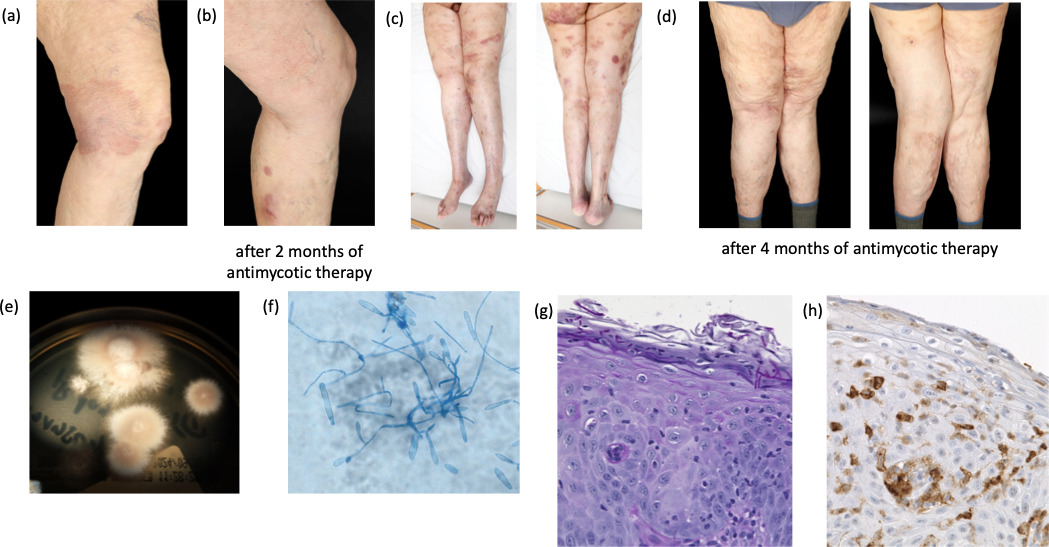
Fig. 1. Clinical and histopathological documentation of fungal skin infections. Representative clinical photographs and microbiological and histopathological findings from CTCL patients with fungal skin infections. (a) Clinical presentation of tinea in patient 1 at disease onset. (b) Clinical improvement 2 months after antifungal therapy consisting of systemic terbinafine (2 months) and topical ciclopirox. (c) Clinical presentation of tinea in patient 3 at disease onset (d) Clinical improvement 4 months after antifungal therapy with topical ciclopirox. (e) Scale fungus culture of T. tonsurans obtained from patient 1. (f) Higher magnification of the scale fungus culture illustrating fungal growth. (g) Periodic acid–Schiff (PAS) staining of a skin biopsy obtained from patient 2, demonstrating fungal elements within the epidermis (20 x magnification). (h) Immunohistochemical staining for CD4 in a skin biopsy from patient 2, highlighting the underlying CTCL-associated T-cell infiltrate (20 x magnification).
The identified pathogens included Trichophyton tonsurans (20%), T. rubrum (20%), T. interdigitale (20%), and Candida species (40%). The pathogens were detected by scale fungus culture (60%) (Fig. 1c and d), microbiological swabs (20%) and histopathological examination (20%) (Fig. 1e).
Further clinical photographs of human patients and scale fungus cultures are provided in the supplements. None of the AEs related to fungal infection was severe. However, 40% of the affected patients experienced CTCAE grade 1, and 60% of the patients CTCAE grade 2.
Following the results, 60% of the patients received topical treatment with ciclopirox for their infection with Trichophyton species, while 40% of the patients were treated with topical amphotericin B regarding their infection with Candida species. However, 60% of the affected patients required systemic antifungal treatment with terbinafine (40%) or fluconazole (20%) in combination with topical therapy after failure of the topical monotherapy (Table I). Notably, systemic antifungal therapy was indicated in patient 3, who ultimately could not receive systemic antifungal treatment due to drug interactions.
DISCUSSION
We found 5 CTCL patients to be affected by fungal skin infections under Mogamulizumab therapy; the severity of the CTCAE grades was grade 1 and 2. Currently, there is growing evidence on the side-effect profile of Mogamulizumab in CTCL patients both regarding infections.
Patients with CTCL are known to have im-paired immune function as a consequence of both the underlying malignant disease and the immuno-modulatory or immunosuppressive effects of systemic oncologic therapies. This compromised skin barrier and immune status contributes to an increased susceptibility to infectious complications, including bacteremia and sepsis, particularly in patients receiving multiple lines of systemic treatment or polychemotherapy (10).
The phenomenon of increased susceptibility to fungal skin infections has already been described in the Th1-dominant chronic inflammatory diseases psoriasis and hidradenitis suppurativa. A meta-analysis revealed an increased risk for candidiasis upon treatment with the IL-17 antagonists Ixekizumab and Bimekizumab. IL17 is implied in the defence against bacterial and fungal infections, and particularly in mucocutaneous microbial surveillance (11). However, for the Th2-dominant atopic dermatitis, no such effects were described upon therapy with IL4- or IL-13 antagonists or JAK-inhibitors. Nevertheless, in the latter, fungal skin infections can easily be overseen and thus be underrated due to clinical resemblance to the underlying disease, just like in CTCL.
Surprisingly, fungal infections were not explicitly reported in the pivotal MAVORIC trial. In the MAVORIC study, “skin infections or cellulitis” were reported in 2.7% (5/184) of patients (1% CTCAE grade 1–2, 2% CTCAE grade 3, 1% CTCAE grade 4) (8). A post hoc analysis from the MAVORIC trial regarding long-term safety of Mogamulizumab did not report fungal infections. The OMEGA study on the real-world use of Mogamulizumab in France did not report any infectious adverse events (12).
Multiple case series have been published on the real-world experience of Mogamulizumab in CTCL from France, Italy, Spain, the UK and the US on both infectious and immune-related adverse events under Mogamulizumab therapy. Molloy et al. identified 30.1% of CTCL patients affected by skin infections, and 5% of grade≥3 related to skin infections in a real-world study on the Mogamulizumab use in the UK and Spain (13). In a study from the US, 41% of CTCL patients developed an immune-related adverse event including MAR, while 2.4% of patients experienced drug-induced liver failure (14). Currently, the MINT study in Germany and the MIBERIC study in Spain are systematically collecting further data on the real-world use of Mogamulizumab.
There are currently no uniform recommendations for anti-infective prophylaxis during therapy with Mogamulizumab (15). The European Society of Clinical Microbiology and Infectious Diseases (ESCMID) Study Group for Infections in Compromised Hosts (ESGICH) recommends prophylaxis with acyclovir and cotrimoxazole during Mogamulizumab therapy, but these recommendations are based on experience in ATLL patients undergoing Mogamulizumab therapy. Currently, there are no clear recommendations concerning antifungal prophylaxis in CTCL (16).
The phenomenon of increased susceptibility to fungal skin infections has already been described in the Th1-dominant chronic inflammatory diseases psoriasis and hidradenitis suppurativa. A meta-analysis revealed an increased risk for candidiasis upon treatment with the IL-17 antagonists Ixekizumab and Bimekizumab. IL17 is implied in the defence against bacterial and fungal infections, and particularly in mucocutaneous microbial surveillance (11).
Since CTCL and tinea corporis share morphologic properties, we suspect that fungal skin infections might be an overlooked adverse effect in Mogamulizumab treatment, as they are easily misinterpreted as CTCL symptoms or MAR. Additionally, the onset of fungal skin infections under Mogamulizumab-therapy seems to be a CTCL-specific effect. In summary, we would like to raise awareness of an increased risk of fungal skin infection under Mogamulizumab therapy in CTCL patients in order to further increase safety of this therapy.
REFERENCES
- Alaggio R, Amador C, Anagnostopoulos I, Attygalle AD, Araujo IB de O, Berti E, et al. The 5th edition of the World Health Organization classification of haematolymphoid tumours: Lymphoid neoplasms. Leukemia 2022; 36: 1720–1748. https://doi.org/10.1038/s41375-022-01620-2
- Dobos G, Pohrt A, Ram-Wolff C, Lebbé C, Bouaziz JD, Battistella M, et al. Epidemiology of cutaneous T-cell lymphomas: a systematic review and meta-analysis of 16,953 patients. Cancers 2020; 12: 12. https://doi.org/10.3390/cancers12102921
- Blaizot R, Ouattara E, Fauconneau A, Beylot-Barry M, Pham-Ledard A. Infectious events and associated risk factors in mycosis fungoides/Sézary syndrome: a retrospective cohort study. Br J Dermatol 2018; 179: 1322–1328. https://doi.org/10.1111/bjd.17073
- Martin SJ, Duvic M. Prevalence and treatment of palmoplantar keratoderma and tinea pedis in patients with Sézary syndrome. Int J Dermatol 2012; 51: 1195–1198. https://doi.org/10.1111/j.1365-4632.2011.05204.x
- Lakhani SJ, Bilimoria F, Lakhani JD. Adverse effects of steroid use in dermatophytic infections: a cross sectional study. J Integr Health Sci 2017; 5: 63. https://doi.org/10.4103/2347-6486.240248
- Priyanka A N, K Kaviarasan P, Kannambal K, Poorana B, Abhirami C. Clinicoepidemiological profile of steroid modified dermatophytosis following abuse of irrational combination of topical corticosteroid containing preparations (ICSP). IJCED 2020; 6: 318–324. https://doi.org/10.18231/j.ijced.2020.064
- Latzka J, Assaf C, Bagot M, Cozzio A, Dummer R, Guenova E, et al. EORTC consensus recommendations for the treatment of mycosis fungoides/Sézary syndrome - update 2023. Eur J Cancer 2023; 195: 113343. https://doi.org/10.1016/j.ejca.2023.113343
- Kim YH, Bagot M, Pinter-Brown L, Rook AH, Porcu P, Horwitz SM, et al. Mogamulizumab versus vorinostat in previously treated cutaneous T-cell lymphoma (MAVORIC): an international, open-label, randomised, controlled phase 3 trial. Lancet Oncol 2018; 19: 1192–1204. https://doi.org/10.1016/S1470-2045(18)30379-6
- Campo E, Jaffe ES, Cook JR, Quintanilla-Martinez L, Swerdlow SH, Anderson KC, et al. The international consensus classification of mature lymphoid neoplasms: a report from the Clinical Advisory Committee. Blood 2022; 140: 1229–1253. https://doi.org/10.1182/blood.2022015851
- Allen PB, Switchenko J, Ayers A, Kim E, Lechowicz MJ. Risk of bacteremia in patients with cutaneous T-cell lymphoma (CTCL). Leuk Lymphoma 2020; 61: 2652–2658. https://doi.org/10.1080/10428194.2020.1779259
- Wu S, Xu Y, Yang L, Guo L, Jiang X. Short-term risk and long-term incidence rate of infection and malignancy with IL-17 and IL-23 inhibitors in adult patients with psoriasis and psoriatic arthritis: a systematic review and meta-analysis. Front Immunol 2023; 14: 1294416. https://doi.org/10.3389/fimmu.2023.1294416
- Beylot-Barry M, Quereux G, Nardin C, Duval-Modeste AB, Dereure O, Dalac-Rat S, et al. Effectiveness of mogamulizumab in patients with Mycosis Fungoides or Sézary syndrome: a multicentre, retrospective, real-world French study. J Eur Acad Dermatol Venereol 2023; 37: 1777–1784. https://doi.org/10.1111/jdv.19134
- Molloy K, Vico C, Ortiz-Romero PL, Scarisbrick JJ. Real-world experience of using mogamulizumab in relapsed/refractory mycosis fungoides/Sézary syndrome. Br J Dermatol 2021; 184: 978–981. https://doi.org/10.1111/bjd.19720
- Jfri A, Virgen CA, Tawa M, Giobbie-Hurder A, Kupper TS, Fisher DC, et al. Prevalence and implications of mogamulizumab-induced immune-related adverse events in mycosis fungoides/Sézary syndrome; a single-center experience. J Am Acad Dermatol 2023; 89: 1044–1047. https://doi.org/10.1016/j.jaad.2023.05.082
- Assaf C, Booken N, Dippel E, Dobos G, Eich HT, Klemke CD, et al. Practical recommendations for therapy and monitoring of mogamulizumab patients in Germany. J Dtsch Dermatol Ges 2025; 23: 341–354. https://doi.org/10.1111/ddg.15639
- Drgona L, Gudiol C, Lanini S, Salzberger B, Ippolito G, Mikulska M. ESCMID Study Group for Infections in Compromised Hosts (ESGICH) Consensus Document on the safety of targeted and biological therapies: an infectious diseases perspective (Agents targeting lymphoid or myeloid cells surface antigens [II]: CD22, CD30, CD33, CD38, CD40, SLAMF-7 and CCR4). Clin Microbiol Infect 2018; 24 Suppl 2: S83–S94. https://doi.org/10.1016/j.cmi.2018.03.022