ORIGINAL REPORT
Quality of Life, Mental Health and Executive Function in Individuals with Basal Cell Naevus Syndrome
Karianne H. BRANDTZÆG1,2* , Charlotte VON DER LIPPE3, Ina S. ALMDAHL4, Anvor ROSSOW5, Ragnhild S. FALK6, Petter GJERSVIK1, Kristin H. HORTEMO1,2† and Solrun SIGURDARDOTTIR4†
1Institute of Clinical Medicine, University of Oslo, Oslo, Norway, 2Department of Dermatology, Oslo University Hospital, Oslo, Norway, 3Department of Medical Genetics, Telemark Hospital, Skien, Norway, 4Norwegian Centre for Rare Diseases, Unit Gaustad, Oslo University Hospital, Oslo, Norway, 5Norwegian Centre for Rare Diseases, Unit Oral Health, Lovisenberg Diaconal Hospital, Oslo, Norway, and 6Oslo Centre for Biostatistics and Epidemiology, Oslo University Hospital, Oslo, Norway.
†These authors contributed equally as joint last authors
Corr: Karianne H. Brandtzæg, Oslo University Hospital, P.O. Box 4950 Nydalen, N-0424 Oslo, Norway. Email: kahaga@ous-hf.no
Key words: Gorlin syndrome; basal cell naevus syndrome; basal cell carcinoma; health-related quality of life; executive functioning; anxiety.
Citation: Acta Derm Venereol 2026; 106: adv-2026-0335. DOI: https://doi.org/10.2340/actadv.v106.adv-2026-0335.
Copyright: 2026 ©Author(s). Published by MJS Publishing, on behalf of the Society for Publication of Acta Dermato-Venereologica. This is an Open Access article distributed under the terms of the Creative Commons Attribution-NonCommercial 4.0 International License (https://creativecommons.org/licenses/by-nc/4.0/).
Submitted: Jan 9, 2026. Accepted after revision: Jul 7, 2026.
Published: Aug 11, 2026.
Competing interests and funding: The authors have no conflicts of interest to declare.
Data is available on request. The data underlying this manuscript will be shared on reasonable request to the corresponding author.
The study protocol was approved by the Regional Committee for Medical Research Ethics South East Norway (approval number 280,289 and approval number 753456) and the Oslo University Hospital Data Protection Officer (approval number 21/19008). The study was performed in accordance with the Declaration of Helsinki.
Basal cell naevus syndrome (BCNS) is a rare genetic disorder characterized by multiple basal cell carcinomas, as well as different extracutaneous tumours, cysts and abnormalities. Research on health-related quality of life (HRQoL) and mental health in BCNS is limited. This cross-sectional study included 62 individuals ≥18 years diagnosed with BCNS. Clinical and genetic data were collected, and 5 validated questionnaires were used to assess self-reported HRQoL, psychological distress, fatigue, pain and everyday executive functioning. Median regression analyses were conducted to identify factors associated with HRQoL. Independent samples t-tests and one proportion z-tests were conducted to compare the BCNS group with the general population. Individuals with BCNS reported lower HRQoL compared with the general population. Elevated anxiety symptoms were observed in 14 individuals (24%). The proportion of individuals reporting everyday executive deficits was higher in the BCNS group compared with the general population. Engagement in employment or higher education was associated with better physical and mental HRQoL, whereas symptoms of anxiety and everyday executive deficits were associated with reduced mental HRQoL. Findings highlight mental health challenges in BCNS. Routine screening for anxiety and executive functioning is suggested as essential steps in identifying those at risk and providing timely psychological support.
SIGNIFICANCE
Basal cell naevus syndrome (BCNS) is a rare genetic disorder characterized by multiple skin cancers and other health issues. In this study, adults with BCNS reported lower quality of life compared to the general population, along with frequent symptoms of anxiety and executive difficulties, such as planning, remembering and multitasking. Employment or higher education was linked to better quality of life, while elevated anxiety symptoms and executive difficulties were linked to poorer quality of life. The findings highlight the mental difficulties in BCNS and suggest that psychological aspects should be addressed in clinical care.
INTRODUCTION
Basal cell naevus syndrome (BCNS), also known as naevoid basal cell carcinoma syndrome or Gorlin syndrome, is a rare autosomal dominant condition. Most BCNS cases are caused by pathogenic variants in the PTCH1 gene, while a minority is caused by variants in SUFU (1, 2). Clinically, BCNS is characterized by early onset and multiple basal cell carcinomas (BCCs), odontogenic keratocysts and palmoplantar pitting. Additionally, skeletal and ocular abnormalities and various extra-cutaneous tumours and cysts are common (3, 4).
Research on BCNS has mainly focused on somatic features. Only a few studies have assessed health-related quality of life (HRQoL) and mental health in BCNS, with inconsistent results concerning HRQoL and high levels of depression reported (5, 6). Intellectual disability has been reported in a minority (7–18%) of individuals with BCNS (4, 7, 8). However, cognitive domains and executive functioning, i.e. cognitive functions such as attention, planning, problem-solving and management of emotions (9), remain underexplored. This highlights a critical gap in the literature and underscores the need for more research.
The objective of the current study was to assess self-reported HRQoL in adults with BCNS, identify factors associated with HRQoL and evaluate levels of psychological distress, fatigue, pain and everyday executive functioning.
MATERIALS AND METHODS
Study design
This cross-sectional study was conducted at the Oslo University Hospital, Norway, and is reported in accordance with the STROBE statement (10). Two individuals with BCNS were involved in study planning and interpretation of the results.
Study population
From August 2021 to July 2024, individuals across Norway with a confirmed diagnosis of BCNS were invited to the multidisciplinary BCNS clinic at the Oslo University Hospital and to participate in the Oslo University Hospital Skin Registry. All individuals ≥18 years who participated at the BCNS clinic during this period were eligible for inclusion. Details regarding the recruitment procedure and the collection of demographic and clinical data have been described previously (4). Individuals being assessed by healthcare professionals as unable to understand or provide meaningful responses to the questionnaires were excluded, along with those lacking written informed consent and not being Norwegian speaking. Demographic and clinical data were obtained at the same time as participants completed the instruments.
Instruments
The instruments were administered in conjunction with clinical consultations at the BCNS clinic at the Oslo University Hospital. No treatment procedures were performed during these consultations. Individuals responded onsite the same day (n=53) or at home (n=9). For those responding on site, the questionnaires were completed independently without assistance. Those who responded at home were instructed to complete the questionnaires independently and to return them by mail. The following validated instruments were used, in Norwegian translations.
-
The Short Form 36 Health Survey (SF-36) version 2.0, consisting of 36 items measuring 8 domains of physical and mental health, was used to measure HRQoL (11, 12, 13). By aggregating the physical and mental domain subscales (each scored from 0 to 100), a physical component summary (PCS) score and a mental component summary (MCS) score were calculated, each standardized to a mean of 50 and a standard deviation of 10. Higher scores indicate better HRQoL. A licence from Quality Metric was used for scoring (License Agreement QM051240).
-
The Hospital Anxiety and Depression Scale (HADS) (14) has 14 items, assessing anxiety (7 items) and depression (7 items) adding up to an anxiety and a depression subscale score (0–21). A score of ≥8 for each HADS subscale was used as thresholds to indicate elevated anxiety or depression symptoms (15, 16).
-
The Chalder Fatigue Scale (CFQ-11) (17) has 11 items measuring physical fatigue (7 items) and mental fatigue (4 items). The Likert scoring method was used for scoring (0–3), with the score ranges for total fatigue, mental fatigue and physical fatigue being 0–33, 0–12 and 0–21, respectively.
-
The Brief Pain Inventory (BPI) (18, 19) has 11 items measuring the severity of pain and how pain interferes with everyday living and feelings during the last 24 h. Each item is scored from 0 (no pain) to 10 (pain as bad as you can imagine). A Pain Severity Index and a Pain Interference Index can be calculated as the means of selected items.
-
The Behavioural Rating Inventory of Executive Function - Adult version (BRIEF-A) (20) was used to measure everyday executive functioning. The BRIEF-A has 75 items covering 9 subscales and with 3 calculated indexes. Raw scores are converted to T-scores (mean=50, SD=10). T-scores ≥65 indicate clinically significant executive function difficulties (21).
Additionally, 3 questions were asked capturing self-reported learning difficulties in childhood, delayed motor development and troublesome social functioning in childhood.
Data analyses
Statistical analyses were performed using Stata software version 18. Due to the explorative nature of this study, an alpha level of 0.05 was chosen with no corrections for multiple testing. Gender differences were assessed using t-tests or Mann–Whitney U tests for continuous variables, and Fisher exact tests or χ2 tests for dichotomous variables, as appropriate.
To explore variables associated with the SF-36 PCS and MCS, multivariate median regression analyses were conducted in 2 steps. First, a basic model was constructed including only demographic variables. Subsequently, this model was expanded by adding each clinical variable individually to assess its independent association with PCS/MCS, while adjusting for demographic variables. The median BRIEF-A GEC index T-scores were calculated for selected subgroups and compared with the respective reference groups using Mann–Whitney U tests. To explore associations between a HADS anxiety score ≥8 and selected variables, logistic regressions were performed.
The BCNS group was compared with the general population of Norway in terms of SF-36 (22), HADS (23), CFQ-11 (24) and BRIEF-A (25). When possible (i.e. for the SF-36 and CFQ-11), the population data were weighted according to the age distribution in the BCNS group. Independent samples t-tests were performed to assess mean differences between the BCNS group and the general population for continuous variables. One proportion z-tests were performed to compare proportions between the BCNS group and general population.
RESULTS
Out of 72 individuals with BCNS aged ≥18 years, 6 were excluded as they were assessed by professionals as unable to understand or provide meaningful responses to the questionnaires. These individuals were registered with sequelae following traumatic head injury (n=1) or stroke (n=1), cerebral palsy (n=1) or intellectual disability (n=3). Four individuals were excluded due to absence of written informed consent. There were no significant differences in gender or age between participants and those excluded.
Demographic and clinical characteristics
Among the 62 participants, 34 (55%) were males and 28 (45%) were females (Table I). Participants were from across Norway, with 31 (50%) from the South-East, 17 (27%) from the West, 12 (19%) from the Central and 2 (3%) from the North. Most participants had a high education level (>13 years of education) (61%) and were employed or engaged in higher education (66%). More males than females were employed or engaged in higher education (82% vs 46%, p=0.003).
Table I. Demographic and clinical characteristics of 62 adults with basal cell naevus syndrome
| Demographics | |
|---|---|
| Males, n (%) | 34 (55%) |
| Age (years), mean (±SD) | 45 (16) |
| Education>13 years, n (%) | 38 (61%) |
| Employed/Engaged in higher education, n (%) | 41 (66%)* |
| Receiving disability benefits, n (%) Old-age pensioner, n (%) |
12 (19%) 9 (15%) |
| Married/Partner, n (%) | 33 (53%) |
| Single/Divorced/Widower/Widow, n (%) | 29 (47%) |
| Living alone, n (%) | 21 (34%) |
| Living with others, n (%) | 41 (66%) |
| Clinical data | |
| Age at basal cell naevus syndrome diagnoses (years), median (IQR) | 24 (14–37) |
| Number of lifetime basal cell carcinomas, median (IQR) | 34 (4–150) |
| ≥100 lifetime basal cell carcinomas, n (%) Number of basal cell carcinomas at inclusion visit, median (IQR) |
21 (34%) 1 (0–4) |
| Number of lifetime odontogenic keratocysts, median (IQR) | 5 (1–9) |
| Eye abnormality, n (%) | 25 (41%) |
| Skeletal abnormality, n (%) | 60 (97%) |
| Neurological disease #, n (%) | 12 (19%) |
|
*Sex differences p=0.003. # i.e. intracranial tumours, hydrocephalous and epilepsy. |
|
Considerable variations in clinical features were observed (Table I). No gender-related differences in clinical features were found. All individuals except one had a pathogenic variant in PTCH1, with 9 of the variants being missense and 14 being loss-of-function variants. None of the individuals had a pathogenic SUFU variant. In 28 individuals (45%), the pathogenic variants were inherited, while the variants were de novo in 26 individuals (42%). In 8 cases (13%), the type of inheritance was unknown.
A broad spectrum of healthcare services had been involved in the lifetime follow-up of participants (Fig. 1). Fifty-five individuals (89%) had consulted 5 or more different medical specialists, and 47 (76%) were regularly followed by a dermatologist. Follow-up by a mental healthcare professional was less frequent, with 21 individuals (34%) stating that they had received mental health-care. Eleven individuals (18%) had consulted a speech therapist.

Fig. 1. Medical specialists, allied health professionals and educational support services involved in the lifetime follow-ups of 62 individuals with basal cell naevus syndrome. Each individual could have consulted all types of specialists, allied health professionals and educational support services.
Twenty-three individuals (37%) reported learning difficulties in childhood, 15 (24%) delayed motor development, and 18 (29%) troublesome social functioning in childhood.
Health-related quality of life
Measuring HRQoL, the median PCS and MCS scores were 55 and 51, respectively (Table II). Females reported poorer physical HRQoL compared with males (median PCS score: 51 vs 56, p=0.005).
Table II. Median (IQR) scores of the Short Form 36 (SF-36) Health Survey subscales in adults with basal cell naevus syndrome
| Total (n=60–61#*) |
Male (n=33) |
Female (n=27–28*) |
p-value** | |
|---|---|---|---|---|
| Physical functioning | 95 (75–100) | 100 (90–100) | 85 (50–95) | 0.001 |
| Role-physical | 100 (59–100) | 100 (94–100) | 75 (38–100) | 0.002 |
| Bodily pain | 84 (61–100) | 84 (72–100) | 67 (46–100) | 0.03 |
| General health | 72 (50–87) | 82 (67–90) | 55 (35–75) | <0.001 |
| Vitality | 56 (38–69) | 63 (44–75) | 50 (25–69) | 0.03 |
| Social functioning | 88 (75–100) | 88 (75–100) | 75 (44–100) | 0.007 |
| Role-emotional | 92 (75–100) | 100 (83–100) | 79 (54–100) | 0.01 |
| Mental health | 75 (65–85) | 80 (65–90) | 75 (60–85) | 0.10 |
| Physical component summary | 55 (47–59) | 56 (54–60) | 51 (37–56) | 0.005 |
| Mental component summary | 51 (43–56) | 53 (47–57) | 48 (40–54) | 0.11 |
|
#Missing = 1-2 *One individual did not respond to the subscales role-physical, vitality and mental health. Consequently, the PCS and MCS scores were not calculated for this individual. **Comparison of median scores in males and females; p-values calculated by Mann–Whitney U tests. |
||||
The BCNS group scored lower on several subscales of the SF-36 and on the MCS compared with the general population (Supplement 1). The differences were most pronounced in females where mean differences exceed −10 in the general health, vitality, social functioning and mental health subscales.
Psychological distress, fatigue and pain
Fourteen individuals (24%) had a HADS anxiety score ≥8 and 7 individuals (12%) a HADS depression score ≥8. Five individuals scored ≥8 on both the HADS anxiety and depression scores. A higher proportion of females than males scored ≥8 on the HADS depression scale (Table III). No differences were observed between the mean HADS anxiety and mean HADS depression scores in the BCNS group compared with the general population (Supplement 2).
Table III. Median (IQR) scores of the Hospital Anxiety and Depression Scale (HADS), Chalder Fatigue Scale and Brief Pain Inventory subscales in adults with basal cell naevus syndrome
| Total | Male | Female | p-value* | ||
|---|---|---|---|---|---|
| Hospital Anxiety and Depression Scale | (n=58#) | (n=33) | (n=25) | ||
| HADS anxiety score | Median (IQR) | 3 (2–7) | 3 (2–5) | 4 (2–9) | 0.56 |
| Score≥8, n (%) | 14 (24) | 7 (21) | 7 (28) | 0.55 | |
| HADS depression score | Median (IQR) | 2 (1–6) | 3 (1–5) | 1 (1–7) | 0.52 |
| Score≥8, n (%) | 7 (12) | 1 (3) | 6 (24) | 0.04 | |
| Chalder Fatigue Scale | (n=59##) | (n=33) | (n=26) | ||
| Total fatigue | 12 (10–15) | 11 (10–13) | 14 (11–20) | 0.02 | |
| Mental fatigue | 4 (4, 5) | 4 (4) | 4 (4–6) | 0.14 | |
| Physical fatigue | 8 (6–10) | 7 (6–8) | 10 (7–14) | 0.008 | |
| Brief Pain Inventory | (n=60–62###**) | (n=33–34**) | (n=27–28**) | ||
| Pain severity index (0–10) | 1 (0–2) | 1 (0–2) | 2 (1–3) | 0.01 | |
| Pain interference index (0–10) | 0 (0–2) | 0 (0–0) | 1 (0–4) | <0.001 | |
|
#Missing = 4. ##Missing = 3. ###Missing = 0-2. *Comparison of median scores in males and females; p-values calculated by Mann–Whitney U tests, and comparison of proportions with a HADS anxiety score and a HADS depression score ≥8 in males and females; p-values calculated by χ2 test (HADS anxiety score ≥8) and Fisher exact test (HADS depression score ≥8). **One female and one male did not respond to the Brief Pain Inventory Pain interference index. |
|||||
Females reported higher overall fatigue and physical fatigue than males as measured by the CFQ-11 (Table III). Compared with the general population, females with BCNS reported higher physical fatigue (Supplement 3).
Pain severity and pain interference as measured by the BPI were low, with up to 42% of participants reporting no pain. Females reported significantly higher pain than males (Table III).
Executive functioning
Females scored significantly higher than males on the BRIEF-A subscale of emotional control (Table IV). The proportion scoring above the clinical cut-off (T-score ≥ 65) was significantly higher in 6 of 9 subscales, as well as for the BRI index, among those with BCNS compared with the general population (Fig. 2). The BCNS group scored significantly higher than the general population on all BRIEF-A indexes and subscales, except for the initiate and task monitor subscales (Supplement 4).
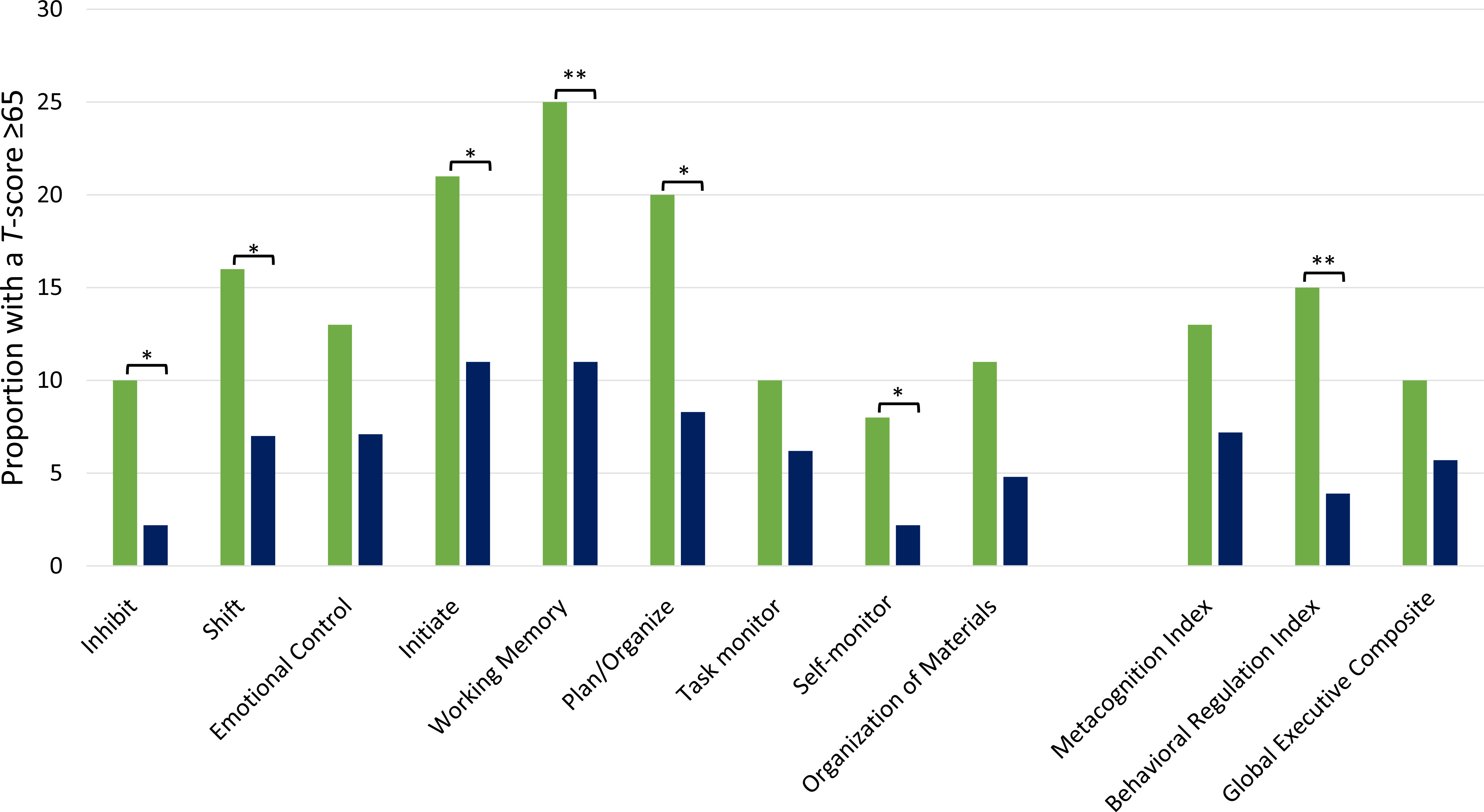
Fig. 2. Proportions with a Behavior Rating Inventory of Executive Function – Adult version sub-scale score or index score above the clinical cut off (T-score ≥65) in the basal cell naevus syndrome group (green bars) compared with the general population of Norway (blue bars) (25). (*) p<0.05. (**) p≤0.001.
Table IV. Median (IQR) T-scores of the Behaviour Rating Inventory of Executive Function – Adult version subscales in adults with basal cell naevus syndrome
| Total (n=61#) |
Male (n=34) |
Female (n=27) |
p-value* | |
|---|---|---|---|---|
| Inhibit | 48 (43–54) | 47 (42–52) | 49 (43–57) | 0.43 |
| Shift | 48 (43–61) | 48 (43–56) | 54 (40–66) | 0.26 |
| Emotional control | 48 (42–59) | 45 (41–54) | 57 (45–64) | 0.01 |
| Initiate | 52 (42–64) | 51 (42–63) | 55 (42–67) | 0.37 |
| Working memory | 53 (43–65) | 52 (40–64) | 59 (43–67) | 0.25 |
| Plan/organize | 52 (44–63) | 51 (43–67) | 56 (45–68) | 0.05 |
| Task monitor | 48 (43–56) | 48 (40–55) | 50 (43–62) | 0.28 |
| Self-monitor | 42 (38–54) | 42 (38–54) | 47 (42–60) | 0.17 |
| Organization of materials | 48 (43–59) | 47 (40–57) | 50 (47–63) | 0.12 |
| Metacognition index | 53 (43–61) | 51 (41–60) | 57 (47–66) | 0.13 |
| Behavioural regulation index | 48 (41–57) | 45 (41–53) | 52 (44–62) | 0.08 |
| Global executive composite index | 50 (43–60) | 49 (40–58) | 55 (44–65) | 0.11 |
|
#Missing = 1. *Comparison of median scores in males and females; p-values calculated by Mann–Whitney U tests. |
||||
Modelling of factors associated with HRQoL, anxiety and executive functioning
The regression models assessing HRQoL demonstrated that engagement in employment or higher education was associated with better physical and mental HRQoL, whereas a HADS anxiety score ≥8 and elevated BRIEF-A GEC Index T-score were associated with poorer mental HRQoL (Supplement 5).
The median BRIEF-A GEC Index T-score was elevated among individuals with self-reported learning difficulties in childhood, those not engaged in employment or higher education, those reporting troublesome social functioning in childhood and those with a HADS anxiety score ≥8 compared with the respective reference groups (Supplement 6).
A HADS anxiety score ≥8 was associated with pain and self-reported troublesome social functioning in childhood (Supplement 7).
No significant associations were observed between the number of BCCs or other clinical features, type of pathogenic PTCH1 variant or type of inheritance and HRQoL, HADS anxiety score ≥8 or the BRIEF-A GEC index T-score (Supplement 5, 6 and 7).
DISCUSSION
This cross-sectional study reveals reduced HRQoL and highlights symptoms of anxiety and self-reported everyday executive deficits in individuals with BCNS.
Individuals with BCNS scored lower on several SF-36 subscales capturing physical and mental domains, as well as the MCS, compared with the general population. However, the wide score ranges indicate that BCNS has a variable impact on HRQoL, consistent with prior research (5, 6). No associations were observed between number of BCCs and HRQoL, which contrasts with a previous study reporting poorer HRQoL among individuals with ≥100 BCCs (6). In our study, most participants were regularly followed by a dermatologist, and the number of BCC at inclusion was low, implying that they were adequately treated. As emotional support has been linked to life satisfaction among adults with rare diseases (26), the absence of reduced HRQoL among those with ≥100 BCCs in our study may reflect the emotional support provided through regular clinical follow-ups. However, important aspects of the disease burden may not have been fully captured, as variables such as facial involvement, scarring and number of surgical procedures were not assessed.
Individuals with BCNS often exhibit characteristic visible features, such as macrocephaly, broad nasal bridge and multiple scars from prior surgeries. Additionally, BCNS is a rare condition, and individuals may never have met others with the condition. They may also encounter physicians with limited knowledge of BCNS. These factors may contribute to feelings of loneliness and anticipation of stigma, both of which may reduce HRQoL (27, 28). However, the study's cross-sectional design does not allow causal conclusions and further studies are warranted.
The HADS is a well-established screening tool for depression and anxiety, with subscale scores ≥8 indicating clinical symptoms and scores≥11 suggesting a probable mood disorder (15, 16). Elevated anxiety symptoms (HADS score ≥8) were more prevalent in the BCNS sample than in the general population of Norway (24% vs 15.5%) (15), consistent with research on other rare diseases and hereditary cancer syndromes (29, 30). Based on patient interviews, Mathias et al. identified concerns about passing the disorder to their children, their appearance, jaw cysts and medical follow-up as key worries in BCNS (31), all of which may have contributed to the elevated anxiety symptoms observed. Further studies are needed to better understand the underlying causes of anxiety in BCNS.
In a recent cross-sectional study of BCNS, 9 of 72 individuals aged ≥18 years, 62 of whom participated in the current study, reported any episode of symptoms of anxiety (4). This discrepancy suggests potential underdiagnosis of anxiety in BCNS. Consistent with another study, pain was associated with anxiety (32).
The pain instrument used measured pain experienced within the past 24 h, and the study was conducted independently of surgical procedures. Our observation of no pain increase implies that individuals with BCNS in general do not experience chronic pain.
The study identified self-reported everyday executive deficits in BCNS. The pattern of BRIEF-A index scores in individuals with BCNS resembled those observed in neurological conditions but differed from patterns observed in neuropsychiatric disorders (33). Self-reported everyday executive deficits, as measured by the GEC Index, were associated with reduced mental HRQoL, a HADS anxiety score ≥8, self-reported learning difficulties, self-reported troublesome social functioning in childhood and disengagement from employment or higher education. These findings imply that individuals with BCNS may experience difficulties across multiple domains of everyday life. The BRIEF-A measures self-reported executive functioning and does not assess objective neuropsychological impairment. Our findings highlight the need for neuropsychological testing to be included in further studies to more comprehensively evaluate executive function in BCNS.
Most participants had a high education level and were engaged in employment or higher education. However, the proportion receiving disability benefits was nearly twice that of the general population (19% vs 10.7%) (34). The BCNS phenotype varies considerably. For individuals with a high disease burden, maintaining full-time employment may be challenging. A relationship was observed between disengagement from employment or higher education and everyday executive deficits, and between everyday executive deficits and self-reported learning difficulties. It may be hypothesized that executive deficits underlie both learning difficulties and challenges in engagement in employment and higher education.
Overall, females tended to report poorer outcomes than males across most instruments. The reasons for these differences remain unclear but are unlikely explained by differences in somatic features, as no gender differences were observed in these variables. Population-based studies have shown that females tend to report lower scores on the SF-36 subscales, higher symptoms of anxiety and greater total and physical fatigue (22, 24, 35). Similar trends may apply to individuals with BCNS. Further research is needed to better understand these gender-related differences.
This study reveals a wide range of mental health issues among individuals with BCNS, several of which were observed associated with HRQoL. However, only a minority of participants had received mental health-care, in contrast to the comprehensive somatic follow-up provided (Fig. 1). Moreover, 18% had received speech therapy, a therapy not traditionally included in BCNS care and thus warranting further investigation. Overall, both somatic and mental health issues varied considerably among individuals, underscoring the need for a personalized, multidisciplinary approach to the BCNS healthcare.
Strengths and limitations
To our knowledge, this is the largest study to assess mental health issues and the first to evaluate executive functioning in BCNS. By using well-established generic instruments, comparisons with data from the general population were possible. However, there are some limitations. Individuals assessed as unable to understand and providing meaningful responses to the questionnaires were excluded, likely omitting those who struggle most with mental health issues. Questionnaires were completed both at home and onsite, and differences in privacy, time available, perceived pressure or assistance from others may have varied between settings. This variability may have introduced measurement bias, as self-reported outcomes can be influenced by the settings under which questionnaires are completed. Further, participants may have responded more positively due to their relationship with the BCNS clinic. Skin-related symptoms were only limitedly assessed in the present study. Further studies should consider including a validated questionnaire like Skindex-29 (36) to better address these aspects. Adjustment for differences in age distribution between the BCNS group and the population data for the BPI, HADS and BRIEF-A was not possible, potentially introducing bias. Many measures were skewed, making medians the most appropriate statistics to report. Nevertheless, comparisons with the general population were based on observed means as reported in reference studies. The proportion of participants with a high education level in the BRIEF-A reference population was higher than that reported by Statistics Norway (37), which may have biased these comparisons. Executive functioning was assessed through self-report. Further studies employing objective neuropsychological testing are needed to more fully evaluate the cognitive aspects in BCNS. Although the study sample was relatively large for a rare disease, the absolute sample size was limited, especially for subgroup analyses and regression models. In addition, numerous exploratory comparisons were performed without correction for multiple testing. These limitations should be considered when interpreting the findings.
Conclusion
A substantial proportion of individuals with BCNS reported anxiety symptoms, everyday executive deficits and reduced HRQoL. We suggest to screen for anxiety and executive functioning to identify individuals at risk and facilitate access to psychological support. Further studies are needed to better understand the relationships between somatic features, mental health and HRQoL in BCNS.
ACKNOWLEDGMENTS
We thank the individuals with BCNS participating in the study, particularly the 2 individuals that gave input to the planning and implementation of the study and interpretation of the results, and all clinicians involved in the multidisciplinary BCNS team at Oslo University Hospital, particularly Anne Undrum at the Resource Centre for Rare Disorders and Ingrid Roscher at the Department of Dermatology.
REFERENCES
- Farndon PA, Del Mastro RG, Evans DG, Kilpatrick MW. Location of gene for Gorlin syndrome. Lancet 1992; 339: 581–582. https://doi.org/10.1016/0140-6736(92)90868-4
- Smith MJ, Beetz C, Williams SG, Bhaskar SS, O’Sullivan J, Anderson B, et al. Germline mutations in SUFU cause Gorlin syndrome-associated childhood medulloblastoma and redefine the risk associated with PTCH1 mutations. J Clin Oncol 2014; 32: 4155–4161. https://doi.org/10.1200/JCO.2014.58.2569
- Verkouteren BJA, Cosgun B, Reinders MGHC, Kessler PAWK, Vermeulen RJ, Klaassens M, et al. A guideline for the clinical management of basal cell naevus syndrome (Gorlin-Goltz syndrome). Br J Dermatol 2022; 186: 215–226. https://doi.org/10.1111/bjd.20700
- Brandtzæg KH, von der Lippe C, Vestengen IK, Holtan JP, Winge MI, Rustad CF, et al. Clinical and genetic findings in 103 individuals in Norway with basal cell naevus syndrome. Br J Dermatol 2026; 194: 264–272. https://doi.org/10.1093/bjd/ljaf413
- Shah M, Mavers M, Bree A, Fosko S, Lents NH. Quality of life and depression assessment in nevoid basal cell carcinoma syndrome. Int J Dermatol 2011; 50: 268–276. https://doi.org/10.1111/j.1365-4632.2010.04658.x
- Huq AJ, Bogwitz M, Gorelik A, Winship IM, White SM, Trainer AH. Cohort study of Gorlin syndrome with emphasis on standardised phenotyping and quality of life assessment. Intern Med J 2017; 47: 664–673. https://doi.org/10.1111/imj.13429
- Alonso N, Cañueto J, Ciria S, Bueno E, Palacios-Alvarez I, Alegre M, et al. Novel clinical and molecular findings in Spanish patients with naevoid basal cell carcinoma syndrome. Br J Dermatol 2018; 178: 198–206. https://doi.org/10.1111/bjd.15835
- Endo M, Fujii K, Sugita K, Saito K, Kohno Y, Miyashita T. Nationwide survey of nevoid basal cell carcinoma syndrome in Japan revealing the low frequency of basal cell carcinoma. Am J Med Genet A 2012; 158A: 351–357. https://doi.org/10.1002/ajmg.a.34421
- Goldstein S, Naglieri JA. Introduction: A history of executive functioning. Handbook of executive functioning. New York, NY: Springer; 2014: 3–12pp.
- Vandenbroucke JP, von Elm E, Altman DG, Gøtzsche PC, Mulrow CD, Pocock SJ, et al. Strengthening the Reporting of Observational Studies in Epidemiology (STROBE): explanation and elaboration. Epidemiology 2007; 18: 805–835. https://doi.org/10.1097/EDE.0b013e3181577511
- Ware JE. SF-36 health survey. In: Manual and interpretation guide. Vol6. The Health Institute; 1993: p. 1–6.
- Ware JE, Keller SD, Kosinski M. SF-36 Physical and mental health summary scales. Boston: Health Assessment Lab; 1994.
- Maruish M. User’s manual for the SF-36v2 Health Survey. Lincoln: Quality Metric Incorporated; 2011: 198p.
- Zigmond AS, Snaith RP. The hospital anxiety and depression scale. Acta Psychiatr Scand 1983; 67: 361–370. https://doi.org/10.1111/j.1600-0447.1983.tb09716.x
- Bjelland I, Lie SA, Dahl AA, Mykletun A, Stordal E, Kraemer HC. A dimensional versus a categorical approach to diagnosis: anxiety and depression in the HUNT 2 study. Int J Methods Psychiatr Res 2009; 18: 128–137. https://doi.org/10.1002/mpr.284
- Wu Y, Levis B, Sun Y, He C, Krishnan A, Neupane D, et al. Accuracy of the Hospital Anxiety and Depression Scale Depression subscale (HADS-D) to screen for major depression: systematic review and individual participant data meta-analysis. BMJ 2021; 373: n972. https://doi.org/10.1136/bmj.n972
- Chalder T, Berelowitz G, Pawlikowska T, Watts L, Wessely S, Wright D, et al. Development of a fatigue scale. J Psychosom Res 1993; 37: 147–153. https://doi.org/10.1016/0022-3999(93)90081-p
- Klepstad P, Loge JH, Borchgrevink PC, Mendoza TR, Cleeland CS, Kaasa S. The Norwegian brief pain inventory questionnaire: translation and validation in cancer pain patients. J Pain Symptom Manage 2002; 24: 517–525. https://doi.org/10.1016/s0885-3924(02)00526-2
- Cleeland CS, Ryan K. The brief pain inventory. User guide. 2009.
- Roth RM, Isquith PK, Gioia GA. Behavior Rating Inventory of Executive Function®--adult version. Arch Clin Neuropsychol 2005. https://doi.org/10.1037/t86244-000
- Roth RM, Isquith PK, Gioia GA. Assessment of executive functioning using the Behavior Rating Inventory of Executive Function (BRIEF). In: Handbook of executive functioning. New York: Springer; 2013. doi: 10.1007/978-1-4614-8106-5_18.
- Garratt AM, Stavem K. Measurement properties and normative data for the Norwegian SF-36: results from a general population survey. Health Qual Life Outcomes 2017; 15: 51. https://doi.org/10.1186/s12955-017-0625-9
- Forskningssenter. HUNT Databank: HUNT Forskningssenter. 2024. Available from: https://hunt-db.medisin.ntnu.no/hunt-db/variablelist
- Loge JH, Ekeberg O, Kaasa S. Fatigue in the general Norwegian population: normative data and associations. J Psychosom Res 1998; 45: 53–65. https://doi.org/10.1016/s0022-3999(97)00291-2
- Buer S, Hagen BI, Søraas A, White RA, Bø R, Ellingjord-Dale M, et al. Executive deficits after SARS-CoV-2 infection: a cross-sectional population study. Brain Behav Immun Health 2024; 41: 100857. https://doi.org/10.1016/j.bbih.2024.100857
- Bryson BA, Bogart KR. Social support, stress, and life satisfaction among adults with rare diseases. Health Psychol 2020; 39: 912–920. https://doi.org/10.1037/hea0000905
- Earnshaw VA, Quinn DM, Park CL. Anticipated stigma and quality of life among people living with chronic illnesses. Chronic Illn 2012; 8: 79–88. https://doi.org/10.1177/1742395311429393
- Nicoloro-SantaBarbara J, Lobel M. Loneliness and its predictors in rare versus common chronic illnesses. Int J Behav Med 2024; 31: 422–432. https://doi.org/10.1007/s12529-023-10231-9
- Uhlenbusch N, Swaydan J, Höller A, Löwe B, Depping MK. Affective and anxiety disorders in patients with different rare chronic diseases: a systematic review and meta-analysis. Psychol Med 2021; 51: 2731–2741. https://doi.org/10.1017/S0033291721003792
- Kastner AM, Fischer-Jacobs J, Brederecke J, Hahne A, Zimmermann T. Distress, anxiety, and depression in persons with hereditary cancer syndromes: Results from a nationwide cross-sectional study in Germany. Cancer Med 2023; 12: 13701–13711. https://doi.org/10.1002/cam4.5999
- Mathias SD, Chren MM, Colwell HH, Yim YM, Reyes C, Chen DM, et al. Assessing health-related quality of life for advanced basal cell carcinoma and basal cell carcinoma nevus syndrome: development of the first disease-specific patient-reported outcome questionnaires. JAMA Dermatol 2014; 150: 169–176. https://doi.org/10.1001/jamadermatol.2013.5870
- Beesdo K, Jacobi F, Hoyer J, Low NCP, Höfler M, Wittchen HU. Pain associated with specific anxiety and depressive disorders in a nationally representative population sample. Soc Psychiatry Psychiatr Epidemiol 2010; 45: 89–104. https://doi.org/10.1007/s00127-009-0045-1
- Løvstad M, Sigurdardottir S, Andersson S, Grane VA, Moberget T, Stubberud J, et al. Behavior Rating Inventory of Executive Function adult version in patients with neurological and neuropsychiatric conditions: symptom levels and relationship to emotional distress. J Int Neuropsychol Soc 2016; 22: 682–694. https://doi.org/10.1017/S135561771600031X
- Statistics Norway. Recipients of disability benefit: Statistics Norway. 2025. [cited 2025 June 24]. Available from: https://www.ssb.no/en/sosiale-forhold-og-kriminalitet/trygd-og-stonad/statistikk/uforetrygdede
- Olssøn I, Mykletun A, Dahl AA. The Hospital Anxiety and Depression Rating Scale: a cross-sectional study of psychometrics and case finding abilities in general practice. BMC Psychiatry 2005; 5: 46. https://doi.org/10.1186/1471-244X-5-46
- Chren MM. The Skindex instruments to measure the effects of skin disease on quality of life. Dermatol Clin 2012; 30: 231–236. https://doi.org/10.1016/j.det.2011.11.003
- Statistics Norway. Statistics on Educational attainment of the population. 2025. [cited 2025 June 11]. Available from: https://www.ssb.no/en/utdanning/utdanningsniva/statistikk/befolkningens-utdanningsniva