ORIGINAL REPORT
Real-world Effectiveness and Safety of Lebrikizumab in Atopic Dermatitis: A TREATgermany Analysis
Barbara KIND1*† , Christina PHAM2†, Luise HEINRICH1, Tatjana HONSTEIN2, Annice HERATIZADEH2, Inken HARDER3, Dora STÖLZL3, Petra STAUBACH-RENZ4, Thomas SCHAEFER5, Susanne ABRAHAM1,6, Matthias AUGUSTIN7, Jutta RAMAKER-BRUNKE8, Andreas PINTER9, Kathrin MEINHARDT10, Sven QUIST11, Sabine ANDERS12, Beate SCHWARZ13, Michael SCHULZ-KIESOW14, Sabine STEINKE15, Nicole ADLER16, Christiane HANDRICK17, Knut SCHAEKEL18, Michael STICHERLING19, Anne BONG20, Felix D. JACOBS21, Bernd GROßMANN22, Maren STAHL23, Carl-Philipp BUERKLE24, Hannah L. GORRIAHN-MAITERTH25, Tilo BIEDERMANN26, Jochen SCHMITT1†, Stephan WEIDINGER3† and Thomas WERFEL2†
1Center for Evidence-Based Healthcare, University Hospital Carl Gustav Carus and Carl Gustav Carus Faculty of Medicine, Technische Universitaet Dresden, Dresden, Germany, 2Department of Dermatology and Allergy, Hannover Medical School, Hannover, Germany, 3Department of Dermatology and Allergy, University Medical Center Schleswig-Holstein, Campus Kiel, Kiel, Germany, 4Clinic for Dermatology, University Hospital, Mainz, Germany, 5Practice Dr. med. Thomas Schaefer and Dr. med. Doreen Belz, Derma Koeln, Cologne, Germany, 6Department of Dermatology, University Allergy Center, Carl Gustav Carus Faculty of Medicine, Technische Universitaet Dresden, Dresden, Germany, 7Institute for Health Services Research in Dermatology Hamburg, University Medical Center Hamburg Eppendorf, Hamburg, Germany, 8Practice 'Die Hautärzte' Braunschweig, Braunschweig, Germany, 9Department of Dermatology, Venereology and Allergology, Clinical Research, University Hospital, Frankfurt am Main, Germany, 10Practice Kathrin Meinhardt, Beckum, Germany, 11Dermatology Clinic, Helix Medical Ecellence Center Mainz, Mainz, Germany, 12Practice Dr. med. Sabine Anders, Munich, Germany, 13Practice Dr. med. Beate Schwarz, Langenau, Germany, 14Practice Dr. med. Michael Schulz-Kiesow and Dr. med. Inken Reimers, Lübeck, Germany, 15Hohenzollernring Dermatology Practice, Münster, Germany, 16Hautärzte am Fastnachtsbrunnen, FÄ Nicole Adler, Mainz, Germany, 17Practice Dr. med. Christiane Handrick, Berlin, Germany, 18Department of Dermatology, University Hospital, Heidelberg, Germany, 19Department of Dermatology, University, German Center for Immunotherapy, Erlangen, Germany, 20Practice Dr. med. Anne Bong, Emmerich, Germany, 21Practice DERMAKULM, Kulmbach, Germany, 22Practice Dr. med. Bernd Großmann, Koblenz, Germany, 23Stahl, M., Practice Dr. med. Maren Stahl, Osterode, Germany, 24Skin and laser medicine Kinzigtal, Practice Dr. med. Bürkle, Haslach, Germany, 25Practice Dermasana, Karlsruhe, Germany, and 26Department of Dermatology and Allergy, School of Medicine, Technical University of Munich, Munich, Germany.
†These authors contributed equally to this work as co-first authors.
†These authors share senior authorship.
Corr: Barbara Kind, Center for Evidence-Based Healthcare, University Hospital Carl Gustav Carus and Carl Gustav Carus Faculty of Medicine, Technische Universitaet Dresden, Dresden, Germany. Email: barbara.kind@ukdd.de
Key words: atopic dermatitis; lebrikizumab; daily practice; HOME Core Outcome Set; TREATgermany; biologics; quality of life.
Citation: Acta Derm Venereol 2026; 106: adv-2026-0542. DOI: https://doi.org/10.2340/actadv.v106.adv-2026-0542.
Copyright: © The Authors 2026. Published by MJS Publishing, on behalf of the Society for Publication of Acta Dermato-Venereologica. This is an Open Access article distributed under the terms of the Creative Commons Attribution-NonCommercial 4.0 International License (https://creativecommons.org/licenses/by-nc/4.0/).
Submitted: Mar 26, 2026. Accepted after revision: Jun 29, 2026.
Published: Aug 13, 2026.
Competing interests and funding: TREATgermany is an academic, investigator-initiated clinical disease registry that is financially supported by AbbVie Deutschland GmbH & Co. KG, Almirall Hermal GmbH, Galderma S.A., LEO Pharma GmbH, and Sanofi.
The data that support the findings of this study are available from the TREATgermany head office upon reasonable request.
The medical faculty of the Technical University Dresden, Germany has granted approval for the registry (registration number EK 118032016).
CP has received travel grants from Almirall, Galderma, Lilly and LEO Pharma. AH has received institutional research grants from Beiersdorf, has lectured at educational events sponsored by AbbVie, ALK, LEO Pharma, Novartis, Pierre Fabre, Lilly, Sanofi, Beiersdorf and Almirall, has participated in advisory boards for AbbVie, Almirall, LEO Pharma, Klinge Pharma and Sanofi and received travel grants from Janssen, Pfizer and AbbVie. MA has served as a consultant, lecturer, researcher, and/or has received research grants from AbbVie, Almirall, Beiersdorf, Eli Lilly, Galderma, LEO and Sanofi-Genzyme. SA has received lecture and/or consultancy fees from AbbVie, Almirall, Amgen, Biocryst, BMS, Beiersdorf, Galderma, Janssen, LEO Pharma, Lilly, Novartis, Pfizer, Sanofi, Takeda and UCB and received travel grants from AbbVie, Pfizer, BioCryst and UCB research grants from Almirall and BMS. JM reports institutional grants for investigator-initiated research from the German GBA, BMG, BMBF, EU, Federal State of Saxony, Novartis, Sanofi, ALK, and Pfizer. He also participates or participated in advisory board meetings as a paid consultant for Sanofi, Lilly, and ALK. SW has received institutional research grants from LEO Pharma, Pfizer Inc., and Sanofi; has performed consultancies for AbbVie, Almirall, Apogee, Astria, Boehringer Ingelheim, Eli Lilly and Company, Galderma, LEO Pharma, Pfizer Inc., Regeneron Pharmaceuticals, Sanofi, UCB; has lectured at educational events sponsored by AbbVie, Almirall, Galderma, LEO Pharma, Pfizer Inc., Regeneron Pharmaceuticals and Sanofi; and is involved in performing clinical trials with many pharmaceutical companies that manufacture drugs used for the treatment of inflammatory skin diseases. TW has received honouraria for lectures or scientific advice on atopic dermatitis from AbbVie, Almirall, Galderma, Janssen/JNJ, LEO Pharma, Leti, Lilly, Novartis, Pfizer and Regeneron/Sanofi. BS has received honouraria for lectures or scientific advice on atopic dermatitis from AbbVie, Allmiral, Amgen, Aptivsolutions, Biogen, BMS, Dermapharm, Galderma, Incyte, Janssen, Leo Pharma, Lilly Pharma, Novartis, Pfizer and Regeneron/Sanofi. All other coauthors declared no conflict of interest.
Atopic dermatitis (AD) is driven by type 2 inflammation, with interleukin-13 (IL-13) as one of the central operators. Lebrikizumab is a monoclonal antibody that inhibits IL-13 signalling. Adult patients with moderate-to-severe AD who received lebrikizumab in the TREATgermany registry until 12/2024 were selected, and patient characteristics as well as effectiveness and safety outcomes after 1, 3 and 6 months were evaluated. A total of 108 patients were initiated on lebrikizumab, with 80 having follow-up data available for this analysis (“registry cohort”). Forty-one patients were switched to lebrikizumab without a “washout period” from another advanced systemic therapy (“switchers”). The mean Eczema Area and Severity Index (EASI) decreased from 14.8 at baseline to 5.6 and 3.0 at month 3 and month 6 and was comparable between switchers and nonswitchers. Clinically meaningful improvements were also seen across all patient reported outcomes (PROs) equally in both groups, e.g. a decrease of the mean peak pruritus numeric rating scale (PP-NRS) from 6.6 to 3.8 and 3.4 and the Dermatology Life Quality Index (DLQI) from 11.9 to 4.9 and 4.8. Overall, adverse events (AEs) were reported for 26.6% of patients within the first 3. The most frequently reported AE was conjunctivitis or other ocular complications, reported in 13 patients (20.3%). 32 patients (40%) had an initial EASI≥16 and were comparable to patients in lebrikizumab phase 3 studies. In this “trial-like” cohort, EASI-75 and EASI-90 response rates were 60% and 26.7% at month 3 and 70% and 50% at month 6. Lebrikizumab shows effectiveness in routine care well comparable to observations made in randomized controlled trials.
SIGNIFICANCE
Atopic dermatitis is a long-term skin condition linked to immune-system activity and itching. This real-world study followed 80 adults with moderate-to-severe disease treated with lebrikizumab, including patients who switched directly from another systemic treatment. After six months, skin symptoms improved substantially: average severity score (Eczema Area and Severity Index, EASI) fell from 14.8 to 3.0, while itching and quality-of-life scores also decreased. By month six, 70% achieved at least 75% improvement in skin symptoms, and 50% achieved at least 90% improvement. Side effects occurred in 26.6% of the cases, most commonly eye problems. Overall, results matched clinical trials, supporting lebrikizumab’s effectiveness in routine care for adults with difficult-to-treat disease.
INTRODUCTION
Atopic dermatitis (AD) is a chronic, inflammatory skin disease characterized by intense itch and chronic or recurrent eczematous lesions. AD poses a remarkable burden on both patients and healthcare systems and often leads to reduction in quality of life and productivity (1, 2, 3, 4). Its pathobiology is complex, but type 2 inflammation and in particular interleukin-13 (IL-13) and interleukin-4 (IL-4) are considered key drivers (5, 6). In recent years, the approval of innovative, targeted systemic therapies has greatly expanded the available therapeutic options (7, 8, 9, 10, 11, 12, 13, 14, 15). However, data from registries and health insurance records indicate that a considerable proportion of patients continue to suffer from suboptimal disease control and impaired quality of life, highlighting persistent gaps in care and the need for further innovation and more individualized therapeutic approaches (16). Lebrikizumab, a high-affinity monoclonal antibody targeting interleukin-13, represents one of the most recent biologic options for the systemic treatment of moderate-to-severe AD. Randomized controlled trials (RCTs) and extension studies, together with several network meta-analyses (17, 18), demonstrated robust efficacy. With mean EASI reductions of up to 65% and EASI-75 response rates of approximately 60% as well as clinically relevant itch improvement in around 40% of patients at week 16 on monotherapy (19), responses increase with concomitant TCS and longer-term therapy (20, 21). As experience from daily practice with lebrikizumab continues to grow, its precise role within the expanding therapeutic landscape for AD will continue to be defined. Here, we set out to investigate the treatment pattern, clinical effectiveness and safety of lebrikizumab under routine care conditions.
METHODS
Study design and setting
TREATgermany is a registry for patients with moderate-to-severe AD receiving or eligible for systemic treatment. Details on the study design were published previously (16, 22, 23, 24, 25). Currently >2,500 adult patients are followed-up prospectively. The medical faculty of the Technical University Dresden, Germany has granted approval for the registry (registration number EK 118032016). Moreover, all ethics committees at the participating sites have given their approval. The registry has been registered at clinicaltrials.gov (NCT03057860) and in the ENCePP Resource Database.
Case selection
For the current analysis, all adult patients initiated on lebrikizumab during registry observation until December 2024 were selected. Patients were restricted to those initiating lebrikizumab between 2 weeks before to 4 weeks after the registry visit. For analysis of effectiveness, patients with data available from at least one follow-up visit were used (registry cohort). To contextualize effectiveness outcomes relative to regulatory trials, an exploratory sensitivity analysis was performed in patients fulfilling key disease severity criteria of the pivotal lebrikizumab trials (baseline EASI≥16) (trial-like cohort). An additional analysis of patients on lebrikizumab for 1 month (4±2 weeks), 3 months (13±2 weeks) and 6 months of therapy (26±4 weeks) was carried out for the patients with a visit under therapy in the respective time frame – regardless of number of FUVs (see Figs. 1 and 2). Patients who were receiving another systemic therapy at the time of lebrikizumab initiation (less than 4 weeks from lebrikizumab initiation) were considered to have undergone a therapy switch.
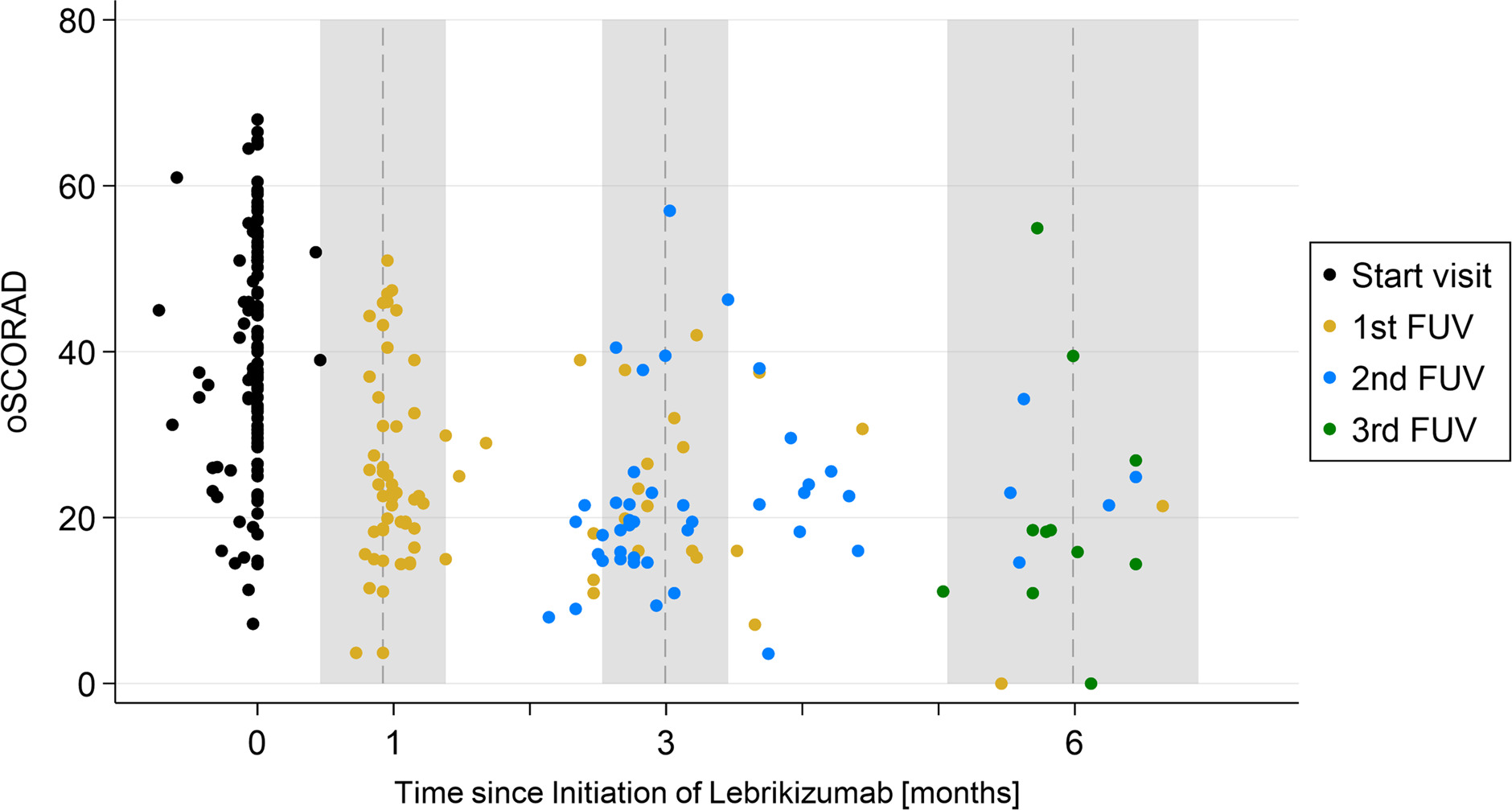
Fig. 1. Effectiveness of lebrikizumab treatment represented by oSCORAD over time in TREATgermany and definition of time frames. Patients with a defined start visit for lebrikizumab (n=108, black dots) are shown. Since the initiation of therapy does not have to have taken place exactly at the time of the visit, the black dots scatter around the origin. 80 of these patients had at least one follow-up visit (FUV) on lebrikizumab (n=80, yellow dots). To facilitate comparison with lebrikizumab approval studies 3 time frames were defined in addition: after 1 month (4 (±2) weeks, n=55), 3 months (13 (±2) weeks, n=36) and after 6 months (26 (±4) weeks, n=17) of therapy (grey areas).

Fig. 2. Flow chart of the study cohort.
Outcomes
Physicians-reported outcomes included investigator global assessment (IGA, 6-point-scale), Eczema area and severity index (EASI; 0–72 points) and objective Scoring AD (oSCORAD; 0–83 points) (26, 27, 28, 29). Apart from demographics and disease history the following Patient-Reported Outcomes (PROs) were assessed: patient global assessment (PGA, 6-point-scale), Patient Oriented Eczema Measure (POEM; 0–28 points) (30), Recap of atopic eczema (RECAP; 0–28 points) (31), body surface area affected (BSA; 0–100%), peak pruritus (PP) in the past 24 h, average pruritus, sleep loss and pain in the past 3 days (10-point numeric rating scale (NRS)), Dermatology Life Quality Index (DLQI; 0–30 points) (32), Centre for Epidemiologic Studies Depression Scale (CES-D; 0–60 points) and Fatigue Severity Scale (FSS, 1–7 points) (33, 34). The number of well-controlled (i.e. causing only minor symptoms) and completely controlled (i.e. causing no symptoms) weeks within the past 12 weeks was assessed by patient self-report. Physician and patient satisfaction with the treatment were also assessed.
Safety
Adverse events (AEs) were recorded at each visit, and their severity was assessed by the physician. Patients with at least 3 months of follow-up after initiation were included, i.e. there had to be at least one follow-up visit after 3 months or later after initiation, irrespective of whether the treatment was ongoing or had been discontinued. All AEs occurring within the first 3 months of therapy were considered.
Statistical analysis
Endpoints were analyzed descriptively using all observed data. Statistical analysis was performed using Stata 15 and R software (35). Statistical significance was assessed using Fisher exact test.
RESULTS
Patient characteristics
As of December 2024, data from 108 TREATgermany patients initiated on lebrikizumab with follow-up data on 80 patients were available (“registry cohort”). The mean age at treatment initiation was 42.2 years, and 43.5% of the patients were females. Comorbid allergic rhinitis and asthma were prevalent in 66.0% and 40.4% of the patients, respectively. These rates were comparable to those observed in the overall TREATgermany population, as were rates of other comorbidities (Table I).
Table I. Characteristics of all TREATgermany patients, as compared to both the lebrikizumab cohort with a start visit on lebrikizumab and the study cohort with at least one follow-up visit on lebrikizumab. The table displays information regarding study site, age, body mass index (BMI), sex, socioeconomic factors and relevant comorbidities assessed at registry inclusion. Discrepancies in totals are due to missing data
| Baseline characteristic | Lebrikizumab start in the registry | Lebrikizumab start in registry and 1. FUV | TREATgermany |
|---|---|---|---|
| Number of patients | N=108 | N=80 | N=2,369 |
| Study site | |||
| Clinic | 64 (59.3%) | 52 (65.0%) | 1,437 (60.7%) |
| Practice | 44 (40.7%) | 28 (35.0%) | 932 (39.3%) |
| Age, mean±SD (N) | 40.9±14.8 | 40.9±14.9 | 39.9±15.0 |
| Age at start visit, mean±SD (N) | 42.2±15.3 | 42.2±15.3 | - |
| BMI, mean±SD (N) | 26.7±4.4 | 26.9±4.6 | 25.9±5.2 |
| Sex | |||
| Male | 61 (56.5%) | 44 (55.0%) | 1,271 (53.7%) |
| Female | 47 (43.5%) | 36 (45.0%) | 1,096 (46.3%) |
| Divers | - | - | 2 (0.1%) |
| Education | |||
| Without graduation | 0 (0.0%) | 0 (0.0%) | 22 (1.0%) |
| Certificate of secondary education | 6 (5.7%) | 5 (6.3%) | 272 (11.8%) |
| General certificate of secondary education | 35 (33.0%) | 28 (35.4%) | 765 (33.1%) |
| General qualification for university entrance | 28 (26.4%) | 20 (25.3%) | 658 (28.5%) |
| Graduate degree | 37 (34.9%) | 26 (32.9%) | 594 (25.7%) |
| Age of onset | |||
| Since infancy | 55 (51.9%) | 43 (54.4%) | 1,288 (55.8%) |
| Since preschool | 25 (23.6%) | 18 (22.8%) | 353 (15.3%) |
| Since adolescence | 13 (12.3%) | 8 (10.1%) | 293 (12.7%) |
| Since adulthood | 11 (10.4%) | 9 (11.4%) | 345 (14.9%) |
| Unknown | 2 (1.9%) | 1 (1.3%) | 30 (1.3%) |
| Smoking status | |||
| Smoker | 23 (21.7%) | 18 (22.8%) | 580 (25.1%) |
| Ex-smoker (<10 years without smoking) | 12 (11.3%) | 9 (11.4%) | 313 (13.5%) |
| Ex-smoker (≥10 years without smoking) | 13 (12.3%) | 7 (8.9%) | 239 (10.3%) |
| Never smoked | 58 (54.7%) | 45 (57.0%) | 1,181 (51.1%) |
| Allergic comorbidity | |||
| Rhinitis | 66 (66.0%) | 52 (67.5%) | 1,368 (60.9%) |
| Asthma | 40 (40.4%) | 33 (44.6%) | 953 (41.8%) |
| Nonallergic comorbidities present | |||
| Hypertension | 12 (11.3%) | 11 (13.9%) | 376 (16.2%) |
| Cardiac insufficiency | 1 (0.9%) | 1 (1.3%) | 18 (0.8%) |
| Condition after myocardial infarction | 2 (1.9%) | 1 (1.3%) | 18 (0.9%) |
| Condition after stroke | 0 (0.0%) | 0 (0.0%) | 10 (0.5%) |
| Diabetes type I | 1 (0.9%) | 1 (1.3%) | 7 (0.3%) |
| Diabetes type II | 1 (0.9%) | 1 (1.3%) | 64 (2.7%) |
| Morbus Crohn/Colitis ulcerosa | 2 (1.9%) | 2 (2.5%) | 29 (1.2%) |
| Renal insufficiency | 0 (0.0%) | 0 (0.0%) | 22 (0.9%) |
| Rheumatoid arthritis | 0 (0.0%) | 0 (0.0%) | 7 (0.3%) |
| Depression | 10 (9.5%) | 10 (12.8%) | 225 (9.8%) |
| Alopecia areata (inquired about since 2021) | 1 (1.1%) | 1 (1.4%) | 25 (2.1%) |
| Cancer in the past | 1 (1.0%) | 1 (1.3%) | 41 (1.9%) |
| Serious infections | 2 (1.9%) | 2 (2.6%) | 35 (1.7%) |
Out of the study cohort, 54 (50%) patients who initiated lebrikizumab had no systemic treatment for at least 4 weeks prior initiation of lebrikizumab (“nonswitcher”), and 54 (50%) patients were transitioned directly from a previous systemic therapy (“switcher”, Table SI); 25 (23.1%) patients in the “nonswitcher” group had no systemic therapy ever (any); 29 (53.7%) of the nonswitchers were treated in practices, while the majority of “switchers” (39; 72.2%) were patients in clinics. Demographics were comparable between these groups. Asthma was significantly more frequent in switchers (29; 55.8%) as compared to nonswitchers (11; 23.4%; p=0.001), suggesting a higher burden of respiratory comorbidity in previously treated patients. In contrast, the prevalence of allergic rhinitis was nearly identical in both groups (34 [66.7%] in switchers vs 32 [65.3%] in nonswitchers). Depression was more frequently reported among switchers (7; 13.2%) than in nonswitchers (3; 5.8%), although this difference was not significant (p=0.194).
Out of the study cohort of n=80, 32 (29.6%) patients had a baseline EASI score ≥16 and were analyzed as a severity-based subgroup to enable contextualization with lebrikizumab phase 3 studies (19). This subgroup was slightly older and included a higher proportion of male patients than the overall TREATgermany cohort, while other demographic characteristics were broadly comparable (Table SIV).
Physician-reported outcomes
Key physician and patient reported outcomes of the 80 patients of the registry cohort with at least one follow-up visit under lebrikizumab are summarized in Tables II and III. At lebrikizumab initiation, most patients presented moderate to very severe clinical signs (IGA 3–4 : 82.5%, IGA 5 : 5%, mean oSCORAD 39.0±14.4 (severe) and mean EASI 14.8±11.2 (moderate)). Physician satisfaction with the current disease treatment was low (with mean 4.1 on a 0 to 10 NRS), indicating an unmet clinical need before lebrikizumab initiation. After 3 months of therapy, no patients had IGA>3, and only 30.6% still had IGA 3. The mean EASI had decreased from 14.8 to 5.6; with 48.6%, 37.1% and 20.0% of patients achieving EASI-50, EASI-75 and EASI-90, respectively, and the mean oSCORAD had decreased from 39.0 to 23.8. Physician satisfaction with treatment improved from 4.1 to 7.3, representing a substantial positive change in satisfaction.
Table II. Disease severity at start visit, first follow-up visit and follow-up visits after 1 month, 3 months and 6 months as assessed by the physicians
| Lebrikizumab start visit with follow-up | 1.Follow-up visit | Time frames | |||
|---|---|---|---|---|---|
| Follow-up visit at 1 month | Follow-up visit at 3 months | Follow-up visit at 6 months | |||
| Number of patients | N=80 | N=80 | N=55 | N=36 | N=17 |
| IGA - categories | |||||
| clear=0 | 0 (0.0%) | 1 (1.3%) | 0 (0.0%) | 0 (0.0%) | 2 (11.8%) |
| almost clear=1 | 3 (3.8%) | 11 (13.9%) | 6 (11.1%) | 6 (16.7%) | 5 (29.4%) |
| mild=2 | 7 (8.8%) | 35 (44.3%) | 24 (44.4%) | 19 (52.8%) | 4 (23.5%) |
| moderate=3 | 45 (56.3%) | 29 (36.7%) | 22 (40.7%) | 11 (30.6%) | 5 (29.4%) |
| severe=4 | 21 (26.3%) | 3 (3.8%) | 2 (3.7%) | 0 (0.0%) | 1 (5.9%) |
| very severe=5 | 4 (5.0%) | 0 (0.0%) | 0 (0.0%) | 0 (0.0%) | 0 (0.0%) |
| oSCORAD | 39.0±14.4 | 24.8±11.4 | 25.8±11.8 | 23.8±10.9 | 21.0±13.3 |
| oSCORAD - categories | |||||
| clear=0–8 | 1 (1.3%) | 4 (5.1%) | 2 (3.7%) | 0 (0.0%) | 2 (11.8%) |
| mild=8–24 | 11 (13.8%) | 40 (50.6%) | 28 (51.9%) | 25 (69.4%) | 10 (58.8%) |
| moderate=24–38 | 30 (37.5%) | 22 (27.8%) | 13 (24.1%) | 6 (16.7%) | 3 (17.6%) |
| severe=38–83 | 38 (47.5%) | 13 (16.5%) | 11 (20.4%) | 5 (13.9%) | 2 (11.8%) |
| EASI | 14.8±11.2 | 6.6±6.2 | 7.1±6.6 | 5.6±6.0 | 3.0±3.0 |
| EASI - categories | |||||
| clear=0 | 0 (0.0%) | 1 (1.3%) | 0 (0.0%) | 0 (0.0%) | 2 (13.3%) |
| mild=0–6 | 22 (27.5%) | 49 (64.5%) | 33 (62.3%) | 26 (74.3%) | 10 (66.7%) |
| moderate=6–23 | 41 (51.2%) | 24 (31.6%) | 18 (34.0%) | 8 (22.9%) | 3 (20.0%) |
| severe=23–72 | 17 (21.3%) | 2 (2.6%) | 2 (3.8%) | 1 (2.9%) | 0 (0.0%) |
| EASI≤7 | 26 (32.5%) | 52 (68.4%) | 34 (64.2%) | 26 (74.3%) | 13 (86.7%) |
| EASI subscales | |||||
| EASI head and neck | 1.9±1.5 | 1.1±1.0 | 1.2±1.0 | 0.8±0.6 | 0.6±0.5 |
| EASI trunk | 4.2±3.9 | 1.6±1.9 | 1.8±2.2 | 1.6±2.2 | 0.8±1.3 |
| EASI arms | 3.5±2.7 | 1.7±1.5 | 1.8±1.6 | 1.4±1.4 | 0.9±1.2 |
| EASI legs | 5.1±5.5 | 2.2±3.6 | 2.4±3.6 | 1.8±3.6 | 0.7±1.5 |
| EASI response rates | |||||
| EASI-50 | - | 40 (52.6%) | 25 (47.2%) | 17 (48.6%) | 13 (86.7%) |
| EASI-75 | - | 21 (27.6%) | 11 (20.8%) | 13 (37.1%) | 10 (66.7%) |
| EASI-90 | - | 6 (7.9%) | 3 (5.7%) | 7 (20.0%) | 7 (46.7%) |
| EASI-100 | - | 1 (1.3%) | 0 (0.0%) | 0 (0.0%) | 2 (13.3%) |
| Physicians’ satisfaction with treatment | 4.1±2.7 | 7.4±2.2 | 7.4±2.4 | 7.3±2.3 | 7.7±2.2 |
Table III. Disease severity at start visit, first follow-up visit and follow-up visits after 1 month, 3 months and 6 months as assessed by the patients
| Lebrikizumab start visit with follow-up | 1.Follow-up visit | Time frames | |||
|---|---|---|---|---|---|
| Follow-up visit at 1 month | Follow-up visit at 3 months | Follow-up visit at 6 months | |||
| Number of patients | N=80 | N=80 | N=55 | N=36 | N=17 |
| PGA - categories | |||||
| clear=0 | 0 (0.0%) | 0 (0.0%) | 0 (0.0%) | 0 (0.0%) | 1 (6.3%) |
| almost clear=1 | 5 (6.4%) | 17 (23.6%) | 12 (24.0%) | 6 (16.7%) | 4 (25.0%) |
| mild=2 | 12 (15.4%) | 27 (37.5%) | 16 (32.0%) | 20 (55.6%) | 7 (43.8%) |
| moderate=3 | 28 (35.9%) | 20 (27.8%) | 15 (30.0%) | 8 (22.2%) | 4 (25.0%) |
| severe=4 | 25 (32.1%) | 7 (9.7%) | 6 (12.0%) | 1 (2.8%) | 0 (0.0%) |
| very severe=5 | 8 (10.3%) | 1 (1.4%) | 1 (2.0%) | 1 (2.8%) | 0 (0.0%) |
| DLQI | 11.9±7.3 | 6.1±5.5 | 6.5±6.0 | 4.9±4.8 | 4.8±4.6 |
| POEM | 17.1±7.5 | 10.4±6.3 | 10.6±6.7 | 10.1±6.2 | 9.1±7.5 |
| Fatigue (FSS) | 3.9±1.8 | 3.4±1.8 | 3.3±1.8 | 3.1±1.6 | 2.9±1.8 |
| CES-D | 17.6±10.5 | 14.0±9.6 | 10.0±5.5 | 12.0±9.8 | 13.5±12.3 |
| RECAP | 16.3±6.8 | 10.1±6.5 | 10.4±7.1 | 9.0±5.3 | 8.5±6.9 |
| Good controlled weeks (last 12 weeks) | 3.3±3.4 | 6.4±3.5 | 3.1±1.7 | 7.6±3.5 | 8.8±3.3 |
| Completely controlled weeks (last 12 weeks) | 1.5±2.8 | 3.3±3.7 | 2.0±1.9 | 4.6±4.1 | 6.7±4.7 |
| Skin pain last 3 days | 4.3±3.0 | 2.5±2.5 | 2.5±2.6 | 2.3±2.4 | 2.0±2.0 |
| Pruritus last 3 days | 6.6±2.4 | 4.1±2.4 | 4.0±2.4 | 4.0±2.3 | 3.7±2.3 |
| Sleep loss last 3 days | 5.0±3.5 | 2.7±3.0 | 2.9±3.2 | 1.9±2.3 | 2.3±3.0 |
| Peak pruritus last 24 h | 6.6±2.9 | 3.9±2.4 | 3.9±2.5 | 3.8±2.6 | 3.4±2.5 |
| BSA | 30.3±31.7 | 15.4±23.7 | 18.3±27.0 | 8.7±17.0 | 4.1±2.8 |
| Patients’ satisfaction with medical treatment | 4.8±3.0 | 7.9±2.2 | 8.7±1.0 | 7.7±1.8 | 7.9±2.1 |
| Patients’ satisfaction with medical care | 7.0±3.0 | 8.6±1.4 | 9.3±0.8 | 8.4±1.9 | 8.7±1.7 |
To account for a potential influence of recent prior systemic therapies, outcomes were compared between non-switcher patients (n=39) and switchers (n=41; Fig. 2). Although baseline disease severity was notably higher in nonswitchers (Table SII), both subgroups reached comparably low absolute EASI and oSCORAD scores over the treatment course (7.9±7.5 and 25.9±10.8 (nonswitcher) vs 4.0±4.3 and 22.4±11.1 (switcher) at month 3; and 3.4±2.7 and 18.2±10.4 (nonswitcher) vs 2.8±3.4 and 23.0±15.3 (switcher) at month 6 (Fig. 3).

Fig. 3. Boxplots of EASI scores at therapy start and at 3, 6 and 12 months. Shown are all patients with a defined start visit for lebrikizumab and at least one follow-up visit on lebrikizumab (n=80). Data are stratified into therapy-experienced patients (switchers, nstart=41, n1month=29, n3months=22, n6months=10) and patients without prior systemic therapy exposure after an appropriate washout period (nonswitchers, nstart=39, n1month=26, n3months=14, n6months=7).
Details on the trial-like cohort are summarized in Table SV and SVI (36). At initiation, mean EASI and oSCORAD scores were 25.9±8.6 and 50.1±10.8. At month 3, the mean EASI had decreased to 6.4, with 80.0%, 60.0% and 26.7% of patients achieving EASI-50, EASI-75 and EASI-90, respectively. At month 6, the observed improvements were further enhanced: 36.4% of the trial-like cohort had achieved an IGA of 0 or 1. The mean EASI had further decreased to 3.8. EASI-50, EASI-75 and EASI-90 in the trial-like-cohort were 100%, 70.0% and 50.0%. Physicians' satisfaction with treatment had increased from initially 3.0 to 7.7 after 6 months, supporting sustained clinical effectiveness of lebrikizumab.
Patient-reported outcomes
At treatment initiation, patients starting lebrikizumab therapy reported moderate impairments across various PROs. According to the PGA, 42.3% of patients rated their AD as severe or very severe. This proportion decreased substantially to 5.6% in 3 months and 0% in 6 months. The DLQI demonstrated clear reductions from initially 11.9 (very large effect on patient’s life) to 4.9 after 3 months and 4.8 after 6 months (small effect on patient’s life). This represents a 58.8% reduction of the impact of AD on patient’s daily life, emotional well-being, and social functioning already after 3 months of lebrikizumab therapy.
Other PROs, such as the POEM and RECAP score, confirmed substantial improvement under lebrikizumab. The mean POEM score decreased from 17.1 at baseline to 10.1 after 3 months and 9.1 after 6 months, indicating a meaningful improvement of disease burden. Similarly, the RECAP score improved from 16.3 to 9.0 and 8.5 after 3 and 6 months respectively, reflecting enhanced patient-received disease control. The number of well-controlled and completely controlled weeks within the past 12 weeks more than doubled over the treatment period, supporting sustained improvement in symptom burden and quality of life.
Patients reported substantial and sustained improvements in itch, pain and sleep quality during lebrikizumab therapy, accompanied by reduced fatigue and depressive symptoms and high satisfaction with treatment (Table III).
Analysis of perception of lebrikizumab therapy in nonswitchers vs switchers
At treatment initiation, nonswitchers reported slightly higher disease burden across several PROs, consistent with their higher baseline disease activity. Both groups improved substantially over time, although direct comparisons are limited by baseline imbalances and small subgroup sizes. Over the treatment course, both groups improved in all major PROs, including DLQI, POEM, RECAP and PP-NRS. These exploratory findings suggest that clinical improvement under lebrikizumab can also be observed in patients previously exposed to systemic therapies (Table SIII).
Safety
Of the 108 patients who initiated lebrikizumab therapy, follow-up data were available for 83 patients (including 3 patients without lebrikizumab at the follow-up visit, see data flow diagram Fig. 2), with≥3 months follow-up data available from 64 patients. Within this subgroup, at least one adverse event (AE) was reported in 17 patients (26.6%). The most frequently documented AE was conjunctivitis or other ocular complications, reported in 13 patients (20.3%). In 5 of these patients conjunctivitis had been reported with previous dupilumab treatment. Of the remaining 8 patients, 5 had previously received dupilumab without developing conjunctivitis or ocular symptoms, and 3 patients were naïve for advanced systemic therapies. Less frequently reported AEs include 2 cases of upper respiratory tract infections and individual cases of fatigue, worsening of known asthma, flush, exanthema, acne, weight gain, worsening of itch, herpes simplex and depressive symptoms. All reported AEs were mild to moderate in severity. No severe or life-threatening events due to AEs were observed. Discontinuation of lebrikizumab due to AE within the 3 months was rare and only reported in 1 patient.
DISCUSSION
In this interim analysis of the TREATgermany registry, lebrikizumab demonstrated clinically meaningful effectiveness and acceptable safety in adults with moderate-to-severe AD treated under routine care conditions. Most patients showed rapid and sustained improvements in physician-reported outcomes, with mean EASI scores decreasing from moderate baseline levels to the mild range by month 3 and further by month 6. Patient-reported outcomes, including pruritus, sleep and quality of life, improved in parallel, and treating physicians reported marked gains in treatment satisfaction. These findings support lebrikizumab as an effective option for patients with moderate-to-severe disease in everyday clinical practice.
When we restricted the analysis to a “trial-like” subgroup (EASI≥16) with baseline AD severity comparable to those in pivotal phase 3 trials, clinical responses were in a similar range to the results reported from randomized controlled studies. In those trials, lebrikizumab monotherapy or in combination with topical corticosteroids achieved mean EASI reductions of around 60–65% and EASI-75 response rates of approximately 60% after 16 weeks, with further gains during longer-term treatment (19, 20, 36, 37, 38). In our trial-like cohort, EASI-75 and EASI-90 responses by month 3 and month 6 broadly mirrored these figures, indicating that the efficacy observed in controlled settings translates well into routine care. However, this analysis was intended as a descriptive contextualization rather than a direct comparison with clinical trials, given the differing inclusion criteria, follow-up procedures and concomitant treatment approaches between registry and regulatory trial settings. Network meta-analyses have placed lebrikizumab among the more efficacious targeted therapies for atopic dermatitis, and our data are consistent with that, suggesting that selective IL-13 inhibition is a meaningful therapeutic approach (18).
An important aspect of our analysis is the comparison between patients who switched “directly” (without true washout) from another systemic treatment to those who initiated lebrikizumab without recent systemic therapy (“nonswitchers”). Switchers more frequently had asthma and tended to be managed in clinics, indicating a more complex, pretreated population. Despite these differences, both groups achieved similarly low absolute EASI and oSCORAD scores over time. Patient-reported outcomes improved to a similar extent in both groups. However, these exploratory subgroup findings should be interpreted cautiously given the baseline imbalances and limited sample size, and no conclusions regarding comparative effectiveness can be drawn. For clinicians, this supports the use of lebrikizumab also as a reasonable option after insufficient response or tolerability issues with other systemic agents. The conjunctivitis rate observed in our cohort was numerically higher than reported in pivotal trials. This may partly reflect the inclusion of patients previously treated with dupilumab, including individuals with prior dupilumab-associated ocular complications. However, several patients who had developed conjunctivitis with dupilumab also reported ocular problems with lebrikizumab, re-inforcing the broadly similar safety profile of these 2 biologics. Overall, the safety profile observed broadly with data from clinical trials, with no new safety signals identified, and conjunctivitis or other ocular complications being the most frequent side-effect reported in approximately one fifth of patients, including both such recurrent cases as well as de novo cases. Other adverse events were infrequent and mostly mild or moderate, and treatment discontinuations due to safety reasons were rare. Overall, these observations support the conclusion that lebrikizumab has a manageable safety and tolerability profile in daily practice.
This study has limitations inherent to observational registry research and the short time lebrikizumab has yet been available in routine care. Due to the recent approval of lebrikizumab in Germany, follow-up duration was still limited, resulting in smaller patient numbers at later timepoints, particularly at 6 months. Therefore, long-term effectiveness estimates should be interpreted cautiously, as patients with ongoing treatment and available follow-up may represent a selected subgroup. The sample size, particularly in subgroup and sensitivity analyses, was modest and follow-up was limited to a maximum of 6 months in this interim analysis. There was no control group, and treatment allocation as well as concomitant therapies followed routine clinical practice, which may introduce confounding by indication. Missing data were not imputed, which can bias estimates toward patients with more complete follow-up. In addition, information on concomitant non-AD medications and some potential confounders was limited. Analyses exploring predictors of response and longer-term outcomes will require larger patient numbers and extended follow-up.
In summary, this interim analysis of the TREATgermany registry indicates that lebrikizumab is an effective and well-tolerated treatment option for adults with moderate-to-severe AD in real-world practice and reinforces the role of selective IL-13 inhibition as a valuable component of individualized, long-term management strategies.
Acknowledgments
The authors gratefully acknowledge the substantial contributions made to this work by the participating patients, physicians and clinical staff, the documentation team and the TREATgermany Study Group as listed on treatgermany.org.
REFERENCES
- Armario-Hita JC, Carrascosa JM, Flórez Á, Herranz P, Pereyra-Rodríguez JJ, Serra-Baldrich E, et al. Pruritus and pain constitute the main negative impact of atopic dermatitis® from the patient’s perspective: A systematic review. Dermatitis 2024; 35: 216–234. https://doi.org/10.1089/derm.2023.0163
- Birkner T, Siegels D, Heinrich L, Haufe E, Abraham S, Heratizadeh A, et al. Itch, sleep loss, depressive symptoms, fatigue, and productivity loss in patients with moderate-to-severe atopic dermatitis: Analyses of TREATgermany registry data. J Dtsch Dermatol Ges 2023; 21: 1157–1168. https://doi.org/10.1111/ddg.15159
- Weidinger S, Beck LA, Bieber T, Kabashima K, Irvine AD. Atopic dermatitis. Nat Rev Dis Primers 2018; 4: 1. https://doi.org/10.1038/s41572-018-0001-z
- Lee W, Chaudhary F, Agrawal DK. Environmental influences on atopic eczema. J Environ Sci Public Health 2024; 8: 101–115. https://doi.org/10.26502/jesph.96120209
- Traidl S, Werfel T, Traidl-Hoffmann C. Atopic eczema: Pathophysiological findings as the beginning of a new era of therapeutic options. Handb Exp Pharmacol 2022; 268: 101–115. https://doi.org/10.1007/164_2021_492
- Le Floc’h A, Allinne J, Nagashima K, Scott G, Birchard D, Asrat S, et al. Dual blockade of IL-4 and IL-13 with dupilumab, an IL-4Rα antibody, is required to broadly inhibit type 2 inflammation. Allergy 2020; 75: 1188–1204. https://doi.org/10.1111/all.14151
- Wollenberg A, Schnopp C. Evolution of conventional therapy in atopic dermatitis. Immunol Allergy Clin North Am 2010; 30: 351–368. https://doi.org/10.1016/j.iac.2010.06.005
- Blauvelt A, de Bruin-Weller M, Gooderham M, Cather JC, Weisman J, Pariser D, et al. Long-term management of moderate-to-severe atopic dermatitis with dupilumab and concomitant topical corticosteroids (LIBERTY AD CHRONOS): A 1-year, randomised, double-blinded, placebo-controlled, phase 3 trial. Lancet 2017; 389: 2287–2303. https://doi.org/10.1016/S0140-6736(17)31191-1
- Reich K, Kabashima K, Peris K, Silverberg JI, Eichenfield LF, Bieber T, et al. Efficacy and safety of baricitinib combined with topical corticosteroids for treatment of moderate to severe atopic dermatitis: A randomized clinical trial. JAMA Dermatol 2020; 156: 1333–1343. https://doi.org/10.1001/jamadermatol.2020.3260
- Silverberg JI, Toth D, Bieber T, Alexis AF, Elewski BE, Pink AE, et al. Tralokinumab plus topical corticosteroids for the treatment of moderate-to-severe atopic dermatitis: Results from the double-blind, randomized, multicentre, placebo-controlled phase III ECZTRA 3 trial. Br J Dermatol 2021; 184: 450–463. https://doi.org/10.1111/bjd.19573
- Blauvelt A, Teixeira HD, Simpson EL, Costanzo A, De Bruin-Weller M, Barbarot S, et al. Efficacy and safety of upadacitinib vs dupilumab in adults with moderate-to-severe atopic dermatitis: A randomized clinical trial. JAMA Dermatol 2021; 157: 1047–1055. https://doi.org/10.1001/jamadermatol.2021.3023
- Simpson EL, Sinclair R, Forman S, Wollenberg A, Aschoff R, Cork M, et al. Efficacy and safety of abrocitinib in adults and adolescents with moderate-to-severe atopic dermatitis (JADE MONO-1): A multicentre, double-blind, randomised, placebo-controlled, phase 3 trial. Lancet 2020; 396: 255–266. https://doi.org/10.1016/S0140-6736(20)30732-7
- Werfel T, Heratizadeh A, Aberer W, Augustin M, Biedermann T, Bauer A, et al. S3 guideline atopic dermatitis: Part 1 - General aspects, topical and non-drug therapies, special patient groups. J Dtsch Dermatol Ges 2024; 22: 137–153. https://doi.org/10.1111/ddg.15230
- Werfel T, Heratizadeh A, Aberer W, Augustin M, Biedermann T, Bauer A, et al. S3 guideline atopic dermatitis: Part 2 - Systemic treatment. J Dtsch Dermatol Ges 2024; 22: 307–320. https://doi.org/10.1111/ddg.15229
- Silverberg JI, Wollenberg A, Reich A, Thaçi D, Legat FJ, Papp KA, et al. Nemolizumab with concomitant topical therapy in adolescents and adults with moderate-to-severe atopic dermatitis (ARCADIA 1 and ARCADIA 2): Results from two replicate, double-blind, randomised controlled phase 3 trials. Lancet 2024; 404: 445–460. https://doi.org/10.1016/S0140-6736(24)01203-0
- Siegels D, Haufe E, Heinrich L, Werfel T, Weidinger S, Schmitt J, et al. Status report on the atopic dermatitis registry TREATgermany. Allergol Select 2021; 5: 274–286. https://doi.org/10.5414/ALX02262E
- Drucker AM, Lam M, Prieto-Merino D, Malek R, Ellis AG, Yiu ZZN, et al. Systemic immunomodulatory treatments for atopic dermatitis: Living systematic review and network meta-analysis update. JAMA Dermatol 2024; 160: 936–944. https://doi.org/10.1001/jamadermatol.2024.2192
- Silverberg JI, Bieber T, Paller AS, Beck L, Kamata M, Puig L, et al. Lebrikizumab vs other systemic monotherapies for moderate-to-severe atopic dermatitis: Network meta-analysis of efficacy. Dermatol Ther (Heidelb) 2025; 15: 615–633. https://doi.org/10.1007/s13555-025-01357-7
- Silverberg JI, Guttman-Yassky E, Thaçi D, Irvine AD, Stein Gold L, Blauvelt A, et al. Two phase 3 trials of lebrikizumab for moderate-to-severe atopic dermatitis. N Engl J Med 2023; 388: 1080–1091. https://doi.org/10.1056/NEJMoa2206714
- Simpson EL, Gooderham M, Wollenberg A, Weidinger S, Armstrong A, Soung J, et al. Efficacy and safety of lebrikizumab in combination with topical corticosteroids in adolescents and adults with moderate-to-severe atopic dermatitis: A randomized clinical trial (ADhere). JAMA Dermatol 2023; 159: 182–191. https://doi.org/10.1001/jamadermatol.2022.5534
- de Bruin-Weller MS, Boesjes CM, Achten RA, Beck LA, Irvine AD, Vestergaard C, et al. Biologics to treat atopic dermatitis: Effectiveness, safety, and future directions. Allergy 2026; 81: 326–344. https://doi.org/10.1111/all.70061
- Bosma AL, Musters AH, Bloem M, Gerbens LAA, Middelkamp-Hup MA, Haufe E, et al. Mapping exercise and status update of eight established registries within the TREatment of ATopic eczema Registry Taskforce. J Eur Acad Dermatol Venereol 2023; 37: 123–136. https://doi.org/10.1111/jdv.18566
- Heratizadeh A. CORRIGENDUM: Baseline characteristics, disease severity and treatment history of patients with atopic dermatitis included in the German AD registry TREATgermany. Acad Dermatol Venereol 2023; 37: 633–634. https://doi.org/10.1111/jdv.18838
- Heratizadeh A, Haufe E, Stölzl D, Abraham S, Heinrich L, Kleinheinz A, et al. Baseline characteristics, disease severity and treatment history of patients with atopic dermatitis included in the German AD Registry TREATgermany. J Eur Acad Dermatol Venereol 2020; 34: 1263–1272. https://doi.org/10.1111/jdv.16078
- Kind B, Heinrich L, Werfel T, Schmitt J, Weidinger S. Treatment of moderate-to-severe atopic dermatitis with upadacitinib: Results from an interim analysis of the TREATgermany registry. Acta Derm Venereol 2025; 105: adv42206. https://doi.org/10.2340/actadv.v105.42206
- Chopra R, Vakharia PP, Sacotte R, Patel N, Immaneni S, White T, et al. Severity strata for Eczema Area and Severity Index (EASI), modified EASI, Scoring Atopic Dermatitis (SCORAD), objective SCORAD, Atopic Dermatitis Severity Index and body surface area in adolescents and adults with atopic dermatitis. Br J Dermatol 2017; 177: 1316–1321. https://doi.org/10.1111/bjd.15641
- Leshem YA, Hajar T, Hanifin JM, Simpson EL. What the Eczema Area and Severity Index score tells us about the severity of atopic dermatitis: An interpretability study. Br J Dermatol 2015; 172: 1353–1357. https://doi.org/10.1111/bjd.13662
- Hanifin JM, Thurston M, Omoto M, Cherill R, Tofte SJ, Graeber M. The Eczema Area and Severity Index (EASI): Assessment of reliability in atopic dermatitis. EASI Evaluator Group. Exp Dermatol 2001; 10: 11–18. https://doi.org/10.1034/j.1600-0625.2001.100102.x
- Kunz B, Oranje AP, Labrèze L, Stalder JF, Ring J, Taïeb A. Clinical validation and guidelines for the SCORAD index: Consensus report of the European Task Force on Atopic Dermatitis. Dermatology 1997; 195: 10–19. https://doi.org/10.1159/000245677
- Charman CR, Venn AJ, Ravenscroft JC, Williams HC. Translating Patient-Oriented Eczema Measure (POEM) scores into clinical practice by suggesting severity strata derived using anchor-based methods. Br J Dermatol 2013; 169: 1326–1332. https://doi.org/10.1111/bjd.12590
- Howells LM, Chalmers JR, Gran S, Ahmed A, Apfelbacher C, Burton T, et al. Development and initial testing of a new instrument to measure the experience of eczema control in adults and children: RECAP of atopic eczema (RECAP). Br J Dermatol 2020; 183: 524–536. https://doi.org/10.1111/bjd.18780
- Finlay AY, Khan GK. Dermatology Life Quality Index (DLQI)--A simple practical measure for routine clinical use. Clin Exp Dermatol 1994; 19: 210–216. https://doi.org/10.1111/j.1365-2230.1994.tb01167.x
- Krupp LB, LaRocca NG, Muir-Nash J, Steinberg AD. The fatigue severity scale. Application to patients with multiple sclerosis and systemic lupus erythematosus. Arch Neurol 1989; 46: 1121–1123. https://doi.org/10.1001/archneur.1989.00520460115022
- Lewinsohn PM, Seeley JR, Roberts RE, Allen NB. Center for Epidemiologic Studies Depression Scale (CES-D) as a screening instrument for depression among community-residing older adults. Psychol Aging 1997; 12: 277–287. https://doi.org/10.1037//0882-7974.12.2.277
- R Core Team. R: A language and environment for statistical computing. Vienna, Austria: R Foundation for Statistical Computing; 2020. Available from: https://www.R-project.org
- Hagino T, Uchiyama A, Onda M, Kosaka K, Araki T, Motegi SI, et al. 24-week real-world effectiveness and safety of lebrikizumab for atopic dermatitis in Japan: An analysis stratified by prior systemic therapy. Dermatitis 2025: derm20250045. https://doi.org/10.1089/derm.2025.0045
- Blauvelt A, Thyssen JP, Guttman-Yassky E, Bieber T, Serra-Baldrich E, Simpson E, et al. Efficacy and safety of lebrikizumab in moderate-to-severe atopic dermatitis: 52-week results of two randomized double-blinded placebo-controlled phase III trials. Br J Dermatol 2023; 188: 740–748. https://doi.org/10.1093/bjd/ljad022
- Paller AS, Flohr C, Eichenfield LF, Irvine AD, Weisman J, Soung J, et al. Safety and efficacy of lebrikizumab in adolescent patients with moderate-to-severe atopic dermatitis: A 52-week, open-label, phase 3 study. Dermatol Ther (Heidelb) 2023; 13: 1517–1534. https://doi.org/10.1007/s13555-023-00942-y