ORIGINAL REPORT
The Use of Systemic Immunomodulating Drugs and Management Practices in Stevens–Johnson Syndrome and Toxic Epidermal Necrolysis among Dermatologists in the Philippines: A Cross-sectional Survey Study
Ivan Arni PRECLARO1,2*, Michaela TABALON-MORALES1, Ma. Corazon INIEGO-RODAS1,3 and Lian JAMISOLA1,4
1Department of Dermatology and Venereology, Department of Health-Tondo Medical Center, Manila, Philippines, 2Molecular Medicine Program, College of Medicine, St. Luke’s Medical Center- William H. Quasha Memorial, Quezon City, Philippines, 3Department of Dermatology, East Avenue Medical Center, Quezon City,Philippines, and 4Department of Internal Medicine, Section of Dermatology,University of the East- Ramon Magsaysay Medical Center, Quezon City, Philippines
Corr: Ivan Arni Preclaro, Medical Specialist I (Part-time), Department of Dermatology and Venereology, Department of Health- Tondo Medical Center, Manila, Philippines. *Email: ivanpreclaro@gmail.com, preclaro.ic.s@slmc-cm.edu.ph
Key words: inpatient dermatology; resource-limited setting; Stevens-Johnson syndrome; immunosuppressive agents; surveys and questionnaires; referral and consultation.
Citation: Acta Derm Venereol 2026; 106: adv-2026-0499. DOI: https://doi.org/10.2340/actadv.v106.adv-2026-0499.
Copyright: 2026 ©Author(s). Published by MJS Publishing, on behalf of the Society for Publication of Acta Dermato-Venereologica. This is an Open Access article distributed under the terms of the Creative Commons Attribution-NonCommercial 4.0 International License (https://creativecommons.org/licenses/by-nc/4.0/).
Submitted: Mar 15, 2026. Accepted after revision: Aug 7, 2026.
Published: Sept 23, 2026.
Competing interests and funding: The authors have no conflicts of interest to declare.
The authors confirm that the data of this study are available within the article and included in Appendix S1.
This study has been approved by the institution’s review board with the code REC-2024-00079.
Stevens–Johnson syndrome and toxic epidermal necrolysis (SJS/TEN) are rare, life-threatening cutaneous adverse drug reactions with potential morbidity and mortality. Despite increasing use of systemic immunomodulatory therapies, consensus regarding optimal medical management remains lacking, particularly in resource-limited settings. We evaluated management practices and treatment preferences for SJS/TEN among board-certified dermatologists in the Philippines using a clinical vignette-based (CV) survey approach. A cross-sectional online survey was conducted among Philippine board-certified dermatologists from January to June 2025. The survey assessed respondent characteristics, clinical experience with SJS/TEN, management practices, referral patterns and treatment preferences across 6 standardized CVs. Ordinal data were analysed using weighted scores, Friedman tests and Kendall coefficient of concordance to assess inter-physician agreement. There were 48 dermatologists participated. Most respondents reported prior SJS/TEN experience and inpatient clinical exposure. Corticosteroids were the most commonly used systemic therapy (85.4%), while 35.4% reported managing selected cases with supportive care alone. Significant differences in treatment rankings were observed across all 6 vignettes (all p<0.001). Agreement was large for CV1 (W=0.516), moderate for CV2–5 (W=0.398–0.465) and small for CV6 (W=0.236). Corticosteroids and IVIG consistently ranked highest, while other immunosuppressants showed scenario-dependent variability. The use of systemic immunosuppressants remains to be preferred in SJS/TEN treatment. However, treatment practices among Filipino dermatologists demonstrate substantial heterogeneity especially in complex cases. These findings highlight the need for stratified treatment frameworks and persistent uncertainty in SJS/TEN management.
SIGNIFICANCE
Stevens–Johnson syndrome and toxic epidermal necrolysis are life-threatening drug reactions requiring supportive care. Systemic therapies including corticosteroids, IVIG, cyclosporine and biologics are increasingly used, but high-quality evidence is limited and international guidelines remain inconsistent, particularly in resource-limited settings. This study demonstrates real-world treatment preferences among Filipino dermatologists, showing corticosteroids and IVIG are most favoured. It reveals significant inter-physician variability across clinical scenarios, highlighting heterogeneity and persistent uncertainty in complex Stevens–Johnson syndrome and toxic epidermal necrolysis management decisions. Our findings emphasize the need for clearer, stratified, and context-specific Stevens–Johnson syndrome and toxic epidermal necrolysis treatment frameworks. Identified variability and limited consensus may inform future guideline refinement and encourage development of standardized, evidence-based recommendations, especially for complex presentations.
INTRODUCTION
Stevens–Johnson syndrome and toxic epidermal necrolysis (SJS/TEN) are a spectrum of severe cutaneous adverse drug reactions characterized by sloughing of the skin and mucosal surfaces which may lead to morbidity and mortality (1). Discontinuation of the culprit drug and supportive management have been the standard of care in most treatment centres (2). Due to its rarity, there is no current consensus available on the role of active medical management in SJS/TEN (3). Despite this, advances in understanding the immunologic pathogenesis of SJS/TEN have led many clinicians to use immunomodulating agents in the active phase of the disease, with the goal of decreasing disease duration and mitigating complications (4).
In the Philippines, hospital consultations for SJS/TEN were 0.04% to 0.07% between 2012 and 2022 with an annual prevalence rate of 1.82 per 10,000 patients (5). Yet, there are no consensus guidelines in SJS/TEN among dermatologists in the use of systemic agents. It is imperative to establish the knowledge of the role of medical management in SJS/TEN among dermatologists in the Philippines. As a specialist dealing with the skin, dermatologists should be at the forefront of care for patients with SJS/TEN. Determining the current knowledge and the prevailing practice patterns in the use of systemic agents in SJS/TEN may provide avenues for future studies and basis for potential guidelines in the country.
This study aimed to describe the clinical experience, management practices, and treatment preferences regarding systemic immunomodulating therapies for SJS/TEN among board-certified dermatologists in the Philippines.
METHOD
Study design
This study employed a cross-sectional survey design from January 2025 to June 2025. An online questionnaire was distributed using a Google Forms platform to members of the Philippine Dermatological Society (PDS), a nonprofit organization composed of board-certified dermatologists from the Philippines. The study was approved by the hospital institutional review board of Tondo Medical Center with the code REC-2024–00079.
Study population and sampling
The study population consisted of board-certified dermatologists with active medical practice from the Philippines. Convenience sampling was employed, and participation was voluntary. The respondents were recruited through online invitations with the survey instrument link and quick-response code disseminated by the PDS secretariat to each member’s email. Dermatologists without board certification, those not engaged in clinical practice, and incomplete survey responses were excluded from analysis.
Survey instrument and data collection
The survey instrument was adapted from a previously published vignette-based questionnaire by Han et al. (6). The survey consisted of 4 sections: (1) Respondent characteristics which include hospital affiliation, year of residency graduation, inpatient service exposure and prior management to SJS/TEN cases; (2) clinical experience with SJS/TEN which include number of SJS/TEN cases seen; (3) practices in SJS/TEN management which include timing of systemic immunosuppressant administration, referral patterns and treatments used in the past 5 years; and (4) vignette-based treatment preference assessment. The original questionnaire was retained without modification despite using Google Forms platform.
Clinical vignettes (CV) were designed to simulate real-world SJS/TEN scenarios with varying disease severity, ocular involvement, renal dysfunction and suspected sepsis. A total of 6 CVs corresponding to different clinical scenarios were administered. Respondents were asked to rank treatment options for each scenario based on their preferred clinical approach. The copy of the survey administered can be found in Appendix S1.
Statistical analysis
Descriptive statistics and non-parametric test methods were employed, while categorical variables were summarized as frequencies and percentages. Ordinal ranking data from vignette responses were summarized using rank distributions and weighted ranking scores. No assumptions of normality were made. Statistical analysis was performed using R program version 4.1. A p-value of <0.05 was considered statistically significant when applicable.
RESULTS
Respondent characteristics
A total of 48 board-certified dermatologists participated in the survey. More than half were affiliated with residency training institutions, and practised primarily in Metro Manila. Fifty-four percent had completed residency training within the past 5 years, and most reported involvement in inpatient dermatologic care. The respondents’ characteristics can be seen in Table I.
Table I. Respondent demographics and practice characteristics (n=48)
| Characteristic | n (%) |
|---|---|
| Practice setting | |
| Government nontraining hospital affiliation | 4 |
| Training institution affiliation | 27 |
| Private non-training hospital/clinic | 17 |
| Practice location | |
| Within Metro Manila | 33 |
| Outside of Metro Manila | 15 |
| Year of dermatology residency completion | |
| ≤5 years | 26 |
| 6–10 years | 8 |
| >10 years | 12 |
| SJS/TEN cases managed in the past year | |
| None | 12 (25.0) |
| 1–5 cases | 30 (62.5) |
| 6–10 cases | 5 (10.4) |
| ≥11 cases | 1 (2.1) |
| Percentage of clinical time spent on inpatient service | |
| 0% | 8 (16.7) |
| 1–25% | 18 (37.5) |
| 26–50% | 16 (33.3) |
| >50% | 6 (12.5) |
Clinical experience with SJS/TEN
Most respondents reported prior experience managing SJS/TEN. Thirty respondents (62.5%) reported having managed 1–5 cases, while 5 respondents had managed 6–10 cases. One respondent reported managing more than 15 cases. Notably, 3 out of 4 respondents reported having encountered at least one case of SJS/TEN within the preceding year. The extent of inpatient service involvement varied, although the majority reported some degree of inpatient care. Approximately a quarter of the respondents reported that more than half of their clinical workload involved inpatient service, indicating substantial exposure to hospitalized dermatologic conditions.
Management practices
Systemic corticosteroids was the most widely used systemic agent by dermatologists (85.40%) within the past 5 years. Other treatments, like intravenous immunoglobulin (IVIG) and cyclosporine, were used less frequently. A subset of respondents (35.40%) reported managing selected cases with supportive care alone.
There was notable variability in the timing of systemic therapy initiation. More than half of respondents deferred treatment until 1 (33.3%) to 2 (25%) weeks after symptom onset, whereas 7 respondents initiated therapy regardless of disease duration reflecting heterogeneity in clinical thresholds for systemic treatment initiation.
Referral patterns demonstrated frequent multi-disciplinary collaboration. Ophthalmology referral was reported as routine by most respondents, reflecting recognition of ocular involvement as a major source of morbidity. Referrals to gynaecology and urology were more variable. The clinical practices can be seen in Table II.
Table II. Clinical practices of Philippine board-certified dermatologists in Stevens–Johnson syndrome/toxic epidermal necrolysis
| Timing of systemic therapy discontinuation | |||||
|---|---|---|---|---|---|
| Time from symptom onset after which systemic therapy is no longer considered | n (%) | ||||
| ≤3 days | 5 (10.4) | ||||
| 5 days | 4 (8.3) | ||||
| 1 week | 16 (33.3) | ||||
| 2 weeks | 12 (25.0) | ||||
| >2 weeks | 4 (8.3) | ||||
| Always consider systemic therapy | 7 (14.6) | ||||
| Frequency of specialty consultation recommendations | |||||
| Specialty | Always | Most of the time | Some-times | Rarely | Never |
| Ophthalmology | 27 | 14 | 6 | 1 | 0 |
| Otolaryngology | 12 | 17 | 15 | 3 | 1 |
| Gynaecology (female patients) | 7 | 17 | 21 | 3 | 0 |
| Urology | 4 | 16 | 22 | 5 | 1 |
| Systemic therapies used in the past 5 years | |||||
| Treatment modality | N | % of respondents | |||
| Corticosteroids | 41 | 85.40% | |||
| Intravenous immunoglobulin (IVIG) | 18 | 37.50% | |||
| Cyclosporine | 16 | 33.30% | |||
| Supportive care only | 17 | 35.40% | |||
| TNF-α inhibitors | 6 | 12.50% | |||
| Cyclophosphamide | 2 | 4.20% | |||
| Plasmapheresis | 2 | 4.20% | |||
| Granulocyte colony-stimulating factor (G-CSF) | 1 | 2.10% | |||
| Other therapies | 6 | 12.50% | |||
| No SJS/TEN cases in past 5 years (N/A) | 3 | 6.30% | |||
Vignette-based treatment preferences
Overall concordance of treatment preferences
The scenarios in each CV were as follows: CV1=SJS with<5% body surface area (BSA); CV2=SJS with mucosal involvement and<5% BSA; CV3=SJS with<5% BSA and chronic kidney disease; CV4=SJS with<5% BSA and renal dysfunction on haemodialysis; CV5=TEN with>30% BSA; and CV6=TEN with>30% BSA and suspected bacteremia. Significant differences in treatment preferences were observed across all 6 CVs (all p<0.001). However, the strength of agreement among respondents using Kendall’s coefficient of concordance (W), varied by vignette which indicated vignette-specific heterogeneity in choosing appropriate therapies.
Among the vignettes, CV1 demonstrated large agreement among respondents (W=0.516), while CV2 through CV5 showed moderate agreement (W range: 0.398–0.465). In contrast, CV6 exhibited small agreement (W=0.236), suggesting substantial variability of treatment selection in this scenario.
Vignette-specific findings
In CV1, treatment rankings differed significantly among therapeutic options (Friedman χ²=198.0, df=8, p<0.001), with large inter-rater agreement (Kendall W=0.516). This indicated a relatively high level of consensus among respondents regarding preferred systemic immunosuppressant.
Furthermore, CV2 (χ²=178.0, df=8, p<0.001), CV3 (χ²=166.0, df=8, p<0.001) and CV5 (χ²=177.0, df=8, p<0.001) also demonstrated statistically significant differences in treatment rankings but with moderate agreement (W=0.465; 0.433; 0.460). This reflected a consistent but non-uniform preferences across respondents. In CV4, though treatment ranking differ significantly (χ²=153.0, df=8, p<0.001), the agreement among respondents was slightly lower (W=0.398).
Among the vignettes, CV6 exhibited the lowest differentiation in treatment rankings (χ²=90.7, df=8, p<0.001) with low concordance among respondents (W=0.236). This indicated high variability in therapeutic decision-making in the given scenario. The comparison of weighted scores can be seen in Fig. 1.
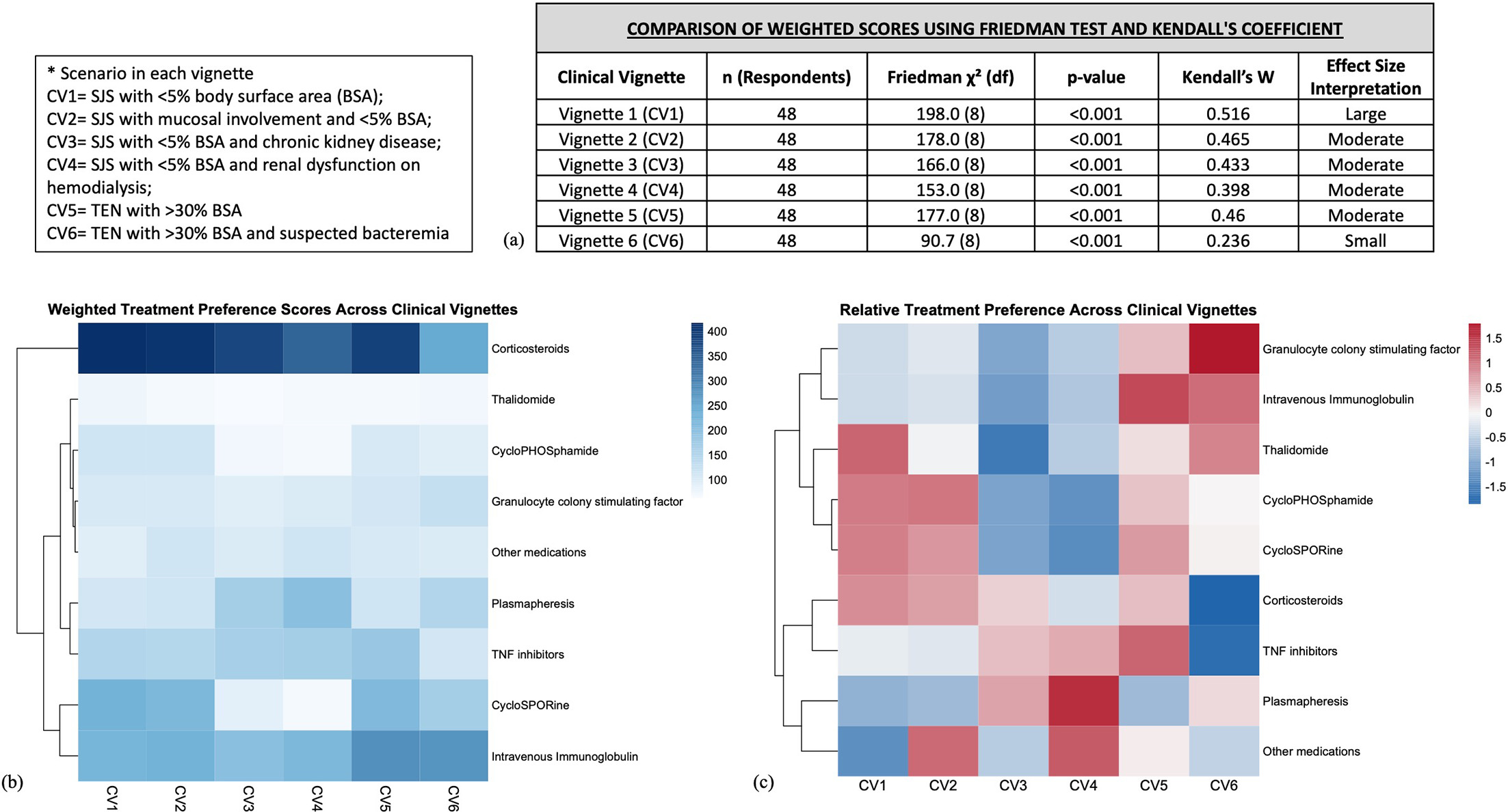
Fig. 1. Frequency and comparison of weighted scores in the use of systemic immunosuppressive agents in various clinical vignettes (CV). (a) Table summary of CV agreement in systemic immunosuppressant use assessed using Friedman test and Kendall concordance coefficient. All CVs demonstrated statistically significant differences in rankings (p=<0.001). The largest agreement was observed in CV1, moderate agreement from CV2-CV5, and smallest agreement in CV6. (b) Heatmap of absolute weighted treatment preference across CV1-CV6. The respondents ranked available treatment options for each CV according to their treatment preference. Rankings were converted into weighted scores with higher scores indicating greater overall preference. A deeper colour in the heatmap means a higher cumulative scores and greater overall treatment preference within each clinical scenario (c) Heatmap of relative treatment preference across CV1-CV6. The heatmap was generated from the cumulative weighted scores for treatment preference shown in Fig. 1b. For each CV, weighted scores were standardized using z-score to facilitate comparison of the relative preference of treatments across scenarios. Positive values (warmer colours) indicate treatments preferred more strongly than the average for that vignette, whereas negative values (cooler colours) indicate comparatively lower preference. The heatmap illustrates relative preference patterns rather than absolute treatment frequencies.
Weighted treatment preferences across vignettes
Heatmap of weighted scores demonstrated both vignette-specific and cross-vignette patterns. The cumulative weighted preference scores derived from respondents’ rankings of each treatment option within every clinical vignette can be found in Fig. 1b. Higher weighted scores indicate a greater overall treatment preference in each CV which had darker in colour. For comparison of the relative treatment preference across clinical scenarios, the weighted scores were standardized using z-score and can be found in Fig. 1c. Positive values, coloured in red, represent treatments that were favoured more strongly than the computed mean in each CV, whereas negative values, coloured in blue, indicate a relatively lower preference. Systemic corticosteroids and IVIG were among the most preferred treatment options ranked consistently across CVs. While cyclophosphamide, cyclosporine and thalidomide generally received lower preference scores.
Plasmapheresis and tumour necrosis factor (TNF) inhibitors demonstrated variable preference rankings on different clinical scenarios. Their use may reflect a context-dependent clinical practice. Row-wise scaling further highlighted relative shifts in treatment prioritization within each vignette. This emphasizes that therapeutic decision-making differed substantially across clinical presentations rather than following a uniform treatment ranking.
DISCUSSION
This study provides insight into the clinical experience and therapeutic practices among board-certified dermatologists in the Philippines with the use of systemic immunomodulators for SJS/TEN. By integrating the respondents’ characteristics, management practices and vignette-based treatment preferences this study may highlight both areas of consensus and variability in current clinical practice.
In this study, most of the respondents were early- to mid-career dermatologists affiliated with dermatology residency training institutions and actively involved in inpatient dermatologic care. This may reflect the current workforce distribution in tertiary referral centres within Metro Manila (7). This predominance of younger dermatologists may be relevant, as recent completion of structured, curriculum-based training may be associated with greater familiarity with evolving therapeutic approaches (8). Despite the relative rarity of SJS/TEN, a significant proportion of respondents reported recent clinical exposure, suggesting a persistent burden of these conditions in tertiary referral centres (9, 10). An active inpatient dermatologic care, involvement in clinical academic training and exposure to SJS/TEN further substantiates that the participants have a high level of familiarity with SJS/TEN management (11).
Systemic corticosteroids were the most commonly utilized treatment, consistent with practices reported in some countries despite ongoing debate regarding their efficacy and safety in SJS/TEN (12, 13, 14, 15). Their continued frequent use likely reflects relative affordability, widespread accessibility and clinician familiarity, particularly in resource-limited settings where access to biologic agents or extracorporeal therapies remains limited (16, 17). On the other hand, the relative use of IVIG and cyclosporine observed in this study mirrors findings from published meta-analyses, in which evidence remains conflicting and practice patterns are often influenced by institutional experience rather than definitive guidelines (13, 18). Notably, over one-third of respondents reported managing selected cases with supportive care alone, consistent with guideline recommendations that emphasize early drug withdrawal and meticulous supportive management as the standard of care (19, 20).
Variability in timing of systemic immunosuppressant initiation and referral practices further underscores the absence of consensus and highlights opportunities for guideline development and standardization of care pathways. While some dermatologists prefer to defer immunosuppression beyond the acute inflammatory phase, others initiate therapy irrespective of timing, reflecting therapeutic decision differences from evidence and varying tolerance for the risks of infection and systemic complications (21, 22).
The high frequency of ophthalmology referral observed in this study is consistent with established recommendations, given the high prevalence and long-term morbidity of ocular involvement in SJS/TEN (23). In contrast, variability in gynaecologic and urologic referrals may reflect under-recognition of genital mucosal sequelae or logistical constraints, a pattern reported in other resource-limited countries (24, 25). These findings underscore opportunities to further standardize multidisciplinary care pathways to improve long-term outcomes (25).
The vignette-based analysis showed significant differences in treatment rankings across all 6 CVs. This confirms that therapeutic decision-making in SJS/TEN is highly scenario-dependent. Moderate-to-large agreement for CV1-5 suggests shared clinical approach when dermatologists are faced with more conventional clinical presentations. In contrast, CV6 exhibited only small concordance indicating substantial variability in treatment selection. This pattern may reflect clinical uncertainty associated with rare diseases and complex scenarios such as evolving disease severity or different risks present at the time of consult. The lack of robust clinical trials for treatment of SJS/TEN may also be a factor resulting clinical heterogeneity of inter-physician agreement (13, 26).
Across most scenarios, systemic corticosteroids and IVIG consistently ranked among the most preferred therapies. This finding aligns with observational studies demonstrating widespread corticosteroid and IVIG use (13). This may be particular in resource-limited settings where treatment decisions are often guided by institutional practice and clinician experience rather than definitive comparative evidence (27). In contrast, cyclophosphamide, cyclosporine and thalidomide consistently demonstrated lower weighted preference scores which may reflect concerns regarding toxicity, limited accessibility and inconsistent supporting evidence (28, 29, 30, 31). Despite relatively favoured in CV1 and CV6, thalidomide still received an absolute low preference score across CVs and is no longer recommended for SJS/TEN management. On the other hand, plasmapheresis and TNF inhibitors showed marked vignette-specific variability. This suggests selective consideration in refractory cases rather than routine use (32, 33). This pattern is consistent with increasing evidence supporting these therapies as selectively applied interventions rather than routine standard-of-care options (11, 14, 34). However, the row-wise scaled heatmap indicates that clinicians do not apply a uniform treatment hierarchy across SJS/TEN scenarios. Instead, prioritization of systemic immunosuppressants shifts according to perceived disease progression and risk–benefit considerations. Collectively, these findings highlight the need for real-world scenario-based treatment examples and highlight the persistent uncertainty in SJS/TEN management.
Our study findings were broadly consistent with North American dermatologists where in active medical management was preferred compared to supportive care alone. However, the choice of systemic immunomodulator in the Philippines was systemic corticosteroids in almost all vignettes compared to the use of cyclosporine, IVIG and TNF inhibitors in North America (6). This may be attributed to experience of use, access to treatment options and treatment affordability, which may contribute to therapeutic decision-making. In a resource-limited setting, such as the Philippines, out-of-pocket expenses for medical treatment and limited health insurance coverage were the norm (35).
Overall, this study provides an overview of current practice patterns in the management of SJS/TEN among dermatologists in the Philippines, highlighting areas of both consensus and variability that may inform future research and local guideline development. Despite the use of non-parametric statistics to quantify the agreement among dermatologists, several limitations of the study were noted. First, the sample size and sampling method limits the generalizability of study findings. Potential recall bias may occur in self-reported practices. The CVs structured in the survey may not be reflective of the real-world scenario in SJS/TEN management and its diagnoses of previously managed cases could not be independently verified. The treatment preferences made by the participants may remain as suggestions in each designed scenario without accounting multidisciplinary input, treatment availability and financial considerations. Future prospective multicentre studies focusing on different management practices are needed to establish and evidence-based clinical pathways for SJS/TEN. Lastly, pragmatic clinical trials and centralized registries may bridge the evidence gap in terms of SJS/TEN treatment strategies.
In conclusion, systemic immunosuppressants in SJS/TEN are widely used among dermatologists from the Philippines. Corticosteroids remained the most preferred choice. However, heterogenous treatment practices have been noted in different clinical scenarios. This highlights a persistent need for evidence-based treatment strategies and clinical pathways in SJS/TEN.
REFERENCES
- Preclaro IAC, Liwag KIL, Tabalon-Morales M, Iniego-Rodas MC. Severe cutaneous adverse reactions: A narrative literature review. J Philipp Dermatol Soc 2024; 33: 67–79. https://doi.org/10.4103/JPDS.JPDS_38_24
- Kang S, Amagai M, Bruckner AL, Enk AH, Margolis DJ, McMichael AJ, et al. Fitzpatrick’s Dermatology, 9e. New York, NY: McGraw-Hill Education; 2019.
- Creamer D, Walsh SA, Dziewulski P, Exton LS, Lee HY, Dart JKG, et al. UK guidelines for the management of Stevens-Johnson syndrome/toxic epidermal necrolysis in adults 2016. J Plast Reconstr Aesthet Surg 2016; 69: e119–e153. https://doi.org/10.1016/j.bjps.2016.01.034
- Widgerow AD. Toxic epidermal necrolysis - management issues and treatment options. Int J Burns Trauma 2011; 1: 42–50.
- Preclaro IAC, Bollenbach-Venturina LAM, Llantos SAA, Reyes-Ramos AR, Templonuevo JR, Tabalon-Morales M. Stevens-Johnson syndrome as the presenting manifestation of human immunodeficiency virus and syphilis coinfection. Dermatol Online J 2025; 31. https://doi.org/10.25251/h5hgtj57
- Han JJ, Creadore A, Seminario-Vidal L, Micheletti R, Noe MH, Mostaghimi A. Medical management of Stevens-Johnson syndrome/toxic epidermal necrolysis among North American dermatologists. J Am Acad Dermatol 2022; 87: 429–431. https://doi.org/10.1016/j.jaad.2021.08.051
- Genuino RF, Jamora MJJ, Espiritu L, Villanueva EQ. The distribution of dermatologists in the Philippines. Cureus 2024; 16: e60402. https://doi.org/10.7759/cureus.60402
- Alharithy R, Alotaibi HM, Shadid A, Alhaddad S, Alotaibi MA, Alsubhi AM, et al. Recent trends in dermatologists’ career choices: a cross-sectional study in Saudi Arabia. J Nat Sci Med 2023; 6: 186–191. https://doi.org/10.4103/jnsm.jnsm_49_23
- Okoth LA, Mirieri HM. Nursing care of stevens johnson syndrome and toxic epidermal necrolysis: case study of dermatology unit of referral hospital, Kenya. OJN 2019; 09: 742–756. https://doi.org/10.4236/ojn.2019.97056
- Justice J, Mukherjee E, Martin-Pozo M, Phillips E. Updates in the pathogenesis of SJS/TEN. Allergol Int 2025; 74: 361–371. https://doi.org/10.1016/j.alit.2025.05.002
- Creamer D, Walsh SA, Dziewulski P, Exton LS, Lee HY, Dart JKG, et al. U.K. guidelines for the management of Stevens-Johnson syndrome/toxic epidermal necrolysis in adults 2016. Br J Dermatol 2016; 174: 1194–1227. https://doi.org/10.1111/bjd.14530
- Schneck J, Fagot JP, Sekula P, Sassolas B, Roujeau JC, Mockenhaupt M. Effects of treatments on the mortality of Stevens-Johnson syndrome and toxic epidermal necrolysis: A retrospective study on patients included in the prospective EuroSCAR Study. J Am Acad Dermatol 2008; 58: 33–40. https://doi.org/10.1016/j.jaad.2007.08.039
- Zimmermann S, Sekula P, Venhoff M, Motschall E, Knaus J, Schumacher M, et al. Systemic immunomodulating therapies for stevens-johnson syndrome and toxic epidermal necrolysis: a systematic review and meta-analysis. JAMA Dermatol 2017; 153: 514–522. https://doi.org/10.1001/jamadermatol.2016.5668
- Gupta LK, Martin AM, Agarwal N, D’Souza P, Das S, Kumar R, et al. Guidelines for the management of Stevens-Johnson syndrome/toxic epidermal necrolysis: An Indian perspective. Indian J Dermatol Venereol Leprol 2016; 82: 603–625. https://doi.org/10.4103/0378-6323.191134
- Hama N, Aoki S, Chen CB, Hasegawa A, Ogawa Y, Vocanson M, et al. Recent progress in Stevens–Johnson syndrome/toxic epidermal necrolysis: diagnostic criteria, pathogenesis and treatment. Br J Dermatol 2024; 192: 9–18. https://doi.org/10.1093/bjd/ljae321
- Sen S, Rudra O, Gayen T. Extracorporeal therapy in dermatology. Indian J Dermatol 2021; 66: 386–392. https://doi.org/10.4103/ijd.IJD_897_20
- Weiss D, Nordhorn I, Tizek L, Werfel T, Zink A, Biedermann T, et al. Prescription behaviour and barriers to prescription of biologicals for treatment of chronic inflammatory skin diseases in dermatological practice in two German Federal States. Acta Derm Venereol 2021; 101: adv00560. https://doi.org/10.2340/00015555-3901
- Ng QX, De Deyn MLZQ, Venkatanarayanan N, Ho CYX, Yeo WS. A meta-analysis of cyclosporine treatment for Stevens-Johnson syndrome/toxic epidermal necrolysis. J Inflamm Res 2018; 11: 135–142. https://doi.org/10.2147/JIR.S160964
- Watanabe Y, Hama N. Recent advances in the diagnosis and treatment of Stevens-Johnson syndrome/toxic epidermal necrolysis. Allergol Int 2025; 74: 345–355. https://doi.org/10.1016/j.alit.2025.05.008
- Seminario-Vidal L, Kroshinsky D, Malachowski SJ, Sun J, Markova A, Beachkofsky TM, et al. Society of dermatology hospitalists supportive care guidelines for the management of Stevens-Johnson syndrome/toxic epidermal necrolysis in adults. J Am Acad Dermatol 2020; 82: 1553–1567. https://doi.org/10.1016/j.jaad.2020.02.066
- Lee HY, Walsh SA, Creamer D. Long-term complications of Stevens-Johnson syndrome/toxic epidermal necrolysis (SJS/TEN): the spectrum of chronic problems in patients who survive an episode of SJS/TEN necessitates multidisciplinary follow-up. Br J Dermatol 2017; 177: 924–935. https://doi.org/10.1111/bjd.15360
- Ozhathil DK, Powell CM, Corley CV, Golovko G, Song J, El Ayadi A, et al. A retrospective analysis of mortality risk and immunosuppressive therapy for Stevens-Johnson Syndrome and toxic epidermal necrolysis syndrome using the TriNetX research network. Burns 2024; 50: 75–86. https://doi.org/10.1016/j.burns.2023.08.009
- Sotozono C, Ueta M. Updates on the ocular manifestations and treatment of SJS/TEN. Allergol Int 2025; 74: 356–360. https://doi.org/10.1016/j.alit.2025.05.003
- White KD, Abe R, Ardern-Jones M, Beachkofsky T, Bouchard C, Carleton B, et al. SJS/TEN 2017: Building multidisciplinary networks to drive science and translation. J Allergy Clin Immunol Pract 2018; 6: 38–69. https://doi.org/10.1016/j.jaip.2017.11.023
- Bouraima MB, Jovčić S, Švadlenka L, Simic V, Badi I, Maraka ND. An integrated multi-criteria approach to formulate and assess healthcare referral system strategies in developing countries. Healthcare Analytics 2024; 5: 100315. https://doi.org/10.1016/j.health.2024.100315
- Wang J, Yamada R. In silico study of medical decision-making for rare diseases: heterogeneity of decision-makers in a population improves overall benefit. PeerJ 2018; 6: e5677. https://doi.org/10.7717/peerj.5677
- Sekula P, Dunant A, Mockenhaupt M, Naldi L, Bouwes Bavinck JN, Halevy S, et al. Comprehensive survival analysis of a cohort of patients with Stevens-Johnson syndrome and toxic epidermal necrolysis. J Invest Dermatol 2013; 133: 1197–1204. https://doi.org/10.1038/jid.2012.510
- Nazerian A, Jafarzadeh A, Salehi S, Ghasemi M, Goodarzi A. Cyclosporin for the treatment of Stevens-Johnson syndrome (SJS) and toxic epidermal necrolysis (TEN): a systematic review of observational studies and clinical trials focusing on single therapy, combination therapy, and comparative assessments. Inflammopharmacology 2025; 33: 485–503. https://doi.org/10.1007/s10787-024-01590-0
- Wolkenstein P, Latarjet J, Roujeau JC, Duguet C, Boudeau S, Vaillant L, et al. Randomised comparison of thalidomide versus placebo in toxic epidermal necrolysis. The Lancet 1998; 352: 1586–1589. https://doi.org/10.1016/S0140-6736(98)02197-7
- Frangogiannis NG, Boridy I, Mazhar M, Mathews R, Gangopadhyay S, Cate T. Cyclophosphamide in the treatment of toxic epidermal necrolysis. South Med J 1996; 89: 1001–1003. https://doi.org/10.1097/00007611-199610000-00015
- Wang L, Varghese S, Bassir F, Lo YC, Ortega CA, Shah S, et al. Stevens-Johnson syndrome and toxic epidermal necrolysis: A systematic review of PubMed/MEDLINE case reports from 1980 to 2020. Front Med 2022; 9. https://doi.org/10.3389/fmed.2022.949520
- Kimura H, Oginezawa M, Hama N, Watanabe Y, Yamaguchi Y, Nakajima S, et al. Efficacy and safety of etanercept in Japanese patients with stevens-johnson syndrome and toxic epidermal necrolysis unresponsive to systemic steroid therapy: A Multicenter, open-label, single-arm study. J Dermatol 2025; 52: 1536–1544. https://doi.org/10.1111/1346-8138.17860
- Miyamoto Y, Ohbe H, Kumazawa R, Matsui H, Fushimi K, Yasunaga H, et al. Evaluation of plasmapheresis vs immunoglobulin as first treatment after ineffective systemic corticosteroid therapy for patients with stevens-johnson syndrome and toxic epidermal necrolysis. JAMA Dermatol 2023; 159: 481–487. https://doi.org/10.1001/jamadermatol.2023.0035
- Watanabe H, Ogawa Y, Yamaguchi Y, Nakajima S, Mizukawa Y, Mushiroda T, et al. Guidelines for the management of Stevens–Johnson syndrome and toxic epidermal necrolysis 2025 supplement. J Dermatol 2026; 53. https://doi.org/10.1111/1346-8138.70136
- Zabala DAR, Guillano VP, Lugasan MBD. The economic burden of psoriasis: a cross-sectional study in a tertiary hospital in the Philippines. J Philipp Dermatol Soc 2022; 31: 01671546–202231010.