SHORT COMMUNICATION
Incidence, Prevalence and Diagnostic Delay in Pyoderma Gangrenosum: A Finnish Nationwide Registry-based Study
Suvi-Päivikki SINIKUMPU1* , Jari JOKELAINEN2 and Laura HUILAJA1
1Department of Dermatology, University Hospital of Oulu, Oulu, Finland and Medical Research Center, Research Unit of Clinical Medicine, University of Oulu, Oulu, Finland, and 2Northern Finland Birth Cohorts, Arctic Biobank, Infrastructure for Population Studies, Faculty of Medicine, University of Oulu, Oulu, Finland. *Email: suvi-paivikki.sinikumpu@oulu.fi
Citation: Acta Derm Venereol 2026; 106: adv-2026-0937. DOI: https://doi.org/10.2340/actadv.v106.adv-2026-0937.
Copyright: 2026 ©Author(s). Published by MJS Publishing, on behalf of the Society for Publication of Acta Dermato-Venereologica. This is an Open Access article distributed under the terms of the Creative Commons Attribution-NonCommercial 4.0 International License (https://creativecommons.org/licenses/by-nc/4.0/).
Submitted: Aug 10, 2026. Accepted after revision: Sept 14, 2026.
Published: Oct 20, 2026.
Competing interests and funding: The authors have no conflicts of interest to declare.
The data used in this analysis are from the Finnish Care Register for Health Care, which is maintained by the Finnish Institute of Health and Welfare. According to Finnish laws and regulations, the data in the social welfare and health care registers and documents are confidential. As the responsible authority, FinData can, on a case-by-case basis, grant permission to use the registers and documents for the purposes of scientific research. More information on research authorization applications can be found on www.findata.fi/en.
The study was exempted from institutional review board ethics review because it was retrospective and based only on data from medical records data.
Pyoderma gangrenosum (PG) is a neutrophilic inflammatory skin disease that is challenging to diagnose (1). PG can occur at any age but is most common in adults aged 20–50 years and slightly more common in women than in men (2). Its incidence in the UK was 0.63 per 100,000 person-years in year 2012 (1) and estimated global prevalence 0.018% (3). Although some studies suggest that PG diagnoses may have increased slightly in recent years (4), data remain limited. As PG ulcers are painful and the disease associated with a high risk of comorbidities (2), prompt diagnostic evaluation is essential. We therefore aimed to study the incidence trends, prevalence and diagnostic delay of PG.
MATERIALS AND METHODS
Study data were obtained from the database of the Finnish Care Register for Health Care, which includes information on all visits to hospitals in Finland. Data were retrieved for all individuals whose record contained at least 2 entries of the International Classification of Diseases version 10 code L88 for a diagnosis of PG in dermatology clinics during the period years of 1998–2024. Crude incidence rates of PG were calculated using annual population-at-risk data from Statistics Finland for the years 1998–2024. Age-standardized incidence rates were calculated using the direct method, with rates standardized to the 2013 European Standard Population. Categorical variables were presented as proportions and compared using the Pearson χ2 test and Mann–Whitney U-test for continuous variables. Diagnostic delay was assessed in a subpopulation of individuals in whom an unspecified ulcer diagnosis (L98.4 or L97) preceded the L88 diagnosis. p-values <0.05 were considered statistically significant. All statistical analyses were performed using the R software package (version 4.2.2; R Core Team, Vienna, Austria) within RStudio (version 2023.03.1 Build 446; RStudio, PBC, Boston, MA, USA).
RESULTS
In total, 1,300 individuals fulfilled the inclusion criteria, majority of them being women (64.1%). The mean age at diagnosis was 55.6 years, and it was higher in women than in men (p<0.003). The total adjusted incidence of PG was 1.74/100,000 (95% confidence interval 0.17–6.80) in year 2024 when the European standard population was used as a reference and the prevalence was 0.017 % in the population. The incidence started to increase in year 2011 (Fig. 1). In 24.2% of individuals, a diagnosis code of unspecific ulcer preceded the PG diagnosis, and the median diagnostic delay was 2 months (Q1, Q3, 0.0–12.5).
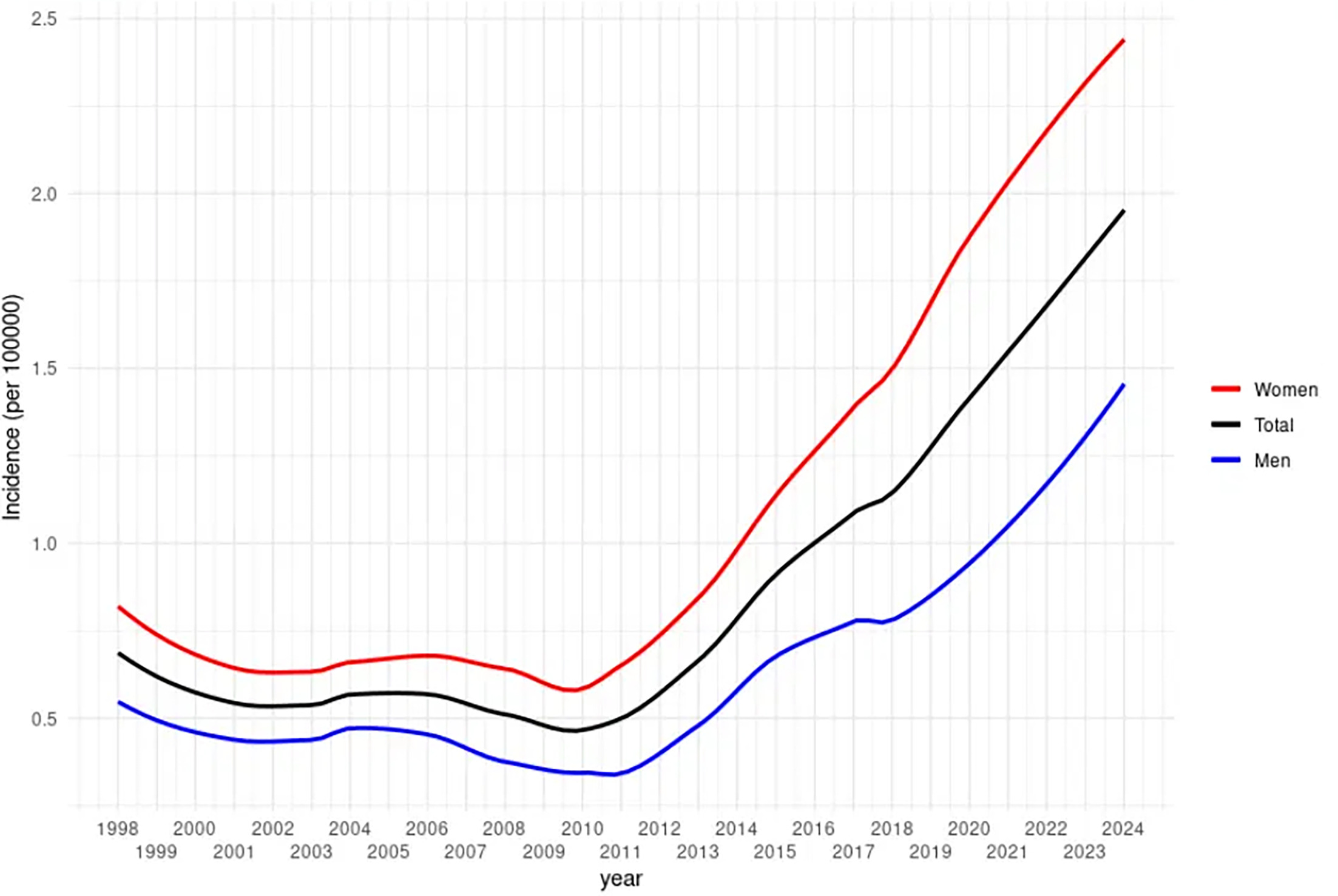
Fig. 1. Incidence of pyoderma gangrenosum in Finland by sex between 1998 and 2024.
DISCUSSION
In our study, the prevalence corresponds with global prevalence (3), but the incidence was higher than that reported in a study conducted in the UK (1). This difference may be explained by methodological factors: in our study, only diagnoses made by dermatologists were accepted. In contrast, the UK study was based on general practitioner registry data, which may have led to underdiagnosis, since recognizing PG is difficult even for dermatologists (1, 5). Additionally, aforementioned study was performed over 10 years ago, and as our study shows marked increase in incidence in last 13 years. Similar increasing trends have been reported in some regions in Italy (4). However, we do not believe that there is overdiagnosis in our own study, since the inclusion criteria required at least 2 records of L88 diagnose in registry whereas in UK study no specification regarding the number of diagnoses was required. In addition, the diagnosis “pyoderma” was accepted in their study (1). Nevertheless, in our study the registry-based nature of the design left unable to confirm the diagnoses.
PG is challenging to diagnose, as the ulcers often resemble other atypical wounds and there are no universally accepted diagnostic criteria. The diagnosis is frequently made by exclusion (6). Our study further demonstrated that diagnosing PG remains difficult even for dermatologists: in a quarter of cases in subpopulation, the correct diagnosis was preceded by a nonspecific diagnosis, and the median diagnostic delay was 2 months. Diagnostic delay has also been observed in 1 smaller study, and it has been shown to be associated with prolonged healing of PG and impaired quality of life (7, 8).
In conclusion, this study shows that incidence of PG is clearly increasing in Finland. This may be due to increased awareness of PG or a rising prevalence of associated comorbidities and population aging. However, the diagnostic delay remains even among specialists, which is concerning, given that PG is a painful disease that is associated with reduced quality of life and increased mortality (1). Greater awareness and recognition of PG are still needed even among dermatologists.
REFERENCES
- Langan SM, Groves RW, Card TR, Gulliford MC. Incidence, mortality, and disease associations of pyoderma gangrenosum in the United Kingdom: a retrospective cohort study. J Invest Dermatol 2012; 132: 2166–2170. https://doi.org/10.1038/jid.2012.130
- Ruocco E, Sangiuliano S, Gravina AG, Miranda A, Nicoletti G. Pyoderma gangrenosum: an updated review. J Eur Acad Dermatol Venereol 2009; 23: 1008–1017. https://doi.org/10.1111/j.1468-3083.2009.03199.x
- Shea M, Munoz EP, Kumar I, Zanet RA, Sengupta S, Ortega-Loayza AG. Prevalence of pyoderma gangrenosum: A systematic review and meta-regression analysis. J Invest Dermatol 2025; 145: 3191–3195. https://doi.org/10.1016/j.jid.2025.05.030
- Michelucci A, Capodici A, Granieri G, Manzo Margiotta F, Cei B, Marzano AV, et al. Trend in the diagnosis of pyoderma gangrenosum in Italy: A multicenter study. Dermatology 2026; 242: 137–144. https://doi.org/10.1159/000549357
- Reese AM, Gupta AS, Latour E, Loyo M, Kaffenberger B, Creadore A, et al. Clinical characteristics and misdiagnosis of pyoderma gangrenosum of the head and neck: A retrospective study. J Am Acad Dermatol 2022; 87: 1130–1133. https://doi.org/10.1016/j.jaad.2022.02.008
- Isoherranen K, O’Brien JJ, Barker J, Dissemond J, Hafner J, Jemec GBE, et al. Atypical wounds. Best clinical practice and challenges. J Wound Care 2019; 28: S1–S92. https://doi.org/10.12968/jowc.2019.28.Sup6.S1
- Haddadin OM, Erickson KM, Latour E, Sisley J, Ortega-Loayza AG. Impact of delay of diagnosis of pyoderma gangrenosum on healing outcomes and health care utilization: A prospective cohort study. J Am Acad Dermatol 2024; 91: 1274–1277. https://doi.org/10.1016/j.jaad.2024.08.038
- Taylor LT, Kody S, Rios-Duarte JA, Ortega-Loayza AG. Impact of diagnostic delay on patient perspectives in pyoderma gangrenosum: an online support group-based survey study. Arch Dermatol Res 2023; 315: 2737–2739. https://doi.org/10.1007/s00403-023-02685-4