RESEARCH LETTER
Local Management of Anogenital Warts in Nonimmunocompromised Adults: A Network Meta-analysis of Randomized Controlled Trials
Réda SAIB1 , Elisa JOLY1, Sébastien FOUÉRÉ2, Christian DERANCOURT3, Babacar TOUNKARA4, Cyril FERDYNUS4 and Antoine BERTOLOTTI1,4*
1Department de Maladies-Infectieuses, Dermatologie, CHU de La Réunion, Saint Pierre, France, 2CeGIDD Saint-Louis, Fernand-Widal, Le Checkpoint, Hôpitaux Universitaires Saint-Louis, Lariboisière, Fernand-Widal, Assistance Publique des Hôpitaux de Paris, Paris, France, 3Cabinet libéral, 623 Rue du Barry, 05130 Tallard, France, and 4Inserm CICEC 1410, La Réunion, Saint-Pierre, France. *Email: antoine.bertolotti@chu-reunion.fr
Citation: Acta Derm Venereol 2026; 106: adv-2026-0435. DOI: https://doi.org/10.2340/actadv.v106.adv-2026-0435.
Copyright: 2026 ©Author(s). Published by MJS Publishing, on behalf of the Society for Publication of Acta Dermato-Venereologica. This is an Open Access article distributed under the terms of the Creative Commons Attribution-NonCommercial 4.0 International License (https://creativecommons.org/licenses/by-nc/4.0/).
Submitted: Feb 25, 2026. Accepted after revision: Aug 20, 2026.
Published: Oct 21, 2026.
Competing interests and funding: The authors have no conflicts of interest to declare.
The data that support the findings of this study are available from the corresponding author upon reasonable request.
To the Editor,
Anogenital warts (AGWs) remain a therapeutic challenge due to the complexity of their management and the high recurrence rates commonly observed (1, 2). This study aimed to evaluate the efficacy of topical and ablative treatments for AGW management through an updated network meta-analysis (NMA), building upon the work of Bertolotti et al. (3).
A systematic literature search of two databases was conducted from inception to August 2025. A total of 81 randomized controlled trials (RCTs) involving 11,083 participants were included, evaluating local treatments for AGWs. Eligible studies were parallel-group RCTs enrolling immunocompetent adults treated with at least one provider-administered or self-applied intervention. Studies in paediatric or immunocompromised populations were excluded. Full methodological details, including the search strategy, study selection (included and excluded studies), flow diagram and supplementary references, are provided in Appendices S1–S7.
The primary outcome was complete clearance of AGWs without recurrence, analysed using a network meta-analytic approach.
Results are presented as a forest plot (Fig. 1) and Surface Under The Cumulative Ranking (SUCRA) rankings (Fig. 2). Treatments were ranked using the SUCRA, with values ranging from 0 to 1, reflecting the probability that a given treatment occupies a particular rank, with values closer to one indicating greater efficacy.
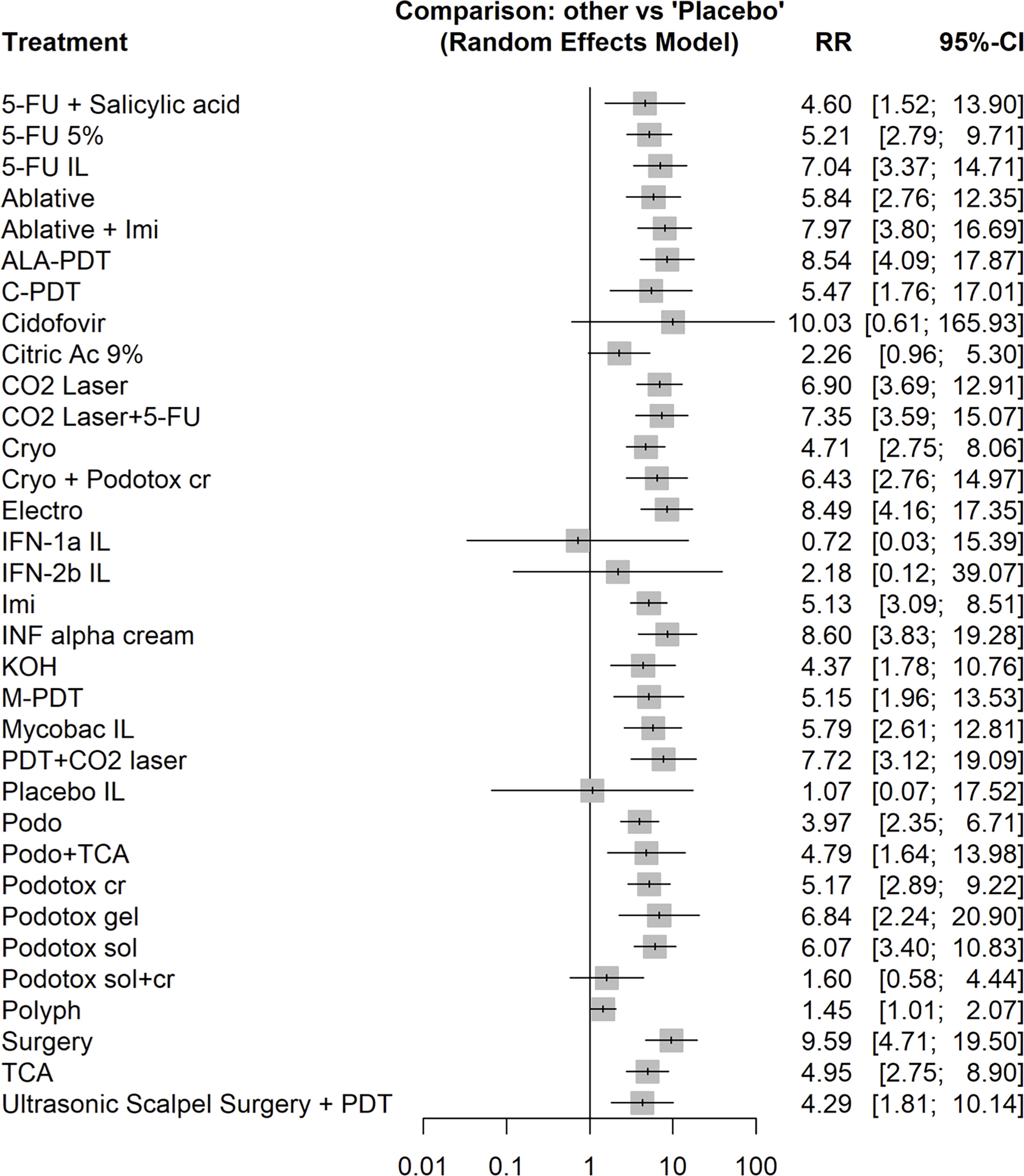
Fig. 1. Forest plot of the estimates of relative risk between each treatment and the reference placebo for complete lesion response. Data presented as RR (95% CI). 5-FU: 5 fluoro-uracil, 5-FU IL: 5 fluorouracil intra intralesional, ablative ablative treatment (surgery or electrosurgery or CO2 laser or cryotherapy), Cryo: cryotherapy, Electro electrosurgery, IFN B: interferon B, Imi: imiquimod, INF cream: interferon cream, Mycobac IL: mycobacterium intra intralesional, PDT: photodynamic therapy, podo: podophyllin 20–25%, Podotox cr: podophyllotoxin cream, Podotox sol: podophyllotoxin solution, podotox gel: podophyllotoxin 0.5 % gel, podotox sol+cr: podophyllotoxin 0.5 % solution + cream, polyph: polyphenon, KOH: potassium hydroxide, TCA: trichloroacetic acid, Vit c: vitamin c, Cryo+Podo: cryotherapy+podophyllin, Cryo+Podotox: cryotherapy+podophyllotoxin, INF alfa 2-b: Interferon alfa 2-b.
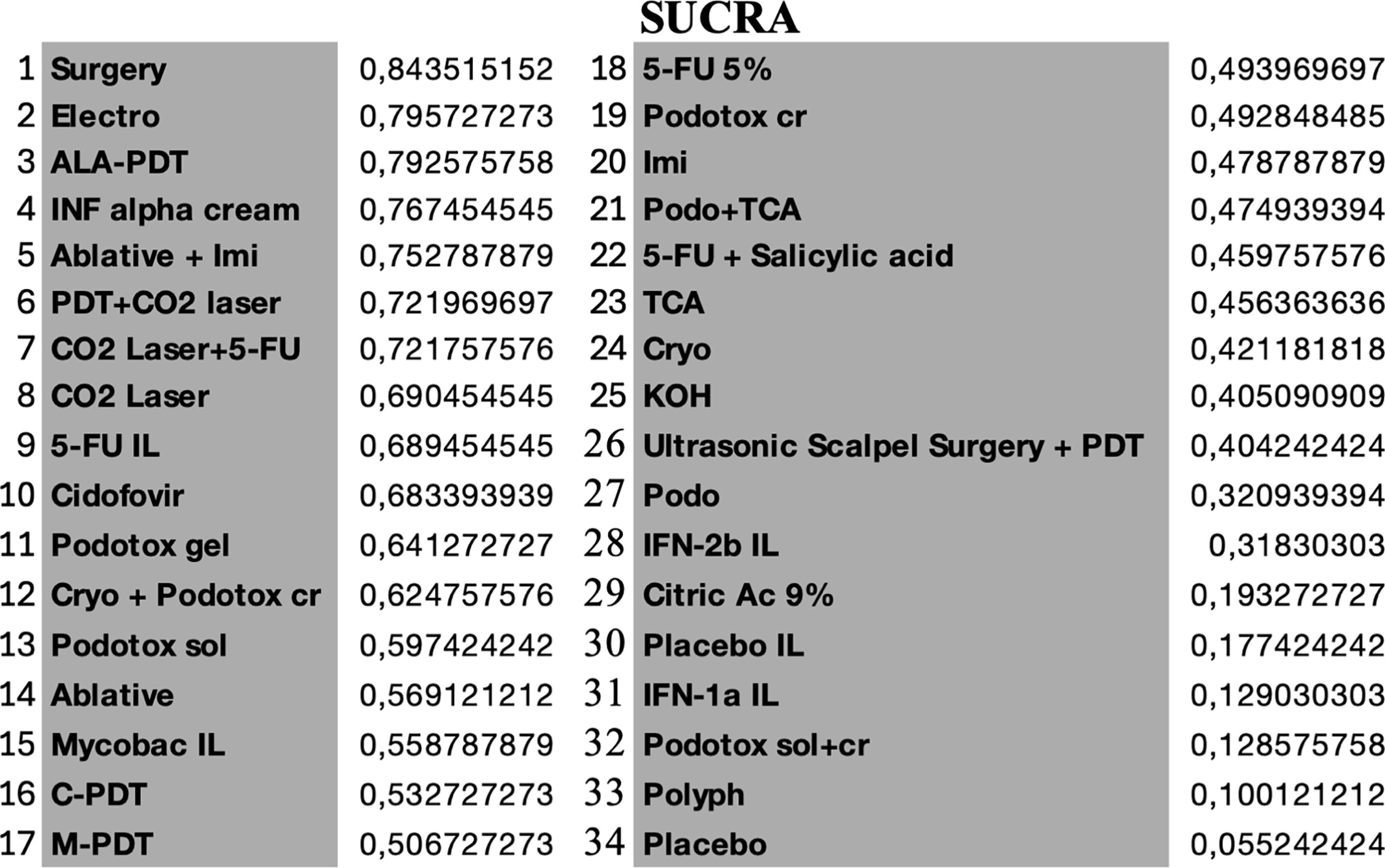
Fig. 2. Surface Under the Cumulative Ranking Curve (SUCRA) Analysis Representing probabilities of treatment ranking. SUCRA: surface under the cumulative ranking curve; ablative treatment: surgery or electrosurgery or CO2 laser or cryotherapy, 5-FU: 5 fluoro-uracil, TCA: trichloroacetic acid, PDT: photodynamic therapy, KOH: potassium hydroxide, INF-1a: interferon-1α, INF-2b: interferon-2β.
All treatments demonstrated significantly greater efficacy than placebo, except for cidofovir and interferons administered intralesionally or topically (excluding interferon-α cream).
Among ablative therapies, surgical excision was the most effective (RR 9.59; 95% CI 4.71–19.50; SUCRA 0.843), followed by electrocoagulation (RR 8.49; 95% CI 4.16–17.35; SUCRA 0.792), aminolevulinic acid–photodynamic therapy (ALA-PDT) (RR 8.54; 95% CI 4.09–17.87; SUCRA 0.792), and CO₂ laser (RR 6.90; 95% CI 3.69–12.91; SUCRA 0.690).
Among topical agents, 5-fluorouracil (RR 5.21; 95% CI 2.79–9.71; SUCRA 0.493) and imiquimod 5 % (RR 5.13; 95% CI 3.09–8.51; SUCRA 0.478) showed moderate efficacy. Podophyllotoxin appeared more effective in gel form than in cream or solution, while cidofovir ranked tenth overall.
Our findings confirm those of Bertolotti et al., identifying surgical excision as the most effective ablative option, and align with previous literature recognizing the high efficacy of electrosurgery and CO₂ laser (3, 4). Compared with the 2024 French guidelines – which recommend cryotherapy, imiquimod 5%, or podophyllotoxin as first-line options (1) – our results offer a complementary therapeutic perspective. In our analysis, cryotherapy achieved recurrence-free clearance in 47% of cases, consistent with the 44–87% range reported in European guidelines (2). Jung et al. suggested that imiquimod 2% may be more effective than 5%. However, one of the two RCTs evaluating 2% imiquimod used a twice-daily regimen, which deviates from standard practice (typically three times per week) and may have biased outcomes. Moreover, the assumption that lower concentrations improve tolerability is not supported by our previous NMA or Jung’s analysis, both of which found no reduction in adverse events with lower doses (5, 6).
Formulation and dosage significantly influence the efficacy of podophyllotoxin. The 0.5% solution was more effective than the cream, confirming the findings of Werner et al. (RR 1.26; 95% CI 1.07–1.48) (7). Although our NMA suggested a trend favouring the 0.5% solution over imiquimod 5% (SUCRA 0.597 vs 0.478), Werner et al. did not find a significant difference between the two. No head-to-head study has compared the 0.5% gel and solution, but our results indicate higher efficacy for the gel (SUCRA 0.641), warranting further investigation.
A complementary NMA focusing on tolerability (6) showed that imiquimod 5% was better tolerated than podophyllotoxin, cryotherapy or 5-FU, while cidofovir emerged as the most tolerated topical agent. Overall, topical therapies were associated with fewer adverse events than ablative procedures. These results should be interpreted with caution. Surgical excision is less appropriate for patients with multiple lesions and carries greater risks of scarring and postoperative complications. CO₂ laser and PDT are limited by high cost, restricted availability, and technical challenges related to lesion localization. From a health-economics perspective, Agbeci et al. reported that the podophyllotoxin 0.5% solution is the most cost-effective first-line option (8).
This study has several limitations: it focuses exclusively on local treatments and six-month clearance, does not assess long-term recurrence, lacks endpoints for safety or cost-effectiveness and includes some heterogeneity among trials.
In conclusion, this NMA indicates that surgical excision, PDT and electrosurgery offer the highest likelihood of achieving recurrence-free clearance in AGWs. Among first-line options recommended by the French guidelines, podophyllotoxin 0.5 % stands out for its efficacy, while imiquimod 5 % provides a balanced profile combining efficacy and tolerability. Further studies are warranted to confirm these observations.
ACKNOWLEDGEMENTS
We thank Maeva Boyer and Manon Boyer for their valuable assistance.
REFERENCES
- Haute Autorité de Santé. Therapeutic management of patients with anogenital warts. 2024. Available from: https://www.has-sante.fr/upload/docs/application/pdf/2024-11/prise_en_charge_therapeutique_des_patients_atteints_de_condylomes_ano-genitaux_-_recommandations.pdf
- Gilson R, Nugent D, Werner RN, Ballesteros J, Ross J. 2019 IUSTI‐Europe guideline for the management of anogenital warts. Acad Dermatol Venereol 2020; 34: 1644–1653. https://doi.org/10.1111/jdv.16522
- Bertolotti A, Ferdynus C, Milpied B, Dupin N, Huiart L, Derancourt C. Local management of anogenital warts in non-immunocompromised adults: a network meta-analysis of randomized controlled trials. Dermatol Ther 2020; 10: 249–262. https://doi.org/10.1007/s13555-020-00357-z
- Barton S, Wakefield V, O’Mahony C, Edwards S. Effectiveness of topical and ablative therapies in treatment of anogenital warts: a systematic review and network meta-analysis. BMJ Open 2019; 9: e027765. https://doi.org/10.1136/bmjopen-2018-027765
- Jung JM, Jung CJ, Lee WJ, Won CH, Lee MW, Choi JH, et al. Topically applied treatments for external genital warts in nonimmunocompromised patients: a systematic review and network meta-analysis. Br J Dermatol 2020; 183: 24–36. https://doi.org/10.1111/bjd.18638
- Saib R, Joly E, Fouere S, Derancourt C, Tounkara B, Ferdynus C, et al. Adverse effects of treatments for anogenital warts in non-immunocompromised adults: a network meta-analysis of randomized controlled trials. Dermatol Ther 2026; 16: 4325–4340. https://doi.org/10.1007/s13555-026-01857-0
- Werner RN, Westfechtel L, Dressler C, Nast A. Self-administered interventions for anogenital warts in immunocompetent patients: a systematic review and meta-analysis. Sex Transm Infect 2017; 93: 155–161. https://doi.org/10.1136/sextrans-2016-052768
- Agbeci H, Rollot O, Derancourt C, Baglione Q, Benard A, Bertolotti A. Health economic evaluation of topical treatments for external anogenital warts. Ann Dermatol Venereol 2024; 151: 103288. https://doi.org/10.1016/j.annder.2024.103288