SHORT COMMUNICATION
Exploring Capsaicin and Cinnamaldehyde for Scratching Behaviour in Mice: Effects of Sex, Concentration and Time Course
Rosane Schenkel de AQUINO1,2*, Aledson Rosa TORRES3, Alcir Luiz DAFRE4 and Adair Roberto Soares SANTOS2,†
1Area of Environment and Health, Department of Education, Research and Extension, Federal Institute of Santa Catarina, 88506-400 Lages, SC, Brazil, 2Laboratory of Neurobiology of Pain and Inflammation, Department of Physiological Sciences, Federal University of Santa Catarina, Florianopolis, 3Catarinense Federal Institute, Campus Videira, Videira and 4Department of Biochemistry, Center of Biological Sciences, Federal University of Santa Catarina, Florianopolis, SC, Brazil. E-mail: rosane.aquino@ifsc.edu.br. †Deceased.
Citation: Acta Derm Venereol 2023; 103: adv9642. DOI https://doi.org/10.2340/actadv.v103.9642.
Copyright: © Published by Medical Journals Sweden, on behalf of the Society for Publication of Acta Dermato-Venereologica. This is an Open Access article distributed under the terms of the Creative Commons Attribution-NonCommercial 4.0 International License (https://creativecommons.org/licenses/by-nc/4.0/)
Accepted: May 8, 2023; Published: Jun 13, 2023
Competing interests and funding: The authors have no conflicts of interest to declare.
INTRODUCTION
Pruritus has been defined for over 340 years by the German physician Samuel Hafenreffer as “an unpleasant sensation that elicits the desire or reflex to scratch”, a definition that remains valid today (1). Recent evidence indicates the existence of distinct neuronal circuits in the central and peripheral nervous systems for pain and itch (2, 3). The transduction and generation of sensations of pain and itch involve many molecules, including transient receptor potential (TRP) channels, through their representatives: histamine-mediated TRPV1-4 (vanilloid), and non-histamine pathways, such as TRPA1 (ankyrin). Capsaicin and cinnamaldehyde are known activators of TRPV1 and TRPA1 channels, respectively (4, 5). These substances are widely used to reveal their actions on sensory pathways involved in pain and itch. However, there is scarce literature describing the use of these substances as tools for the study of pruritus. To this end, dose- and time-response curves (0–8 h) were determined for capsaicin and cinnamaldehyde in mice. The induction of itch was performed by subcutaneous injection of 50 µL capsaicin (2.5–24.5 nmol/site) or cinnamaldehyde (250–2,500 nmol/site) into the interscapular region of mice. Typical scratching response was observed, indicating that capsaicin and cinnamaldehyde may constitute novel tools for studying new drugs and mechanisms associated with pruritus.
MATERIALS, METHODS AND RESULTS
Swiss male and female mice (30–45 g) were obtained from the Federal University of Santa Catarina in Florianópolis, SC, Brazil. The animal use protocols were previously approved by the institution’s animal use committee (Comissão de Ética no Uso de Animais/UFSC) and followed National Institutes of Health (NIH) guidelines (7). Capsaicin and cinnamaldehyde were obtained from Sigma-Aldrich (St Louis, MO, USA). Capsaicin was dissolved in 10% ethanol/10% Tween 80 in phosphate-buffered saline (PBS) (v/v/v), and cinnamaldehyde was dissolved in 5% Tween 80 in PBS (v/v). To evaluate scratching behaviour, the substances were injected into the interscapular area of the mouse’s back, following previously published procedures (6).
Compared with a control value of approximately 30 bouts of scratching, capsaicin caused a time-dependent increase in scratching behaviour, with a maximum value of approximately 130 bouts during the 30-min observation period (Fig. 1A). The number of scratching bouts increased with increasing concentration of capsaicin (Fig. 1B). At a dose of 8.2 nmol/site, capsaicin-induced scratching behaviour was blunted, and stabilized at approximately 45 bouts of scratching at around 15 min (data not shown), while at lower doses the scratching frequency doubled. Furthermore, mice remained immobilized, an evidence of pain behaviour.
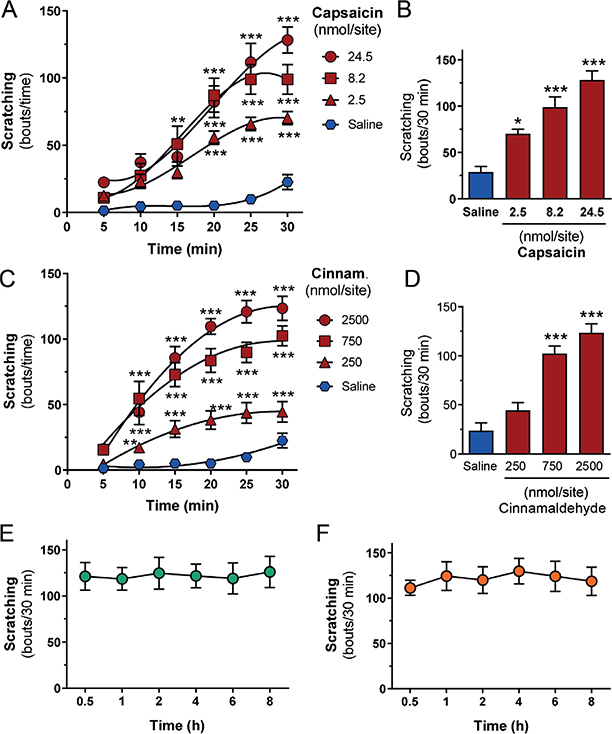
Fig. 1. Time course, dose-response, and sex differences in scratching behaviour induced by capsaicin and cinnamaldehyde. Time course (A and C), and dose-response (B and D) response to capsaicin and cinnamaldehyde, respectively. Doses and time-points are indicated, and graphs B and D were constructed using the values obtained at 30 min. Data are presented as mean ± standard error of mean (SEM) (n = 5–8). Two-way analysis of variance (ANOVA) followed by Newman-Keuls post hoc test. Cinnamaldehyde (750 nmol/site) was used for a time course response in female (E) and male (F) mice to detect any possible sex effect. Data are presented as mean ± SEM (n = 4). One-way ANOVA followed by Newman-Keuls post hoc test. Statistical differences are indicated by **p < 0.01 or ***p < 0.001, compared with the saline group.
Mice injected subcutaneously with cinnamaldehyde in the interscapular area of the back displayed a time-dependent increase in scratching behaviour, as shown in Fig. 1C. The number of scratching bouts increased proportionally to the increase in cinnamaldehyde concentration, from a basal value of approximately 20 bouts to approximately 120 bouts (Fig. 1D). The scratching behaviour induced by cinnamaldehyde remained stable for 8 h, with similar results observed in females (Fig. 1E) and males (Fig. 1F).
DISCUSSION
This study describes the first animal protocol for inducing pruritus using capsaicin and cinnamaldehyde in the interscapular area of the back in mice. A previous study demonstrated that the cheeks of mice can also be used to study scratching behaviour induced by cinnamaldehyde, showing the involvement of TRPV1 and TRPV4 in the itch response (8). Itch and pain are distinct sensations that both rely on a nervous system with dedicated sensory subdivisions that interact. The intricate link between pain and itch depends on the concentration of substances that modify the function controlling dynamic ion selectivity by the TRP receptors (9). In the current study, scratching behaviour was induced by capsaicin and cinnamaldehyde, without any typical nociceptive behaviour, such as forepaw withdrawal or licking, hind paw withdrawal or licking, stamping, leaning posture and jumping.
Although it is well established that capsaicin can induce itch (1), there are limited protocols for using it in animal models. In the current study, the lowest dose of capsaicin that induced scratching behaviour in mice was 2.5 nmol/site, which is lower than the dose required for pain induction, which can be up to 100 µg/site (10).
Cinnamaldehyde-induced pruritus was significant at a dose of 250 nmol/site, with a maximum response observed at 750 nmol/site, 30 min after injection. Notably, the pruritus response lasted longer as compared with the pain response (350 nmol/site), which lasts for only a few minutes (11).
Studies in humans have reported that women show an increased response to itch-inducing agents under chronic treatment (12); however, studies focusing on acute response are scarce. Yamaura et al. (13) tested 6 classical activators related to TRPA1 and TRPV1 pathways, and found that only SLIGRL-NH2, which targets PAR-2 receptors, exhibited a sex difference in scratching behaviour, with female mice exhibiting higher scratching counts than male mice.
The fact that capsaicin (14) and cinnamaldehyde (15) can also elicit itch in humans supports their use as pruritus-inducing agents. Although pruritus can be debilitating, it has received less attention than pain, and its underlying mechanisms are not fully understood. Given its impact on human health, pruritus is an important area of research. However, to date there are a limited number of pruritus models and data on pruritus is scarce. The protocol presented here provides an additional tool for use in investigating pruritus, in research into the action mechanisms, routes of itch, and substances capable of activating or inactivating direct TRP receptors.
ACKNOWLEDGEMENTS
ALD is a fellow of the Brazilian funding agency National Council for Scientific and Technological Development (CNPq). ChatGPT platform (https://chat.openai.com) was utilized as a tool for revising the authors’ written texts.
REFERENCES
- Han L, Dong X. Itch mechanisms and circuits. Annu Rev Biophys 2014; 43: 331–355.
- Koch SC, Acton D, Goulding M. Spinal circuits for touch, pain, and itch. Annu Rev Physiol 2018; 80: 3–29.
- Pluskal T, Weng JK. Natural product modulators of human sensations and mood: molecular mechanisms and therapeutic potential. Chem Soc Rev 2018; 47: 1592–1637.
- Atoyan R, Shander D, Botchkareva NV. Non-neuronal expression of transient receptor potential type A1 (TRPA1) in human skin. J Invest Dermatol 2009; 129: 2312–2315.
- Caterina MJ, Pang Z. TRP channels in skin biology and pathophysiology. Pharmaceuticals 2016; 9: 77.
- Ohtsuka E, Kawai S, Ichikawa T, Nojima H, Kitagawa K, Shirai Y, et al. Roles of mast cells and histamine in mosquito bite-induced allergic itch-associated responses in mice. Jpn J Pharmacol 2001; 86: 97–105.
- NIH (National Research Council (US)) - Guide for the Care and Use of Laboratory Animals Committee for the Update of the Guide for the Care and Use of Laboratory Animals. 8th edition. Washington (DC): National Academies Press (US); 2011.
- Domocos D, Follansbee T, Nguyen A, Nguyen T, Carstens MI, Carstens E. Cinnamaldehyde elicits itch behavior via TRPV1 and TRPV4 but not TRPA1. Itch Phila Pa 2020; 5: e36.
- Zhao J, Lin King JV, Paulsen CE, Cheng Y, Julius D. Irritant-evoked activation and calcium modulation of the TRPA1 receptor. Nature 2020; 585: 141–145.
- Ma XL, Zhang FX, Dong F, Bao L, Zhang X. Experimental evidence for alleviating nociceptive hypersensitivity by single application of capsaicin. Mol Pain 2015; 11: 22.
- Lolignier S, Bonnet C, Gaudioso C, Noël J, Ruel J, Amsalem M, et al. The Nav1.9 channel is a key determinant of cold pain sensation and cold allodynia. Cell Rep 2015; 11: 1067–1078.
- Schut C, Zeidler C, Schneider G. Relevanz demographischer und psychologischer Faktoren bei Pruritus. Dermatol Heidelb Ger 2022; 73: 620–624.
- Yamaura K, Tomono A, Suwa E, Ueno K. Sex-related differences in SLIGRL-induced pruritus in mice. Life Sci 2014; 94: 54–57.
- Sikand P, Shimada SG, Green BG, LaMotte RH. Sensory responses to injection and punctate application of capsaicin and histamine to the skin. Pain 2011; 152: 2485–2494.
- Højland CR, Andersen HH, Poulsen JN, Arendt-Nielsen L, Gazerani P. A human surrogate model of itch utilizing the TRPA1 agonist trans-cinnamaldehyde. Acta Derm Venereol 2015; 95: 798–803.