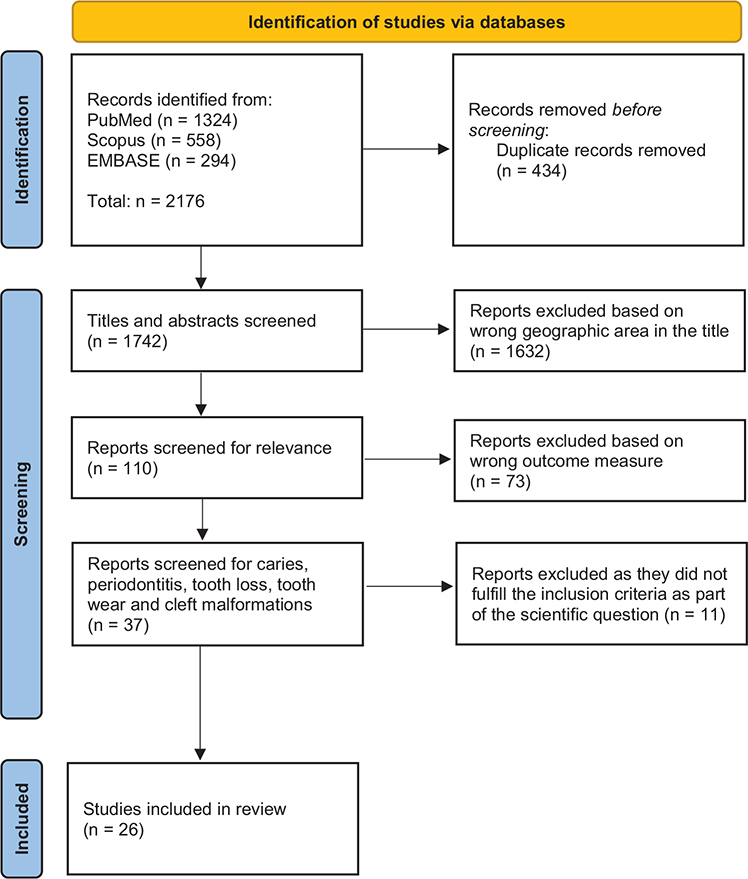
Figure 1. PRISMA study flow diagram.
REVIEW
Maria Bankvalla and Mats Jontellb
aDepartment of Odontology and Oral Sciences, School of Health and Welfare, University of Jönköping, Sweden; bDepartment of Oral Medicine and Pathology, Institute of Odontology, Sahlgrenska Academy University of Gothenburg, Sweden
Objective: Swedish smokeless tobacco, or ‘snus’, has a long history of use and has undergone significant transformations, including the introduction of portion-packed snus and tobacco-free nicotine pouches. This systematic review evaluates the impact of Swedish snus on oral health, focusing on gingivitis, gingival recession, periodontitis, caries, tooth wear, and oral cleft malformations.
Material and methods: The databases PubMed, Scopus, and EMBASE were used, terminating the searches on 11th June 2025. Original scientific articles written in the English or Scandinavian languages were screened by two independent researchers, finally including 26 out of 2,176 articles. The included articles were exported to the Elicit Pro library for quality assessment performed using the Joanna Briggs Institute’s Critical Appraisal Tool for Systematic Reviews. Premalignant and malignant changes were excluded from the search.
Results and conclusion: The findings indicate that Swedish snus is associated with gingival recession, particularly among users of loose snus, with mechanical pressure and cytotoxic effects contributing to these lesions. Gingivitis was more prevalent among snus users, even after controlling for plaque levels, though no significant association with periodontitis was observed. Evidence regarding caries risk was inconsistent, with some studies reporting higher caries indices values among snus users, while others found no correlation. Additionally, maternal use during pregnancy was linked to a 48% increased risk of oral cleft malformations in offspring. Tooth wear and self-reported temporomandibular disorder (TMD) symptoms were also associated with snus use. These findings underscore the importance of public health measures to regulate snus use, particularly among populations such as pregnant women and adolescents, where they have increased in popularity.
KEYWORDS: Health; Nicotine; Snus; Tobacco
Citation: ACTA ODONTOLOGICA SCANDINAVICA 2026; VOL. 85: 84–95. DOI: https://doi.org/10.2340/aos.v85.45421.
Copyright: © 2026 The Author(s). Published by MJS Publishing on behalf of Acta Odontologica Scandinavica Society. This is an Open Access article distributed under the terms of the Creative Commons Attribution 4.0 International License (http://creativecommons.org/licenses/by/4.0/), allowing third parties to copy and redistribute the material in any medium or format and to remix, transform, and build upon the material, with the condition of proper attribution to the original work.
Received: 30 December 2025; Accepted: 5 January 2026; Published: 06 February 2026.
CONTACT: Mats Jontell jontell@odontologi.gu.se Department of Oral Medicine and Pathology, Institute of Odontology, Sahlgrenska Academy, University of Gothenburg, PO Box 450, 405 30 Göteborg, Sweden
Funding: The authors received funding from the Haypp Group for updates on scientific information about Swedish smokeless tobacco. The Haypp Group has had no influence on the writing or content of the present systematic review.
Swedish smokeless tobacco, called ‘snus’, has a long-standing tradition, with documented use dating back to the 17th century [1]. The product has undergone significant transformations, evolving from an aristocratic luxury item in the 18th century to becoming a widely used tobacco product in Sweden but also abroad. A pivotal development occurred in the 1970s with the introduction of portion-packed snus, which enhanced the product’s accessibility and popularity. The snus market has experienced substantial changes in recent years, particularly through the introduction of new product categories. The traditional division between loose snus and portion snus has been complemented by tobacco-free nicotine pouches (so-called white snus) and products containing synthetic nicotine.
The development of different types of smokeless tobacco poses a challenge when it comes to studying its impact on oral health. It is complicated by factors such as brand, dose, exposure time, personal dental care, socio-economic status etc, where the latter has a particularly strong influence on oral diseases. Therefore, it is important to avoid generalizing smokeless tobacco and its impact on the oral cavity [2]. While smokeless tobacco is one of the most common causes of oral cancer in South Asia, it is uncommon for malignant changes to be caused by Swedish snus [3]. Even in the Western world, the use of smokeless tobacco differs. In the United States, moist snuff is used, which is fermented, possibly increasing the content of carcinogenic nitrosamines [4], as opposed to Swedish snus, which is pasteurized to reduce harmful bacteria and nitrosamines [5].
Except for Sweden, Swedish snus has been banned from the market in countries of the European Union since it has major health risks, but to what degree and to what extent has been extensively debated. The use of snus may impact the cardiovascular system by increasing blood pressure and impairing the vasodilatory function of blood vessels, but a direct association between snus use and the incidence of myocardial infarction or stroke has not been definitively established [2]. In addition, evidence suggests that individuals who use snus may be at an increased risk of developing type 2 diabetes compared to non-users [6]. In a recent comprehensive analysis on the use of Swedish snus and mortality, male snus users were found to have statistically significant increased mortality from all causes, cardiovascular diseases, and other causes [7]. However, the results have been questioned on methodological grounds [8]. In recent years major changes have emerged in the use of smokeless tobacco in both Scandinavia and the US with the introduction of oral tobacco-free nicotine pouches, which come in many flavors and are quickly gaining popularity and raising new public health concerns [2].
A number of systematic reviews have been published over the years, but since Kallischnigg et al., [9], no review has been published that specifically addresses snus and its effects on oral tissues. Kallischnigg et al. [9] provided suggestive evidence of an association of snus use with gingival recession and attachment loss, and of chewing tobacco with dental caries. Since then, several original articles have been published, which open avenues for new systematic reviews.
The present systematic review specifically addresses the impact of Swedish snus on gingivitis, gingival recession, periodontitis, caries, tooth wear, and oral cleft malformations. Oral premalignant and malignant diseases were not included, as the authors aim to return with a systematic review regarding these subject areas.
The protocol of this systematic review adheres to the recommendations by the PRISMA 2020 guidelines. It was registered on PROSPERO International Prospective Register of Systematic Reviews (CRD420251068717).
This systematic review included original scientific articles that specifically studied the association between Swedish snus and gingivitis, gingival recession, periodontitis, caries, tooth wear, and oral cleft malformations. A defined question was created, and the following framework was used:
Articles that dealt with smokeless tobacco used in the Middle East, South Asia, and Africa were excluded. Only articles written in English or Scandinavian languages were screened. Case reports, case series, animal studies, in vitro research, review articles, books, single abstracts, posters, article retractions, unavailable full-text studies, letters, comments, and editorials were not included as part of this review. No US studies were available that address the adverse effects of Swedish snus, presumably because there is limited market penetration of this type of smokeless tobacco in the US.
Searches were made using MeSH, keywords, and free-text terms in the title/abstract, adapted to fit each database separately. The searc strategy was compiled from general and specific search terms based on clinical experience as well as results from test searches. The databases PubMed, Scopus, and EMBASE were searched using the following query: (stomatognathic disease[Mesh] OR caries[tiab] OR cari*[tiab] OR gingiv*[tiab] OR saliva[tiab] OR periodont*[tiab] OR pain[tiab] OR taste[tiab] OR cleft[tiab] AND (snus[tiab] OR snus-like[tiab] OR snuff[tiab] OR nicotine pouches[tiab] OR smokeless tobacco[tiab] OR “Tobacco, Smokeless”[Mesh])) NOT (India[Title] OR Pakistan[Title] OR Nepal[Title] OR Saudi[Title] OR Sudan[Title] OR Middle East[Title] OR Asia[Title] OR Africa[Title] OR vitro[Title] OR cessation[Title]). When using citation searching, no further articles were retrieved. The overall search strategy was developed together with librarians at the University of Gothenburg’s Biomedical Library to maximize the sensitivity. The last search was terminated on the 11th June, 2025.
All eligible articles were exported to EndNote (version 21) to delete duplicates. All remaining articles were then exported to Rayyan [10] for screening independently at title and abstract level by two researchers (MB and MJ) against the inclusion criteria defined for the review. Thereafter, the decisions were de-blinded and cross-referenced. Conflicting decisions were discussed until consensus was reached. Where required, the full text was retrieved and exported back to EndNote as an attached PDF document and read before a decision was reached. Full-text studies that did not meet the inclusion criteria were excluded, and the reasons for exclusion were noted. The search results are presented in the PRISMA flow diagram (Figure 1). The final included PDF documents were exported to the Elicit Pro library [11]. Elicit Pro was used to tabulate the items in the framework mentioned above. These entries were manually checked in the separate PDFs.
Figure 1. PRISMA study flow diagram.
The quality assessments of the reviewed cross-sectional studies were performed using the Joanna Briggs Institute’s Critical Appraisal Tool for Systematic Reviews [12]. The tool uses eight critical questions related to criteria for inclusion, study subjects, exposure, measurement, confounding factors, outcomes, and statistical analysis. The three cohort studies were assessed by adding three questions to the cross-sectional tool that pertain to the follow-ups in the cohort studies. Two researchers (MB and MJ) independently assessed all included articles. The decisions were then cross-checked, and conflicting assessments were discussed and reviewed. Appraisal scores were calculated as the number of quality points received out of possible points for each respective study type, expressed as a percentage. Quality decisions and appraisal scores are presented in Table 1. Due to the limited material available for this topic, all studies were included regardless of quality, which ultimately affects the quality of the present review. Elicit Pro [11] was used to identify the specific sections in the PDFs that contained the answers to the critical questions.
Elicit Pro [11] assisted in the extraction of relevant data. The extracted characteristics were modified to fit all types of included studies and clarified to enable a better overview. Data extraction was performed by one researcher (MJ) and checked by another researcher (MB). The complete data extraction is presented in Table 2. Only data relevant to the study was extracted. To be able to compare the studies more clearly, the data was reported in the same way across all studies, where possible. However, there are exceptions as not all studies presented their data in the same way.
In total, 2,176 articles were retrieved from the three databases PubMed, Scopus, and EMBASE. After removing duplicates, 1,742 articles remained. Out of those, 110 articles passed the title and abstract screening, of which 26 fulfilled the inclusion criteria and were eligible for inclusion after full-text screening. The data extraction and selection process are presented in the PRISMA diagram (Figure 1).
The methodological quality ranged from 23 to 100 % between studies and 63 to 100 % within single studies (Table 1). The lowest score for a single item was 23 % and was due to the omission of the types of snus that the study participants used. This means that in close to three-quarters of the studies, it was not possible to relate the outcome measure to a specific type of snus. However, as the authors assumed there was a mixture of loose and portion-packed snus in the studies where the type of snus used was not specified, the figure would be significantly higher. In most studies, the study population was clearly described, but since they often represented specific populations, generalizability is limited due to potential selection bias. However, because of the low number of studies included, no articles were excluded after quality assessment regardless of appraisal score.
The included studies were conducted between 1980 and 2025 in English. Studies were published from Finland, Hungary, Norway, and Sweden, whereas there were no studies from countries outside of Europe. There was a dominance of articles from Sweden, and surprisingly no articles were published from Denmark, which also belongs to the Scandinavian countries. The studies varied in geographical location, including schools, universities, military facilities, sports facilities, a construction site, a shipping site, and public and private practices.
Patient data was retrieved from various sources such as interviews, questionnaires, clinical examination, radiographic assessment, saliva samples, pH measurement, impressions of the upper and lower jaw, and medical records from the Swedish population-based register, the SkaPa register (Svenskt kvalitetsregister för Karies och Parodontit), the Jönköping study register, and the Physical Activity and Nutrition in Children (PANIC) study register. Sample sizes ranged from 10 to 8,552 for caries, 80 to 1,674 for periodontitis and 585 to 1,086,213 for other conditions such as tooth wear and oral cleft malformations. There was a dominance of males in the study populations, where some studies did not include females at all. The age ranged from 12 to 70 years in studies related to caries and in studies related to periodontitis. For other conditions, this was not calculated because they represented single studies. The complete data extraction with study characteristics is presented in Table 2.
Among the studies there were contradictory results with regard to the increased risk of caries due to the use of Swedish snus even though the majority showed no correlation. This was also the case in studies of behavioral patterns.
The average salivary pH was significantly higher (p < 0.001) during the usage of snus and increased even more shortly after snus removal [13]. Also, saliva secretion rates were found to be higher in users of snus than in non-tobacco users [14], which was however not supported in the study by Hugosson et al., when studied over time [15]. The buffering capacity was not found to be different between snus users and non-snus users or the amount of streptococcus mutans or lactobacillus [14]. For the plaque pH, nicotine-containing snus increased it as opposed to nicotine-free products, which lowered the pH [16].
There was a positive correlation for DMFT (decayed, missing, filled teeth) and the number of years that snus had been used (p < 0.05) [17]. Also, Jacobsen et al. [18] supported this observation when studying DMFS (decayed, missing, filled surfaces) and reported an odds ratio (OR) of 1.57 (1.12–2.21). Most articles, however, did not find a positive correlation between snus and caries when assessing DFS (decayed, filled surfaces) [14, 15, 19] and DT (decayed teeth) [20, 21]. This lack of correlation was also observed over time [22].
The consumption of sports drinks is particularly common among those who exercise frequently, with studies showing that snus users, who tend to be more physically active, have higher consumption rates of sports drinks [21]. However, some physically active individuals and snus users demonstrate better dietary habits in other areas, such as lower intake of snacks between meals and less frequent consumption of cookies and buns [14, 23], which could help offset the cariogenic effects of sports drinks. The protective effect of exercise against caries may be partially explained by the fact that physically active individuals tend to have healthier behaviors overall, although this benefit can be compromised by the frequent consumption of carbohydrate-rich sports drinks and reduced salivary flow during prolonged physical activity [21].
The studies that were included showed that Swedish snus is associated with gingivitis and gingival recession but were not indicative of an increased risk of developing periodontitis.
No significant difference in Plaque Index (PLI) was observed between snus users and non-users [14, 19]. However, when examining the Gingival Index (GI), snus use showed a significant positive correlation after adjusting for plaque levels (p < 0.001; [24]). This association was further supported by Hellqvist and coworkers [14], who reported a mean ± SD for the GI of the full dentition of 20.4 ± 18.2 in snus users versus 14.4 ± 13.9 in non-users (p = 0.009). In the anterior maxillary region, the corresponding values were 14.9 ± 20.6 and 7.7 ± 11.9, respectively (p = 0.003).
In a questionnaire-based study, 60% of current snus users reported gum bleeding, compared to 37% among never-users (p = 0.04; [25]). In contrast, Trullenque-Eriksson et al. [26] found no significant association between snus use and marginal bleeding scores, a finding consistent with results from the cohort study by Rolandsson et al. [19] and the study by Montén et al. [27].
These were observed in only 2.9% of individuals using portion-bagged snus, compared to 23.5% among users of loose snus (p < 0.005) [28]. The form of the product, loose versus portioned snus, emerged as the factor associated with the highest relative risk (RR = 8.7, p < 0.009) for the development of caries. In a separate study, Rolandsson et al. [19] reported that 17% of snus users exhibited gingival recession, whereas none was observed among non-users. These recessions were most pronounced in the anterior region, typically corresponding to the site of snus placement. Kopperud et al. [29] similarly noted a 34% increase in the odds of gingival recession for each additional year of snus use. Supporting these findings, Montén et al. [27] reported an OR of 5.10 (95% confidence interval [CI]: 1.67–15.55), further indicating a significant association between snus use and gingival recession.
The following studies assessed probing pocket depth (PPD) as an indicator of periodontal disease in relation to snus use. Rolandsson et al. [19] measured PPD at four sites per tooth and reported no significant differences between snus users and non-users. No periodontal pockets deeper than 4 mm were observed. Similarly, Bergström et al. [30] also using four measurement sites per tooth, found that pockets exceeding 3 mm were rare, with a mean PPD of 1.94 mm. No statistically significant differences were noted between current snus users, former users, and non-users. Montén et al. [27], who measured PPD at six sites per tooth, likewise, found no significant differences between groups, with mean pocket depths of 2.3 mm among snus users and 2.4 mm among controls. Hugoson & Rolandsson [31] recorded PPD ≥ 4 mm as part of their periodontal assessment and concluded that snus use was not significantly associated with increased pocket depth, in contrast to smoking, which was linked to a higher prevalence of PPD ≥ 4 mm. The most recent study, by Trullenque-Eriksson et al. [26], defined PPD ≥ 6 mm at two or more teeth as a clinical marker of periodontitis. No significant association between snus use and increased PPD was found.
One population-based cohort study including 1,086,213 infants in Sweden, where 11 461 infants had mothers using snus, showed that use during early pregnancy increased the risk of oral cleft malformation (n = 31) by 48 % (OR 1.48; 95% CI 1.00–2.21) [32]. In contrast, in infants of mothers who stopped using snus before the antenatal booking, the corresponding risk was not increased (OR 0.71 95% CI 0.44–1.14). Overall, high maternal age (< 35 years), a Nordic country of birth, chronic hypertension or preeclampsia in the mother, multiple births, and infant male sex were associated with increased rates of oral cleft malformations, while pre-pregnancy diabetes was reported to reduce the rate.
Unexpectedly, the use of Swedish snus has been shown to be associated with other oral health problems as well. Snus has been associated with the increase of tooth wear based on data from 585 men and women (1:1), aged 20–80 years (p < 0.01; [33]). Furthermore, a reduced number of teeth, male sex, occurrence of bruxism, increasing age, and a reduced saliva buffer capacity influenced the degree of incisal and occlusal wear.
Also, the use of snus has been associated with self-reported temporomandibular disorders (TMD) symptoms in a group of predominantly Finnish male conscripts increasing the risk for all TMD symptoms, especially for facial pain (OR 1.36 95% CI 1.18–1.58) but not jaw clicking [34].
The present systematic review was performed to assess the potential adverse effect of Swedish snus as a contributor to certain non-malignant oral conditions. We recognize the influence of socio-economic status, which has not been the focus of this study, and acknowledge this as important to highlight in future studies. Regarding caries, DMFT values were found to be significantly higher (p < 0.001) in Swedish snus users compared to non-users [17]. The authors acknowledge that confounding factors such as diet, oral hygiene, and exposure to fluoride may have contributed to the results. In the review by Kallischnigg et al. [9], this study was also identified, but since then no systematic review that specifically addresses Swedish snus and its potential to contribute to caries development has been published. A more recent and comprehensive study [18] using a multivariate regression analysis, indicated that use of Swedish snus showed a strong independent association with prevalence of manifest dental caries. The time difference between this study and the study by Hirsch et al. does not indicate that portion snus is less carcinogenic than loose snus as from the 1990s onward, the use of portion snus increased steadily, particularly among younger users and women. It is noteworthy that some nicotine-free products contained up to 6.5% low-molecular-weight carbohydrates and 26.0% starch, which creates the conditions for dental caries [16]. However, most articles [13–16, 19–23, 35] did not find any statistically significant correlation between Swedish snus and an increased risk of developing caries. Since there are no studies of white snus or tobacco-free snus, it is not possible to evaluate the risk of caries.
There is substantial evidence that the use of Swedish snus is associated with gingival recession [19, 27–31, 36, 37]. In the study by Andersson and Axéll [28], gingival recession associated with snus use was identified in 23.5% of the individuals among users of loose snus and in only 2.9% among users of portion-packed snus. This result is also indirectly supported by Hugoson and Rolandsson [31], who found a decreased incidence of gingival recession over time even though they did not specify the number of loose snus and portion-packed snus users, given the fact that the use of portion-packed snus was more common in 2003 compared to 1993. Montén et al. [27] reported an even higher prevalence of gingival recession, 42% among snus users compared to 17% in non-users, even though a larger proportion of users in their cohort likely consumed portion-packed snus. The discrepancy between these findings may be attributed to differences in the definition or clinical criteria of gingival recession. In a binary logistic regression model, Kopperud et al. [29] found that the odds of exhibiting gingival recession increased by 34% for each additional year of snus use. Notably, the occurrence of gingival recession appears to be independent of oral hygiene status [27, 29], supporting the hypothesis that both mechanical pressure and the cytotoxic effects of snus contribute to the development of these lesions.
Although the presence of plaque and gingivitis does not necessarily result in periodontitis, it is nonetheless important to eliminate chronic inflammatory conditions, as these may hypothetically contribute to other adverse health outcomes [38]. In the present review, users of snus exhibited significantly higher levels of gingivitis (as measured by the GI) compared to non-users, even after controlling for plaque levels (plaque index) [14, 24]. These findings are noteworthy, as they suggest that snus may independently induce gingival inflammation. In the study conducted by Modéer and colleagues in 1980, the participants were likely to have predominantly used loose snus, whereas in the 2015 study by Hellqvist et al., the opposite is presumed. However, data are conflicting as no association between Swedish snus and gingivitis has also been reported [27, 31].
Gingival recessions should not be conflated with periodontitis, as was unfortunately the case in a recently published systematic review and meta-analysis on smokeless tobacco and periodontitis [39]. Periodontitis arises from a complex interplay of risk factors, among which dental plaque plays a central role [40]. In the systematic review by Kallischnigg et al. [9] covering scientific papers from 1963 to 2007, none of the included studies on Swedish snus and periodontal disease showed any significant correlation [27, 30, 36]. Two additional studies from that time period were not indicative of periodontal disease [41, 42]. Since then, the cohort study by Trullenque‐Eriksson et al. [26], including subjects followed between 23 and 31 years, did not report any increased incidence of periodontitis, although the periodontitis was assessed solely on the presence of deep periodontal probing (PPD). In 1983, an association between PPD > 4 mm and snus use (OR = 3.98; p = 020) was reported by Hugosson and Rolandsson [31], but this association was not found in the analyses from 1993 or 2003.
The finding that maternal snus use during pregnancy is associated with an increased risk of oral cleft malformations in offspring is of considerable concern [32]. Compared to non-users, snus users were in the study more likely to be teenage mothers. Furthermore, in 2023, 26% of upper secondary school students in Sweden reported current use of snus, compared to 13% in 2012 – the lowest recorded level. The increase has been particularly marked among female students, with the prevalence of snus use rising from 4% to 21% over the past decade [43]. The newer tobacco-free form of snus now predominates and contains nicotine levels comparable to those found in traditional snus, the compound that Gunnerbeck and colleagues [32] identified as the most plausible teratogenic agent. These findings underscore the critical importance of enforcing existing regulations, including the minimum legal age of 18 years and the prohibition on marketing targeting individuals under the age of 25. Furthermore, considering its teratogenicity, snus should not be recommended as a safe alternative to smoked tobacco products.
This systematic review highlights the need for further research on newer tobacco-free nicotine products and their potential oral health risks since they have increased in popularity especially among women [44] and teenagers [45]. These findings underscore the importance of public health measures to regulate snus use, particularly among populations such as pregnant women and adolescents.
[1] Jonson M. Snus! : historia, märken, tillverkning & konsten att snusa. 7e upplagan edn: Bokförlaget Semic: Stockholm; 2017.
[2] Dennison Himmelfarb CR, Benowitz NL, Blank MD, Bhatnagar A, Chase PJ, Davis EM, et al. Impact of smokeless oral nicotine products on cardiovascular disease: implications for policy, prevention, and treatment: a policy statement from the American Heart Association. Circulation. 2025;151:e1–21. https://doi.org/10.1161/CIR.0000000000001293
[3] Siddiqi K, Husain S, Vidyasagaran A, Readshaw A, Mishu MP, Sheikh A. Global burden of disease due to smokeless tobacco consumption in adults: an updated analysis of data from 127 countries. BMC Med. 2020;18:222. https://doi.org/10.1186/s12916-020-01677-9
[4] Karati D, Mukherjee S, Das S, Saha A. Unraveling nitrosamine-induced carcinogenesis: toxicological aspects and molecular insights. Toxicol Mech Methods. 2025:1–20. https://doi.org/10.1080/15376516.2025.2584504
[5] Song MA, Marian C, Brasky TM, Reisinger S, Djordjevic M, Shields PG. Chemical and toxicological characteristics of conventional and low-TSNA moist snuff tobacco products. Toxicol Lett. 2016;245:68–77. https://doi.org/10.1016/j.toxlet.2016.01.012
[6] Carlsson S, Andersson T, Araghi M, Galanti R, Lager A, Lundberg M, et al. Smokeless tobacco (snus) is associated with an increased risk of type 2 diabetes: results from five pooled cohorts. J Intern Med. 2017;281:398–406. https://doi.org/10.1111/joim.12592
[7] Byhamre ML, Araghi M, Alfredsson L, Bellocco R, Engström G, Eriksson M, et al. Swedish snus use is associated with mortality: a pooled analysis of eight prospective studies. Int J Epidemiol. 2021;49:2041–50. https://doi.org/10.1093/ije/dyaa197
[8] Rodu B, Plurphanswat N. Heterogeneity and other problems in a pooled analysis of snus use and mortality. F1000Res. 2021;10:388.
[9] Kallischnigg G, Weitkunat R, Lee PN. Systematic review of the relation between smokeless tobacco and non-neoplastic oral diseases in Europe and the United States. BMC Oral Health. 2008;8: 1-20 https://doi.org/10.1186/1472-6831-8-13
[10] Ouzzani M, Hammady H, Fedorowicz Z, Elmagarmid A. Rayyan-a web and mobile app for systematic reviews. Syst Rev. 2016;5:210. https://doi.org/10.1186/s13643-016-0384-4
[11] Elicit. Elicit: the AI research assistant. Pro version. 2023. Available from: https://elicit.com [cited June 7th, 2025]
[12] Moola S, Tufanaru C, Aromataris E, Sears K, Sfetcu R, Currie M, et al. Systematic reviews of etiology and risk. In: Aromataris E, Lockwood C, Porritt K, Pilla B, Jordan Z, editors. JBI: Adelaide, South Australia. JBI manual for evidence synthesis. 2020.
[13] Andersson G, Warfvinge G. The influence of pH and nicotine concentration in oral moist snuff on mucosal changes and salivary pH in Swedish snuff users. Swed Dent J. 2003;27:67–75.
[14] Hellqvist L, Rolandsson M, Hugoson A, Lingström P, Birkhed D. Dental caries and associated factors in a group of Swedish snus users. Swed Dent J. 2015;39:47–54.
[15] Hugoson A, Hellqvist L, Rolandsson M, Birkhed D. Dental caries in relation to smoking and the use of Swedish snus: epidemiological studies covering 20 years (1983–2003). Acta Odontol Scand. 2012;70:289–96. https://doi.org/10.3109/00016357.2011.654247
[16] Hellqvist L, Boström A, Lingström P, Hugoson A, Rolandsson M, Birkhed D. Effect of nicotine-free and nicotine-containing snus on plaque pH in vivo. Swed Dent J. 2012;36:187–94.
[17] Hirsch JM, Livian G, Edward S, Noren JG. Tobacco habits among teenagers in the city of Göteborg, Sweden, and possible association with dental caries. Swed Dent J. 1991;15:117–23.
[18] Jacobsen ID, Eriksen HM, Espelid I, Schmalfuss A, Ullbro C, Crossner CG. Prevalence of dental caries among 16-year-olds in Troms County, Northern Norway. Swed Dent J. 2016;40:191–201.
[19] Rolandsson M, Hellqvist L, Lindqvist L, Hugoson A. Effects of snuff on the oral health status of adolescent males: a comparative study. Oral Health Prev Dent. 2005;3:77–85.
[20] Methuen M, Kauppinen S, Suominen AL, Eloranta AM, Väistö J, Lakka T, et al. Dental caries among Finnish teenagers participating in physical activity and diet intervention: association with anthropometrics and behavioural factors. BMC Oral Health. 2021;21:333. https://doi.org/10.1186/s12903-021-01690-1
[21] Päkkilä J, Anttonen V, Patinen P, Nyman K, Valkeapää K, Birkhed D, et al. Profiling of smokers and snuffers among young Finnish men – cross-sectional epidemiological study. Acta Odontol Scand. 2017;75:577–83. https://doi.org/10.1080/00016357.2017.1361548
[22] Petersson GH, Twetman S. Tobacco use and caries increment in young adults: a prospective observational study. BMC Res Notes. 2019;12:218. https://doi.org/10.1186/s13104-019-4253-9
[23] Huttunen M, Kämppi A, Soudunsaari A, Päkkilä J, Tjäderhane L, Laitala ML, et al. The association between dental caries and physical activity, physical fitness, and background factors among Finnish male conscripts. Odontology. 2023;111:192–200. https://doi.org/10.1007/s10266-022-00717-5
[24] Modéer T, Lavstedt S, Ahlund C. Relation between tobacco consumption and oral health in Swedish schoolchildren. Acta Odontol Scand. 1980;38:223–7. https://doi.org/10.3109/00016358009003493
[25] Németh O, Sipos L, Mátrai P, Szathmári-Mészáros N, Iványi D, Simon F, et al. Snus use in adolescents: a threat to oral health. J Clin Med. 2024;13. https://doi.org/10.3390/jcm13144235
[26] Trullenque-Eriksson A, Derks J, Andersson JS. Onset of periodontitis – a registry-based cohort study. Clin Oral Investig. 2023;27:2187–95.
[27] Montén U, Wennström JL, Ramberg P. Periodontal conditions in male adolescents using smokeless tobacco (moist snuff). J Clin Periodontol. 2006;33:863–8. https://doi.org/10.1111/j.1600-051X.2006.01005.x
[28] Andersson G, Axéll T. Clinical appearance of lesions associated with the use of loose and portion-bag packed Swedish moist snuff: a comparative study. J Oral Pathol Med. 1989;18:2–7.
[29] Kopperud SE, Ansteinsson V, Mdala I, Becher R, Valen H. Oral lesions associated with daily use of snus, a moist smokeless tobacco product. A cross-sectional study among Norwegian adolescents. Acta Odontol Scand. 2023;81:473–8. https://doi.org/10.1080/00016357.2023.2178502
[30] Bergström J, Keilani H, Lundholm C, Rådestad U. Smokeless tobacco (snuff) use and periodontal bone loss. J Clin Periodontol. 2006;33:549–54. https://doi.org/10.1111/j.1600-051X.2006.00945.x
[31] Hugoson A, Rolandsson M. Periodontal disease in relation to smoking and the use of Swedish snus: epidemiological studies covering 20 years (1983–2003). J Clin Periodontol. 2011;38:809–16. https://doi.org/10.1111/j.1600-051X.2011.01749.x
[32] Gunnerbeck A, Edstedt Bonamy AK, Wikström AK, Granath F, Wickström R, Cnattingius S. Maternal snuff use and smoking and the risk of oral cleft malformations – a population-based cohort study. PLoS One. 2014;9:e84715. https://doi.org/10.1371/journal.pone.0084715
[33] Ekfeldt A, Hugoson A, Bergendal T, Helkimo M. An individual tooth wear index and an analysis of factors correlated to incisal and occlusal wear in an adult Swedish population. Acta Odontol Scand. 1990;48:343–9.
[34] Miettinen O, Anttonen V, Patinen P, Päkkilä J, Tjäderhane L, Sipilä K. Prevalence of temporomandibular disorder symptoms and their association with alcohol and smoking habits. J Oral Facial Pain Headache. 2017;31:30–6. https://doi.org/10.11607/ofph.1595
[35] Tanner T, Kämppi A, Päkkilä J, Järvelin MR, Patinen P, Tjäderhane L, et al. Association of smoking and snuffing with dental caries occurrence in a young male population in Finland: a cross-sectional study. Acta Odontol Scand. 2014;72:1017–24.
[36] Wickholm S, Söder PO, Galanti MR, Söder B, Klinge B. Periodontal disease in a group of Swedish adult snuff and cigarette users. Acta Odontol Scand. 2004;62:333–8. https://doi.org/10.1080/00016350410001801
[37] Alizadehgharib S, Lehrkinder A, Alshabeeb A, Östberg AK, Lingström P. The effect of a non-tobacco-based nicotine pouch on mucosal lesions caused by Swedish smokeless tobacco (snus). Eur J Oral Sci. 2022;130:e12885. https://doi.org/10.1111/eos.12885
[38] Franks AL, Slansky JE. Multiple associations between a broad spectrum of autoimmune diseases, chronic inflammatory diseases and cancer. Anticancer Res. 2012;32:1119–36.
[39] Quadri MFA, Kamel AM, Nayeem M, John T, Thacheril A, Tartaglia G, et al. Smokeless tobacco and periodontitis: a systematic review with meta-analysis. J Periodontal Res. 2024;59:1062–70. https://doi.org/10.1111/jre.13274
[40] Papapanou PN, Sanz M, Buduneli N, Dietrich T, Feres M, Fine DH, et al. Periodontitis: consensus report of workgroup 2 of the 2017 world workshop on the classification of periodontal and peri-implant diseases and conditions. J Clin Periodontol. 2018;45
[41] Källestål C, Uhlin S. Buccal attachment loss in Swedish adolescents. J Clin Periodontol. 1992;19:485–91. https://doi.org/10.1111/j.1600-051X.1992.tb01161.x
[42] Wouters FR, Salonen LW, Frithiof L, Helldén LB. Significance of some variables on interproximal alveolar bone height based on cross-sectional epidemiologic data. J Clin Periodontol. 1993;20:199–206. https://doi.org/10.1111/j.1600-051X.1993.tb00344.x
[43] Zetterqvist M. CAN:s nationella skolundersökning 2023. In: Thor S, editor. Stockholm: Centralförbundet för alkohol- och narkotikaupplysning (CAN). 2023.
[44] Folkhälsomyndigheten. Vuxnas bruk av tobaks- och nikotinprodukter. 2023. p. 1–11.
[45] Folkhälsomyndigheten. Ungas bruk av tobaks- och nikotinprodukter. 2023. p. 1.