ORIGINAL ARTICLE
Continuous tobacco smoking increases mortality in diffuse large B-cell lymphoma but not follicular lymphoma, a Finnish population-based study
Taina Reunamoa,b  , Erika Alannea,b,c , Toni Mikkolad , Antti Karlssone,f , Antti Ellonena,b , Tarja Laitineng , Maarit Bärlundd,h , Pia Österlundd,h , Heikki Minne , Sirpa Leppäi,j , Sirkku Jyrkkiöa,b and Eetu Heerväa
aDepartment of Oncology, Turku University Hospital and University of Turku, Turku, Finland; bWellbeing services county of Southwest Finland, Turku, Finland; cWestern Finland Cancer Centre, Turku, Finland; dDepartment of Oncology and Tays Cancer Center, Tampere University Hospital, Wellbeing Services County of Pirkanmaa, Tampere, Finland; eUniversity of Turku, Turku, Finland; fPihlajalinna Oyj, Tampere, Finland; gInstitute for Molecular Medicine Finland, University of Helsinki, Helsinki, Finland; hFaculty of Medicine and Health Technology, University of Tampere, Tampere, Finland; iDepartment of Oncology and Research Programs Unit, Faculty of Medicine, University of Helsinki, Helsinki, Finland; jComprehensive Cancer Centre, Helsinki University Hospital, Helsinki, Finland
ABSTRACT
Background and purpose: Tobacco smoking was prognostic in B-cell lymphomas in the pre-rituximab era, but the association with modern treatment, stage, subtypes, and survival outcomes remains unclear.
Patient/material and methods: All patients with diffuse large B-cell lymphoma (DLBCL) and follicular lymphoma (FL) from Turku and Tampere University Hospitals 2009–2019 were identified. Population-based data from electronic medical records included demographics, tumour histology, Ann Arbor staging, and treatments. Smoking status was extracted with a deep learning-based natural language processing algorithm. Kaplan–Meier overall survival (OS) estimates and adjusted hazard ratios (HRs) were calculated.
Results: With a median follow-up of 96 months, 1,258 patients with DLBCL and 529 with FL were included. In DLBCL, the 5-year OS rate was 61%, 53%, and 45% among never, former, and persistent smokers, respectively. Persistent smoking remained an independent prognostic factor for shorter OS, HR 1.27 (95% confidence interval 1.10–1.60) after adjustment for comorbidities and completed treatment. The prognosis of FL was indolent with no difference in OS regardless of smoking status, with 5-year OS rates of 79%, 75%, and 74% among never, former, and persistent smokers, respectively. Smokers were younger at diagnosis, while other baseline demographics were similar. No differences in the systemic therapy use were observed between the different smoking categories in both FL and DLBCL.
Interpretation: Overall and lymphoma-specific mortality is increased in persistent smokers with DLBCL compared with never smokers. Smoking prevention and cessation support remains of utmost importance.
KEYWORDS: Tobacco smoking; diffuse large B-cell lymphoma; follicular lymphoma; real word data
Citation: ACTA ONCOLOGICA 2025, VOL. 64, 1680–1687. https://doi.org/10.2340/1651-226X.2025.44776.
Copyright: © 2025 The Author(s). Published by MJS Publishing on behalf of Acta Oncologica. This is an Open Access article distributed under the terms of the Creative Commons Attribution 4.0 International License (http://creativecommons.org/licenses/by/4.0/).
Received: 9 September 2025; Accepted: 4 December 2025; Published: 17 December 2025
CONTACT: Taina Reunamo taina.reunamo@varha.fi Department of Oncology, Turku University Hospital and University, Hämeentie 11, FIN-20521 Turku, Finland
Supplemental data for this article can be accessed online at https://doi.org/10.2340/1651-226X.2025.44776
Competing interests and funding: The authors report there are no competing interests to declare.
Introduction
Diffuse large B-cell lymphoma (DLBCL) is an aggressive lymphoid B-cell cancer and the most common lymphoma entity [1]. The standard DLBCL treatment is immunochemotherapy (ICT) containing the anti-CD20 antibody rituximab with a combination of cyclophosphamide, doxorubicin, vincristine, and prednisolone (R-CHOP regimen). In selected cases, dose-intensifications and consolidation radiotherapy may be offered [2–5]. R-CHOP regimen is considered curative, offering a complete response in 73%–82% of patients and resulting in 5-year overall survival (OS) rates of 60%–70% [6–10]. Reduced dose R-mini-CHOP is well- tolerated and has yielded clinically meaningful disease control in the elderly and frail patients [11]. Substantial improvements in survival rates compared with the R-CHOP regimen have not been clearly shown, regardless of intensive research with novel agents [12–14].
The more indolent-course follicular lymphoma (FL) is the second most common lymphoma subtype, with 5-year OS rates being up to 93% [1, 15]. The treatment strategies for FL vary according to clinical presentation from observation of asymptomatic patients to CD20 immunotherapy alone, or ICT for patients needing more aggressive treatment [16].
Data on post-diagnosis survival in DLBCL and FL relative to tobacco smoking are scarce. Retrospective questionnaire-based studies assessing this relationship were mostly conducted before the rituximab era [17–21]. Studies included heterogeneous groups of non-Hodgkin lymphomas and showed an impaired OS in patients with the most pack years smoked compared to never smokers. Subgroup analysis of patients with FL suggested that smoking impairs their OS [18, 20, 22]. while among patients with DLBCL, no differences were reported [17–20]. Only one study about smoking and survival during the rituximab era has been published: Among Australian patients with FL, smoking increased overall and lymphoma-specific mortality compared to never smokers in a dose-dependent manner [22]. In addition to these reports, smoking has also been suggested to increase the risk of developing FL [22–26], especially in women [25,26], but whether smoking increases the incidence of DLBCL is debatable [24–26].
Even though the literature is suggestive for a link between smoking status and outcome in B-cell lymphoma, a research gap exists. Population-based OS in B-cell lymphomas from Finland has been reported as low as 50%, clearly suggesting that treatment intensity and precise B-cell lymphoma diagnosis must be considered [9–10, 27]. Multiple smoking-related comorbidities may confound the lymphoma-specific outcomes [21, 28], along with other lifestyle factors [17–19, 29].
The aim of the current study was to analyse the impact of smoking status on crude and demographic/treatment-adjusted overall and lymphoma-specific survival (LSS) in patients with DLBCL and FL population-based.
Patients/material and methods
Study permissions
The study was approved by the Finnish Social and Health Data Permit Authority ‘Findata’ (THL529_14.02.00_2022). According to Finnish legislation, patients’ informed consent is not required for the secondary use of health and social data for register-based research. Local Institutional Review Board permissions and informed consent were not required for retrospective use of health records. Administrative permission was obtained from Turku University Hospital (T132/2019) and Tampere University Hospital (R19582, 1575/2021).
Findata maintains a secure data analysis and storaBaseline demographics in DLBCL accordingge environment (https://findata.fi/en/). The datasets were combined, and the personal data of study patients were processed and analysed in this secure and highly regulated environment. After anonymisation, only the aggregated summary statistics were released.
Study population
The study population consisted of all patients with DLBCL and FL, diagnosed histologically during 2009–2019, identified at two Finnish University Hospitals, Turku and Tampere (catchment populations 480,000 and 540,000 inhabitants, respectively). These university hospitals cover all active treatments in their regions, while neighbouring smaller regions may refer additional selected lymphoma patients for radiotherapy, high-dose chemotherapy, or autologous stem cell transplantation.
Both hospitals have electronic medical record systems covering pathology, ICD-10 diagnoses, surgery, radiotherapy, and systemic anticancer treatments. Additionally, both hospitals have ‘data lakes’ in which data from different health care software systems can be combined and reorganised using patients’ unique social security number.
These two hospital data lakes were combined in a Findata analysis platform. Then, dates and causes of death were obtained from nationwide registry Statistics Finland at the cut-off of December 2022. Patients diagnosed at autopsy (n = 24) were excluded. Nine patients had both DLBCL and FL simultaneously and were classified as DLBCL.
Data collection
To determine the smoking status, a natural language processing model as described previously was used [30, 31]. In short, all sentences specific to tobacco smoking were extracted from the medical narrative using a rule-based algorithm. The sentences were then further classified into three classes: persistent, former or never smoker. The deep learning network classifies all sentences at the patient level covering the entire observational period (2009–2019) and ultimately classifies the patient either as a never, former, or persistent smoker based on probability logic. Former smokers include patients who quit before or after cancer diagnosis. We reported earlier accuracy of 0.92, 0.78, and 0.92 for never, former, and persistent smokers, respectively [27].
Clinical variables collected included all ICD-10 codes, ECOG (Eastern Cooperative Oncology Group) performance status, and body mass index (BMI). Comorbidities were assessed using ICD-10 codes for the Charlson Comorbidity Index [32], where an index of 0 means lack of comorbidities. Ann Arbor stage (I–IV) was obtained directly from medical records.
Electronic chemotherapy charts were available from 2009 in Turku, but from 2012 in Tampere, with some missing information. The exact regimen could not be specified among 86 (7%) patients with DLBCL and 47 (9%) with FL. Total radiation doses (Gy) and target organ of radiotherapy were available. A radiotherapy dose of at least 30 Gy for DLBCL [3, 4] or 24 Gy for FL [16] was considered as a part of curative intent treatment and lower doses as palliative care.
Statistics
Baseline demographics between never, former, and persistent smokers were compared with the Bonferroni-adjusted Chi-square method. OS was defined from the histological lymphoma diagnosis to death and LSS to death from lymphoma or leukaemia (C81-85 and C91-97), while other deaths were censored. Median survival and 5-year survival rates were estimated with the Kaplan–Meier method and hazard ratios (HRs) with the 95% confidence interval (CI) were calculated with Cox regression. The Cox proportional hazards assumption was assessed visually for crossing of the survival curves and no violations were observed. Median follow-up was calculated with the reverse Kaplan–Meier method. Missing data was apparently not random (Supplementary Table 2), and was forced into the multivariable model as ‘not available’. All statistical analyses were performed with SPSS version 27 (IBM Armonk, NY).
Results
DLBCL population
A total of 1,258 patients with DLBCL were identified. Datasets from Tampere and Turku were comparable (Supplementary Table 1), but Tampere had more missing data regarding smoking status (30% vs. 13%), stage (27% vs. 8%), and systemic regimens given (12% vs. 0%). Patients from Tampere had better ECOG performance status (ECOG 0–1 in 67% vs. 59%) but more comorbidities (57% vs. 47%) compared to patients from Turku.
Once combined (Supplementary Table 2), the median age of the cohort was 69 years, 76% of patients were aged over 60 years, 54% were male, and Ann Arbor stage was III–IV in 67% of the patients. Systemic therapy was initiated to 909 patients, ICT for at least six cycles for 489, and best supportive care or radiotherapy only in 349, whereas treatment was unclassified among 86 patients. Smoking status was available for 978 (78%) patients with DLBCL. Compared to DLBCL patients with known smoking status (Supplementary Table 2), those with unknown smoking status were typically older women (26% vs. 42% >75 years) receiving best supportive care or with unknown treatment information.
Baseline demographics and treatment of DLBCL according to smoking status
Among patients with DLBCL, 563 (58%) were never, 229 (23%) former, and 186 (19%) persistent smokers. At diagnosis (Table 1), males smoked more frequently. Persistent smokers were younger at diagnosis compared to never smokers (age over 60 years 66% vs. 74%, and over 75 years 13% vs. 30%). Ann Arbor stage and ECOG performance status were equally distributed between the groups. Persistent smokers had more comorbidities than never smokers.
No differences for systemic treatment or radiotherapy proportions were seen based on smoking status (Supplementary Table 3). Among never, former, and persistent smokers, 447 (79%), 183 (80%), and 135 (73%) were fit for systemic treatment, respectively, and 58%, 57%, and 59% completed six cycles of ICT. No differences were observed in the systemic regimens, number of cycles, or consolidation/palliative radiotherapy use between the different smoking groups.
Smoking status and survival in DLBCL
During the median follow-up time of 96 months (interquartile range [IQR] 66–128 months), 662 patients had died, of which 523 died due to lymphoma or leukaemia, followed by cardiovascular causes among smokers (Supplementary Table 5). Five-year OS rates were 61%, 53%, and 45% for never, former, and persistent smokers, respectively (Figure 1A). The 5-year OS rate was 36% for those with unknown smoking status and 52% for the entire DLBCL cohort. For patients initiating systemic treatment (n = 762), the OS rates were 70%, 59%, and 53% (Supplementary Figure 1A), respectively. The 5-year OS rate was 46% among those with unknown smoking status and 62% in the whole respective cohort.
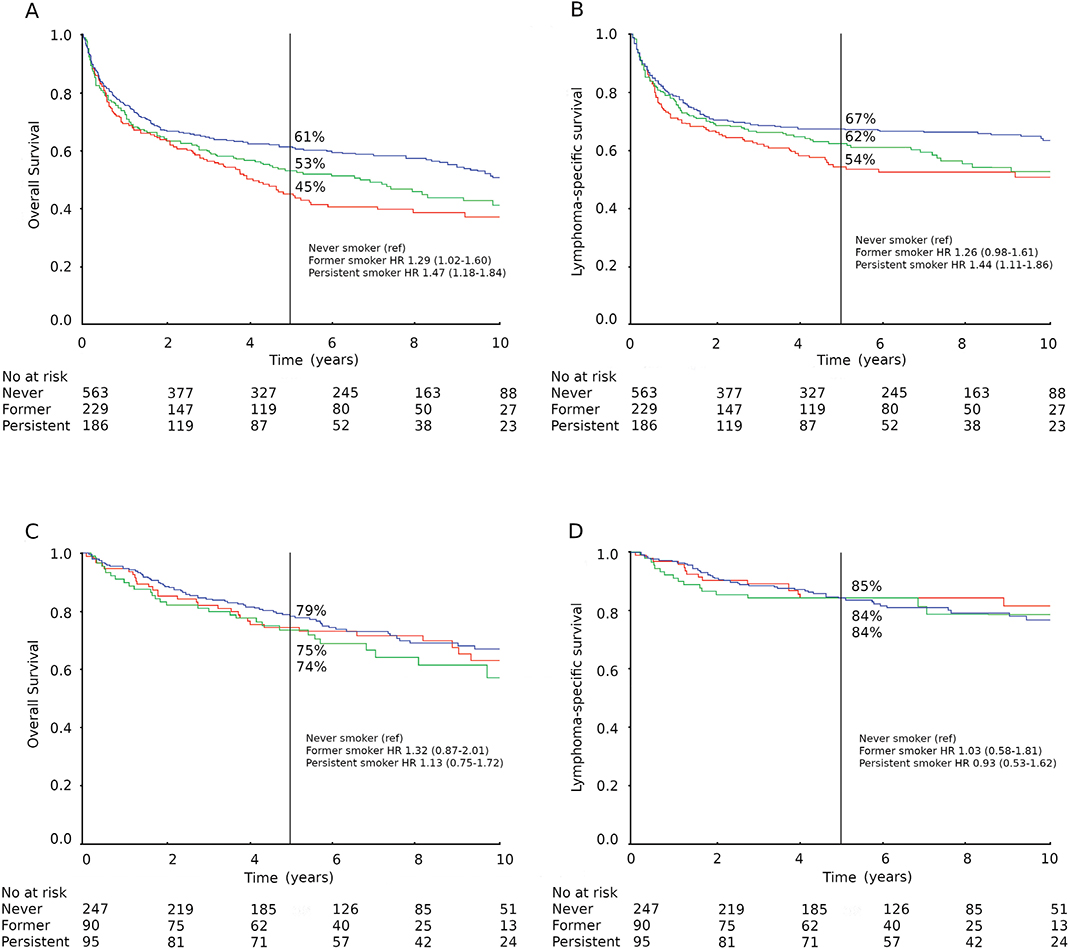
Figure 1. Survival according to smoking status. DLBCL (upper panel A and B) and FL (lower panel C and D), with overall survival (left A and C) and lymphoma-specific survival (right B and D). Never smokers (blue); former smokers (green); persistent smokers (red).
The longest median OS (mOS) was observed in never smokers with DLBCL (Figure 1A); mOS was 128, 81, and 50 months for the never, former, and persistent smokers, respectively. mOS was 17 months among those with unknown smoking status and 72 months in the whole DLBCL cohort.
Multivariate Cox regression analysis was performed for OS. After adjustment for sex, age, ECOG performance status, Charlson Comorbidity Index, Ann Arbor stage, and the use of systemic therapy (Table 2), persistent smoking impaired OS independently with HR 1.29 (95% CI 1.05–1.63), and former smoking with HR 1.10 (0.88–1.37) compared to never smokers.
Five-year LSS rates were 67%, 62%, and 54% for never, former, and persistent smokers, respectively (Figure 1B). For patients initiating systemic treatment (n = 762), the respective LSS rates were 75%, 66%, and 61% (Supplementary Figure 1B). The longest median LSS (mLSS) was observed in never smokers (Figure 1B). After multivariable adjustment (Table 2), persistent smoking did not reach statistical significance, with HR 1.25 (0.96–1.63), and neither did former smoking, with HR 1.10 (0.85–1.42).
FL population
FL was diagnosed in 529 patients, with smoking status known for 432 (82%). The datasets for Turku and Tampere were comparable (Supplementary Table 1), but a larger proportion of missing smoking status, stage, BMI, and treatment records were observed in Tampere compared with Turku. Patients from Tampere were older.
In the combined FL cohort, the median age was 67 years, 72% were aged over 60 years at diagnosis, and 47% were male. Ann Arbor stage was III–IV in 67% of the patients (Supplementary Table 2).
Patients with FL and unknown smoking status were comparable to those with known smoking status (Supplementary Table 2), with the exception that best supportive care or missing treatment records were more common among those with unknown smoking status, also information on stage and BMI were more often missing in patients with unknown smoking status.
Baseline demographics and treatments in FL according to smoking status
A total of 247 (57%) patients with FL were never smokers, 90 (21%) former, and 95 (22%) persistent (Table 3). Persistent smokers were younger at diagnosis compared to never smokers (age over 60 years 55% vs. 75%, and over 75 years 8% vs. 26%). BMI ≤22 kg/m2 was most common among persistent smokers. Systemic anticancer treatment was initiated for 166 (69%) never, 57 (65%) former, and 57 (60%) persistent smokers. No statistically significant differences for systemic treatment or radiotherapy proportions were seen based on smoking status (Supplementary Table 4).
Smoking status and survival in FL
During a median follow-up time of 97 months, 147 patients had died, 94 from lymphoma/leukaemia, followed by other cancers or cardiovascular causes (Supplementary Table 5). Sixteen patients (12 never smokers) with FL developed DLBCL during the follow-up. Regardless of smoking status, no difference in 5-year OS rates was observed, 79%, 75%, and 74% for never, former, and persistent smokers, respectively (Figure 1C). Five-year OS rate was 80% for those with unknown smoking status and 77% for all FL patients. mOS or mLSS were not reached, but survival did not differ between smoking status groups (Figure 1C, D).
After multivariate adjustment for sex, age, ECOG performance status, Charlson Comorbidity Index, Ann Arbor stage and treatment, OS, and LSS were unaffected by smoking status (Table 4).
Discussion and conclusion
In the current study, multiple data sources were combined with a unique patient identifier, to demonstrate the fact that patients with DLBCL who continue to smoke have the worst OS and borderline significant LSS compared to never smokers, while former smokers remain in-between. Five-year OS rate was reduced from 61% to 45% and LSS from 67% to 54% among never and persistent smokers, respectively. Persistent smoking independently impaired mOS regardless of age, sex, Ann Arbor stage, ECOG performance status, comorbidities, and administration of systemic therapy.
Previous questionnaire-based studies on tobacco smoking and prognosis of DLBCL included between 120 and 338 patients as compared to 978 patients in the current population-based dataset, where smoking status was retrieved automatically from electronic medical records [17–20]. However, we recognize that smoking status was missing from 22% of the DLBCL patients; this group showed the poorest survival.
The 5-year OS rate of 59% in our study is comparable to 60%–70% observed in previous studies including only patients receiving R-CHOP-based treatment [7, 8, 10]. As compared to the Swedish DLBCL population from 2007 to 2014 [9], 55% of patients had stage III–IV disease (67% in our study), 23% ECOG performance status 2–4 (27% here), and 84% initiated systemic treatment (74% here). These differences could explain the better 5-year OS rate in Sweden (65%). However, it is challenging to put our results into perspective with previous survival data for smokers since 5-year OS rates for smokers with DLBCL were not reported [17–20].
The biological mechanism of how smoking affects DLBCL survival remains unexplored. Biological differences in DLBCL exist. Non-GCB-like DLBCL has an inferior outcome compared to GCB DLBCL [33, 34]. In general, smoking has been associated with a higher prevalence of anti-apoptotic BCL2 oncogene t(14:18) translocation [35, 36]. Translocations and other rearrangements of BCL2 and MYC significantly worsen the outcome of DLBCL [33, 37], and overexpression of BCL2 is associated with poor prognosis and R-CHOP treatment failure in DLBCL [38]. Thus, the lower survival in smoking DLBCL patients could be explained by these biological factors outside the score of the current study.
Presence of comorbidities also impaired survival in DLBCL (Table 2), and was more prevalent among smokers. Comorbidities could affect dose-intensity, which was not available in the current study, while treatment initiation and completion rates were equal among smokers and never smokers. We also noticed less comorbidities recorded in Tampere, even though poor performance status was noted more often than in Turku. Thus, ICD-10 codes do not necessarily capture all comorbidities. Also the missing smoking status appeared not be random (Supplementary Table 2), and we cannot exclude the possibility that comorbidities are missing non-randomly.
Concerning patients with FL, the effect of smoking on survival has been reported as most profound. Unselected studies with up to 709 FL patients have shown impaired OS when comparing current and never smokers, but 5-year survival rates were not reported [18, 22]. This survival difference was not observed in our study. The FL patients in our study represent a different population that was both older than those in Odutola’s study [22] (median age 67 and 61 years, respectively) and presenting more often with advanced stage III–IV (67% vs. 49%), receiving anticancer therapy more often (64% vs. 45%), and being persistent smokers more often (22% vs. 9%). Odutola et al. [22] did not report the type or amount of chemotherapy or rituximab used. In our cohort, no differences were observed in the proportions of patients receiving systemic treatment or radiotherapy based on smoking status. Previous studies have indicated that patients with FL who are persistent smokers tend to have poorer survival outcomes, particularly among those who smoke the highest quantities of cigarettes [18, 22]. Unfortunately, our study lacked information regarding the number of cigarettes smoked, which may explain the absence of a survival difference based on smoking status in our cohort.
The limitations of our study are common to all registry-based studies: The data in electronic medical records are not always comprehensive; for example, missing smoking status in 18%–22% of patients. Our results could be confounded by a variety of bias including the missing smoking status, other lifestyle factors, and the lack of original treatment intent and ICT dosing intensity [17–19, 29]. International lymphoma prognostication indexes IPI and FLIPI [3, 15] and levels of serum lactate dehydrogenase should also be explored in future studies.
The smoking algorithm used also has limitations, being unable to assess the time frame between cancer diagnoses and the date when smoking status was assessed. We neither had the data on how many cigarettes per day or pack years patients had smoked as that is seldom recorded in the medical records. While never and persistent smokers were identified usually correctly, former smokers remain a challenge for the algorithm [30, 31]. Furthermore, the algorithm is not validated outside Turku.
In conclusion, persistent smoking impaired OS in patients with DLBCL independent of explanatory covariates or treatment completion rate in our population-based retrospective study. Smoking prevention and cessation programs at the national level would be of utmost importance.
Acknowledgements
The personnel at Findata and Turku and Tampere clinical informatics are acknowledged for their assistance. The authors thank Adelaide Lönnberg (MapleMountain Editing) for the language revision. The study was financially supported by the Juho Vainio Foundation, State funding for university-level health research (Turku), State funding for university-level health research (Tampere), and Cancer Foundation Finland, during 2021–2024.
Data availability statement
Data can be requested from https://findata.fi/en/.
Ethics declarations & trial registry information
The study was approved by the Finnish Social and Health Data Permit Authority Findata (THL529_14.02.00_2022).
Author contributions
EH, TR, EA, TL, MB, PÖ, HM, and SJ designed the research study. AK and TM contributed to the smoking status definition. TR, AE, and EH analysed the data. All authors wrote and approved the paper.
References
[1] Thandra KC, Barsouk A, Saginala K, Padala SA, Barsouk A, Rawla P. Epidemiology of non-Hodgkin’s lymphoma. Med Sci. 2021;9(1):5. doi: 10.3390/medsci9010005.
[2] Leppä S, Meriranta L, Arffman M, Jørgensen J, Karjalainen-Lindsberg ML, Beiske K, et al. Biomarker-adapted treatment in high-risk large B-cell lymphoma. Hemasphere. 2025 May 12;9(5):e70139. doi: 10.1002/hem3.70139.
[3] Martelli M, Ferreri AJM, Agostinelli C, Di Rocco A, Pfreundschuh M, Pileri SA. Diffuse large B-cell lymphoma. Crit Rev Oncol Hematol. 2013;87(2):146–71. doi: 10.1016/j.critrevonc.2012.12.009.
[4] Hodgson DC, Mikhaeel NG. Consolidative radiation in DLBCL: evidence-based recommendations. Curr Oncol Rep. 2015;17(11):49. doi: 10.1007/s11912-015-0472-y
[5] Cunningham D, Hawkes EA, Jack A, Qian W, Smith P, Mouncey P, et al. Rituximab plus cyclophosphamide, doxorubicin, vincristine, and prednisolone in patients with newly diagnosed diffuse large B-cell non-Hodgkin lymphoma: a phase 3 comparison of dose intensification with 14-day versus 21-day cycles. Lancet 2013;381:1817–26. doi: 10.1016/S0140-6736(13)60313-X
[6] Pfreundschuh M, Trümper L, Osterborg A, Pettengell R, Trneny M, Imrie K, et al. CHOP-like chemotherapy plus rituximab versus CHOP-like chemotherapy alone in young patients with good-prognosis diffuse large-B-cell lymphoma: a randomised controlled trial by the MabThera International Trial (MInT) Group. Lancet Oncol. 2006 May;7(5):379–91. doi: 10.1016/S1470-2045(06)70664-7
[7] Pfreundschuh M, Schubert J, Ziepert M, Schmits R, Mohren M, Lengfelder E, et al. Six versus eight cycles of bi-weekly CHOP-14 with or without rituximab in elderly patients with aggressive CD20+ B-cell lymphomas: a randomised controlled trial (RICOVER-60). Lancet Oncol. 2008;9(2):105–16. doi: 10.1016/S1470-2045(08)70002-0
[8] Coiffier B, Thieblemont C, Van Den Neste E, Lepeu G, Plantier I, Castaigne S, et al. Long-term outcome of patients in the LNH-98.5 trial, the first randomized study comparing rituximab-CHOP to standard CHOP chemotherapy in DLBCL patients: a study by the Groupe d’Etudes des Lymphomes de l’Adulte. Blood. 2010;116(12):2040–5. doi: 10.1182/blood-2010-03-276246
[9] Harrysson S, Eloranta S, Ekberg S, Enblad G, Jerkeman M, Wahlin BE, et al. Incidence of relapsed/refractory diffuse large B-cell lymphoma (DLBCL) including CNS relapse in a population-based cohort of 4243 patients in Sweden. Blood Cancer J. 2021;11(1):9. doi: 10.1038/s41408-020-00403-1
[10] Geerdes EE, Durmaz M, Lugtenburg PJ, Chamuleau MED, Visser O, Issa DE, et al. No sex differential in relative survival among older patients with DLBCL treated with R-CHOP21: a population-based study. Blood Adv. 2023;7(17):4869–73. doi: 10.1182/bloodadvances.2023010480
[11] Peyrade F, Jardin F, Thieblemont C, Thyss A, Emile JF, Castaigne S, et al. Attenuated immunochemotherapy regimen (R-miniCHOP) in elderly patients older than 80 years with diffuse large B-cell lymphoma: a multicentre, single-arm, phase 2 trial. Lancet Oncol. 2011;12(5):460–8. doi: 10.1016/S1470-2045(11)70069-9
[12] Younes A, Sehn LH, Johnson P, Zinzani PL, Hong X, Zhu J, et al. Randomized phase III trial of ibrutinib and rituximab plus cyclophosphamide, doxorubicin, vincristine, and prednisone in non–germinal center B-cell diffuse large B-cell lymphoma. J Clin Oncol. 2019;37(15):1285–95. doi: 10.1200/JCO.18.02403
[13] Nowakowski GS, Chiappella A, Gascoyne RD, Scott DW, Zhang Q, Jurczak W, et al. ROBUST: a phase III study of lenalidomide plus R-CHOP versus placebo plus R-CHOP in previously untreated patients with ABC-type diffuse large B-cell lymphoma. J Clin Oncol. 2021;20;39(12):1317–28. doi: 10.1200/JCO.20.01366
[14] Tilly H, Morschhauser F, Sehn LH, Friedberg JW, Trněný M, Sharman JP, et al. Polatuzumab vedotin in previously untreated diffuse large B-cell lymphoma. N Engl J Med. 2022;386(4):351–63. doi: 10.1056/NEJMoa2115304
[15] Batlevi CL, Sha F, Alperovich A, Ni A, Smith K, Ying Z, et al. Follicular lymphoma in the modern era: survival, treatment outcomes, and identification of high-risk subgroups. Blood Cancer J. 2020 Jul 17;10(7):74. doi: 10.1038/s41408-020-00340-z.
[16] Jacobsen E. Follicular lymphoma: 2023 update on diagnosis and management. Am J Hematol. 2022;97(12):1638–51. doi: 10.1002/ajh.26737
[17] Battaglioli T, Gorini G, Costantini AS, Crosignani P, Miligi L, Nanni O, et al. Cigarette smoking and alcohol consumption as determinants of survival in non-Hodgkin’s lymphoma: a population-based study. Ann Oncol. 2006;17(8):1283–9. doi: 10.1093/annonc/mdl096
[18] Geyer SM, Morton LM, Habermann TM, Allmer C, Davis S, Cozen W, et al. Smoking, alcohol use, obesity, and overall survival from non‐Hodgkin lymphoma: a population‐based study. Cancer. 2010;116(12):2993–3000. doi: 10.1002/cncr.25114
[19] Talamini R, Polesel J, Spina M, Chimienti E, Serraino D, Zucchetto A, et al. The impact of tobacco smoking and alcohol drinking on survival of patients with non‐Hodgkin lymphoma. Int J Cancer. 2008;1;122(7):1624–9. doi: 10.1002/ijc.23205
[20] Ollberding NJ, Evens AM, Aschebrook-Kilfoy B, Caces DB, Weisenburger DD, Smith SM, et al. Pre‐diagnosis cigarette smoking and overall survival in non‐ Hodgkin lymphoma. Br J Haematol. 2013;163(3):352–6. doi: 10.1111/bjh.12512
[21] Wang Y, Tao H, Paxton RJ, Wang J, Mubarik S, Jia Y, et al. Post-diagnosis smoking and risk of cardiovascular, cancer, and all-cause mortality in survivors of 10 adult cancers: a prospective cohort study. Am J Cancer Res. 2019;9(11):2493–514.
[22] Odutola MK, van Leeuwen MT, Turner J, Bruinsma F, Seymour JF, Prince HM, et al. Associations between smoking and alcohol and follicular lymphoma incidence and survival: a family-based case-control study in Australia. Cancers. 2022;14(11):2710. doi: 10.3390/cancers14112710
[23] Ekström-Smedby K. Epidemiology and etiology of non-Hodgkin lymphoma – a review. Acta Oncol. 2006;45(3):258–71. doi: 10.1080/02841860500531682
[24] Morton LM, Hartge P, Holford TR, Holly EA, Chiu BC, Vineis P, et al. Cigarette smoking and risk of non-Hodgkin lymphoma: a pooled analysis from the International Lymphoma Epidemiology Consortium (interlymph). Cancer Epidemiol Biomarkers Prev. 2005;14(4):925–33. doi: 10.1158/1055-9965.EPI-04-0693
[25] Schöllkopf C, Smedby KE, Hjalgrim H, Rostgaard K, Gadeberg O, Roos G, et al. Cigarette smoking and risk of non-Hodgkin’s lymphoma – a population-based case-control study. Cancer Epidemiol Biomarkers Prev. 2005;14(7):1791–6. doi: 10.1158/1055-9965.EPI-05-0077
[26] Diver WR, Patel AV, Thun MJ, Teras LR, Gapstur SM. The association between cigarette smoking and non-Hodgkin lymphoid neoplasms in a large US cohort study. Cancer Causes Control. 2012;23(8):1231–40. doi: 10.1007/s10552-012-0001-3
[27] Anttalainen A, Ukkola-Vuoti L, Vihervaara V, Silvola S, Kuittinen O. Population based registry study on large B-cell lymphoma mortality and morbidity in Finland. Acta Oncol. 2025 Feb 25;64:303–11. doi: 10.2340/1651-226X.2025.42539.
[28] Dai X, Gil GF, Reitsma MB, Ahmad NS, Anderson JA, Bisignano C, et al. Health effects associated with smoking: a burden of proof study. Nat Med. 2022 Oct;28(10):2045–55. doi: 10.1038/s41591-022-01978-x
[29] Groenset C, Bech MN, Jarden M, Høgdal N, Hutchings M, Suetta C, et al. The effectiveness of exercise-based interventions on muscle mass, muscle strength, functional performance, aerobic capacity, and health-related quality of life in adults with malignant lymphoma undergoing chemotherapy: a systematic review of randomized controlled trials. Acta Oncol. 2025 Jan 28;64:129–42. doi: 10.2340/1651-226X.2025.42056
[30] Karlsson A, Ellonen A, Irjala H, Väliaho V, Mattila K, Nissi L, et al. Impact of deep learning-determined smoking status on mortality of cancer patients: never too late to quit. ESMO Open. 2021;6(3):100175. doi: 10.1016/j.esmoop.2021.100175
[31] Hirvonen E, Karlsson A, Saaresranta T, Laitinen T. Documentation of the patient’s smoking status in common chronic diseases – analysis of medical narrative reports using the ULMFiT based text classification. Eur Clin Respir J. 2021;23;8(1):2004664. doi: 10.1080/20018525.2021.2004664
[32] Charlson ME, Pompei P, Ales KL, MacKenzie CR. A new method of classifying prognostic comorbidity in longitudinal studies: development and validation. J Chronic Dis. 1987;40(5):373–83. doi: 10.1016/0021-9681(87)90171-8
[33] Scott DW, Mottok A, Ennishi D, Wright GW, Farinha P, Ben-Neriah S, et al. Prognostic significance of diffuse large B-cell lymphoma cell of origin determined by digital gene expression in formalin-fixed paraffin-embedded tissue biopsies. J Clin Oncol. 2015; 10;33(26):2848–56. doi: 10.1200/JCO.2014.60.2383
[34] Roschewski M, Phelan JD, Wilson WH. Molecular classification and treatment of diffuse large B-cell lymphoma and primary mediastinal B-cell lymphoma. Cancer J. 2020;26(3):195–205. doi: 10.1097/PPO.0000000000000450
[35] Bell DA, Liu Y, Cortopassi GA. Occurrence of bcl-2 oncogene translocation with increased frequency in the peripheral blood of heavy smokers. J Natl Cancer Inst. 1995;87(3):223–4. doi: 10.1093/jnci/87.3.223
[36] Nogai H, Dörken B, Lenz G. Pathogenesis of non-Hodgkin’s lymphoma. J Clin Oncol. 2011;29(14):1803–11. doi: 10.1200/JCO.2010.33.3252
[37] Barrans S, Crouch S, Smith A, Turner K, Owen R, Patmore R, et al. Rearrangement of MYC is associated with poor prognosis in patients with diffuse large B-cell lymphoma treated in the era of rituximab. J Clin Oncol. 2010;28(20):3360–5. doi: 10.1200/JCO.2009.26.3947.
[38] Tsuyama N, Sakata S, Baba S, Mishima Y, Nishimura N, Ueda K, et al. BCL2 expression in DLBCL: reappraisal of immunohistochemistry with new criteria for therapeutic biomarker evaluation. Blood. 2017;130(4):489–500. doi: 10.1182/blood-2016-12-759621