LETTER
Specialized healthcare diagnostic events within one year preceding colorectal cancer diagnosis
Elina M. Hermiöa,b  , Salla E. Toikkanena , Liisa H. Pylkkänenc , Jutta Järvelind , Janne M. Pitkäniemia,b,e , Nea K. Malilaa and Karri J. Seppäa
aFinnish Cancer Registry, Helsinki, Finland; bFaculty of Social Sciences, Health Sciences, Tampere University, Tampere, Finland; cDepartment of Oncology, University of Turku, Turku, Finland; dFinnish Institute for Health and Welfare, Helsinki, Finland; eDepartment of Public Health, Faculty of Medicine, University of Helsinki, Helsinki, Finland
KEYWORDS: health services; specialized care; colorectal cancer; health services utilization
Citation: ACTA ONCOLOGICA 2026, VOL. 65, 173–177. https://doi.org/10.2340/1651-226X.2026.44788.
Copyright: © 2026 The Author(s). Published by MJS Publishing on behalf of Acta Oncologica. This is an Open Access article distributed under the terms of the Creative Commons Attribution 4.0 International License (https://creativecommons.org/licenses/by/4.0/), allowing third parties to copy and redistribute the material in any medium or format and to remix, transform, and build upon the material, with the condition of proper attribution to the original work.
Received: 19 September 2025; Accepted: 13 February 2026; Published: 1 March 2026
CONTACT: Elina Hermiö elina.hermio@cancer.fi Finnish Cancer Registry, Mäkelänkatu 2, 00500 Helsinki, Finland
Supplemental data for this article can be accessed online at https://doi.org/10.2340/1651-226X.2026.44788
Competing interests and funding: The authors report there are no competing interests to declare.
Introduction
Colorectal cancer (CRC) is the second most common cancer in Finland and the burden of CRC is increasing worldwide [1–3]. The majority of CRC cases are diagnosed at an older age or at advanced stages due in part to non-specific symptoms [1, 4–6].
The use of health services (HS) starts to increase a few months before CRC diagnosis [7, 8]. Several studies [9–11] have reported pre-diagnostic symptoms, clinical features and prescribed medicine before CRC diagnosis [12, 13]. However, few have described diagnostic groups for healthcare utilization.
Our aim was to assess the occurrence of HS events in specialized healthcare settings by diagnostic codes during the year preceding CRC diagnosis.
Patients/material and methods
Incident CRC cases with International Classification of Diseases and Related Health Problems, 10th revision (ICD-10) codes C18-C20 [14] diagnosed in 2015 were retrieved from the Finnish Cancer Registry (FCR) [15, 16]. All HS events (outpatient visits or inpatient stays in specialized HS) within 1 year before CRC diagnosis were retrieved from the Care Register for Health Care (Hilmo) [17].
Sex, date of diagnosis, stage, and age of patient at the time of CRC diagnosis were available from the FCR, and the dates of HS events with diagnostic ICD-10-codes from Hilmo. The individual data from FCR and Hilmo were linked using the unique personal identity number.
Diagnostic codes for HS events were classified into diagnostic ICD‑10 groups according to the first character of each code, forming homogeneous groups that represent diseases with shared characteristics or a single defined condition [14] (Table 1). We focus on ICD-10 diagnostic groups with at least one visit by 15% or more of the patients: Malignant neoplasms (C), Neoplasms and diseases of the blood (D), Diseases of the digestive system (K), Symptoms, signs and abnormal clinical and laboratory findings (R), and No events within 1 year before diagnosis (No events). Codes considered not relevant for CRC were grouped into one category, ‘Other diagnoses’. Furthermore, codes Diseases of oral cavity, salivary glands and jaws (K00–K14); Injuries, poisoning, and certain other consequences of external causes (S00–T98); External causes of morbidity (V00–Y99) and other non-specific factors influencing health status and contact with HS (Z00–Z99) were not included (Table 1).
| Diagnostic group | Men | Women | Relative Risk1 | 95% CI | ||||
| Number of HS events | Number of patients | Proportion (%)1 | Number of HS events | Number of patients | Proportion (%)1 | |||
| Certain infectious and parasitic diseases (A) | 153 | 67 | 4.09 | 87 | 55 | 3.63 | 0.90 | 0.62–1.26 |
| Certain infectious and parasitic diseases (B) | 20 | 7 | 0.39 | 5 | 4 | 0.29 | 0.86 | 0.18–2.38 |
| Malignant neoplasms (C) | 1660 | 320 | 19.05 | 927 | 247 | 16.98 | 0.89 | 0.75–1.05 |
| Neoplasms and diseases of the blood (D) | 839 | 389 | 23.35 | 905 | 440 | 30.10 | 1.29 | 1.12–1.48 |
| Endocrine, nutritional and metabolic diseases (E) | 144 | 66 | 3.97 | 92 | 37 | 2.49 | 0.64 | 0.41–0.93 |
| Mental and behavioural disorders (F) | 115 | 38 | 2.33 | 114 | 27 | 1.83 | 0.81 | 0.47–1.28 |
| Diseases of the nervous system (G) | 196 | 94 | 5.51 | 152 | 67 | 4.65 | 0.85 | 0.61–1.15 |
| Diseases of the eye and ear (H) | 445 | 164 | 9.92 | 425 | 168 | 11.34 | 1.15 | 0.92–1.42 |
| Diseases of the circulatory system (I) | 698 | 293 | 17.59 | 435 | 203 | 13.57 | 0.77 | 0.64–0.92 |
| Diseases of the respiratory system (J) | 232 | 114 | 6.86 | 178 | 87 | 5.93 | 0.87 | 0.65–1.15 |
| Diseases of the digestive system (K) | 99 | 353 | 21.41 | 662 | 306 | 20.74 | 0.97 | 0.83–1.13 |
| Diseases of the skin (L) | 106 | 30 | 1.80 | 65 | 36 | 2.38 | 1.37 | 0.81–2.19 |
| Diseases of the musculoskeletal system (M) | 286 | 103 | 6.02 | 294 | 122 | 8.53 | 1.43 | 1.09–1.85 |
| Diseases of the genitourinary system (N) | 414 | 109 | 6.48 | 229 | 110 | 7.56 | 1.17 | 0.89–1.52 |
| Symptoms, signs and abnormal clinical and laboratory findings (R) | 511 | 277 | 16.61 | 420 | 238 | 16.31 | 0.98 | 0.82–1.16 |
| Pregnancy, childbirth (O); Conditions in the perinatal period (P); Congenital malformations (Q); Codes for special purposes (U), (Other diagnoses) | 25 | 14 | 0.82 | 16 | 7 | 0.45 | 0.60 | 0.20–1.32 |
| No pre-diagnosis events (No events) | 498 | 498 | 29.22 | 391 | 391 | 26.99 | 0.93 | 0.81–1.05 |
| Total2 | 6643 | 1682 | 5006 | 1461 | ||||
| 1Age-adjusted proportion of patients and relative risk (RR) with 95% credible intervals. 2Total number events does not include ‘No events’. *Codes concerning Diseases of oral cavity, salivary glands and jaws (K00–K14); Injuries, poisoning, and certain other consequences of external causes (S00–T98); External causes of morbidity (V00–Y99) and other non-specific factors influencing health status and contact with health services (Z00–Z99) were not included. HS: health services; CRC: colorectal cancer; CI: confidence interval. |
||||||||
Stage of cancer was classified into three levels: localized (including localized and locally advanced, i.e. any T and N0 M0), non-localized (including both regional lymph node metastases and distant metastases, i.e. N or M ≠ 0), and unknown (no information on stage of cancer). For age at diagnosis, age groups under 65 years, 65–74 years, 75–84 years, and 85 years or over were used.
Statistical methods
The binary outcome was a patient having at least one HS event with a specific diagnostic ICD-10 group within 1 year preceding CRC diagnosis. We estimated the proportion of patients by diagnostic group. The respective proportions were modelled using Bayesian Poisson regression with the total number of patients as offset and standardized by age and sex using the number of patients in the four age groups by sex as weights. The standardized proportions were compared by estimating patients’ relative risks (RR) and their 95% confidence intervals (CI), using men, the youngest age group, or localized stage as the reference categories. Statistical analyses were performed using R software version 4.4.1 and rjags -package [18, 19].
This study was approved by the Finnish Institute for Health and Welfare (THL) (THL/201/6.02.00/2016).
Results
In 2015, 3143 CRC patients were diagnosed in Finland (54% men, 46% women; median age 71, range 22–96). Cancer stage was localized in 32%, non-localized in 42%, and unknown in 26%. During the year preceding diagnosis, 11,649 HS events were recorded. However, 889 (28%) patients had no preceding HS events recorded (Table 1 and Supplementary Table 1).
The largest proportions of patients with at least one HS event were in diagnostic categories: Neoplasms and diseases of the blood (group D, 26%), Diseases of the digestive system (group K, 21%), Malignant neoplasms (group C, 18%), and Symptoms, signs and abnormal clinical and laboratory findings (group R, 16%).
The age-standardized proportion of patients with at least one HS event in diagnostic group D (Neoplasms and diseases of the blood) was larger in female patients than in male patients (30% vs. 23%, RR 1.29, 95% CI 1.12–1.48) and in diagnostic group I (Diseases of the circulatory system) the proportion of female patients was smaller than in male patients (14% vs. 18%, RR 0.77, 0.64–0.92) (Supplementary Figure 1).
In diagnostic groups C Malignant neoplasms (20% vs. 13%), D Neoplasms and diseases of the blood (31% vs. 23%), and K Diseases of the digestive system (27% vs. 22%), the proportion of patients was larger in the oldest compared with the youngest age group, respectively. In group ‘No events’, the proportion of patients was smaller in the oldest age group compared with the youngest age group (18% vs. 36%) (Supplementary Figure 2)
The most frequent diagnosis in group D (Neoplasms and diseases of the blood) was anaemia (ICD-10 codes D50.9, D64.9 and D50.0) present in 45% of patients with at least one event in group D. Benign neoplasm of colon, rectum, anus and anal canal (D12.0, D12.2, D12.3, D12.5, D12.6. D12.7 and D12.8) occurred in 29%, and neoplasm of uncertain behavior of oral cavity and digestive organs (D37.4 and D37.5) occurred in 22% of patients, respectively.
CRC patients with at least one group K event (Diseases of the digestive system), intestinal obstruction (K56.6; 12% of patients), melena (K92.1; 9%, respectively), and rectal bleeding (K62.5; 8%, respectively) were most common diagnoses. Respectively, in group R (Symptoms, signs and abnormal clinical and laboratory findings), stomach or lower abdominal pain (R10.3, R10.4) occurred in 36% of patients. In group C (malignant neoplasms), CRC (C18–C20) was the most common diagnosis, affecting 42% of patients with at least one group C event.
The proportion of patients having at least one HS event in diagnostic group D (Neoplasms and diseases of blood) was smaller in non-localized than in localized CRC (24% vs. 29%; RR 0.83, 0.71–0.97). In contrast, at least one HS event in diagnostic group C (Malignant neoplasms) was more common among patients with non-localized compared with localized CRC (20% vs. 15%, RR 1.38, 1.12–1.69). The proportion of patients with at least one HS event in diagnostic group K (Diseases of the digestive system) was smaller in non-localized than in localized CRC (19% vs. 23%, RR 0.82, 0.68–0.98), whereas in diagnostic group R, the proportion was larger among patients with non-localized than in localized CRC (18% vs. 15%, RR 1.23, 1.00–1.50) (Figure 1).
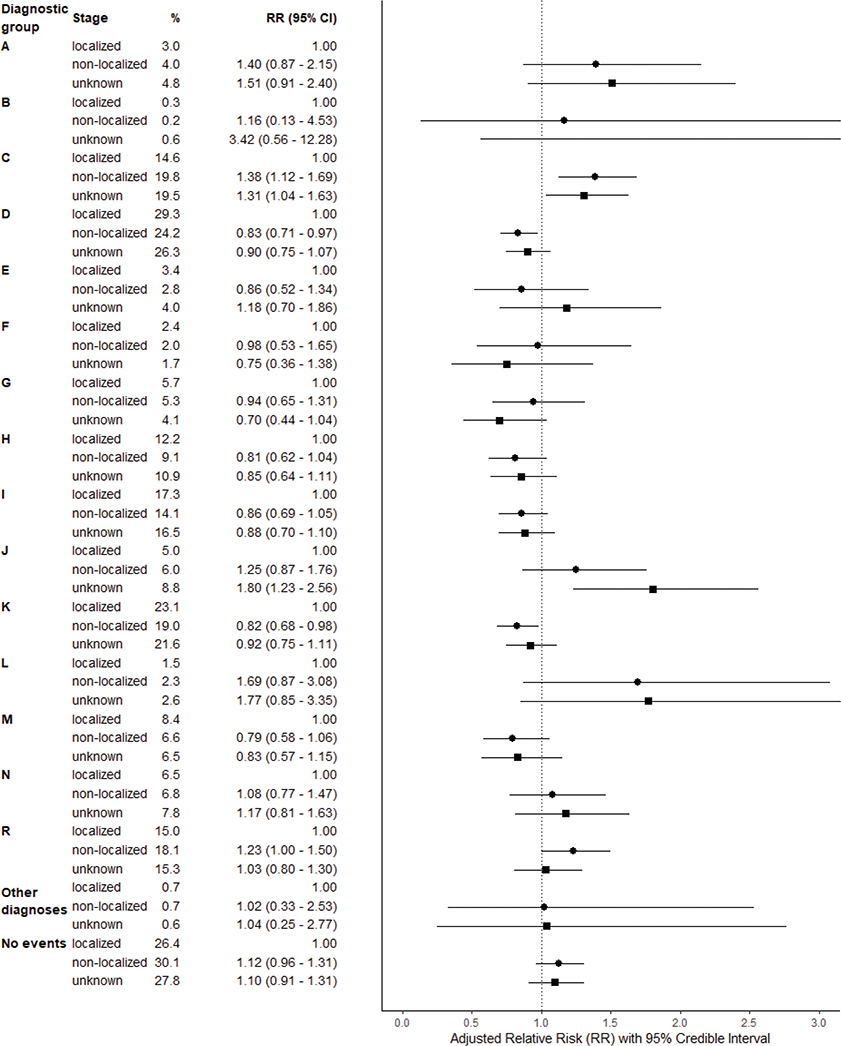
Figure 1. Proportion of colorectal cancer patients having at least one HS event within 1 year preceding CRC diagnosis and age and sex adjusted relative risk (RR) with 95% credible intervals by diagnostic group of HS event and stage. (Foot note: localized stage as reference category). HS: health services; CRC: colorectal cancer.
Discussion and conclusion
We found the proportion of patients with specialized HS events to be predominant in diagnostic groups Neoplasms and diseases of the blood (D), Diseases of the digestive system (K), Malignant neoplasms (C), and Symptoms, signs and abnormal clinical and laboratory findings (R), all of which can be linked to the diagnostic process of CRC [5, 12, 13, 20–22]. Surprisingly, a considerable proportion of patients (28%) had no pre-diagnostic HS events within 1 year before diagnosis, with the highest proportion observed among the youngest age group.
After adjusting for age and sex, patients with non-localized or unknown-stage CRC were more likely to have no pre-diagnostic HS events compared to those with localized disease. The finding suggests that some patients with non-localized cancer were admitted urgently with no recorded HS events in the year preceding CRC diagnosis [5]. Our findings are consistent with prior research showing that a significant proportion of inpatient stays within 1 year before CRC diagnosis started as urgent admissions [7] and that 16% of cancers were diagnosed via unplanned hospital admissions [23]. Furthermore, the presence of non-specific symptoms can contribute to delays in CRC diagnosis in both patients and clinicians [12].
In diagnostic group C, the proportion of patients was larger in the non-localized and unknown stages compared to localized stage, likely reflecting the diagnosis code given before confirmation of diagnosis. The lower HS event risk observed for diagnostic groups D and K among non‑localized and unknown cases suggests that symptoms were either too non‑specific to prompt care seeking or were absent [12]. Also other factors, such as understanding the need for medical care, willingness to receive care, mistrust of healthcare organizations, and access to HS, may have influenced the use of HS in patients with non-localized cancer [24–26].
This register-based study avoided recall bias as it was based on comprehensive data from national health registries [15, 27]. A key strength was the ability to examine pre-diagnostic HS events in CRC patients with latent disease while preparing for national screening policy [28]. The main limitations included missing data on primary HS, which may lead to an underestimation of pre-diagnostic HS events.
With our data, we were able to identify specialized HS diagnoses that can be utilized for earlier detection of patients. These data are critical for characterizing diagnostic trajectories and understanding healthcare organization, enabling identification of patterns that may inform strategies for early detection and improved care pathways.
Acknowledgments
This work was supported by the Cancer Foundation Finland and LähiTapiola.
Data availability statement
The data that support the findings of this study can be requested in aggregate form from (FCR), but they are not publicly available due to data secrecy issues.
Ethics declarations and trial registry information
Informed consent from study participants was unnecessary as the study utilised administrative registry data not based on consent (based on the Act on the Finnish Institute for Health and Welfare 668/2008 (cancer information), Act on the Population Information System 661/2009 (other than health information) and the Act on the Secondary Use of Health and Social Data (552/2019).
Authors’ contributions
EH conceived and designed the analysis, made data analysis and interpretation, and wrote most of the manuscript. ST carried out data collection and statistical analysis. LP and JJ revised the scientific content and assisted in data interpretation. NM, JP and LP contributed to data interpretation and manuscript writing. KS advised on study design and statistical analysis, and also contributed to manuscript preparation. All authors reviewed the results and participated in finalizing the manuscript.
References
[1] Seppä K, Lappi-Heikkinen S, Johansson S, Malila N, Pitkäniemi J. SYÖPÄ 2023. Tilastoraportti Suomen syöpätilanteesta. Helsinki: Suomen Syöpäyhdistys; 2025. [Finnish]
[2] Savijärvi S, Seppä K, Malila N, Pitkäniemi J, Heikkinen S. Trends of colorectal cancer incidence by education and socioeconomic status in Finland. Acta Oncol. 2019;58(11):1557–63. https://doi.org/10.1080/0284186X.2019.1652340
[3] Cardoso R, Guo F, Heisser T, Hackl M, Ihle P, De Schutter H, et al. Colorectal cancer incidence, mortality, and stage distribution in European countries in the colorectal cancer screening era: an international population-based study. Lancet Oncol. 2021;22(7):1002–13. https://doi.org/10.1016/S1470-2045(21)00199-6
[4] Engholm G, Lundberg FE, Kønig SM, Ólafsdóttir E, Johannesen TB, Pettersson D, et al. TNM stage in the Nordic Cancer Registries 2004–2016: registration and availability. Acta Oncol. 2024;63: 303–12. https://doi.org/10.2340/1651-226X.2024.35232
[5] Koskenvuo L, Malila N, Pitkäniemi J, Miettinen J, Heikkinen S, Sallinen V. Sex differences in faecal occult blood test screening for colorectal cancer. Br J Surg. 2019;106(4):436–47. https://doi.org/10.1002/bjs.11011
[6] Nilssen Y, Brustugun OT, Eriksen MT, Haug ES, Naume B, Møller B. Patient and tumour characteristics associated with inclusion in cancer patient pathways in Norway in 2015–2016. BMC Cancer. 2020;20(1):488. https://doi.org/10.1186/s12885-020-06979-y
[7] Hermiö E, Seppä K, Ryynänen H, Hirvonen E, Pylkkänen L, Järvelin J, et al. Use of health services one year before primary colorectal cancer. BMC Health Serv Res. 2023;23(1):279. https://doi.org/10.1186/s12913-023-09298-7
[8] Kuiper JG, van Herk-Sukel MPP, Lemmens VEPP, Kuipers EJ, Herings RMC. A steep increase in healthcare seeking behaviour in the last months before colorectal cancer diagnosis. BMC Fam Pract. 2021;22(1):121. https://doi.org/10.1186/s12875-021-01482-0
[9] Ahrensberg JM, Fenger-Grøn M, Vedsted P. Primary care use before cancer diagnosis in adolescents and young adults – a nationwide register study. PLoS One. 2016;11(5):e0155933. https://doi.org/10.1371/journal.pone.0155933
[10] Christensen KG, Fenger-Grøn M, Flarup KR, Vedsted P. Use of general practice, diagnostic investigations and hospital services before and after cancer diagnosis – a population-based nationwide registry study of 127,000 incident adult cancer patients. BMC Health Serv Res. 2012;12:224. https://doi.org/10.1186/1472-6963-12-224
[11] Hansen PL, Hjertholm P, Vedsted P. Increased diagnostic activity in general practice during the year preceding colorectal cancer diagnosis. Int J Cancer. 2015;137(3):615–24. https://doi.org/10.1002/ijc.29418
[12] Rasmussen S, Haastrup PF, Balasubramaniam K, Elnegaard S, dePont Christensen R, Storsveen MM, et al. Predictive values of colorectal cancer alarm symptoms in the general population: a nationwide cohort study. Br J Cancer. 2019;120(6):595–600. https://doi.org/10.1038/s41416-019-0385-x
[13] Astin M, Griffin T, Neal RD, Rose P, Hamilton W. The diagnostic value of symptoms for colorectal cancer in primary care: a systematic review. Br J Gen Pract. 2011;61(586):e231–43. https://doi.org/10.3399/bjgp11X572427
[14] World Health Organization. International statistical classification of diseases and related health problems, 10th revision. Volume 2: instruction manual [Internet]. 2016 [cited 2024 Jun 20]. Available from: https://icd.who.int/browse10/content/statichtml/icd10volume2_en_2016.pdf
[15] Leinonen MK, Miettinen J, Heikkinen S, Pitkäniemi J, Malila N. Quality measures of the population-based Finnish Cancer Registry indicate sound data quality for solid malignant tumours. Eur J Cancer. 2017;77:31–9. https://doi.org/10.1016/j.ejca.2017.02.017
[16] Pukkala E, Engholm G, Schmidt LKH, Storm H, Khan S, Lambe M, et al. Nordic Cancer Registries – an overview of their procedures and data comparability. Acta Oncol. 2018;57(4):440–55. https://doi.org/10.1080/0284186X.2017.1407039
[17] Terveyden ja hyvinvoinnin laitos. HILMO – Sosiaalihuollon ja terveydenhuollon hoitoilmoitus: Määrittelyt ja ohjeistus [Internet]. THL; 2014. [cited 2024 Sep 7] Available from: https://urn.fi/URN:ISBN:978-952-302-350-5 [Finnish]
[18] Plummer M. rjags: Bayesian Graphical Models using MCMC [Internet]. 2025 [cited 2025 Jun 25]. Available from: https://cran.r-project.org/web/packages/rjags/index.html
[19] R Foundation for Statistical Computing. The R project for statistical computing [Internet]. [cited 2025 Jun 25]. Available from: https://www.r-project.org/
[20] Holtedahl K, Borgquist L, Donker GA, Buntinx F, Weller D, Campbell C, et al. Symptoms and signs of colorectal cancer, with differences between proximal and distal colon cancer: a prospective cohort study of diagnostic accuracy in primary care. BMC Fam Pract. 2021; 22:148. https://doi.org/10.1186/s12875-021-01452-6
[21] Alexiusdottir KK, Möller PH, Snaebjornsson P, Jonasson L, Olafsdottir EJ, Björnsson ES, et al. Association of symptoms of colon cancer patients with tumor location and TNM tumor stage. Scand J Gastroenterol. 2012;47(7):795–801. https://doi.org/10.3109/00365521.2012.672589
[22] Demb J, Kolb JM, Dounel J, Fritz CDL, Advani SM, Cao Y, et al. Red flag signs and symptoms for patients with early-onset colorectal cancer: a systematic review and meta-analysis. JAMA Netw Open. 2024;7(5):e2413157. https://doi.org/10.1001/jamanetworkopen.2024.13157
[23] Danckert B, Falborg AZ, Christensen NL, Frederiksen H, Lyratzopoulos G, McPhail S, et al. Routes to diagnosis and the association with the prognosis in patients with cancer – a nationwide register-based cohort study in Denmark. Cancer Epidemiol. 2021;74:101983. https://doi.org/10.1016/j.canep.2021.101983
[24] Wilt JK, Siminoff LA, Thomson MD. Pre-diagnosis symptoms, attributed causes, and healthcare seeking assets of younger colorectal cancer survivors. J Canc Educ. 2023;38(6):1932–8. https://doi.org/10.1007/s13187-023-02363-z
[25] Macdonald S, Blane D, Browne S, Conway E, Macleod U, May C, et al. Illness identity as an important component of candidacy: contrasting experiences of help-seeking and access to care in cancer and heart disease. Soc Sci Med. 2016;168:101–10. https://doi.org/10.1016/j.socscimed.2016.08.022
[26] Jensen LF, Pedersen AF, Andersen B, Fenger-Grøn M, Vedsted P. Distance to screening site and non-participation in screening for breast cancer: a population-based study. Public Health (Oxf). 2014;36(2):292–9. https://doi.org/10.1093/pubmed/fdt068
[27] Sund R. Quality of the Finnish Hospital Discharge Register: a systematic review. Scand J Public Health. 2012;40(6):505–15. https://doi.org/10.1177/1403494812456637
[28] Sarkeala T, Färkkilä M, Anttila A, Hyöty M, Kairaluoma M, Rautio T, et al. Piloting gender-oriented colorectal cancer screening with a faecal immunochemical test: population-based registry study from Finland. BMJ Open. 2021;11:e046667. https://doi.org/10.1136/bmjopen-2020-046667