ORIGINAL ARTICLE
Estimated number of children affected by paternal cancer diagnosis and death in Finland during 1970–2022: a population-based registry study
Anniina Kyrönlahtia,b  , Eetu Mäkinena , Karri Seppäa,c , Tea Lallukkad and Janne Pitkäniemia,c,d
aCancer Society of Finland, Finnish Cancer Registry, Helsinki, Finland; bChildren and Adolescents, Helsinki University Hospital and University of Helsinki, Helsinki, Finland; cFaculty of Social Sciences, Tampere University, Tampere, Finland; dDepartment of Public Health, Faculty of Medicine, University of Helsinki, Helsinki, Finland
ABSTRACT
Background and purpose: Parental cancer effects millions of children worldwide. We estimated the number of children influenced by paternal cancer and paternal orphans, and examined changes in their numbers and annual rates over time, with a focus on time trends and the influence of cancer type.
Patients and methods: Male cancer patients aged ≥15 years, diagnosed since 1953, were identified from the Finnish Cancer Registry. Cancer deaths and information on live births were obtained from Statistics Finland. Annual number of new children and prevalent children whose father was diagnosed with cancer and the annual number of new orphans and prevalent orphans due to paternal cancer death for 1970–2022 were estimated indirectly by combining cancer incidence and mortality data with population-level fertility rates.
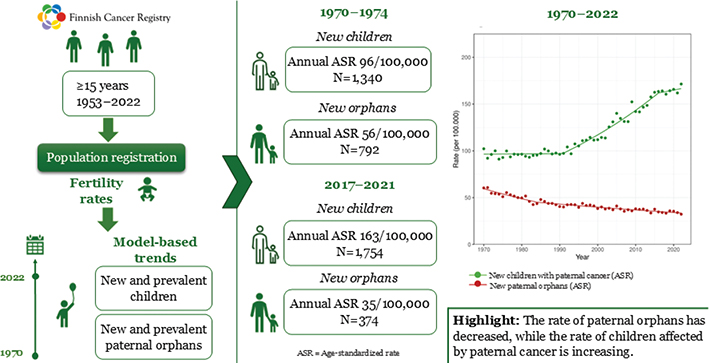
Results: The estimated age-standardized rate of new children with paternal cancer increased from 96/100,000 children in 1970–1974 to 163/100,000 in 2017–2021. The annual rate of new paternal orphans decreased from 56/100,000 in 1970–1974 to 35/100,000 in 2017–2021. The rate of new children increased 1.1% per year while the rate of new orphans decreased 1.1% in 1970–2021.
Interpretation: Although the number of paternal orphans is decreasing due to improved cancer survival, the number of children influenced by paternal cancer is rising reflecting the increasing cancer incidence and resulting in more children vulnerable to the harmful effects of paternal cancer.
KEYWORDS: Child; fathers; cancer; orphans; estimation; trend
Citation: ACTA ONCOLOGICA 2026, VOL. 65, 661–667. https://doi.org/10.2340/1651-226X.2026.45653 .
Copyright: © 2026 The Author(s). Published by MJS Publishing on behalf of Acta Oncologica. This is an Open Access article distributed under the terms of the Creative Commons Attribution 4.0 International License (http://creativecommons.org/licenses/by/4.0/).
Received: 4 March 2026; Accepted: 2 July 2026; Published: 30 July 2026
CONTACT: Anniina Kyrönlahti anniina.kyronlahti@cancer.fi Finnish Cancer Registry, Mäkelänkatu 2, 00500 Helsinki, Finland
Supplemental data for this article can be accessed online at https://doi.org/10.2340/1651-226X.2026.45653
Competing interests and funding: The authors have no conflicts of interests with respect to this research or relevant disclosures outside the submitted work.
Introduction
Globally, an estimated 10.3 million men of all ages are diagnosed with cancer each year, and 5.4 million men die from the disease [1]. In 2022, the cumulative risk of developing cancer before the age of 75 years was 21.8%, and the risk of dying from cancer before the age of 75 was 11.4% among males. Cancer impacts not only the cancer patients themselves but also the whole family. Global estimates of prevalent maternal orphans due to cancer were 7 million children in mid-2020s [2], but little is known about the number of paternal orphans. The annual estimates of minors effected by parental cancer have varied between 0.28% and 0.38% in population-based registry studies [3–5].
Few register studies have estimated the number of children affected solely by paternal cancer. In the 1987 Finnish Birth Cohort study, 1.8% of the children aged 0–17 years had a father with cancer over the 21-year follow-up period [6]. In a Danish population-based study, 2.1% of the children had experienced paternal cancer during 1986–1999 [7]. A Swedish register-based study showed that between 1961 and 2023, 3.4% (n = 126,696) of all children were born to men who had cancer at any point in their lives [8].
In Finland, the most common cancer type among men aged 20–69 years in 2022 was prostate cancer with the incidence of 125.8 per 100,000 person-years followed by colorectal cancer, lung and tracheal cancer, melanoma of the skin, and mature B-cell neoplasms [9]. Among adolescent males aged 15–19 years, lymphomas are the most common cancer type [10]. Cancer incidence among Finnish men has steadily increased up to 2003 reaching a plateau in the recent two decades [9].
In 2022, diseases of the circulatory system were the most common cause of death among males aged 15–64 years in Finland (n = 1,259), followed by neoplasms (n = 1,101), accidents and violence (n = 964), alcohol-related diseases and alcohol poisoning (n = 710), and suicides (n = 417) [11]. The most common cause of cancer death among men aged 20 to 69 years in 2022 was lung and tracheal cancer (mortality 25.6 per 100,000 person-years) followed by colorectal cancer and pancreatic cancer. Cancer mortality in men has been decreasing by 1.2% per year during the period of 2008–2022 [9].
The age of having children has gradually risen in the last decades and in 2023 the average age of becoming a father in Finland was 32.2 years [12]. As cancer risk increases with age alongside growing cancer prevalence [9], more children are expected to be affected by paternal cancer. At the same time, fathers’ caregiving roles have expanded, with increasing involvement in childcare and family leave [13]. Earlier studies have shown children and adolescents of cancer patients to be at higher risk for psychosocial problems [14] suggesting even more pronounced risk with paternal cancer [15]. The aforementioned details highlight the importance of knowing the amount of children impacted by paternal cancer and the possible consequences of the father’s cancer diagnosis on their children.
This is the first study to use longitudinal, comprehensive cancer registry data alongside reliable, registry-based paternal fertility rates to estimate age-standardized rates of children whose father was diagnosed with cancer and of children whose father died of cancer (paternal orphans). As an additional novel aspect, we also explored time trends in the rates of children newly affected by paternal cancer diagnosis (new children) and of children whose father had ever been diagnosed with cancer (prevalent children). In addition, we assessed both incident and prevalent paternal orphans resulting from cancer. Furthermore, we studied the influence of cancer type on the estimated number of children and orphans, as well as their trends over time.
Patients/material and methods
All male cancer patients aged 15 years or older, diagnosed between 1953 and 2022, were identified from the Finnish Cancer Registry database [10, 16]. Causes of death (cancer deaths) were obtained from Statistics Finland [11].
Live births by the age of the father were available annually between 1990 and 2022 from Statistics Finland’s database [17], and fertility rates were calculated based on this information. In addition, total births between 1953 and 1989 were observed. Using an age-period-cohort Poisson model, number of births by father’s age between 1953 and 1989 were estimated and scaled so that the yearly sums of births by the father’s age equaled the observed yearly total number of births. Thus, this study did not use individual-level linkage between fathers and cancer cases. Instead, the number and rates of children were estimated indirectly by combining cancer incidence and mortality data with population-level fertility rates.
Cancer types were divided into their own categories based on ICD-10 coding system [18]. Using the cut-off limit of approximate proportion of 1% in incidence and mortality, cancer types below the limit were categorized as ‘Others’. The cancer grouping is presented in Table S1.
Based on the number of male cancer patients and cancer-related deaths, as well as estimated fertility rates, numbers and rates of underaged children affected by paternal cancer and paternal orphanhoods were estimated for the period 1970–2022. An underage child was defined as a person under the age of 18 and paternal orphans were children whose father had died before the child reached 18 years of age.
Annual number of children whose father was newly diagnosed with cancer (later referred as new children) and the number of orphans due to newly occurred paternal cancer death (later referred as new orphans) were estimated for the whole period 1970–2022. Total number of children (prevalent children) whose father was ever diagnosed with cancer and total number of paternal orphans (prevalent orphans) were also estimated for the whole period. Our approach means that children whose father has been diagnosed with cancer are included in the number of prevalent children with paternal cancer until the age of 18, regardless of the father’s death or recovery from cancer. Estimates were performed following the methodology introduced by Guida et al. in 2022 (Supplement: Statistical Methods) [2]. The age-standardized rates of children with paternal cancer and paternal orphans were estimated using the World (WHO 2000–2025) Standard.
Poisson regression was used to estimate the changepoints and piecewise trends (annual percentage change, APC) in annual new and total number of children influenced by paternal cancer and paternal orphans. APC was also estimated for the rate of new children with paternal cancer and new paternal orphans, and an additional analysis was made adjusting for the father’s age. Bayesian Information Criterion (BIC) was used to select the number of changepoints for each time series [19]. Variations in trends of new children influenced by paternal cancer diagnosis and new paternal orphans due to cancer death over time are demonstrated in Table 1 for 5-year calendar periods 1970–1974, and 2017–2021, and around the estimated changepoints. Estimates for year 2022 are reported separately. Analyses were performed in the programme R (version 4.3.2). All analyses were stratified by cancer type.
Results
A total of 18,457 new cancers (age-standardized rate 442/100,000) among men aged 15 years or older were diagnosed in 2022, of which 2.9% occurred among men aged 15–39 years. Our study showed an increase in both cancer incidence and age at diagnosis; on the average 6,049 new cancers (388/100,000) were diagnosed annually between 1970 and 1974, of which 4.4% occurred among men aged 15–39 years. The estimated median age of the father at cancer diagnosis increased from 44.9 years in 1970–1974 to 47.3 years in 2017–2021.
In 2022, 6,968 new cancer deaths (147/100,000) occurred among men aged 15 years or older. Increase in the number of new cancer deaths over time was seen with the average number of 4,434 cancer deaths occurring between 1970 and 1974. The median age of father at cancer death increased from 45.4 years in 1970–1974 to 50.3 years in 2017–2021.
The estimated median age of children at paternal cancer diagnosis in 2017–2021 was 11.7 years, representing a slight decrease from 12.5 years in 1970–1974 (Table 1). The median age of children at paternal cancer death in 2017–2021 was 12.5 years, with no major changes over time. The lowest median age at both paternal cancer diagnosis and death in 2017–2021 was observed among children whose father had testicular cancer (diagnosis 7.0 years; death 7.5 years), whereas the highest median age was observed in association with paternal prostate cancer (diagnosis 13.9 years; death 13.9 years) (Table S2).
Children influenced by paternal cancer diagnosis
In 2022, the estimated age-standardized rate of children newly influenced by paternal cancer diagnosis (new children) was 171 per 100,000 (Table 1). The average age-standardized rate of new children whose father was diagnosed with cancer has increased overall since the first study period of 1970–1974 from 96 per 100,000 to 167 per 100,000 in 2017–2021. In 1970– 2022, the average age-standardized rate of new children whose fathers were diagnosed with cancer increased by 1.1% per year (Table 2, Figure 1c). When adjusted for father’s age, the increase was attenuated (0.7% per year) (Table 2). Changepoints in the age-standardized rate in 1970–2022 are presented in Table S1.

Figure 1. Estimated annual percentage changes (APCs) in the number of new children/orphans (A), in the number of prevalent children/orphans (B), in the age-standardized rate of new children/orphans (C), and in the age-standardized rate of prevalent children/orphans (D) under 18 years of age influenced by paternal cancer diagnosis (at the age of ≥15 years) and paternal cancer death (orphans) in Finland during 1970–2022.
By cancer type, hematological malignancies were the most common reason for a child to be newly affected by paternal cancer (Table S2, Figure S1a). During 2017–2021, the age-standardized rate of new children whose father was diagnosed with hematological malignancies increased steadily between 1970 and 2022 (Table S3).
The age-standardized prevalence of children whose father had ever been diagnosed with cancer (prevalent children) was 1,151 per 100,000 in 2022 (Table 1). The age-standardized prevalence of children whose father had been diagnosed with cancer increased from 644 per 100,000 in 1970–1974 to 1,159/100,000 in 2017 (Table 1, Figure 1d).
By cancer type, hematological malignancies accounted for the largest proportion of children ever affected by paternal cancer. Unlike most other cancer types, for which the age-standardized rate of prevalent children increased or remained stable or increased over calendar time, the rate of children whose father had lung and tracheal cancer decreased substantially (Table S2).
Paternal orphans due to cancer deaths
The estimated age-standardized rate of orphans due to newly occurred paternal cancer death (new paternal orphans) in 2022 was 32 per 100,000 children (Table 1). A notable decrease in the average age-standardized rate of new paternal orphans was observed over time, 56 per 100,000 in 1970–1974 to 36 per 100,000 in 2017–2021, corresponding to an estimated annual decrease of 1.1% between 1970 and 2022 (Tables 1 and 2, Figure 1c). After adjusting for fathers’ age, the age-standardized rate of new paternal orphans decreased by 1.7% per year between 1970 and 2022 (Table 2, Figure 1c). Changepoints in the age-standardized rate between 1970 and 2022 are presented in Table S4.
Over a prolonged period, lung and tracheal cancers were the most common cancers associated with paternal loss in children, whereas in the most recent period, CNS malignancies became an equally common cause (Table S2, Figure S2a). A decrease in the age-standardized rate of new paternal orphans over time was observed for almost all cancer types (Table S3, Figure S2a).
In 2022, the estimated age-standardized prevalence orphans due to paternal cancer death (prevalent paternal orphans) was 228 per 100,000 children (Table 1). The prevalence of paternal orphans has reduced by almost half from 396 per 100,000 in 1970–1974 to 236 per 100,000 in 2017–2021 (Table 1, Figure 1d).
By cancer type, the age-standardized prevalence of paternal orphans over time was highest for CNS malignancies, lung and tracheal cancer and hematological malignancies (Table S2). The age-standardized prevalence of paternal orphans decreased for most cancer types from 1970–1974 to 2017–2021(Table S2, Figure S2b).
Discussion and conclusion
Using a model-based estimation approach, this study estimated the age-standardized rates and number of children affected by paternal cancer and paternal orphanhood, and assessed trends in 1970–2022 and variation by cancer type. Over time, the age-standardized rate of children affected by paternal cancer increased, while paternal orphanhood declined.
We estimated that, in 2022, 1,832 new children were affected by a paternal cancer diagnosis. Overall, 17,987 men were diagnosed with cancer in 2022 [9], indicating that an estimated 10.2% had children younger than 18 years of age. The increase in both the age-standardized rate of new and prevalent children with paternal cancer aligns with the increasing overall cancer incidence in the male population [9].
During 1990–2022, the annual number of children born to Finnish fathers decreased from 65,549 to 44,764 with a steeper decline since 2010 [17]. On 31st of December 2022, there were 1,026,192 children aged 0–17 years living in Finland [12]. In 2022, we estimated a total of 12,704 children whose father had been diagnosed with cancer during the child’s lifetime, accounting for approximately 1.2% of the entire child population. The average annual number of children whose father had been diagnosed with cancer during a child’s lifetime was 9,228 in 1970–1974 and 8,488 in 1993–1997. During 1972–1974, there were on average 1,301,063 children under the age of 18 living in Finland annually, compared to 1,164,707 in 1993–1997 [12]. This suggests that approximately 0.7% of children in both 1970–1974 and 1993–1997 had a father who had been diagnosed with cancer. These estimates are somewhat lower than those reported a Finnish Birth Cohort study, where 1.8% of children under 18 years of age had a father with cancer [6]. A Danish study found that 2.1% of children under 18 years of age, born between 1978 and 1984, had a father with cancer [7] and a Swedish study identified an even higher proportion, 3.4%, among children born between 1961 and 2003 [8]. The proportions observed in these studies are higher than in our study, however, our estimates are based on aggregated fertility data, whereas the Danish and Swedish studies relied on individually linked register data. In addition, cancer incidence among men is higher in Denmark than in the other Nordic Countries [20], which may partly explain the differences. In Sweden, cancer incidence has been similar than in Finland since the 1980s, although slightly lower in earlier decades. Furthermore, missing data on fertility before 1990 in our study may have affected the estimates to some extent. Male fertility also varies accross the Nordic countries, with childlessness being more common among Finnish men than among their counterparts in the other Nordic countries, as shown in a birth cohort study of men born in the 1960s [21]. However, cohort total fertility has been lowest in Denmark and highest in Norway, with no subtansial differences between the Nordic countries.
Hematological malignancies were the most common cancer type among both new and prevalent cases of children affected by paternal cancer, likely reflecting the younger age distribution of patients with hematological cancers [10]. The age-standardized rate of children affected by paternal lung and tracheal cancer was decreased considerably for both new and prevalent cases, likely reflecting changes in daily smoking prevalence, which declined from 58% to 28% from 1960 to 2000 in Finland. Among working-age individuals (aged 20–64 years), daily smoking declined further from 28% in 1996 to 12% in 2022 [22]. Given the long latency period of lung and tracheal cancer, often spanning several decades [23], these long-term reductions in smoking are consistent with the observed declines in cancer incidence and mortality.
The decrease in the age-standardized rate of new paternal orphans, leading to a decrease in the rate of prevalent orphans, reflects the overall decline in cancer mortality among the male population [9]. While maternal orphanhood due to cancer has been estimated both globally and regionally [2, 24], there remains a gap in knowledge regarding the number of paternal orphans resulting from cancer. Most likely, the lack of reliable data on male fertility has limited the feasibility of such estimates. In this study, we were able to use accurate paternal fertility data, enabling us to produce reliable estimates using a model-based approach, at least for the most recent decades.
Our estimates indicate that lung and tracheal cancer were the leading causes of paternal orphanhood until recently, when CNS malignancies reached similar levels for new paternal orphanhood and surpassed lung and tracheal cancer as the most common cause of prevalent orphanhood. These patterns align with the leading causes of cancer mortality and years of life lost among Finnish men [9].
The average age at fatherhood has increased during our study period, from 28.3 years in 1985 to 32.2 years in 2023 [12]. This is reflected in the fathers’ age-adjusted model for the APC in the age-standardized rate of new children affected by paternal cancer and paternal orphans due to cancer. When adjusting for father’s age, the increase in the rate of new children became less evident, whereas the decrease in the rate of new orphans was more pronounced. The median age of the child at the time of paternal cancer diagnosis decreased slightly, most likely also reflecting the increase in the average age at fatherhood.
The impact of paternal cancer or paternal death likely depends on the father–child relationship. In 2022, 72% of Finnish children lived with both parents and 28% with one parent [25]. Although these statistics do not account for joint residency, studies indicate that about one-third of children with separated parents alternate between households [26]. Thus, most children in Finland live with their father at least part‑time, suggesting that paternal cancer or the loss of a father can affect a large proportion of children.
Strengths and limitations
This study had some limitations. The results on the number and rates of children and orphans are based on model-derived estimates using register-based fertility data from Statistics Finland and do not present individual-level data on parenthood and family relationships.
In particular, the lack of individual-level fertility data among men diagnosed with or dying from cancer represents a key limitation. Our estimates assume that the age-specific number of children among men affected by cancer is similar to that in the general male population in Finland, which may introduce bias. This is especially relevant if cancer risk factors are associated with fertility.
We did not account for the potential effects of cancer type on fertility in our analysis. Although some studies have shown that cancer type generally does not substantially affect future fertility [27], differences in cancer type and treatment may still influence the likelihood of having children. Liable paternal fertility data were available from 1990 onward meaning that the estimates for the number of orphans and number of children whose father was diagnosed with cancer are most reliable from the year 2007 onward. A future aim is to use individual-level data to strengthen the findings and to explore underlying factors that may affect children influenced by paternal cancer diagnosis and death.
The main strength of the study is the use of validated, nationwide population-based cancer registry data [16], along with high-quality statistical data on births [17] and causes of death [11] collected by Statistics Finland. The availability of reliable paternal fertility data is uncommon and highlights the novelty of this study. The statistical approach to estimate the number of children and orphans has previously been presented and assessed by the International Agency for Research on Cancer (IARC) using maternal cancer and fertility data [2].
Conclusions
Cancer affects many families, and children are in a particularly vulnerable position when a parent is diagnosed with cancer. Fortunately, fewer children are experiencing paternal cancer death; however, simultaneously, more children are affected by paternal cancer diagnosis. Fathers are also developing and dying from different types of cancer than in the past. Serious parental illness can have significant consequences for a child’s well-being, and affected children should be offered support tailored to their specific needs. Future research should aim to identify and address the challenges faced by children affected by parental cancer to enable more targeted interventions, including social and financial support as well as accessible mental health services.
Acknowledgments
The authors would like to thank Cancer Foundation Finland (grant no. 240154) and Kusinkapital for supporting this work. The funder had no role in study design, data collection, data analysis, data interpretation, or writing of the paper. The authors used an AI-based language tool (M365 Copilot, GPT-5-chat model) to improve the clarity and readability of the manuscript. The tool was used solely for language editing, and all content was reviewed and approved by the authors.
Data availability statement
Cancer Registry data are publicly available at the Finnish Cancer Registry Statistic Application: https://tilastot.syoparekisteri.fi/syovat/. Data on paternal fertility rates are also publicly available at the StatFin database: https://pxdata.stat.fi/PxWeb/pxweb/en/StatFin/.
Ethics declarations & trial registry information
Non applicable.
Authors’ contributions
JP was in charge of the conceptualization of the study. EM and KS validated the data. EM performed the statistical analysis. AK, EM, KS, TL and JP contributed to the interpretation of the data. The original draft of the manuscript was written by AK. AK, EM, KS, TL and JP contributed to reviewing of the manuscript and approved the final version to be published.
References
[1] Ferlay J, Ervik M, Lam F, Laversanne M, Colombet M, Mery L, et al. Global cancer observatory: cancer today [Internet]. Lyon, France: International Agency for Research on Cancer; 2024 [cited 2025 Feb 25]. Available from: https://gco.iarc.who.int/today
[2] Guida F, Kidman R, Ferlay J, Schüz J, Soerjomataram I, Kithaka B, et al. Global and regional estimates of orphans attributed to maternal cancer mortality in 2020. Nat Med. 2022;28(12):2563–72. https://doi.org/10.1038/s41591-022-02109-2
[3] Inoue I, Higashi T, Iwamoto M, Heiney SP, Tamaki T, Osawa K, et al. A national profile of the impact of parental cancer on their children in Japan. Cancer Epidemiol. 2015;39(6):838–41. https://doi.org/10.1016/j.canep.2015.10.005
[4] Syse A, Aas GB, Loge JH. Children and young adults with parents with cancer: a population-based study. Clin Epidemiol. 2012;4:41–52. https://doi.org/10.2147/CLEP.S28984
[5] Martini A, Morris JN, Jackson HM, Ohan JL. The impact of parental cancer on preadolescent children (0-11 years) in Western Australia: a longitudinal population study. Support Care Cancer. 2019;27(4):1229–36. https://doi.org/10.1007/s00520-018-4480-y
[6] Niemelä M, Paananen R, Hakko H, Merikukka M, Gissler M, Räsänen S. The prevalence of children affected by parental cancer and their use of specialized psychiatric services: the 1987 Finnish Birth Cohort study. Int J Cancer. 2012;131(9):2117–25. https://doi.org/10.1002/ijc.27466
[7] Joergensen AC, Kjaer Urhoj S, Nybo Andersen AM. Primary school achievement and socioeconomic attainment in individuals affected by parental cancer in childhood or adolescence: a Danish nationwide register-based study. J Epidemiol Community Health. 2018;72(11):982–9. https://doi.org/10.1136/jech-2018-210472
[8] Tang SW, Liu J, Juay L, Czene K, Miao H, Salim A, et al. Birth rates among male cancer survivors and mortality rates among their offspring: a population-based study from Sweden. BMC Cancer. 2016;16:196. https://doi.org/10.1186/s12885-016-2236-y
[9] Pitkäniemi J, Malila N, Heikkinen S, Seppä K. Cancer in Finland 2022. Helsinki: Cancer Society of Finland; 2024. Available from: https://syoparekisteri.fi/assets/files/2024/06/Cancer_2022_EN.pdf
[10] Finnish Cancer Registry [Internet]. Data from 2024-10-02, version 2024-11-05-001. [cited 2025 Feb 24]. Available from: https://tilastot.syoparekisteri.fi/syovat
[11] Official Statistics of Finland (OSF). Causes of death [online publication] [Internet]. Helsinki: Statistics Finland; [cited 2025 Feb 25]. Available from: https://stat.fi/en/statistics/ksyyt
[12] Official Statistics of Finland (OSF). Population structure [online publication] [Internet]. Helsinki: Statistics Finland; [cited 2025 Feb 25]. Available from: https://stat.fi/en/statistics/vaerak
[13] Kinnunen A, Lammi-Taskula J, Miettinen A, Närvi J, Saarikallio-Torp M. Family leaves and the reconciliation of employment and family life in a changing working life (Studies in social security and health 165) [Internet]. Social Insurance Institution of Finland; 2024 [cited 2025 Feb 24]. Available from: http://urn.fi/URN:ISBN:978-952-284-192-6
[14] Visser A, Huizinga GA, van der Graaf WTA, Hoekstra HJ, Hoekstra-Weebers JEHM. The impact of parental cancer on children and the family: a review of the literature. Cancer Treat Rev. 2004;30(8):683–94. https://doi.org/10.1016/j.ctrv.2004.06.001
[15] Thastum M, Watson M, Kienbacher C, Piha J, Steck B, Zachariae R, et al. Prevalence and predictors of emotional and behavioural functioning of children where a parent has cancer: a multinational study. Cancer. 2009;115(17):4030–9. https://doi.org/10.1002/cncr.24449
[16] Leinonen MK, Miettinen J, Heikkinen S, Pitkäniemi J, Malila N. Quality measures of the population-based Finnish Cancer Registry indicate sound data quality for solid malignant tumours. Eur J Cancer. 2017;77:31–9. https://doi.org/10.1016/j.ejca.2017.02.017
[17] Official Statistics of Finland (OSF). Births [online publication] [Internet]. Helsinki: Statistics Finland; [cited 2025 Feb 12]. Available from: https://stat.fi/en/statistics/synt
[18] World Health Organization. ICD-10: International statistical classification of diseases and related health problems: tenth revision. 2nd ed. Geneva: World Health Organization; 2004.
[19] Schwartz G. Estimating the dimension of a model. Ann Stat. 6(2):461–4. https://doi.org/10.1214/aos/1176344136
[20] Larønningen S, Arvidsson G, Bray F, Dahl-Olsen E, Engholm G, Ervik M, et al. NORDCAN: cancer incidence, mortality, prevalence and survival in the Nordic countries [Internet]. Association of the Nordic Cancer Registries. Cancer Registry of Norway; 2024 [cited 2026 May 24]. Available from: https://nordcan.iarc.fr/
[21] Jalovaara M, Neyer G, Andersson G, Dahlberg J, Dommermuth L, Fallesen P, et al. Education, gender, and cohort fertility in the Nordic countries. Eur J Popul. 2019;35(3):563–86. https://doi.org/10.1007/s10680-018-9492-2
[22] Koskinen H, Virtanen S. Statistical report 58/2023: tobacco statistics 2022. Helsinki: Finnish Institute for Health and Welfare; 2023. Available from: https://www.julkari.fi/server/api/core/bitstreams/32c94d3b-8d43-4857-8637-3534f1c95c30/content
[23] Chen J. A comparative analysis of lung cancer incidence and tobacco consumption in Canada, Norway and Sweden: a population-based study. Int J Environ Res Public Health. 2023;20(20):6930. https://doi.org/10.3390/ijerph20206930
[24] Talala KM, Mäkinen EE, Seppä KJM, Lallukka TM, Pitkäniemi JM. Model-based trends in the estimated number of children affected by maternal cancer diagnosis or death in Finland in 1968-2022. Acta Oncol. 2025;64:1285–94. https://doi.org/10.2340/1651-226X.2025.44072
[25] Official Statistics of Finland (OSF). Families [online publication] [Internet]. Helsinki: Statistics Finland; [cited 2025 Nov 24]. Available from: https://stat.fi/en/statistics/perh
[26] Suomen virallinen tilasto (SVT): Perheet [online publication]. Vuoroasuminen 2018. [Internet]. Helsinki: Statistics Finland; 2018 [cited 2025 Nov 24]. Available from: https://stat.fi/til/perh/2018/03/perh_2018_03_2019-06-17_tie_001_fi.html?ad=notify
[27] Bandak M, Jensen A, Dehlendorff C, Lauritsen J, Kreiberg M, Wagner T, et al. Paternity after treatment for testicular germ cell cancer: a Danish nationwide population-based cohort study. J Natl Cancer Inst. 2022;114(1):149–55. https://doi.org/10.1093/jnci/djab130