ORIGINAL ARTICLE
Surface roughness of contemporary resin composites after exposure to energy drinks
Jhonatan Vilca-Maytaa, José Giancarlo Tozo-Burgosb and Marco Sánchez-Titob
aSchool of Dentistry, Faculty of Health Sciences, Universidad Privada de Tacna, Tacna, Peru; bResearch Group on Dental Biomaterials and Natural Products, Faculty of Health Sciences, Universidad Privada de Tacna, Tacna, Peru
ABSTRACT
Objective: This study aimed to evaluate the effect of three energy drinks (Red Bull®, Volt®, and 360 Energy Drink®) on the surface roughness of three contemporary resin composites: Filtek Z350 XT, PALFIQUE LX5, and Vittra APS.
Materials and methods: An in vitro experimental design was conducted with 108 resin specimens (n = 12 per group). After polishing, baseline roughness (Ra, µm) was measured using a profilometer. Specimens were immersed in one of the three beverages for 1 and 7 days, with daily renewal. Roughness was recorded at T₀, T₁, and T₂. Data were analyzed using a linear mixed-effects model with Sidak-adjusted post hoc comparisons (α = 0.05).
Results: All resins composites exhibited a progressive increase in Ra from T₀ to T₂. Filtek Z350 XT showed the greatest resistance to surface degradation, while PALFIQUE LX5 and Vittra APS were more susceptible. Red Bull® and 360 Energy Drink® induced greater roughness increases than Volt® (p < 0.05). Although most roughness values remained at or near the clinically accepted threshold of Ra ≤ 0.2 µm, a slight increase above this threshold was observed for PALFIQUE LX5 exposed to 360 Energy Drink® at T₂. A significant resin × time interaction (p = 0.034) indicated that degradation patterns depended on composite type.
Conclusion: Energy drinks promoted measurable increases in the surface roughness of all evaluated resin composites. Filtek Z350 XT showed greater resistance to roughness changes, whereas PALFIQUE LX5 and Vittra APS demonstrated higher susceptibility to acidic degradation.
KEYWORDS: Energy drinks; resin composites; surface roughness; erosive degradation; citric acid; restorative materials
Citation: BIOMATERIAL INVESTIGATIONS IN DENTISTRY 2026, VOL. 13, 631–637. https://doi.org/10.2340/biid.v13.46583.
Copyright: © 2026 The Author(s). Published by MJS Publishing on behalf of Acta Odontologica Scandinavica Society. This is an Open Access article distributed under the terms of the Creative Commons Attribution 4.0 International License (http://creativecommons.org/licenses/by/4.0/), allowing third parties to copy and redistribute the material in any medium or format and to remix, transform, and build upon the material, with the condition of proper attribution to the original work.
Received: 8 May 2026; Accepted: 17 July 2026; Published: 4 August 2026
CONTACT Marco Sánchez-Tito marsanchezt@virtual.upt.pe Facultad de Ciencias de la Salud, Universidad Privada de Tacna, Av. Jorge Basadre Grohmann s/n Pocollay, Tacna, Peru
Competing interests and funding: All authors declare that they have no conflict of interest to disclose.
None.
KEY MESSAGES
- Energy drinks promoted progressive surface roughness changes in all evaluated resin composites, with degradation patterns varying according to both beverage and material composition.
- Filtek Z350 XT demonstrated greater resistance to roughness changes, whereas PALFIQUE LX5 and Vittra APS showed higher susceptibility after exposure to energy drinks.
Introduction
Resin composites are widely used in restorative dentistry because of their favorable esthetic and functional properties. However, their long-term clinical performance may be compromised by exposure to the oral environment and dietary habits, particularly the frequent consumption of acidic beverages [1, 2].
Energy drink consumption has increased markedly, especially among adolescents and young adults [3, 4]. These beverages commonly contain caffeine, taurine, sugars, vitamins, and acidic components that may adversely affect oral tissues and restorative materials [5]. Regular intake has also been associated with several adverse health effects [6–9]. Their low pH has been associated with erosion of dental hard tissues [10] and with changes in the surface properties of restorative materials.
Several in vitro studies have shown that exposure to energy drinks increases surface roughness and alters the morphology of resin composites [11–13]. Kose et al. reported significant roughness increases in Charisma Diamond One after 7 days of immersion in Monster® and Burn® energy drinks [11]. Similarly, Al-Samadani observed progressive roughness increases in Filtek Z350 XT after prolonged immersion in Red Bull®, Bison™, and Power Horse™, with Red Bull® producing the greatest effect [12]. Kolarovszki et al. further showed that composites with irregular filler distribution were more susceptible to surface degradation, whereas materials with more uniform particles showed greater resistance [13].
Despite advances in composites technology, limitations such as polymerization shrinkage, wear resistance, postoperative sensitivity, and concerns regarding long-term clinical performance remain relevant [14]. Among the surface properties of composites, roughness and microhardness are particularly important because increased roughness favors bacterial adhesion, plaque accumulation, extrinsic staining, and material deterioration, whereas reduced hardness may decrease resistance to wear and scratching [15]. Surface topography is also influenced by composite type and by finishing and polishing procedures, which can directly affect bacterial adhesion [16]. Therefore, evaluating surface roughness after acidic exposure is clinically relevant for understanding early degradation patterns in restorative materials.
Although previous studies have evaluated the effects of energy drinks on conventional or widely used resin composites, limited evidence is available for newer materials incorporating modified resin matrices and advanced photopolymerization systems. In particular, PALFIQUE LX5 and Vittra APS have not been extensively investigated regarding their surface stability after exposure to energy drinks. Because the erosive potential of energy drinks depends not only on pH but also on their overall formulation, this study evaluated three commercially available beverages selected to represent different physicochemical profiles, including variations in acidity and ingredient composition. Among them, 360 Energy Drink® was included because, although it shares characteristics with other commercial energy drinks, its effects on dental restorative materials have not previously been investigated.
Therefore, the present study aimed to evaluate the effect of Red Bull®, Volt®, and 360 Energy Drink® on the surface roughness of three contemporary resin composites: Filtek Z350 XT, PALFIQUE LX5, and Vittra APS.
Materials and methods
Study design, ethical aspects, and sample size calculation
This in vitro experimental study was approved by the Institutional Research Ethics Committee (protocol FACSA-CEI/043-05-2025). Sample size was calculated using GPower 3.1.9.7 with a fixed-effects, one-way analysis of variance (ANOVA), effect size f = 0.40, significance level of 5% (α = 0.05), test power of 80% (1-β = 0.8), and nine groups. A minimum of 108 specimens was required (n = 12 per group). Group distribution corresponded to the combination of three composites and three energy drinks. A work flowchart (Figure 1) summarizes the experimental procedures, and the composition of materials is presented in Table 1.
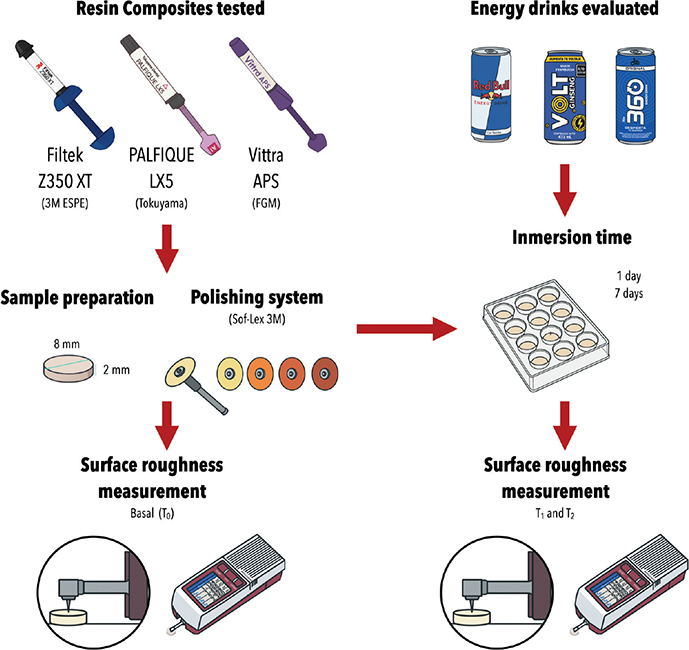
Figure 1. Experimental design and work flowchart for evaluating the effect of energy drinks on the surface roughness of resin composites.
Specimen preparation
A total of 108 disc-shaped specimens were fabricated from the composites evaluated in this study. An A1 shade from the VITA Classical shade guide (VITA Zahnfabrik, Bad Säckingen, Germany) was selected to standardize color among materials. Specimens (8 mm in diameter × 2 mm in thickness) were prepared using stainless-steel molds coated with a thin glycerin layer to facilitate removal [17]. Each composite was inserted in a single increment using a Teflon spatula, covered with a Mylar strip, and compressed with a glass slide to obtain a flat and smooth surface for roughness evaluation [11]. Both sides were light-cured for 20 s using a light-emitting diode (LED) curing unit (VALO LED; Ultradent Products, South Jordan, UT, USA; 1600 mW/cm²). Specimens were then stored in saline solution at room temperature for 24 hours. Discs presenting bubbles, edge irregularities, surface porosities, heterogeneous filler distribution, or thickness variations were excluded to ensure specimen standardization and measurement reliability [18].
Finishing and polishing
Finishing and polishing were performed on a single side of each disc (the upper surface), which was designated as the experimental surface of the study. The Sof-Lex™ XT disc system (3M ESPE, Minnesota, USA) was used in a sequential manner, from the coarsest to the finest grit, attached to a low-speed handpiece operating at 10,000–15,000 rpm. Each disc was applied for 30 s. Between each step, specimens were rinsed with distilled water and dried with lint-free absorbent paper. Discs were replaced after every two specimens to ensure consistent abrasiveness. After polishing, all specimens were stored in saline at room temperature.
Baseline roughness measurement (T₀)
Surface roughness (Ra) was assessed using a profilometer (Mitutoyo America Corporation, Aurora, IL, USA) with parameters of 0.4 g load, 0.8 mm cut-off length, and 0.5 mm/s speed [19]. Three readings were obtained per specimen, and the mean value was recorded [8].
Exposure to energy drinks
Specimens were randomly allocated into nine groups (n = 12), according to composite and beverage type. Each group was immersed in 5 mL of Red Bull® (Red Bull GmbH, Fuschl am See, Austria), Volt® (Ajegroup, Lima, Peru), or 360 Energy Drink® (ISM, Ayacucho, Peru).
Specimens were maintained under continuous immersion at room temperature for 7 days, following protocols previously shown to induce measurable changes in the surface properties of composites under acidic exposure conditions [11]. Beverages were renewed daily. After immersion, specimens were rinsed and stored in saline solution at room temperature. Saline was selected to maintain standardized and reproducible conditions while minimizing the chemical variability associated with artificial saliva [11].
Roughness measurements at T₁ and T₂
After 1 (T₁) and 7 (T₂) days of immersion, specimens were rinsed with saline and dried with absorbent paper, and surface roughness was reassessed under the same conditions described for baseline.
Statistical analysis
Data were analyzed using Stata 17.0 (StataCorp LLC, College Station, TX, USA). Given the repeated-measures design, a linear mixed model was applied to simultaneously evaluate the fixed effects of composite type, energy drink, and time while accounting for random effects associated with specimen variability. Post hoc pairwise comparisons were adjusted with the Sidak method. A significance level of 5% was adopted.
Results
Descriptive surface roughness (Ra) values for the three composites at each time interval are presented in Table 2. Overall, all materials exhibited a progressive increase in roughness from T₀ to T₂, although the extent of change varied according to both composite type and energy drink. Vittra APS showed a marked rise when exposed to Red Bull®, increasing from 0.092 ± 0.040 at T₀ to 0.133 ± 0.048 at T₂, while consistently elevated values were observed across all intervals with 360 Energy Drink®. PALFIQUE LX5 demonstrated a substantial increase after immersion in Volt® and 360 Energy Drink®, reaching one of the highest roughness values recorded at T₂ (0.207 ± 0.135). By contrast, Filtek Z350 XT exhibited more stable behavior, with comparatively lower mean values under most conditions.
Linear mixed model analysis revealed a significant resin × time interaction (p = 0.034), indicating that changes in surface roughness over time were dependent on the type of composite. In this study, resistance to surface degradation was operationally defined as a lower magnitude of roughness increase over time, rather than absolute Ra values at a single time point. Accordingly, materials exhibiting smaller time-dependent increases in roughness were considered more resistant. No other interactions were statistically significant (p > 0.05). Significant main effects were found for composite (p < 0.001), beverage (p = 0.003), and time (p < 0.001) (Table 3).
Post hoc comparisons based on estimated marginal means (Table 4) showed that Vittra APS (ΔRa = 0.021 µm; p = 0.001) and PALFIQUE LX5 (ΔRa = 0.018 µm; p = 0.003) presented significantly higher surface roughness than Filtek Z350 XT. No significant difference was observed between Vittra APS and PALFIQUE LX5 (p = 0.642). Regarding energy drinks, Red Bull® produced significantly greater roughness than Volt® (ΔRa = 0.015; p = 0.007) and 360 Energy Drink® (ΔRa = 0.020; p < 0.001). No significant difference was detected between Volt® and 360 Energy Drink® (p = 0.412).
| Comparison | Mean difference (ΔRa) | 95% CI | Adjusted p-value |
| Filtek Z350 XT vs Vittra | 0.021 | 0.010, 0.032 | 0.001* |
| Filtek Z350 XT vs PALFIQUE LX5 | 0.018 | 0.006, 0.029 | 0.003* |
| Vittra vs PALFIQUE LX5 | –0.003 | –0.014, 0.009 | 0.642 |
| Red Bull vs Volt | 0.015 | 0.004, 0.027 | 0.007* |
| Red Bull vs 360 energy drink | 0.020 | 0.009, 0.031 | < 0.001* |
| Volt vs 360 energy drink | 0.005 | –0.006, 0.016 | 0.412 |
| Post hoc comparisons with Sidak adjustment based on estimated marginal means from the linear mixed-effects model. ΔRa expressed in micrometers (µm). *Adjusted p-values considered significant when < 0.05. Positive ΔRa values indicate higher roughness in the second group of the comparison. | |||
Discussion
This study evaluated the effect of three energy drinks on the surface roughness of three resin composites at different immersion periods. Findings demonstrated that all materials exhibited progressive roughness increases after exposure, although the magnitude of change varied according to both resin type and beverage. These results support the initial hypothesis, showing that interaction between acidic energy drinks and composites induces surface deterioration reflected in higher Ra values.
Among the materials, Filtek Z350 XT showed the most stable behavior, with minimal variations across the evaluated intervals. By contrast, Vittra APS and PALFIQUE LX5 exhibited more pronounced increases in roughness, particularly following exposure to 360 Energy Drink®. This pattern aligns with previous reports indicating that resistance to acidic challenges depends largely on filler characteristics. Filtek Z350 XT, a nanofilled composite containing silica/zirconia nanoclusters, presents a more uniform distribution of smaller fillers, producing a compact and homogeneous surface less prone to chemical degradation [11, 13]. In contrast, composites with larger or irregularly distributed fillers are more susceptible to dissolution and surface breakdown [13].
The marked deterioration observed in PALFIQUE LX5 may be attributed to its matrix composition, which includes Bis-GMA, UDMA, and TEGDMA. TEGDMA, a low-molecular-weight monomer, is particularly vulnerable to water sorption and hydrolytic degradation [20, 21]. These features facilitate plasticization of the matrix and filler particle dislodgement under acidic conditions. Despite its high filler loading (82 wt%), the hybrid distribution of nano- and micro-fillers is less homogeneous than the nanocluster architecture of Filtek Z350 XT, allowing easier acid penetration. Consistently, Abouelmagd and Basheer reported that composites with higher TEGDMA content showed significant hardness loss and increased roughness after exposure to acidic beverages [1].
Vittra APS also exhibited marked increases in surface roughness. Although it has a high filler content (89 wt%), its fillers consist of isolated nanoparticles rather than clustered structures, which may reduce surface compaction and resistance to acidic degradation. In addition, the APS initiator system, which does not rely on camphorquinone, could influence polymerization behavior and the chemical stability of the resin matrix under acidic conditions. However, this interpretation remains speculative because the degree of conversion and chemical stability were not directly evaluated in the present study [22, 23]. These factors may partially explain the greater susceptibility of Vittra APS compared with Filtek Z350 XT, despite its higher filler loading.
The erosive effect of energy drinks was also evident. Red Bull® and 360 Energy Drink® produced greater roughness increases than Volt®, particularly in PALFIQUE LX5 and Vittra APS. Although most roughness values remained within or close to the clinically accepted threshold of Ra ≤ 0.2 µm, PALFIQUE LX5 exposed to 360 Energy Drink® slightly exceeded this limit at T₂ (mean Ra = 0.207 µm). This finding suggests that prolonged acidic exposure may increase the risk of plaque retention, staining, and surface deterioration in certain resin–beverage combinations. These results are consistent with Al-Samadani, who reported progressive surface degradation of composites after prolonged exposure to energy drinks [12].
Interestingly, despite presenting the lowest pH (2.8–3.0), Volt® produced lower roughness changes than Red Bull® and 360 Energy Drink®. This finding suggests that the erosive potential of energy drinks depends not only on pH but also on beverage composition. Red Bull® and 360 Energy Drink® contain higher concentrations of citric acid and sugars, which may enhance erosive activity. Citric acid acts as a chelating agent capable of promoting matrix degradation, filler debonding, and increased surface roughness [10, 11, 15, 24]. In addition, higher sugar content may increase beverage viscosity and prolong acid contact with the composite surface, intensifying degradation.
Time-dependent changes were also observed, as significant differences were detected between baseline and subsequent evaluation periods. This finding supports the cumulative nature of acidic degradation, in agreement with previous studies [11, 12]. Kose et al. reported that energy drinks negatively affect surface roughness, microhardness, and gloss, indicating that even contemporary composites remain susceptible to progressive degradation under acidic conditions [11].
Differences among composites suggest that material composition plays an important role in resistance to acidic exposure. The greater stability of Filtek Z350 XT may be associated with its higher degree of conversion and homogeneous nanofiller distribution, which could reduce surface defects susceptible to acid infiltration [25]. In contrast, Vittra APS and PALFIQUE LX5, which contain more hydrophilic and potentially less stable monomers, showed greater roughness increases over time [19]. Although these properties were not directly evaluated in the present study, they may partially explain the differences observed among the evaluated resin composites.
Loo-Valle et al. also demonstrated that exposure to energy drinks, including Volt®, promotes polymer matrix degradation and deterioration of composite surface properties [26]. The acidic components and sugars present in these beverages may favor erosion, plasticization of the resin matrix, and filler particle dislodgement, thereby contributing to increased surface roughness and long-term material deterioration.
To the best of the authors’ knowledge, no previous studies have evaluated the effects of 360 Energy Drink® on dental restorative materials, highlighting the relevance of the present findings. In this study, 360 Energy Drink® produced surface roughness increases comparable to or greater than those observed with Red Bull®, particularly in PALFIQUE LX5 and Vittra APS. Although both beverages share similar acidic characteristics, differences in citric acid concentration, sugar composition, and buffering agents may influence their erosive potential. Citric acid promotes chelating activity and matrix degradation, whereas sugars may prolong contact between the beverage and the composite surface. These compositional differences may explain the comparable erosive effects observed for both beverages despite their similar pH ranges.
This study has limitations inherent to its in vitro design, which cannot fully reproduce the complexity of the oral environment, including salivary flow, acquired pellicle formation, thermal fluctuations, mechanical wear, and microbiological activity. In addition, complementary surface analyses such as scanning electron microscopy (SEM) or atomic force microscopy (AFM) were not performed, limiting the characterization of microstructural changes induced by acidic exposure. Mechanical properties such as microhardness were also not evaluated, restricting the interpretation of the functional implications of the observed roughness changes. Future studies should incorporate surface, mechanical, and microstructural analyses together with artificial saliva, thermocycling, and toothbrushing simulation to provide a more comprehensive understanding of composite degradation under acidic conditions.
Conclusions
In this in vitro study, exposure to energy drinks increased the surface roughness of all evaluated resin composites. The magnitude of degradation depended on both the beverage and the restorative material. Filtek Z350 XT showed greater resistance to roughness changes over time, whereas PALFIQUE LX5 and Vittra APS were more susceptible to acidic exposure, particularly after immersion in Red Bull® and 360 Energy Drink®. Although most roughness values remained within clinically acceptable limits, the observed surface alterations suggest that frequent consumption of acidic energy drinks may contribute to the long-term deterioration of composite restorations.
Authors’ contributions
Jhonatan Vilca-Mayta: Conceptualization, Methodology, Investigation, Writing-Original Draft, Writing-Review & Editing. José Giancarlo Tozo-Burgos: Validation, Methodology, Writing-Review & Editing. Marco Sánchez-Tito: Conceptualization, Methodology, Investigation, Formal analysis, Writing-Review & Editing.
Ethical approval
This research received approval from the Research Ethics Committee of the Faculty of Health Sciences at the Universidad Privada de Tacna (registration: FACSA-CEI/043-05-2025).
Data availability statement
The datasets are available from the corresponding author upon reasonable request.
Consent for publication
Not applicable.
Declaration of generative AI and AI-assisted technologies
During the preparation of this work, the author(s) used ChatGPT (OpenAI) to assist in the development of the graphical workflow presented in Figure 1. The author(s) reviewed and edited the generated figure as necessary and take full responsibility for the final content of the publication.
References
[1] Abouelmagd DM, Basheer RR. Microhardness evaluation of microhybrid versus nanofilled resin composite after exposure to acidic drinks. J Int Soc Prev Community Dent. 2022;12(3):353–9. https://doi.org/10.4103/jispcd.JISPCD_66_22
[2] Peutzfeldt A. Resin composites in dentistry: the monomer systems. Eur J Oral Sci. 1997;105(2):97–116. https://doi.org/10.1111/j.1600-0722.1997.tb00188.x
[3] Xu KY, Baumgartner KT, Shankar S, Huckenpahler A, Glaser PE. Energy drinks: a clinical primer and national data update. Mo Med. 2024;121(6):481–8.
[4] Breda JJ, Whiting SH, Encarnação R, Norberg S, Jones R, Reinap M, et al. Energy drink consumption in Europe: a review of the risks, adverse health effects, and policy options to respond. Front Public Health. 2014;2:134. https://doi.org/10.3389/fpubh.2014.00134
[5] Grandner MA, Knutson KL, Troxel W, Hale L, Jean-Louis G, Miller KE. Implications of sleep and energy drink use for health disparities. Nutr Rev. 2014;72(Suppl. 1):14–22. https://doi.org/10.1111/nure.12137
[6] Nadeem IM, Shanmugaraj A, Sakha S, Horner NS, Ayeni OR, Khan M. Energy drinks and their adverse health effects: a systematic review and meta-analysis. Sports Health. 2021;13(3):265–77. https://doi.org/10.1177/1941738120949181
[7] Puupponen M, Tynjälä J, Välimaa R, Paakkari L. Associations between adolescents’ energy drink consumption frequency and several negative health indicators. BMC Public Health. 2023;23(1):258. https://doi.org/10.1186/s12889-023-15055-6
[8] Li P, Haas NA, Dalla-Pozza R, Jakob A, Oberhoffer FS, Mandilaras G. Energy drinks and adverse health events in children and adolescents: a literature review. Nutrients. 2023;15(11):2537. https://doi.org/10.3390/nu15112537
[9] Naveh G, Mansour B, Bader M, Steckler R, Nasrallah E, Hujeyrat H, et al. Physiological impacts of energy drink consumption: a clinical analysis in adolescents. Nutrients. 2024;16(14):2328. https://doi.org/10.3390/nu16142328
[10] von Fraunhofer JA, Rogers MM. Effects of sports drinks and other beverages on dental enamel. Gen Dent. 2005;53(1):28–31.
[11] Kose HD, Giray I, Boyacioglu H, Turkun LS. Can energy drinks affect the surface quality of bioactive restorative materials? BMC Oral Health. 2024;24(1):1011. https://doi.org/10.1186/s12903-024-04781-x
[12] Al-Samadani KH. Effect of energy drinks on the surface texture of nanoflled composite resin. J Contemp Dent Pract. 2013;14(5):830–5. https://doi.org/10.5005/jp-journals-10024-1411
[13] Kolarovszki B, Sándor A, Szabó P, Kopniczky J, Frank D, Nagy Á, et al. Energy drinks alter the surface morphology and roughness of composites, fissure sealants and titanium: an in vitro study. Heliyon. 2022;8(9):e10764. https://doi.org/10.1016/j.heliyon.2022.e10764
[14] Barve D, Dave PN, Gulve MN, Meera Sahib MA, Naz F, Shahabe SA. Effect of commonly consumed beverages on microhardness of two types of composites. Int J Clin Pediatr Dent. 2020;13(6):663–7. https://doi.org/10.5005/jp-journals-10005-1854
[15] Bengal S, Badole GP, Shenoi PR, Kubde R, Shahu S. Evaluation of surface roughness and microhardness of bulk-fill and nanohybrid composite after exposure to different beverages at various time intervals – an in vitro study. Ann Afr Med. 2024;23(3):466–73. https://doi.org/10.4103/aam.aam_157_23
[16] Pietrokovski Y, Zeituni D, Schwartz A, Beyth N. Comparison of different finishing and polishing systems on surface roughness and bacterial adhesion of resin composite. Materials (Basel). 2022;15(21):7415. https://doi.org/10.3390/ma15217415
[17] Sánchez-Tito M, Tay LY. Effect of the addition of silver nanoparticles on the mechanical properties of an orthodontic adhesive. Saudi Dent J. 2024;36(2):359–63. https://doi.org/10.1016/j.sdentj.2023.11.021
[18] Peker O, Bolgul B. Evaluation of surface roughness and color changes of restorative materials used with different polishing procedures in pediatric dentistry. J Clin Pediatr Dent. 2023;47(4):72–9. https://doi.org/10.21203/rs.3.rs-2565762/v1
[19] Aref NS, Abdallah RM. Surface analysis and spectrophotometric evaluation of different esthetic restorative materials frequently exposed to a desensitizing agent. Int J Biomater. 2021;2021:9989747. https://doi.org/10.1155/2021/9989747
[20] Alshehri A, Alhalabi F, Mustafa M, Awad MM, Alqhtani M, Almutairi M, et al. Effects of accelerated aging on color stability and surface roughness of a biomimetic composite: an in vitro study. Biomimetics (Basel). 2022;7(4):158. https://doi.org/10.3390/biomimetics7040158
[21] Alrahlah A, Khan R, Al-Odayni AB, Saeed WS, Bautista LS, Alnofaiy IA, et al. Advancing dimethacrylate dental composites by synergy of pre-polymerized TEGDMA co-filler: a physio-mechanical evaluation. Biomimetics (Basel). 2023;8(8):577. https://doi.org/10.3390/biomimetics8080577
[22] Tapety CM, Carneiro YK, Chagas YM, Souza LC, Souza NO, Valadas LA. Degree of conversion and mechanical properties of a commercial composite with an advanced polymerization system. Acta Odontol Latinoam. 2023;36(2):112–19. https://doi.org/10.54589/aol.36/2/112
[23] Basílio M, Gregorio R, Câmara JV, Serrano L, Campos PR, Pierote JJ, et al. Influence of different photoinitiators on the resistance of union in bovine dentin: experimental and microscopic study. J Clin Exp Dent. 2021;13(2):e132–9. https://doi.org/10.4317/jced.57756
[24] Kumari CM, Bhat KM, Bansal R, Singh N, Anupama A, Lavanya T. Evaluation of surface roughness and hardness of newer nanoposterior composite resins after immersion in food-simulating liquids. Contemp Clin Dent. 2019;10(2):289–93. https://doi.org/10.4103/ccd.ccd_535_18
[25] Ahmadizenouz G, Esmaeili B, Taghvaei A, Jamali Z, Jafari T, Amiri Daneshvar F, et al. Effect of different surface treatments on the shear bond strength of nanofilled composite repairs. J Dent Res Dent Clin Dent Prospects. 2016;10(1):9–16. https://doi.org/10.15171/joddd.2016.002
[26] Loo-Valle J, Aguilar Gálvez D, Arriola-Guillén LE. Effect of energy drinks on the surface microhardness of bulk fill resins. In vitro study. J Clin Exp Dent. 2025;17(2):e131–5. https://doi.org/10.4317/jced.61896