ORIGINAL REPORT
ASSOCIATIONS BETWEEN ADHERENCE TO SELF-MANAGEMENT ACTIVITIES AND CHANGE IN FUNCTION AND HEALTH OUTCOMES IN THE REHABILITATION OF PATIENTS WITH RHEUMATIC AND MUSCULOSKELETAL DISEASES
Helene Lindtvedt VALAAS, PT, MSc1, Mari KLOKKERUD, OT, PhD2, Julie HILDESKÅR, RN, MSc3, Anne S. HAGLAND, OT, BSc4, Egil KJØNLI, PT, BSc5, Kristin MJØSUND, PT, BSc6, Lars ØIE, PT, MBA7, Sigrid H. WIGERS, MD, PhD8, Siv G. EPPELAND, PT, MSc9, Turid Ø. HØYSTAD, PT, BSc10, Åse KLOKKEIDE, OT, BSc11, Mona LARSEN and Ingvild KJEKEN, OT, PhD1
From the 1Norwegian National Advisory Unit on Rehabilitation in Rheumatology, Diakonhjemmet Hospital, Oslo, 2Regional Center for Knowledge Translation in Rehabilitation, Sunnaas Hospital, Bjørnemyr, 3Vikersund Rehabilitation Centre, Modum, 4Haugesund Rheumatism Hospital AS, Haugesund, 5Betanien Hospital, Skien, 6Meråker Rehabilitation Centre, Meråker, 7North-Norway Rehabilitation Centre, Tromsø, 8UniCare Jeløy, Moss, 9Sørlandet Hospital, Arendal, 10Innlandet HF Kongsvinger Hospital, Kongsvinger, 11Rehab Vest Rehabilitation Centre, Haugesund
Objectives: To explore the content of, and adherence to, self-management activities reported by patients with rheumatic and musculoskeletal diseases (RMDs), and whether adherence to self-management activities is associated with changes in self-reported health and function over a 1-year period following rehabilitation in specialized healthcare.
Methods: Participants (n = 523) reported function and health outcomes at admission, discharge, and 4, 8 and 12 months post-rehabilitation. Self-management activities reported at discharge were self-evaluated as adherence level at home. Self-management activity content was linked to the International Classification of Functioning, Disability and Health coding system, and summarized as high or low adherence. Associations between adherence to self-management activities and change in outcomes were investigated using a linear mixed model approach with repeated measures.
Results: Self-management activities focused mainly on enhanced physical health and managing everyday routines, and seldom addressed work participation. Adherence to self-management activities was challenging with regard to structure and daily life routines, mental health, and the application of knowledge and coping strategies. Adherence to self-management activities was significantly associated with improvements in all outcomes, except for mental health and activities of daily living.
Conclusion: Adherence to self-management activities, and creating structure and setting everyday routines at home, appear to be important for maintaining health and function over time. Rehabilitation should include a greater focus on mental health challenges and work participation.
LAY ABSTRACT
The aim of this study is to explore the self-management plans reported by patients with rheumatic and musculoskeletal diseases, and whether these plans influenced patients’ health and function after rehabilitation. The participants were followed for 1 year after undergoing rehabilitation and into their home settings. They self-reported their self-management plans, and self-evaluated their adherence to these plans at home. The plans focused mainly on physical health and managing everyday routines. It appears that creating structure and setting routines at home are important for maintaining health and function over time. It was notable that mental health challenges and plans for work participation were seldom prioritized or improved, suggesting a need for greater focus on these issues by healthcare professionals during rehabilitation and in the community.
Key words: rheumatic and musculoskeletal diseases; rehabilitation trajectories; self-management; adherence; function and health outcomes; International Classification of Functioning, Disability and Health; linear mixed models approach with repeated measures.
Citation: J Rehabil Med 2023; 55: jrm00362. DOI: https://doi.org/10.2340/jrm.v55.2214
Copyright: © Published by Medical Journals Sweden, on behalf of the Foundation for Rehabilitation Information. This is an Open Access article distributed under the terms of the Creative Commons Attribution-NonCommercial 4.0 International License (https://creativecommons.org/licenses/by-nc/4.0/)
Accepted: Nov 15, 2022; Published: Jan 12, 2023
Correspondence address: Helene Lindtvedt Valaas, MSc, Norwegian National Advisory Unit on Rehabilitation in Rheumatology, Department of Rheumatology, Diakonhjemmet Hospital PO Box 23 Vinderen, NO-0319 Oslo, Norway. E-mail: HeleneLindtvedt.Valaas@diakonsyk.no
Competing interests and funding: The authors have no conflicts of interest to declare.
For patients with rheumatic and musculoskeletal diseases (RMDs), multidisciplinary rehabilitation entails a long-term continuum of complex care delivered across healthcare levels (1, 2). Such rehabilitation is conducted with the aims of maintaining general health, helping patients cope with living with a chronic condition, and enabling self-management of healthy behaviour (3–6). Rehabilitation in specialized care has beneficial health effects; however, the effects and maintenance of health-behavioural adjustments appear to be short-lived, and to weaken over time (7–9).
Self-management is essential for the successful maintenance of health-behavioural adjustments over time, and for continuing interventions introduced in multidisciplinary rehabilitation (3, 5). The concept of self-management is, however, recognized as comprehensive, and a need to make the concept more assessable is warranted (10). Recommendations for the implementation of self-management strategies in chronic conditions include focus on supporting patients to assume a proactive role in the rehabilitation process (3). Also, self-management aims to enhance patient empowerment and engagement and to improve health status and, consequently, reduce the use of health services, leading to decreased financial pressure on the healthcare sector (11).
Adherence is linked to the self-management process, and includes patients’ behaviour and actions in accordance with planned care and healthcare recommendations (12–14). Notably, studies show that 30–80% of patients with RMDs do not adhere to planned and recommended care or to self-management strategies (15, 16), resulting in poor health outcomes and increased healthcare costs (12, 17).
In a recent systematic review on the effectiveness of self-management strategies, the authors propose the need for future research on how such strategies affect health outcomes over time (18). Such research may provide evidence to guide improvement in rehabilitation processes and their continuation in rheumatology care.
The aim of this study was to explore the content of, and adherence to, self-management activities (SMAs) reported by patients with RMDs. In addition, the study examined whether adherence to SMAs was associated with changes in self-reported health and function throughout the year following rehabilitation in specialized healthcare.
METHODS
Study design
This study was part of a large pragmatic multicentre cohort study conducted with the aims of exploring continuity and coordination in rehabilitation trajectories for patients with RMDs. Patients undergoing multidisciplinary team rehabilitation were enrolled by 5 rehabilitation institutions and 4 rheumatology hospital departments across Norway (hereafter referred to as rehabilitation centres). The participants were followed for 1 year, from their rehabilitation in specialized healthcare to their home situation and potential follow-up in primary healthcare.
Study population and recruitment
The study included eligible participants who were ≥ 18 years of age, and admitted for multidisciplinary rehabilitation in specialized healthcare (2–4 weeks) due to RMDs. Diagnoses were inflammatory rheumatic diseases (spondyloarthritis (SpA), psoriatic arthritis (PsA), and rheumatoid arthritis (RA)), osteoarthritis, chronic low back pain, chronic neck/shoulder pain, chronic widespread pain (fibromyalgia), osteoporosis, connective tissue diseases (systemic lupus erythematosus (SLE)), myositis, fractures, or orthopaedic surgery.
Further inclusion criteria were the ability to read and understand questionnaires in Norwegian, and access to a digital data device, including acquisition of a personal electronic credential that allowed secure login to a digital data reporting system containing the patient-reported questionnaires. Exclusion criteria were severe psychiatric disorders or cognitive impairments. Healthcare professionals from the multidisciplinary rehabilitation team performed the eligibility screening and the inclusion procedures.
All invited study participants received the rehabilitation and follow-up care that they would have received without taking part in the study. All participants received verbal and written information about the study prior to signing informed consent forms. The study was conducted in accordance with the principles of the Declaration Helsinki, together with appropriate privacy requirements. The study was approved by the Norwegian Social Science Data Services, Oslo University Hospital (2015/16099). Inclusion protocols and the collected data were anonymized and password protected. A patient research partner was involved in planning the study, and in discussing and approving the manuscript.
Measurements
Time-points for data collection. Patient-reported data were collected via the digital data reporting system at multiple time-points during rehabilitation: at admission (T1), at discharge (T2), and at home 4, 8, and 12 months after rehabilitation (T3, T4, and T5, respectively). The participants’ background characteristics were collected at T1. Function and health outcomes were self-reported at all time-points, SMAs were reported at T2, and adherence to SMAs at T3, T4, and T5. At T1 and T2, participants could receive personal guidance from a member of the multidisciplinary rehabilitation team, if needed. At T3, T4, and T5, participants were sent a text message and an e-mail with a link to the digital data reporting system and instructions to complete the questionnaires. Non-responders were sent a reminder after 1 week. Patients were included in the study between November 2015 and January 2017, and followed for 1 year. Data collection was completed by January 2018.
Background variables. The following background variables were collected: age, sex, body mass index, education level, employment status, comorbidities, smoking status, frequencies of physical and social activities, and motivation for goal attainment.
Self-management activities. Participants recorded plans for up to 5 SMAs, comprising activities to maintain or improve healthy behavioural adjustments or to reach their rehabilitation goals. Participants self-reported their adherence to each SMA as “I have mainly followed the plan” (score = 2), “I have occasionally followed the plan” (score = 1), or “I have not followed the plan” (score = 0).
Function and health outcomes. Patient-reported aspects of health and function (hereafter referred to as function and health outcomes) were collected using a consensus-based set of outcome measures for rehabilitation in musculoskeletal diseases (MSD), with instruments tested for psychometric properties with satisfactory responsiveness and good feasibility in Norwegian RMD populations (19). Perceived levels of pain and fatigue were assessed based on numerical rating scales (NRS) ranging from 0–10, where 0 indicated no pain or fatigue (20). The core set also included measurements of physical function (the 30-s Sit-to-Stand test) (21), mental health (Hopkins Symptom Checklist (SCL-5), score range: 0–4, with 0 indicating no self-perceived symptoms of nervousness, depression, anxiety, distress, or hopelessness) (22), performance of activities of daily living (Hannover Functional Questionnaire, range: 0–24, with 0 indicating best function) (23), motivation for goal attainment (self-reported on the Patient Specific Functional Scale (PSFS), range: 0–10, with 0 indicating no motivation) (24); health-related quality of life (EuroQol: 5 Dimensions of health status (EQ-5D), rated on a visual analogue scale of 0–100, with 100 indicating best status) (25), social participation (the social participation item from the COOP/WONCA, range: 1–5, with 1 indicating highest participation) (26), and coping (Effective Musculoskeletal Consumer Scale-17 (EC-17), scale: 0–100, with 100 indicating best coping skills) (27).
Analyses
Content of the self-management activities. The content of the self-reported SMAs was analysed using the World Health Organization (WHO) International Classification of Function, Disability and Health (ICF) coding system (28). For this linking process, we applied the ICF linking rules from Cieza et al. with refinements (29–31). SMAs were categorized using third-level ICF codes (3 digits), as follows. Each SMA was linked to 1 main ICF category and up to 3 additional categories, to avoid information loss and confounded interpretation in the event of multicomponent content. In the case of a complex SMA with multiple elements, the main ICF category was linked to the concept of activity and participation, to ensure external validity and to reflect clinical implication.
The first 50 registered SMAs were linked to the ICF independently by 2 researchers (HLV and MK) with different health professional education (physiotherapist and occupational therapist, respectively), and with expertise on the ICF and the ICF linking rules. Their linking agreement was 84% before reaching a consensus on their differences. After comparing their results and agreeing on the most appropriate ICF category in cases that they linked differently, HLV linked the remaining SMAs to the ICF according to their agreed linking strategy.
Adherence to the self-management activities. To evaluate SMA adherence for each participant, an individual SMA adherence score was calculated as follows. First, a potential maximum SMA adherence score was calculated for each participant as the “number of listed SMAs at T2” (ranging from 1–5) multiplied by “the highest possible score for self-reported adherence (2 indicating “I have mainly followed the plan”) multiplied by “the number of completed assessments on T3, T4, and T5” (ranging from 1–3). For each participant, the potential maximum adherence score ranged from 6 (if 1 SMA was listed and received the highest score 3 times) to 30 (if 5 SMAs were listed and received the highest score 3 times). Thereafter, an actual individual adherence score was calculated by following the above-described procedure and adding the actual scorings of each participant to the calculation. Lastly, the individual SMA adherence score was calculated as the “actual individual adherence score” divided by the “potential maximum adherence score” to account for the number of actual SMAs per study participant. To enable description of the results as a continuous variable in percentages, the individual SMA adherence scores were normalized to 100 (0–100%, with 100% indicating full adherence). Hereafter, the individual SMA adherence score is referred to as the SMA adherence level.
To analyse the SMA content within groups based on adherence, the SMA adherence level was dichotomized into high and low adherence. The high adherence group was defined as a SMA adherence level of ≥66% (i.e. two-thirds completion of the potential maximum adherence score).
Statistical analyses. Descriptive analyses were performed to report the background variables and function and health outcomes, and the frequency counts for reported SMA content. Between-group differences were explored regarding background variables for the participants vs non-participants at T5, and regarding SMA content for the high vs low adherence groups.
A linear mixed model approach with repeated measures (LMMRM) was used to assess change in the function and health outcomes based on sum scores throughout the rehabilitation trajectory. The LMMRM was also used to assess the association between self-reported SMA adherence level and change in the function and health outcomes.
Each function and health outcome from the MSD rehabilitation core set was used as a dependent variable in separate models. For each outcome, its values at T2, T3, T4, and T5 were treated as responses, and the fixed effects were its baseline value (T1), the individual SMA adherence score, the number of SMAs per study participant, receipt of follow-up care 12 months after rehabilitation, and a variable capturing the elapsed time since study start. To account for rehabilitation centre level clustering, the rehabilitation centre was included in the models as a random effect. In addition, age and sex were forced into the models. The models were checked for multicollinearity and interacting variables.
All statistical analyses were performed using IBM Corp. Released 2020. IBM SPSS Statistics for Windows, Version 27.0. Armonk, NY: IBM Corp. The statistical significance level was set at 0.05 for comparing T5 responders with T5 non-responders. To control for multiple comparisons for the function and health outcomes the statistical level was set at 0.01.
RESULTS
A total of 523 participants completed the questionnaires at T1, of whom 436 (83%) completed the assessments at T2, 395 (76%) at T3, 366 (70%) at T4, and 354 (68%) at T5. The participants were mostly female (81%), had a mean (standard deviation; SD) age of 50.3 (11.3) years, and a mean (SD) disease duration of 11 (11.7) years. Beyond their primary RMD diagnosis, 72% had 1 or more additional diagnoses. Almost half (46%) were employed part- or full-time. Participants were most frequently referred to multidisciplinary rehabilitation due to inflammatory rheumatic disease (50%), or chronic widespread pain (fibromyalgia) (29%). Table I shows the participants’ background variables.
At T2, 434 (99%) of the participants who completed the T2 assessments had registered at least 1 planned SMA, 405 (93%) reported a minimum of 3 planned SMAs, and approximately 307 (59%) reported 4 planned SMAs, and 225 (43%) 5 planned SMAs. Compared with responders at T5, the non-responders at T5 were significantly younger (p ≤ 0.001), were more frequently smokers (p = 0.003), had higher BMI (p = 0.03), had shorter disease duration (p = 0.04), and were less frequently physically active (p = 0.02) and less frequently participating in social activities (p = 0.01).
Harman’s approach with a single factor score to test for common-methods bias revealed a total variance of 28.2%, explained by the instruments in the MSD core set.
Content of the self-management activities
Linked ICF codes. Overall, 1,805 SMAs were identified at T2, which were linked to 2,590 separate ICF codes, comprising 46 distinctive ICF categories. Twelve categories were more frequently linked than the others, which represented 2,250 (87%) of the 2,590 separate ICF codes. These categories comprised the following ICF third-level categories: “Looking after one’s health” (d570; 32.6% ICF codes linked to this ICF category at discharge), “Carrying out daily routine” (d230; 23.3%), “Walking” (d450; 14.7%), “Moving around” (d455; 13.6%), “Health services, systems and policies” (e580; 10.3%), “Recreation and leisure” (d920; 8.3%), “Personal factors” (pf; 5.7%), “Undertaking a simple task” (d210; 5.1%), “Informal social relationships” (d750; 4.7%), “Sleep functions” (b134; 3.8%), “Remunerative employment” (d850; 3.2%), and “Learning and applying new knowledge” (d199; 2.7%). Fig. 1 shows the distribution of the 12 most frequent ICF categories in coded self-management activities. Table II shows detailed descriptions of the 12 ICF categories and self-management activities, with examples.
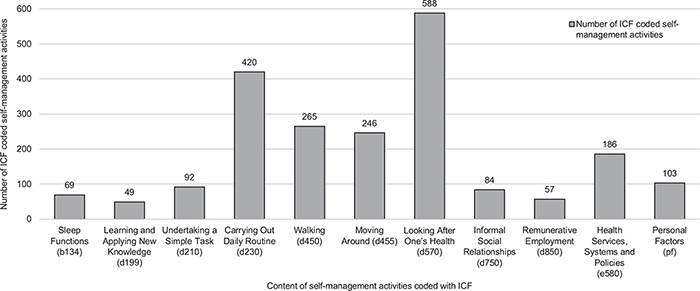
Fig. 1. Self-management activities (SMAs) (n=1,805) reported by 434 patients with rheumatic and musculoskeletal diseases undergoing rehabilitation in specialized healthcare, and linked to the World Health Organization (WHO) International Classification of Function, Disability and Health (ICF) coding system (28).
| Name of ICF category | ICF category | Linked activities to the specific ICF codes, n | Description of ICF category | Examples of registered plans for SMAs |
| “Sleep functions” (Body Functions – Mental Functions – Global Mental Functions) | b134 | 69 | “General mental functions of periodic, reversible and selective physical and mental disengagement from one’s immediate environment accompanied by characteristic physiological changes” (40). | “Get 6 hours of sleep every night”, “Sleep through the whole night”, “Rest some time during the day”, “Rest more” |
| “Learning and applying new knowledge, unspecified” (Activities and Participation) | d199 | 49 | Not classified or described in detail in ICF (40). | “Follow the time schedule I have made at the rehabilitation centre”, “Continue to do the exercises I got from the physiotherapist”, “Actively use the information and knowledge I have gotten about my diagnosis” |
| “Undertaking a simple task” (Activities and Participation – General tasks and demands) | d210 | 92 | “Carrying out simple or complex and coordinated actions related to the mental and physical components of a single task, such as initiating a task, organizing time …, pacing task performance, and carrying out, completing, and sustaining a task” (40). | “Find balance between rest and activity”, “Take breaks between activities”, “Reduce the work load” |
| “Carrying out daily routine” (Activities and Participation – General tasks and demands) | d230 | 420 | “Carrying out simple or complex and coordinated actions in order to plan, manage and complete the requirements of day-to-day procedures or duties, such as budgeting time and making plans for separate activities throughout the day” (40). | “Start up with a time schedule at home”, “Plan my days better”, “Be active on a regular basis” |
| “Walking” (Activities and Participation – Mobility – Walking and Moving) | d450 | 265 | “Moving along a surface on foot, step by step …, such as when strolling, sauntering, walking forwards, backwards, or sideways” (40). | “Take walks 3 times per week”, “Walk with my dog every day”, “Walk to the supermarket instead of driving” |
| “Moving around” (Activities and Participation – Mobility – Walking and Moving) | d455 | 246 | “Moving the whole body from one place to another by means other than walking, such as climbing over a rock or running down a street, skipping, scampering, jumping, somersaulting or running around obstacles” (40). | “Go swimming”, “Go dancing”, “Do interval training outdoors”, “Do hiking in the mountains” |
| “Looking after one’s health” (maintaining diet and fitness, and one’s health) (Activities and Participation – Self-care) | d570 | 588 | “Ensuring physical comfort, health and physical and mental well-being, such as by maintaining a balanced diet, and an appropriate level of physical activity, …” (40). | “Eat healthy and regular meals to lose weight”, “Quit smoking”, “Do fitness”, “Start up at a Community-based Healthy-Life Centre”, “Go to my physiotherapist again” |
| “Informal social relationships” (Activities and Participation – Interpersonal Interactions and Relationships) | d750 | 84 | “Entering into relationships with others, such as casual relationships with people living in the same community or residence, or with co-workers, students, playmates or people with similar backgrounds or professions” (40). | “Be social more often”, “Meet friends at the café”, “Attend dinner parties” |
| “Recreation and leisure” (Activities and Participation – Community, social and civic life) | d920 | 91 | “Engaging in any form of play, recreational or leisure activity, such as informal or organized play and sports, programmes of physical fitness, relaxation, amusement or diversion, going to art galleries, museums, cinemas or theatres; engaging in crafts or hobbies, reading for enjoyment, playing musical instruments; sightseeing, tourism and travelling for pleasure” (40). | “Water aerobics 2 times a week”, “Attend Zumba classes”, “Attend football practices” |
| “Remunerative employment” (Activities and Participation – Major life areas – Work and Employment) | d850 | 57 | “Engaging in all aspects of work, .., for payment, as an employee, full or part time, or self-employed, such as seeking employment and getting a job, doing the required tasks of the job, attending work on time as required, …” (40). | “Continue to work 100% in my job”. “Start up working again”. “Reduced time at work for a while”. |
| “Health services, systems and policies” (Environmental Factors – Service, Systems and Policies) | e580 | 186 | “Services, systems and policies for preventing and treating health problems, providing medical rehabilitation and promoting a healthy lifestyle” (40). | “Start up at the local Community-based Healthy-Life Centre”. “Go to my physiotherapist again”. ‘Make an appointment with my primary physician”. “Contact the Norwegian Labour and Welfare Service”. |
| “Personal factors” | pf | 103 | Is not classified or described in detail in ICF (40). | “Say ‘no’ when I don’t have the energy”. “Listen to what my body tells me”. “Take care of myself and my needs”. “Set limits and frame myself”. “Accept the situation I am in right now”. |
Content descriptions. “Enhance physical health and general well-being” was a SMA topic put forward in a large proportion of the self-management activities (d450, d455, and d570), which involved eating a balanced and healthy diet, weight loss, avoiding smoking, and staying in good physical condition by sustaining an appropriate level of physical activity. “Looking after one’s health” (d570) was the most frequently used single code, and such content involved descriptions of various types of physical exercise, often with the aim of maintaining or improving physical fitness. The SMAs focusing on “everyday routines and activity pacing” (d210 and d230) involved organizing and scheduling time; pacing task performance; and planning, carrying out, and completing a task. These SMAs were also frequently expressed as aiming to find balance between rest and activity, and to develop and sustain routines. SMAs expressing wishes to “utilize new knowledge regarding own health” (d199 and e580) addressed content relating to promoting a healthy lifestyle by utilizing health services, such as a physiotherapy, community healthy life centres, and others. These SMAs also related to the active use of knowledge acquired during the rehabilitation stay, both general and more specifically about disease management; for example, to continue with routines or fitness programmes acquired and initiated at the rehabilitation stay. SMAs addressing social participation and leisure (d750 and d920) comprised wishes to attend activities for enjoyment or recreation, most frequently to engage in and prioritize social events and relationships. SMAs focusing on acceptance and mental health with regards to living with a chronic condition (pf) involved taking care of one’s own needs, setting limits, framing oneself in relation to demands from self and others, and accepting one’s chronic condition and situation. The SMAs focusing on rest and recovery (b134) concerned sleep functions, and prioritizing time for rest and recovery after activities of daily living and stressful engagements, most commonly with the aim of gaining energy and vitality to continue with everyday life. SMAs related to work relations (d850) concerned engaging in all aspects of employment participation, including continuing to work full-time, reducing time at work for a while, or starting to work after a period of sick leave.
Adherence to the self-management activities
Overall adherence. Overall, 2,156 separate ICF codes comprised the SMAs with self-reported adherence within the 12 most frequently linked ICF categories. A total of 1,091 (51%) ICF codes were dichotomized into the high adherence group, and 1,065 (49%) into the low adherence group.
Content of self-management activities with high and low adherence. SMAs in the high adherence group most frequently addressed attendance of recreation activities (d920) or promoting a healthy lifestyle by utilizing health services (e580). The SMAs in the low adherence group were most frequently related to structure and daily life routines (d230), low intensity activities (d450), focusing on acceptance and mental health (pf), or applying acquired knowledge and coping strategies (d199). Fig. 2 shows the percentage distribution of the most frequently used ICF categories in SMAs with high vs low adherence.
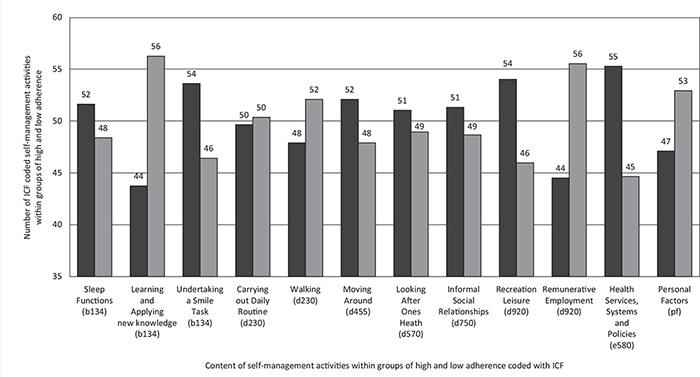
Fig. 2. Self-management activities (SMAs) (n=1,805) reported by 434 patients with rheumatic and musculoskeletal diseases undergoing rehabilitation in specialized healthcare, and linked to the World Health Organization (WHO) International Classification of Function, Disability and Health (ICF) coding system (28). The SMAs were dichotomized into groups of high and low adherence in the year after rehabilitation.
Change in function and health outcomes
Results of the LMMRM analyses revealed significant improvements in the sum scores for all function and health outcomes throughout the rehabilitation trajectory, except for mental health (Table III). These significant improvements were observed between T1 as reference and the other measurement time-points separately (at T2, T3, T4, and T5). For all function and health outcomes, the largest significant improvement in sum score occurred between T1 and T2, with the exception of physical function, which showed the greatest improvement between T1 and T5 (β (95% CI): 5.09 (4.54, 5.64)). Table III shows sum scores for each function and health outcome, and the changes over time compared with T1.
| Function and health outcome [instrument] | Change over time (with T1 as reference value) | ||||
| T2 | T3 | T4 | T5 | ||
| Fatigue [NRS: Fatigue, 0–10, 0=no fatigue] (20) |
β (95% CI) p-value |
−1.37 (−1.61, −1.13) <0.001 |
−0.44 (−0.69, −0.19) <0.001 |
−0.28 (−0.54, −0.028) 0.03 |
−0.46 (−0.72, −0.20) <0.001 |
| Pain [NRS: Pain, 0–10, 0=no pain] (20) |
β (95% CI) p-value |
−0.86 (−1.06, −0.66) | −0.29 (−0.50, −0.09) | −0.31 (−0.52, −0.10) | −0.37 (−0.58, −0.15) |
| <0.001 | 0.005 | 0.003 | <0.001 | ||
| Physical function [30-second sit-to-stand test] (21) |
β (95% CI) p-value |
3.44 (2.92, 3.99) <0.001 |
4.47 (3.93, 5.00) <0.001 |
4.82 (4.27, 5.37) <0.001 |
5.09 (4.54, 5.64) <0.001 |
| Mental health [Hopkins Symptom Checklist (SCL-5), 0–4, 0=no symptoms] (22) |
β (95% CI) p-value |
−0.26 (−0.32, −0.20) <0.001 |
−0.09 (−0.15, −0.02) 0.01 |
−0.05 (−0.12, 0.01) 0.10 |
−0.04 (−0.11, 0.03) 0.24 |
| Activities of daily living [Hannover Functional Questionnaire, 0–24, 0=best function] (23) |
β (95% CI) p-value |
−1.60 (−1.93, −1.26) <0.001 |
−0.65 (−0.99, −0.30) <0.001 |
−0.51 (−0.86, −0.15) 0.01 |
−0.68 (−1.04, −0.32) <0.001 |
| Goal attainment [Patient Specific Functional Scale (PSFS), NRS: 0–10, 0=no goal attainment] (24) |
β (95% CI) | 1.84 (1.65, 2.02) | 1.38 (1.19, 1.57) | 1.39 (1.19, 1.58) | 1.41 (1.22, 1.61) |
| p-value | <0.001 | <0.001 | <0.001 | <0.001 | |
| Health-related quality of life [EQ-5D, Rating of Experienced Health Status on a visual analogue scale: 0–100, 100=best status] (25) |
β (95% CI) p-value |
10.74 (8.70, 12.78) <0.001 |
4.20 (2.12, 6.29) <0.001 |
3.40 (1.28, 5.52) 0.002 |
6.37 (4.20, 8.54) <0.001 |
| Social participation [COOP/WONCA, Sub-score social activities, 1–5, 1=best participation] (26) |
β (95% CI) | −0.47 (−0.58, −0.35) | −0.28 (−0.39, −0.16) | −0.23 (−0.34, −0.11) | −0.27 (−0.38, −0.15 |
| p-value | <0.001 | <0.001 | <0.001 | <0.001 | |
| Coping [Effective Musculoskeletal Consumer Scale (EC-17), 0–100, 100=best coping skills] (27) |
β (95% CI) | 3.73 (2.75, 4.72) | 3.15 (2.13, 4.16) | 2.73 (1.69, 3.76) | 2.84 (1.80, 3.89) |
| p-value | <0.001 | <0.001 | <0.001 | <0.001 | |
| NRS: numerical rating scale; 95% CI: 95% confidence interval. | |||||
Associations between SMA adherence level and changes in the function and health outcomes
SMA adherence level was significantly associated with the improvements in sum score in all function and health outcomes, except for mental health (−0.002 (−0.003, 0.000)) and activities of daily living (−0.01 (−0.02, 0.003)) (Table IV). Table IV shows the associations between SMA adherence level and the improvements over time in each function and health outcome.
| Function and health outcome [instrument] | Associations | |
| β (95% CI) | p-value | |
| Fatigue [NRS: Fatigue, 0–10, 0 = no fatigue] (20) |
−0.01 (−0.02, −0.003) | 0.005 |
| Pain [NRS: Pain, 0–10, 0 = no pain] (20) |
−0.002 (−0.014, −0.004) | < 0.001 |
| Physical function [30-second sit-to-stand test] (21) |
0.03 (0.01, 0.04) | 0.002 |
| Mental health [Hopkins Symptom Checklist (SCL-5), 0–4, 0 = no symptoms] (22) |
−0.002 (−0.003, 0.000) | 0.08 |
| Activities of daily living [Hannover Functional Questionnaire, 0–24, 0 = best function] (23) |
−0.01 (−0.02, 0.003) | 0.31 |
| Goal attainment [Patient Specific Functional Scale (PSFS), NRS: 0–10, 0 = no goal attainment] (24) |
0.01 (0.006, 0.020) | < 0.001 |
| Health-related quality of life [EQ-5D, Rating of Experienced Health Status on a Visual Analogue Scale: 0–100, 100 = best status] (25) |
0.06 (0.01, 0.11) | 0.02 |
| Social participation [COOP/WONCA, Sub-score social activities, 1–5, 1 = best participation] (26) |
−0.01 (−0.01, −0.002) | < 0.001 |
| Coping [Effective Musculoskeletal Consumer Scale (EC-17), 0–100, 100 = best coping skills] (27) |
0.05 (0.02, 0.08) | < 0.001 |
| EQ-5D: EuroQol 5 dimensions; NRS: numerical rating scale; 95% CI: 95% confidence interval. | ||
DISCUSSION
This study is one of few to explore the content of self-management activities among individuals with RMDs, and how adherence to self-management strategies is associated with changes in function and health outcomes throughout the rehabilitation trajectory. One key finding is that SMA adherence was significantly associated with improvements in all function and health outcomes after rehabilitation, except for mental health and activities of daily living. The results also showed that SMAs were most often focused on enhanced physical health and general well-being, and managing everyday routines, and seldom prioritized work participation. In addition, we more commonly found high adherence to activities involving attendance of recreational activities or promoting a healthy lifestyle by utilizing health services, while we more commonly observed low adherence to activities addressing structure and daily life routines, focusing on acceptance and mental health, or applying acquired knowledge and coping strategies.
For most outcomes, the largest improvement occurred during the rehabilitation stay. During the year following rehabilitation, higher SMA adherence was significantly associated with improvements, suggesting that SMA adherence is a key component for maintaining health and function over time. This finding is in line with results from a recent systematic review, showing that non-adherence is associated with poor health outcomes in patients with RMDs (17). The same review concluded that the reasons for non-adherence are complex and depend on social-, healthcare-, and therapy-related factors, as well as disease characteristics (17). Based on these findings, barriers and facilitators for adherence, including people who can support the patient in performing SMAs after discharge, should be identified and incorporated in plans for the post-rehabilitation period.
SMAs focused on structure and daily life routines were frequently prioritized by study participants, but were challenging to adhere to at home. In addition, in a publication on the same study sample, having structures and routines was a significant participant characteristic associated with adherence to self-management strategies after rehabilitation (16). In a recent qualitative study, participants with RMDs experienced the rehabilitation setting as valuable because they could fully focus on themselves and self-care. At the same time, the interventions were implemented outside of the home setting and away from activities of daily living and chores, such that it was challenging to transfer learning from the rehabilitation stay to everyday life (32). Correspondingly, in the current study, the improvements in activities of daily living seen over time were not associated with SMA adherence at home. The clinical implications of this finding may be that carrying out everyday activities and routines should receive more attention during the rehabilitation stay, and should be incorporated in planned follow-up care and in the patient’s home setting. As such, the current findings show a need to address the distribution of healthcare professionals in the multidisciplinary team and to involve healthcare professional expertise in managing activities of daily living; for example, by including occupational therapists (OTs).
Improvement in mental health was neither maintained after rehabilitation, nor associated with SMA adherence in the current study. From a biopsychosocial perspective, successful management of living with a chronic condition requires a combined focus on physiological, emotional, behavioural, psychological, and cognitive aspects (5). Internationally, political strategies and recommendations have increasingly emphasized mental health and a biopsychosocial approach; however, it seems that current rehabilitation for people with RMDs often focuses on the physical aspects of living with a chronic condition. For example, the most common long-term goal put forward by patients with RMDs is to improve physical function (33, 34), and physical function was the single outcome in the current study that showed improvement throughout the rehabilitation trajectory. To properly address a biopsychosocial approach in rehabilitation for patients with RMDs, screening for mental health challenges should be part of the initial assessment and addressed as a potential barrier in planning for self-management strategies. Therefore, the multidisciplinary team should have knowledge and specialized competence in mental health, such as by including psychologists or psychiatric nurses, which should be available both during rehabilitation and in primary healthcare.
Evidence supports a positive relationship between work and health status (35, 36), and people with RMDs have identified the ability to maintain employment and to be productive at work as a priority (37). Therefore, it is somewhat surprising that SMAs focused on work participation were seldom prioritized, even though nearly half of the participants in the current study were employed. This may have the consequence that people of working age will permanently fall out of working life. Improvement in clinical rehabilitation practices should include routinely addressing participation in healthy and sustainable paid work, as part of the initial rehabilitation conversation, when patients are of working age or employed. In addition, during rehabilitation, a dialogue should be arranged with the patient’s employer to discuss work barriers and promotors.
A strength of this study is that it included a relatively large sample size, together with a wide selection of RMD diagnoses and specialized rehabilitation programmes introduced to participants across Norway. Thus, the findings are generalizable to a Norwegian rehabilitation context and to rehabilitation structures that do not significantly differ from the Norwegian healthcare system. Another strength is the use of the ICF as a framework to analyse the content of SMAs reported by patients with RMD, as this tool has been validated for describing and comparing health information (29, 38). A limitation is that the method for calculating SMA adherence level was designed for the current study and has not yet been validated elsewhere. However, no reference tool for measuring adherence has been developed previously (39). A possible limitation of the method is that it did not consider, for example, how participants’ scoring of 1 SMA with high adherence was valued compared with several SMAs scored with low adherence. This may have created a potential source of bias in the calculation of participants’ SMA adherence level. Nonetheless, this method of calculating adherence can inform the development of a standard approach to evaluate patient adherence to self-management in rehabilitation. As a consequence of the statistical differences in T5 responders and T5 non-responders in the current study, more vulnerable and burdened individuals may have been lost to follow-up. As such, the current findings may potentially have under-reported outcomes for individuals less able to adjust to healthy behaviour by adhering to their SMAs, suggesting that the need for rehabilitation and follow-up care may be larger than determined here.
In conclusion, adherence to SMAs appears to be a key component for maintaining health and function over time in individuals with RMDs. There remains a need for greater focus on mental health challenges and work participation, and increased awareness and support of these issues during complex rehabilitation. In addition, it seems important to provide support for creating structure and setting everyday routines at home, in order to maintain health and function over time.
ACKNOWLEDGEMENTS
All authors contributed to the data analyses and interpretation. All authors substantially contributed to drafting or critically revising the article.
This multicentre cohort study was funded by the Dam Foundation.
No sponsors were involved in the study design, data collection, data analysis, data interpretation, or writing of the manuscript.
REFERENCES
- World Health Organization (WHO). Rehabilitation in health systems. Geneva: World Health Organization (WHO); 2017.
- Johansen I, Klokkerud M, Anke A, Borke JB, Glott T, Hauglie U, et al. A quality indicator set for use in rehabilitation team care of people with rheumatic and musculoskeletal diseases; development and pilot testing. BMC Health Serv Res 2019; 19: 265.
- Nikiphorou E, Santos EJF, Marques A, Böhm P, Bijlsma JWJ, Daien CI, et al. 2021 EULAR recommendations for the implementation of self-management strategies in patients with inflammatory arthritis. Ann Rheum Dis 2021; 1–8.
- Klokkerud M, Hagen KB, Lochting I, Uhlig T, Kjeken I, Grotle M. Does the content really matter? A study comparing structure, process, and outcome of team rehabilitation for patients with inflammatory arthritis in two different clinical settings. Scand J Rheumatol 2012; 41: 20–28.
- de Ridder D, Geenen R, Kuijer R, van Middendorp H. Psychological adjustment to chronic disease. Lancet (London, England) 2008; 372: 246–255.
- Iversen MD, Hammond A, Betteridge N. Self-management of rheumatic diseases: state of the art and future perspectives. Ann Rheum Dis 2010; 69: 955–963.
- Kjeken I, Bo I, Ronningen A, Spada C, Mowinckel P, Hagen KB, et al. A three-week multidisciplinary in-patient rehabilitation programme had positive long-term effects in patients with ankylosing spondylitis: randomized controlled trial. J Rehabil Med 2013; 45: 260–267.
- Bearne LM, Byrne AM, Segrave H, White CM. Multidisciplinary team care for people with rheumatoid arthritis: a systematic review and meta-analysis. Rheumatol Int 2016; 36: 311–324.
- Berdal G, Bø I, Dager TN, Dingsør A, Eppeland SG, Hagfors J, et al. Structured goal planning and supportive telephone followup in rheumatology care: results from a pragmatic stepped-wedge cluster-randomized trial. Arthritis Care Res (Hoboken) 2018; 70: 1576–1586.
- Van de Velde D, De Zutter F, Satink T, Costa U, Janquart S, Senn D, et al. Delineating the concept of self-management in chronic conditions: a concept analysis. BMJ Open 2019; 9: e027775.
- Lorig KR, Holman H. Self-management education: history, definition, outcomes, and mechanisms. Ann Behav Med 2003 26: 1–7
- World Health Organization (WHO). Adherence to long term therapies. Evid Action 2003. https://apps.who.int/iris/handle/10665/42682
- Bailey DL, Holden MA, Foster NE, Quicke JG, Haywood KL, Bishop A. Defining adherence to therapeutic exercise for musculoskeletal pain: a systematic review. Br J Sports Med 2020; 54: 326–331.
- Esbensen BA, Kennedy N, Brodin N. Prevention and adherence in rheumatic and musculoskeletal disease. Best Pract Res Clin Rheumatol 2020; 34: 101525.
- van den Bemt BJF, Zwikker HE, van den Ende CHM. Medication adherence in patients with rheumatoid arthritis: a critical appraisal of the existing literature. Expert Rev Clin Immunol 2012; 8: 337–351.
- Valaas HL, Klokkerud M, Hildeskår J, Hagland AS, Kjønli E, Mjøsund K, et al. Follow-up care and adherence to self-management activities in rehabilitation for patients with rheumatic and musculoskeletal diseases: results from a multicentre cohort study. Disabil Rehabil 2021; 30: 1–10.
- Ritschl V, Stamm TA, Aletaha D, Bijlsma JWJ, Böhm P, Dragoi R, et al. Prevention, screening, assessing and managing of non-adherent behaviour in people with rheumatic and musculoskeletal diseases: systematic reviews informing the 2020 EULAR points to consider. RMD Open 2020; 6: e00143.
- Marques A, Santos E, Nikiphorou E, Bosworth A, Carmona L. Effectiveness of self-management interventions in inflammatory arthritis: a systematic review informing the 2021 EULAR recommendations for the implementation of self-management strategies in patients with inflammatory arthritis. RMD Open 2021; 7: e001647.
- Klokkerud M, Dagfinrud H, Uhlig T, Dager TN, Furunes KA, Klokkeide Å, et al. Developing and testing a consensus-based core set of outcome measures for rehabilitation in musculoskeletal diseases. Scand J Rheumatol 2018; 47: 225–234.
- Hjermstad MJ, Fayers PM, Haugen DF, Caraceni A, Hanks GW, Loge JH, et al. Studies comparing numerical rating scales, verbal rating scales, and visual analogue scales for assessment of pain intensity in adults: a systematic literature review. J Pain Symptom Manage 2011; 41: 1073–1093.
- Jones CJ, Rikli RE, Beam WC. A 30-s chair-stand test as a measure of lower body strength in community-residing older adults. Res Q Exerc Sport 1999; 7 0: 113–119.
- Strand BH, Dalgard OS, Tambs K, Rognerud M. Measuring the mental health status of the Norwegian population: a comparison of the instruments SCL-25, SCL-10, SCL-5 and MHI-5 (SF-36). Nord J Psychiatry 2003; 57: 113–118.
- Magnussen LH, Lygren H, Anderson B, Breivik K, Strand LI. Validation of the Norwegian version of Hannover Functional Ability Questionnaire. Spine (Phila Pa 1976) 2010; 35: e646–653.
- Westaway MD, Stratford PW, Binkley JM. The patient-specific functional scale: validation of its use in persons with neck dysfunction. J Orthop Sports Phys Ther 1998; 27: 331–338.
- Johnsen LG, Hellum C, Nygaard OP, Storheim K, Brox JI, Rossvoll I, et al. Comparison of the SF6D, the EQ5D, and the Oswestry Disability Index in patients with chronic low back pain and degenerative disc disease. BMC Musculoskelet Disord 2013; 14:148.
- Bentsen BG, Natvig B, Winnem M. Questions you didn’t ask? COOP/WONCA Charts in clinical work and research. World Organization of Colleges, Academies and Academic Associations of General Practitioners/Family Physicists. Fam Pract 1999; 16: 190–195.
- Hamnes B, Garratt A, Kjeken I, Kristjansson E, Hagen KB. Translation, data quality, reliability, validity and responsiveness of the Norwegian version of the Effective Musculoskeletal Consumer Scale (EC-17). BMC Musculoskelet Disord 2010; 11:21.
- World Health Organizaiton (WHO). International Classification of Functioning, Disability and Health (ICF): World Health Organization 2018 [updated 2 March 2018]. Available from: http://www.who.int/classification/icf/en/. 2018. https://www.who.int/standards/classifications/international-classification-of-functioning-disability-and-health
- Cieza A, Brockow T, Ewert T, Amman E, Kollerits B, Chatterji S, et al. Linking health-status measurements to the International Classification of Functioning, Disability and Health. J Rehabil Med 2002; 34: 205–210.
- Cieza A, Geyh S, Chatterji S, Kostanjsek N, Ustün B, Stucki G. ICF linking rules: an update based on lessons learned. J Rehabil Med 2005; 37: 212–218.
- Cieza A, Fayed N, Bickenbach J, Prodinger B. Refinements of the ICF linking rules to strengthen their potential for establishing comparability of health information. Disabil Rehabil 2019; 41: 510–574.
- Stauner M, Primdahl J. A sanctuary from everyday life: rheumatology patients’ experiences of in-patient multidisciplinary rehabilitation – a qualitative study. Disabil Rehabil 2020; 8: 1–8.
- Valaas HL, Klokkerud M, Hildeskår J, Hagland AS, Kjønli E, Mjøsund K, et al. Rehabilitation goals described by patients with rheumatic and musculoskeletal diseases: content and attainment during the first year after rehabilitation. Disabil Rehabil 2021; 2: 1–11.
- Berdal G, Sand-Svartrud A-L, Bø I, Dager TN, Dingsør A, Eppeland SG, et al. Aiming for a healthier life: a qualitative content analysis of rehabilitation goals in patients with rheumatic diseases. Disabil Rehabil 2018; 40: 765–778.
- Waddell G, Burton K, Aylward M. Work and common health problems. J Insurance Medicine (New York, NY) 2007; 39: 109–120.
- Hammond A, O’Brien R, Woodbridge S, Bradshaw L, Prior Y, Radford K, et al. Job retention vocational rehabilitation for employed people with inflammatory arthritis (WORK-IA): a feasibility randomized controlled trial. BMC Musculoskel Disord 2017; 18: 315.
- Lacaille D, White MA, Backman CL, Gignac MAM. Problems faced at work due to inflammatory arthritis: new insights gained from understanding patients’ perspective. Arthritis Rheum 2007; 57: 1269–1279.
- Fayed N, Cieza A, Edmond Bickenbach J. Linking health and health-related information to the ICF: a systematic review of the literature from 2001 to 2008. Disabil Rehabil 2011; 33: 1941–1951.
- Hall AM, Kamper SJ, Hernon M, Hughes K, Kelly G, Lonsdale C et al. Measurement tools for adherence to non-pharmacologic self-management treatment for chronic musculoskeletal conditions: a systematic review. Arch Phys Med Rehabil 2015; 96: 552–562.
- ICF Illustration Library. International University of Health and Welfare. English version. Accessed 05 June 2018. Available from: http://icfillustration.com/icfil_eng/top.html