
MELACARE Nurse-led follow-up after early-stage melanoma: protocol and feasibility
DOI:
https://doi.org/10.2340/1651-226X.2024.41037Keywords:
Cancer, Fear of cancer recurrence, skin self-examination, patient-reported outcome, randomised controlled trial, interventionAbstract
Background and purpose: We developed the Melacare nurse-led intervention, which combines education
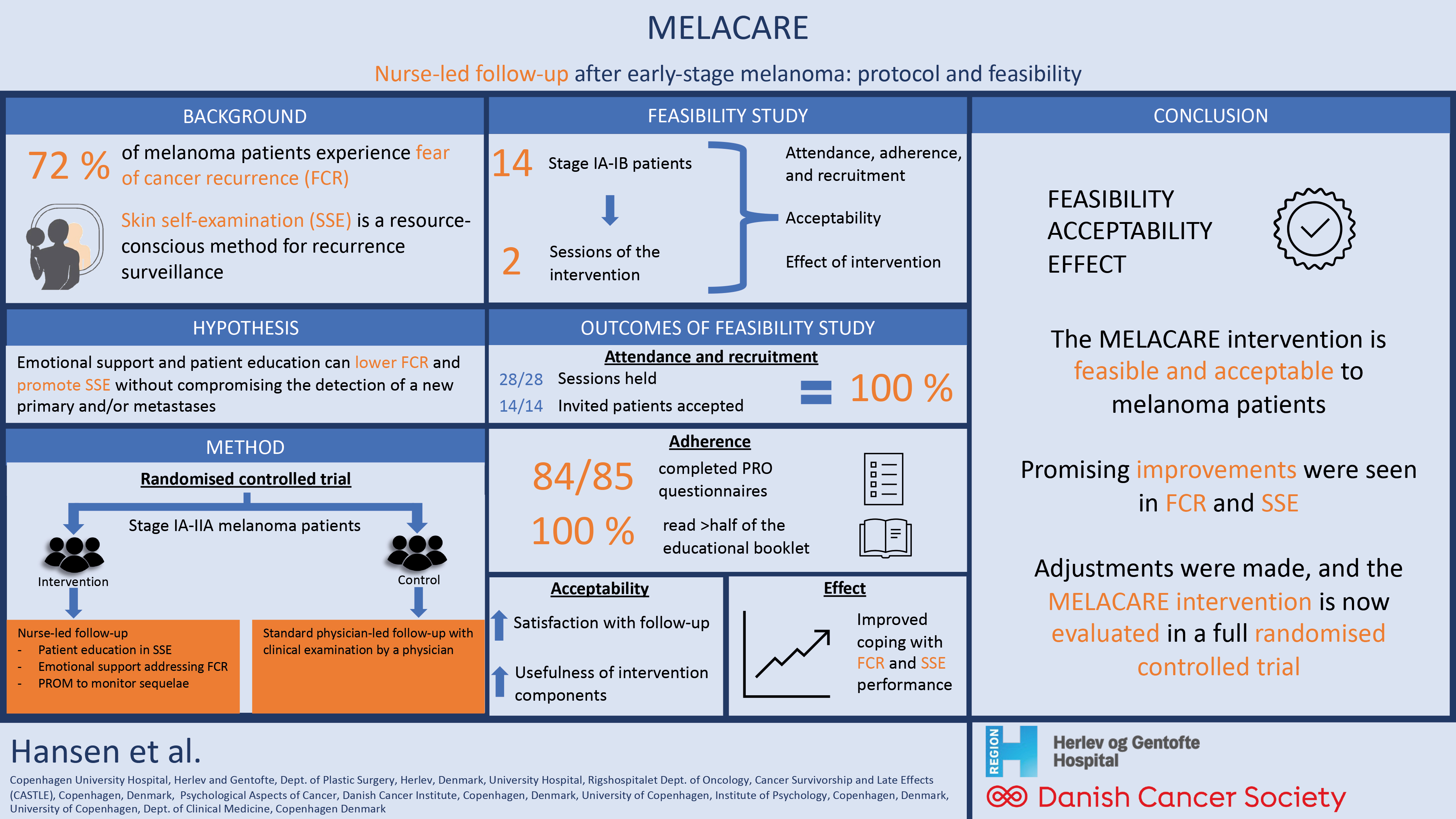
in skin self-examination as a resource-conscious approach to detecting recurrence and management of fear of cancer recurrence in patients treated for melanoma. This publication presents the Melacare study protocol and evaluates the feasibility and acceptability of Melacare prior to a larger randomised controlled trial.
Material and methods: Feasibility and acceptability of Melacare were evaluated in an intervention-only feasibility study, in which patients attended two nurse-led intervention sessions coupled with an educational booklet. Participants completed patient-reported outcome (PRO) questionnaires at baseline and before each session. After the intervention, participants completed a study-specific feedback questionnaire. Feasibility was evaluated in terms of recruitment, adherence, and attendance. Self-reported outcomes from the study-specific questionnaire on intervention effects were also collected.
Results of the feasibility study: Fourteen patients (nine stage IA, five stage IB melanoma) participated. Attendance and recruitment rates were 100%, all participants completed the baseline and PRO questionnaires, and 100% read at least half of the educational booklet. In terms of intervention effects, all patients reported improved knowledge of performing skin self-examination and coping with the fear of cancer recurrence.
Interpretation: Results indicate that the Melacare nurse-led intervention is highly feasible and acceptable for use with patients treated for early-stage melanoma. Prior to clinical trial commencement, minor refinements include changing the method of recruiting by telephone and offering
Downloads
References
Trotter SC, Sroa N, Winkelmann RR, Olencki T, Bechtel M. A global review of melanoma follow-up guidelines. J Clin Aesthet Dermatol. 2013;6(9):18–26.
Johnston L, Starkey S, Mukovozov I, Robertson L, Petrella T, Alhusayen R. Surveillance after a previous cutaneous melanoma diagnosis: a scoping review of melanoma follow-up guidelines. J Cutan Med Surg. 2023;27(5):516–25.
https://doi.org/10.1177/12034754231188434 DOI: https://doi.org/10.1177/12034754231188434
Helvind NM, Weitemeyer MBM, Chakera AH, et al. Earlier recurrence detection using routine FDG PET-CT scans in surveillance of stage IIB to IIID melanoma: a national cohort study of 1480 patients. Ann Surg Oncol. 2023;30(4):2377–88.
https://doi.org/10.1245/s10434-022-13034-6 DOI: https://doi.org/10.1245/s10434-022-13034-6
Danmark, Sundhedsstyrelsen. Pakkeforløb for modermærkekræft i huden: for fagfolk. Sundhedsstyrelsen; 2020, Copenhagen.
Deckers EA, Hoekstra-Weebers JEHM, Damude S, et al. The MELFO study: A multicenter, prospective, randomized clinical trial on the effects of a reduced stage-adjusted follow-up schedule on cutaneous melanoma IB–IIC patients—results after 3 years. Ann Surg Oncol. 2020;27(5):1407–17.
https://doi.org/10.1245/s10434-019-07825-7 DOI: https://doi.org/10.1245/s10434-019-07825-7
Robinson JK, Wayne JD, Martini MC, Hultgren BA, Mallett KA, Turrisi R. Early detection of new melanomas by patients with melanoma and their partners using a structured skin self-examination skills training intervention. JAMA Dermatol. 2016;152(9):979–85.
https://doi.org/10.1001/jamadermatol.2016.1985 DOI: https://doi.org/10.1001/jamadermatol.2016.1985
Dieng M, Smit AK, Hersch J, et al. Patients’ views about skin self-examination after treatment for localized melanoma. JAMA Dermatol. 2019;155(8):914–21.
https://doi.org/10.1001/jamadermatol.2019.0434 DOI: https://doi.org/10.1001/jamadermatol.2019.0434
Kasparian NA. Psychological stress and melanoma: are we meeting our patients’ psychological needs? Clin Dermatol. 2013;31(1):41–6.
https://doi.org/10.1016/j.clindermatol.2011.11.005
Costa DSJ, Dieng M, Cust AE, Butow PN, Kasparian NA. Psychometric properties of the Fear of Cancer Recurrence Inventory: an item response theory approach. Psycho-Oncol. 2016;25(7):832–8. DOI: https://doi.org/10.1002/pon.4018
https://doi.org/10.1016/j.clindermatol.2011.11.005 DOI: https://doi.org/10.1016/j.clindermatol.2011.11.005
Dieng M, Butow PN, Costa DSJ, et al. Psychoeducational intervention to reduce fear of cancer recurrence in people at high risk of developing another primary melanoma: results of a randomized controlled trial. J Clin Oncol 2016;34(36):4405–14.
https://doi.org/10.1200/JCO.2016.68.2278 DOI: https://doi.org/10.1200/JCO.2016.68.2278
Dieng M, Morton RL, Costa DSJ, et al. Benefits of a brief psychological intervention targeting fear of cancer recurrence in people at high risk of developing another melanoma: 12-month follow-up results of a randomized controlled trial. Br J Dermatol. 2020;182(4):860–8.
https://doi.org/10.1111/bjd.17990 DOI: https://doi.org/10.1111/bjd.17990
Paperák P, Javůrková A, Raudenská J. Therapeutic intervention in fear of cancer recurrence in adult oncology patients: a systematic review. J Cancer Surviv. 2023;17(4):1017–35.
https://doi.org/10.1007/s11764-022-01277-x DOI: https://doi.org/10.1007/s11764-022-01277-x
Schulz KF, Altman DG, Moher D. CONSORT 2010 statement: updated guidelines for reporting parallel group randomised trials. BMJ (Online). 2010;340(7748):698–702. DOI: https://doi.org/10.1016/j.ijsu.2010.09.006
https://doi.org/10.1136/bmj.c332 DOI: https://doi.org/10.1136/bmj.c332
Hazen BP, Bhatia AC, Zaim T, Brodell RT. The clinical diagnosis of early malignant melanoma: expansion of the ABCD criteria to improve diagnostic sensitivity. Dermatol Online J. 1999;5(2):3.
https://doi.org/10.5070/D366x188mb DOI: https://doi.org/10.5070/D366X188MB
Butow PN, Bell ML, Smith AB, et al. Conquer fear: protocol of a randomised controlled trial of a psychological intervention to reduce fear of cancer recurrence. BMC Cancer. 2013;13:201.
https://doi.org/10.1186/1471-2407-13-201 DOI: https://doi.org/10.1186/1471-2407-13-201
Dieng M, Kasparian NA, Morton RL, et al. The melanoma care study: protocol of a randomised controlled trial of a psycho-educational intervention for melanoma survivors at high risk of developing new primary disease. BMC Psychol. 2015;3(1):23.
https://doi.org/10.1186/s40359-015-0074-3 DOI: https://doi.org/10.1186/s40359-015-0074-3
Wells A. Detached mindfulness in cognitive therapy: a metacognitive analysis and ten techniques. J Rat-Emo Cogn-Behav Ther. 2005;23(4):337–55.
https://doi.org/10.1007/s10942-005-0018-6 DOI: https://doi.org/10.1007/s10942-005-0018-6
Borkovec TD, Wilkinson L, Folensbee R, Lerman C. Stimulus control applications to the treatment of worry. Behav Res Ther. 1983;21(3):247–51.
https://doi.org/10.1016/0005-7967(83)90206-1 DOI: https://doi.org/10.1016/0005-7967(83)90206-1
Kasparian NA, Mireskandari S, Butow PN, et al. “Melanoma: Questions and Answers.” Development and evaluation of a psycho-educational resource for people with a history of melanoma. Support Care Cancer. 2016;24(12):4849–59.
https://doi.org/10.1007/s00520-016-3339-3 DOI: https://doi.org/10.1007/s00520-016-3339-3
Cornier JN, Davidson L, Xing Y, Webster K, Cella D. Measuring quality of life in patients with melanoma: development of the FACT-melanoma subscale. J Support Oncol. 2005;3(2):139–45.
Cornier J, Ross M, Gershenwald J, et al. Prospective assessment of the reliability, validity, and sensitivity to change of the Functional Assessment of Cancer Therapy-Melanoma questionnaire. Cancer. 2008;112(10):2249–57.
https://doi.org/10.1002/cncr.23424 DOI: https://doi.org/10.1002/cncr.23424
Thewes B, Zachariae R, Christensen S, Nielsen T, Butow P. The Concerns About Recurrence Questionnaire: validation of a brief measure of fear of cancer recurrence amongst Danish and Australian breast cancer survivors. J Cancer Surv Res Pract. 2014;9(1):68–79.
https://doi.org/10.1007/s11764-014-0383-1 DOI: https://doi.org/10.1007/s11764-014-0383-1
Roth AJ, Kornblith AB, Batel-Copel L, Peabody E, Scher HI, Holland JC. Rapid screening for psychologic distress in men with prostate carcinoma: a pilot study. Cancer. 1998;82(10):1904–8.
https://doi.org/10.1002/(SICI)1097-0142(19980515)82:10<1904::AID-CNCR13>3.0.CO;2-X DOI: https://doi.org/10.1002/(SICI)1097-0142(19980515)82:10<1904::AID-CNCR13>3.0.CO;2-X
Donovan KA, Grassi L, McGinty HL, Jacobsen PB. Validation of the distress thermometer worldwide: state of the science. Psycho-Oncol. 2014;23(3):241–50.
https://doi.org/10.1002/pon.3430 DOI: https://doi.org/10.1002/pon.3430
Spitzer RL, Kroenke K, Williams JBW, Löwe B. A brief measure for assessing generalized anxiety disorder: the GAD-7. Arch Intern Med. 2006;166(10):1092–7.
https://doi.org/10.1001/archinte.166.10.1092 DOI: https://doi.org/10.1001/archinte.166.10.1092
Löwe B, Decker O, Müller S, et al. Validation and standardization of the Generalized Anxiety Disorder Screener (GAD-7) in the general population. Med Care. 2008;46(3):266–74.
https://doi.org/10.1097/MLR.0b013e318160d093 DOI: https://doi.org/10.1097/MLR.0b013e318160d093
Spitzer RL, Kroenke K, Williams JB. Validation and utility of a self-report version of PRIME-MD: the PHQ primary care study. Primary Care Evaluation of Mental Disorders. Patient Health Questionnaire. JAMA. 1999;282(18):1737–44.
https://doi.org/10.1001/jama.282.18.1737 DOI: https://doi.org/10.1001/jama.282.18.1737
Kroenke K, Spitzer RL, Williams JB. The PHQ-9: validity of a brief depression severity measure. J Gen Intern Med. 2001;16(9):606–13.
https://doi.org/10.1046/j.1525-1497.2001.016009606.x DOI: https://doi.org/10.1046/j.1525-1497.2001.016009606.x
Brooks R. EuroQol: the current state of play. Health Policy. 1996;37(1):53–72.
https://doi.org/10.1016/0168-8510(96)00822-6 DOI: https://doi.org/10.1016/0168-8510(96)00822-6
Hibbard JH, Stockard J, Mahoney ER, Tusler M. Development of the patient activation measure (PAM): conceptualizing and measuring activation in patients and consumers. Health Serv Res. 2004;39(4 Pt 1):1005–26.
https://doi.org/10.1111/j.1475-6773.2004.00269.x DOI: https://doi.org/10.1111/j.1475-6773.2004.00269.x
Ilmarinen J. The Work Ability Index (WAI). Occup Med. 2007;57(2):160.
https://doi.org/10.1093/occmed/kqm008 DOI: https://doi.org/10.1093/occmed/kqm008
Coffman CJ, Edelman D, Woolson RF. To condition or not condition? Analysing ‘change’ in longitudinal randomised controlled trials. BMJ Open. 2016;6(12):e013096.
https://doi.org/10.1136/bmjopen-2016-013096 DOI: https://doi.org/10.1136/bmjopen-2016-013096
Proust C, Jacqmin-Gadda H, Taylor JMG, Ganiayre J, Commenges D. A nonlinear model with latent process for cognitive evolution using multivariate longitudinal data. Biometrics. 2006;62(4):1014–24.
https://doi.org/10.1111/j.1541-0420.2006.00573.x DOI: https://doi.org/10.1111/j.1541-0420.2006.00573.x
Saltbæk L, Karlsen RV, Bidstrup PE, et al. MyHealth: specialist nurse-led follow-up in breast cancer. A randomized controlled trial – development and feasibility. Acta Oncol. 2019;58(5):619–26.
https://doi.org/10.1080/0284186X.2018.1563717 DOI: https://doi.org/10.1080/0284186X.2018.1563717
Additional Files
Published
How to Cite
Issue
Section
Categories
License
Copyright (c) 2023 Sara M. Hansen, Christoffer Johansen, Magnus P.B. Obinah, Nadine A. Kasparian, Peter Genter, Pernille E. Bidstrup, Lisbet R. Hölmich

This work is licensed under a Creative Commons Attribution 4.0 International License.


