
Optimal treatment duration in metastatic renal cell carcinoma patients responding to immune checkpoint inhibitors: should we treat beyond two years?
DOI:
https://doi.org/10.2340/1651-226X.2025.43876Keywords:
Renal cell carcinoma, immune checkpoint inhibitors, optimal treatment duration, treatment discontinuationAbstract
Background and purpose: Optimal treatment duration is unknown in metastatic renal cell carcinoma (mRCC) responding to immune checkpoint inhibitors (ICPIs). Prolonged treatment can lead to late toxicity, burden for day clinics and financial impact.
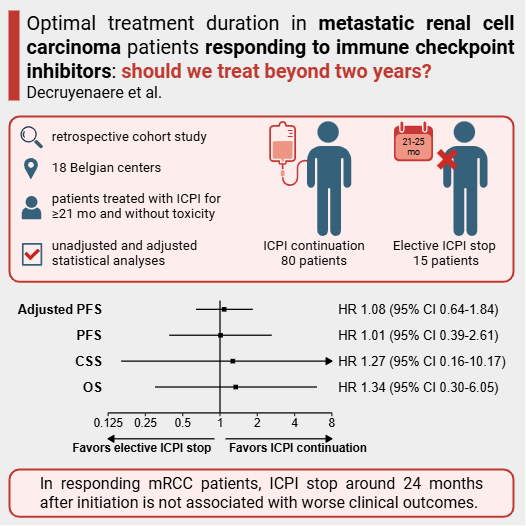
Patients and methods: This multicenter retrospective study included mRCC patients responding to ipilimumab/nivolumab in first-line or nivolumab in later lines, who were treated for at least 21 months and did not stop for toxicity. Progression-free survival (PFS), overall survival (OS), and cancer-specific survival (CSS) were modeled non- and semi-parametrically. The effect of elective ICPI discontinuation (i.e. treatment interruption at the clinician’s discretion) between 21 and 25 months on PFS was assessed by a causal inference approach using artificial censoring along with inverse probability of censoring weighting.
Results: Ninety-five patients were included with a median follow-up of 62.1 (95% confidence interval [CI]: 57.3–67.5) months. Fifty-four received ipilimumab/nivolumab, whereas 41 patients received nivolumab, for a median treatment duration of 33.8 (95% CI: 28.5–39.6) months.
Fifty-seven patients discontinued ICPIs electively. Three-year PFS after discontinuation was 57.1% (95% CI: 34.3–95.1), 3-year OS 67.5% (95% CI: 37.0–100.0), and 3-year CSS 90.0% (95% CI: 73.2–100.0).
Fifteen (15.8%) patients discontinued ICPIs between 21 and 25 months. Compared to 80 patients who were treated longer, they had more often a metachronous metastatic pattern (p = 0.048) and a complete response (p = 0.045). Elective ICPI stop between 21 and 25 months did not significantly impact the hazard for progression/death (adjusted HR 1.08, 95% CI: 0.64–1.84, p = 0.766).
Interpretation: Among mRCC patients responding to ICPI, elective therapy discontinuation approximately 24 months after initiation does not appear to compromise outcomes compared to continuing therapy.
Downloads
References
Regan MM, Jegede OA, Mantia CM, Powles T, Werner L, Motzer RJ, et al. Treatment-free survival after immune checkpoint inhibitor therapy versus targeted therapy for advanced renal cell carcinoma: 42-month results of the CheckMate 214 Trial. Clin Cancer Res. 2021;27(24):6687–95.
https://doi.org/10.1158/1078-0432.CCR-21-2283 DOI: https://doi.org/10.1158/1078-0432.CCR-21-2283
Tzeng A, Tzeng TH, Ornstein MC. Treatment-free survival after discontinuation of immune checkpoint inhibitors in metastatic renal cell carcinoma: a systematic review and meta-analysis. J Immunother Cancer. 2021;9(10):1–11.
https://doi.org/10.1136/jitc-2021-003473 DOI: https://doi.org/10.1136/jitc-2021-003473
Powles T, Albiges L, Bex A, Comperat E, Grunwald V, Kanesvaran R, et al. Renal cell carcinoma: ESMO Clinical Practice Guideline for diagnosis, treatment and follow-up. Ann Oncol. 2024;35(8):692–706.
https://doi.org/10.1016/j.annonc.2024.05.537 DOI: https://doi.org/10.1016/j.annonc.2024.05.537
Waterhouse DM, Garon EB, Chandler J, McCleod M, Hussein M, Jotte R, et al. Continuous versus 1-year fixed-duration nivolumab in previously treated advanced non-small-cell lung cancer: CheckMate 153. J Clin Oncol. 2020;38(33):3863–73.
https://doi.org/10.1200/JCO.20.00131 DOI: https://doi.org/10.1200/JCO.20.00131
Kim H, Kim DW, Kim M, Lee Y, Ahn HK, Cho JH, et al. Long-term outcomes in patients with advanced and/or metastatic non-small cell lung cancer who completed 2 years of immune checkpoint inhibitors or achieved a durable response after discontinuation without disease progression: multicenter, real-world data (KCSG LU20-11). Cancer. 2022;128(4):778–87.
https://doi.org/10.1002/cncr.33984 DOI: https://doi.org/10.1002/cncr.33984
Sun L, Bleiberg B, Hwang WT, Marmarelis ME, Langer CJ, Singh A, et al. Association between duration of immunotherapy and overall survival in advanced non-small cell lung cancer. JAMA Oncol. 2023;9(8):1075–82.
https://doi.org/10.1001/jamaoncol.2023.1891 DOI: https://doi.org/10.1001/jamaoncol.2023.1891
Jansen YJL, Rozeman EA, Mason R, Goldinger SM, Geukes Foppen MH, Hoejberg L, et al. Discontinuation of anti-PD-1 antibody therapy in the absence of disease progression or treatment limiting toxicity: clinical outcomes in advanced melanoma. Ann Oncol. 2019;30(7):1154–61.
https://doi.org/10.1093/annonc/mdz110 DOI: https://doi.org/10.1093/annonc/mdz110
Ito K, Kita Y, Yokomizo A, Miki J, Yoshio Y, Matsumoto H, et al. Discontinuation of pembrolizumab for advanced urothelial carcinoma without disease progression: nationwide cohort study. Cancer Med. 2023;12(3):2325–32.
https://doi.org/10.1002/cam4.5057 DOI: https://doi.org/10.1002/cam4.5057
Seymour L, Bogaerts J, Perrone A, Ford R, Schwartz LH, Mandrekar S, et al. iRECIST: guidelines for response criteria for use in trials testing immunotherapeutics. Lancet Oncol. 2017;18(3):e143–52.
https://doi.org/10.1016/S1470-2045(17)30074-8 DOI: https://doi.org/10.1016/S1470-2045(17)30074-8
Daniel RM, Cousens SN, De Stavola BL, Kenward MG, Sterne JA. Methods for dealing with time-dependent confounding. Stat Med. 2013;32(9):1584–618.
https://doi.org/10.1002/sim.5686 DOI: https://doi.org/10.1002/sim.5686
Robins JM, Hernan MA, Brumback B. Marginal structural models and causal inference in epidemiology. Epidemiology. 2000;11(5):550–60.
https://doi.org/10.1097/00001648-200009000-00011 DOI: https://doi.org/10.1097/00001648-200009000-00011
Hernan MA, Lanoy E, Costagliola D, Robins JM. Comparison of dynamic treatment regimes via inverse probability weighting. Basic Clin Pharmacol Toxicol. 2006;98(3):237–42.
https://doi.org/10.1111/j.1742-7843.2006.pto_329.x DOI: https://doi.org/10.1111/j.1742-7843.2006.pto_329.x
Ochenduszko S, Garcia Sanchez J, Fita MJJ, Gonzalez-Barrallo I, Herrero Colomina J, Mujika K, et al. Characteristics and outcomes of advanced melanoma patients with complete response and elective discontinuation of first-line anti-programmed death-1 monotherapy: a real-world multicentre observational cohort study. Pigment Cell Melanoma Res. 2023;36(5):388–98.
https://doi.org/10.1111/pcmr.13093 DOI: https://doi.org/10.1111/pcmr.13093
Robert C, Ribas A, Hamid O, Daud A, Wolchok JD, Joshua AM, et al. Durable complete response after discontinuation of pembrolizumab in patients with metastatic melanoma. J Clin Oncol. 2018;36(17):1668–74.
https://doi.org/10.1200/JCO.2017.75.6270 DOI: https://doi.org/10.1200/JCO.2017.75.6270
Dimitriou F, Zaremba A, Allayous C, Kahler KC, Gerard CL, Festino L, et al. Sustainable responses in metastatic melanoma patients with and without brain metastases after elective discontinuation of anti-PD1-based immunotherapy due to complete response. Eur J Cancer. 2021;149:37–48.
https://doi.org/10.1016/j.ejca.2021.02.037 DOI: https://doi.org/10.1016/j.ejca.2021.02.037
Chatziioannou E, Leiter U, Thomas I, Keim U, Seeber O, Meiwes A, et al. Features and long-term outcomes of stage IV melanoma patients achieving complete response under anti-PD-1-based immunotherapy. Am J Clin Dermatol. 2023;24(3):453–67.
https://doi.org/10.1007/s40257-023-00775-7 DOI: https://doi.org/10.1007/s40257-023-00775-7
Betof Warner A, Palmer JS, Shoushtari AN, Goldman DA, Panageas KS, Hayes SA, et al. Long-term outcomes and responses to retreatment in patients with melanoma treated with PD-1 blockade. J Clin Oncol. 2020;38(15):1655–63.
https://doi.org/10.1200/JCO.19.01464 DOI: https://doi.org/10.1200/JCO.19.01464
van Zeijl MCT, van den Eertwegh AJM, Wouters M, de Wreede LC, Aarts MJB, van den Berkmortel F, et al. Discontinuation of anti-PD-1 monotherapy in advanced melanoma-Outcomes of daily clinical practice. Int J Cancer. 2022;150(2):317–26.
https://doi.org/10.1002/ijc.33800 DOI: https://doi.org/10.1002/ijc.33800
Rubatto M, Fava P, Stanganelli I, Ribero S, Pigozzo J, Di Giacomo AM, et al. Discontinuation of anti-PD1 in advanced melanoma: an observational retrospective study from the Italian Melanoma Intergroup. Eur J Cancer. 2023;187:25–35.
https://doi.org/10.1016/j.ejca.2023.03.020 DOI: https://doi.org/10.1016/j.ejca.2023.03.020
Valentin J, Ferte T, Dorizy-Vuong V, Dousset L, Prey S, Dutriaux C, et al. Real-world survival in patients with metastatic melanoma after discontinuation of anti-PD-1 immunotherapy for objective response or adverse effects: a retrospective study. J Oncol. 2021;2021:5524685.
https://doi.org/10.1155/2021/5524685 DOI: https://doi.org/10.1155/2021/5524685
Pokorny R, McPherson JP, Haaland B, Grossmann KF, Luckett C, Voorhies BN, et al. Real-world experience with elective discontinuation of PD-1 inhibitors at 1 year in patients with metastatic melanoma. J Immunother Cancer. 2021;9(1):1–9.
https://doi.org/10.1136/jitc-2020-001781 DOI: https://doi.org/10.1136/jitc-2020-001781
Manson G, Brice P, Herbaux C, Silva MG, Bouabdallah K, Deau B, et al. Risk of relapse after anti-PD1 discontinuation in patients with Hodgkin lymphoma. Eur J Nucl Med Mol Imaging. 2021;48(4):1144–53.
https://doi.org/10.1007/s00259-020-05015-2 DOI: https://doi.org/10.1007/s00259-020-05015-2
Boutros A, Croce E, Tanda ET, Cecchi F, Arecco L, Genova C, et al. Early discontinuation of cemiplimab in patients with advanced cutaneous squamous cell carcinoma. J Geriatr Oncol. 2024;15(2):101640.
https://doi.org/10.1016/j.jgo.2023.101640 DOI: https://doi.org/10.1016/j.jgo.2023.101640
Zijlker LP, Levy S, Wolters W, van Thienen JV, van Akkooi ACJ, Tesselaar MET. Avelumab treatment for patients with metastatic Merkel cell carcinoma can be safely stopped after 1 year and a PET/CT-confirmed complete response. Cancer. 2024;130(3):433–8.
https://doi.org/10.1002/cncr.35050 DOI: https://doi.org/10.1002/cncr.35050
Bilger G, Girard N, Doubre H, Levra MG, Giroux-Leprieur E, Giraud F, et al. Discontinuation of immune checkpoint inhibitor (ICI) above 18 months of treatment in real-life patients with advanced non-small cell lung cancer (NSCLC): INTEPI, a multicentric retrospective study. Cancer Immunol Immunother. 2022;71(7):1719–31.
https://doi.org/10.1007/s00262-021-03114-z DOI: https://doi.org/10.1007/s00262-021-03114-z
Sharma H, Moturi KR, Pankratz VS, Yilmaz E, Gbolahan OB, Kumar A, et al. Outcomes of responders to PD-1/PD-L1 inhibitors who discontinue therapy after sustained disease control. J Cancer Res Clin Oncol. 2023;149(11):8673–80.
https://doi.org/10.1007/s00432-023-04812-0 DOI: https://doi.org/10.1007/s00432-023-04812-0
Bila M, Franken A, Van Dessel J, Garip M, Meulemans J, Willaert R, et al. Exploring long-term responses to immune checkpoint inhibitors in recurrent and metastatic head and neck squamous cell carcinoma. Oral Oncol. 2024;149:106664.
https://doi.org/10.1016/j.oraloncology.2023.106664 DOI: https://doi.org/10.1016/j.oraloncology.2023.106664
Keilholz U, Ascierto PA, Dummer R, Robert C, Lorigan P, van Akkooi A, et al. ESMO consensus conference recommendations on the management of metastatic melanoma: under the auspices of the ESMO Guidelines Committee. Ann Oncol. 2020;31(11):1435–48.
https://doi.org/10.1016/j.annonc.2020.07.004 DOI: https://doi.org/10.1016/j.annonc.2020.07.004
Pala L, Pagan E, Sala I, Oriecuia C, Oliari M, De Pas T, et al. Outcomes of patients with advanced solid tumors who discontinued immune-checkpoint inhibitors: a systematic review and meta-analysis. EClinicalMedicine. 2024;73:102681.
https://doi.org/10.1016/j.eclinm.2024.102681 DOI: https://doi.org/10.1016/j.eclinm.2024.102681
Additional Files
Published
How to Cite
Issue
Section
Categories
License
Copyright (c) 2025 Alexander Decruyenaere, Gennigens Christine, Rottey Sylvie, Laenen Annouschka, Emmanuel Seront, Els Everaert, Philip R Debruyne, Heidi Van Den Bulck, Julie Bastin, Verbiest Annelies, Christof Vulsteke, Peter Schatteman, Daisy Luyten, Sandrine Aspeslagh, Nieves Martinez-Chanza, Marlies De Bock, Thomas Meyskens, Jolanda Verheezen, Barbara Brouwers, Benoit Beuselinck

This work is licensed under a Creative Commons Attribution 4.0 International License.


