
Real-world outcomes of 177Lu-PSMA-I&T in metastatic castration-resistant prostate cancer: the KuPSMALu trial in Eastern Finland
DOI:
https://doi.org/10.2340/1651-226X.2025.44748Keywords:
Castration-resistant prostate cancer, PSMA-PET, 177Lu-PSMA radioligand therapy, theranosticsAbstract
Background and purpose: Radioligand therapy targeting prostate-specific membrane antigen (PSMA) with lutetium-177 PSMA (¹⁷⁷Lu-PSMA) compounds has emerged as an effective treatment for metastatic castration-resistant prostate cancer (mCRPC). The KuPSMALu trial evaluated the real-world efficacy and safety of in-house produced ¹⁷⁷Lu-PSMA imaging & therapy (I&T) for mCRPC patients in a public healthcare setting and assessed whether selection based on ¹⁸F-PSMA-PET and contrast-enhanced CT – without FDG-PET – provides favourable oncological outcomes.
Patients/material and methods: This prospective, single-centre observational study included 40 patients with PSMA-positive mCRPC who had progressed after chemotherapy and at least one androgen receptor pathway inhibitor. Patients received 3–6 cycles of ¹⁷⁷Lu-PSMA-I&T at 6–8-week intervals. Imaging, blood-based markers and patient-reported outcomes were collected longitudinally. Dosimetry, adverse events (AEs) and quality-of-life metrics were systematically assessed.
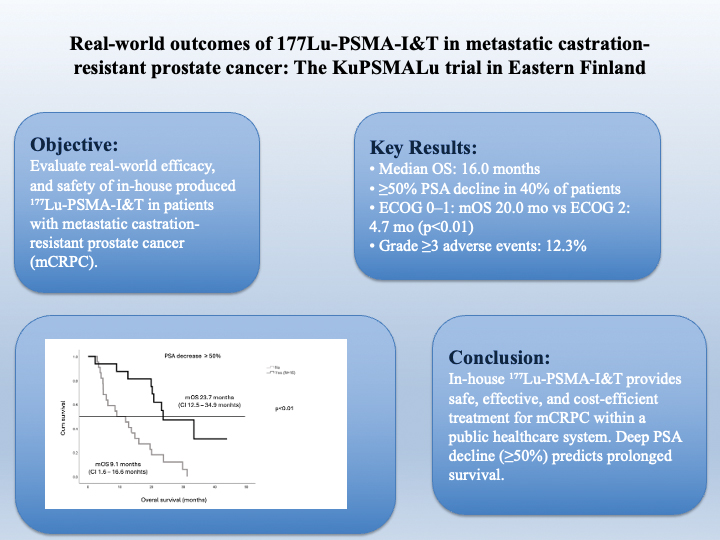
Results: The median overall survival (mOS) was 16.0 months. ECOG 0–1 patients had significantly longer mOS than ECOG 2 patients (20.0 vs. 4.7 months, p < 0.01). A PSA decrease ≥ 50% was observed in 40% of patients and correlated with improved mOS (23.7 vs. 9.1 months, p < 0.01). PSA doubling time (dt) > 4 months predicted superior survival (23.8 vs. 12.6 months, p = 0.040). Grade ≥ 3 AEs occurred in only 12.3% of patients.
Interpretation: In-house ¹⁷⁷Lu-PSMA-I&T production combined with pragmatic imaging-based patient selection provides a safe, cost-effective therapy for mCRPC in public healthcare. PSA kinetics, particularly PSA dt, are strong predictors of therapeutic benefit. The findings align with VISION and TheraP trials and highlight the feasibility of integrating radioligand therapy into routine clinical care.
Downloads
References
Cancer Today. n.d. [cited 2024 Oct 14]. Available from: https://gco.iarc.fr/today/en/dataviz/bars?types=1&mode=cancer&group_populations=1&sort_by=value0&sexes=1&populations=905_908_935
Prostate cancer guideline 2024 EAU. n.d. [cited 2024 Oct 14]. Available from: https://uroweb.org/guidelines/prostate-cancer
Francini E, Gray KP, Xie W, Shaw GK, Valença L, Bernard B, et al. Time of metastatic disease presentation and volume of disease are prognostic for metastatic hormone sensitive prostate cancer (mHSPC). Prostate. 2018;78:889.
https://doi.org/10.1002/PROS.23645 DOI: https://doi.org/10.1002/pros.23645
Gravis G, Boher J-M, Joly F, Soulié M, Albiges L, Priou F, et al. Androgen Deprivation Therapy (ADT) plus docetaxel versus ADT alone in metastatic non castrate prostate cancer: impact of metastatic burden and long-term survival analysis of the randomized phase 3 GETUG-AFU15 trial. Eur Urol 2016;70:256–62.
https://doi.org/10.1016/j.eururo.2015.11.005 DOI: https://doi.org/10.1016/j.eururo.2015.11.005
Tannock IF, de Wit R, Berry WR, Horti J, Pluzanska A, Chi KN, et al. Docetaxel plus prednisone or mitoxantrone plus prednisone for advanced prostate cancer. N Engl J Med 2004;351:1502–12.
https://doi.org/10.1056/NEJMoa040720 DOI: https://doi.org/10.1056/NEJMoa040720
James ND, Sydes MR, Clarke NW, Mason MD, Dearnaley DP, Spears MR, et al. Addition of docetaxel, zoledronic acid, or both to first-line long-term hormone therapy in prostate cancer (STAMPEDE): survival results from an adaptive, multiarm, multistage, platform randomised controlled trial. Lancet 2016;387:1163–77.
https://doi.org/10.1016/S0140-6736(15)01037-5 DOI: https://doi.org/10.1016/S0140-6736(15)01037-5
Ryan CJ, Smith MR, de Bono JS, Molina A, Logothetis CJ, de Souza P, et al. Abiraterone in metastatic prostate cancer without previous chemotherapy. N Engl J Med 2013;368:138–48. DOI: https://doi.org/10.1056/NEJMx130004
https://doi.org/10.1056/NEJMoa1209096 DOI: https://doi.org/10.1056/NEJMoa1209096
Fizazi K, Tran N, Fein L, Matsubara N, Rodriguez-Antolin A, Alekseev BY, et al. Abiraterone plus prednisone in metastatic, castration-sensitive prostate cancer. N Engl J Med 2017;377:352–60.
https://doi.org/10.1056/NEJMoa1704174 DOI: https://doi.org/10.1056/NEJMoa1704174
James ND, de Bono JS, Spears MR, Clarke NW, Mason MD, Dearnaley DP, et al. Abiraterone for prostate cancer not previously treated with hormone therapy. N Engl J Med 2017;377:338–51.
https://doi.org/10.1056/NEJMoa1702900 DOI: https://doi.org/10.1056/NEJMoa1702900
Scher HI, Fizazi K, Saad F, Taplin M-E, Sternberg CN, Miller K, et al. Increased survival with enzalutamide in prostate cancer after chemotherapy. N Engl J Med 2012;367:1187–97.
https://doi.org/10.1056/NEJMoa1207506 DOI: https://doi.org/10.1056/NEJMoa1207506
Davis ID, Martin AJ, Stockler MR, Begbie S, Chi KN, Chowdhury S, et al. Enzalutamide with standard first-line therapy in metastatic prostate cancer. N Engl J Med 2019;381:121–31.
https://doi.org/10.1056/NEJMoa1903835 DOI: https://doi.org/10.1056/NEJMoa1903835
Chi KN, Agarwal N, Bjartell A, Chung BH, Pereira de Santana Gomes AJ, Given R, et al. Apalutamide for metastatic, castration-sensitive prostate cancer. N Engl J Med 2019;381:13–24.
https://doi.org/10.1056/NEJMoa1903307 DOI: https://doi.org/10.1056/NEJMoa1903307
Smith MR, Hussain M, Saad F, Fizazi K, Sternberg CN, Crawford ED, et al. Darolutamide and survival in metastatic, hormone-sensitive prostate cancer. N Engl J Med 2022;386:1132–42.
https://doi.org/10.1056/NEJMoa2119115 DOI: https://doi.org/10.1056/NEJMoa2119115
Mateo J, Carreira S, Sandhu S, Miranda S, Mossop H, Perez-Lopez R, et al. DNA-Repair defects and olaparib in metastatic prostate cancer. N Engl J Med 2015;373:1697–708.
https://doi.org/10.1056/NEJMoa1506859 DOI: https://doi.org/10.1056/NEJMoa1506859
Agarwal N, Azad AA, Carles J, Fay AP, Matsubara N, Heinrich D, et al. Talazoparib plus enzalutamide in men with first-line metastatic castration-resistant prostate cancer (TALAPRO-2): a randomised, placebo-controlled, phase 3 trial. Lancet 2023;402:291–303.
https://doi.org/10.1016/S0140-6736(23)01055-3 DOI: https://doi.org/10.1016/S0140-6736(23)01055-3
Parker C, Nilsson S, Heinrich D, Helle SI, O’Sullivan JM, Fosså SD, et al. Alpha emitter Radium-223 and survival in metastatic prostate cancer. N Engl J Med 2013;369:213–23.
https://doi.org/10.1056/NEJMoa1213755 DOI: https://doi.org/10.1056/NEJMoa1213755
Sartor O, Reid RH, Hoskin PJ, Quick DP, Ell PJ, Coleman RE, et al. Samarium-153-Lexidronam complex for treatment of painful bone metastases in hormone-refractory prostate cancer. Urology 2004;63:940–5.
https://doi.org/10.1016/j.urology.2004.01.034 DOI: https://doi.org/10.1016/j.urology.2004.01.034
Smith M, Parker C, Saad F, Miller K, Tombal B, Ng QS, et al. Addition of radium-223 to abiraterone acetate and prednisone or prednisolone in patients with castration-resistant prostate cancer and bone metastases (ERA 223): a randomised, double-blind, placebo-controlled, phase 3 trial. Lancet Oncol 2019;20:408–19.
https://doi.org/10.1016/S1470-2045(18)30860-X DOI: https://doi.org/10.1016/S1470-2045(18)30860-X
Tombal B, Choudhury A, Saad F, Gallardo E, Soares A, Loriot Y, et al. Enzalutamide plus radium-223 in metastatic castration-resistant prostate cancer: results of the EORTC 1333/PEACE-3 trial. Ann Oncol 2025;36:1058–67.
https://doi.org/10.1016/j.annonc.2025.05.011 DOI: https://doi.org/10.1016/j.annonc.2025.05.011
Evans JC, Malhotra M, Cryan JF, O’Driscoll CM. The therapeutic and diagnostic potential of the prostate specific membrane antigen/glutamate carboxypeptidase II (PSMA/GCPII) in cancer and neurological disease. Br J Pharmacol 2016;173:3041.
https://doi.org/10.1111/BPH.13576 DOI: https://doi.org/10.1111/bph.13576
Kratochwil C, Fendler WP, Eiber M, Baum R, Bozkurt MF, Czernin J, et al. EANM procedure guidelines for radionuclide therapy with Lu-177-labelled PSMA-ligands (Lu-177-PSMA-RLT). Eur J Nucl Med Mol Imaging 2019;46:2536–44.
https://doi.org/10.1007/s00259-019-04485-3 DOI: https://doi.org/10.1007/s00259-019-04485-3
Hartrampf PE, Weinzierl F-X, Buck AK, Rowe SP, Higuchi T, Seitz AK, et al. Matched-pair analysis of [177 Lu]Lu-PSMA I&T and [177 Lu]Lu-PSMA-617 in patients with metastatic castration-resistant prostate cancer. n.d.;1:3.
https://doi.org/10.1007/s00259-022-05744-6 DOI: https://doi.org/10.1007/s00259-022-05744-6
Sartor O, de Bono J, Chi KN, Fizazi K, Herrmann K, Rahbar K, et al. Lutetium-177–PSMA-617 for metastatic castration-resistant prostate cancer. N Engl J Med 2021;385:1091–103.
https://doi.org/10.1056/NEJMoa2107322 DOI: https://doi.org/10.1056/NEJMoa2107322
Hofman MS, Emmett L, Sandhu S, Iravani A, Joshua AM, Goh JC, et al. MSa. [177Lu]Lu-PSMA-617 versus cabazitaxel in patients with metastatic castration-resistant prostate cancer (TheraP): a randomised, open-label, phase 2 trial. Lancet n.d.;397(10276):797–804.
https://doi.org/10.1016/S0140-6736(21)00237-3 DOI: https://doi.org/10.1016/S0140-6736(21)00237-3
Aaronson NK, Ahmedzai S, Bergman B, Bullinger M, Cull A, Duez NJ, et al. The European Organization for Research and Treatment of Cancer QLQ-C30: a quality-of-life instrument for use in international clinical trials in oncology. JNCI: Journal of the National Cancer Institute 1993;85:365–76.
https://doi.org/10.1093/JNCI/85.5.365 DOI: https://doi.org/10.1093/jnci/85.5.365
van Andel G, Bottomley A, Fosså SD, Efficace F, Coens C, Guerif S, et al. An international field study of the EORTC QLQ-PR25: a questionnaire for assessing the health-related quality of life of patients with prostate cancer. Eur J Cancer 2008;44:2418–24.
https://doi.org/10.1016/j.ejca.2008.07.030 DOI: https://doi.org/10.1016/j.ejca.2008.07.030
Cleeland CS, Ryan KM. Pain assessment: global use of the Brief Pain Inventory. Ann Acad Med Singapore 1994;23:129–38.
Harris PA, Taylor R, Thielke R, Payne J, Gonzalez N, Conde JG. Research electronic data capture (REDCap) – a metadata-driven methodology and workflow process for providing translational research informatics support. J Biomed Inform 2009;42:377–81.
https://doi.org/10.1016/J.JBI.2008.08.010 DOI: https://doi.org/10.1016/j.jbi.2008.08.010
Ling SW, de Lussanet de la Sablonière Q, Ananta M, de Blois E, Koolen SLW, Drexhage RC, et al. First real-world clinical experience with [177Lu]Lu-PSMA-I&T in patients with metastatic castration-resistant prostate cancer beyond VISION and TheraP criteria. Eur J Nucl Med Mol Imaging 2025;52:2034–40.
https://doi.org/10.1007/S00259-025-07082-9 DOI: https://doi.org/10.1007/s00259-025-07082-9
Flippot R, Telli T, Velev M, Fléchon A, De Vries-Brilland M, Turpin L, et al. Activity of Lutetium-177 prostate-specific membrane antigen and determinants of outcomes in patients with metastatic castration-resistant prostate cancer previously treated with Cabazitaxel: the PACAP study. Eur Urol Oncol 2024;7:1132–40.
https://doi.org/10.1016/J.EUO.2024.03.013 DOI: https://doi.org/10.1016/j.euo.2024.03.013
Vanwelkenhuyzen J, Van Bos E, Van Bruwaene S, Lesage K, Maes A, Üstmert S, et al. AR and PI3K genomic profiling of cell-free DNA can identify poor responders to Lutetium-177-PSMA among patients with metastatic castration-resistant prostate cancer. Eur Urol Open Sci 2023;53:63–6.
https://doi.org/10.1016/J.EUROS.2023.05.008 DOI: https://doi.org/10.1016/j.euros.2023.05.008
Sathekge MM, Lawal IO, Bal C, Bruchertseifer F, Ballal S, Cardaci G, et al. Actinium-225-PSMA radioligand therapy of metastatic castration-resistant prostate cancer (WARMTH Act): a multicentre, retrospective study. Lancet Oncol 2024;25:175–83.
https://doi.org/10.1016/S1470-2045(23)00638-1 DOI: https://doi.org/10.1016/S1470-2045(23)00638-1
Perrone E, Ghai K, Eismant A, Konz K, Baum RP. 177Lu-PSMA radioligand therapy for isolated bilateral adrenal metastases from prostate cancer. Acta Oncol (Madr) 2024;63:557–62.
https://doi.org/10.2340/1651-226X.2024.40017 DOI: https://doi.org/10.2340/1651-226X.2024.40017
Additional Files
Published
How to Cite
Issue
Section
Categories
License
Copyright (c) 2025 Okko-Sakari Kääriäinen, Pekka Poutiainen, Heidi Gröhn, Timo Voivalin, Hanna Mussalo, Satu Pukkila, Kirsi Ketola, Päivi Auvinen

This work is licensed under a Creative Commons Attribution 4.0 International License.


