
Treatment attrition and outcomes of myeloma patients in Finland: a real-world study
DOI:
https://doi.org/10.2340/1651-226X.2026.46473Keywords:
real-world, multiple myeloma, attritionAbstract
Background and purpose: Relapses, need for further treatment lines and significant treatment attrition are typical for multiple myeloma (MM). This retrospective study investigates attrition and outcomes among MM patients in Finland.
Patient, material and methods: Study included all adult MM patients (n = 1733) diagnosed and treated in four hospital districts in Finland in 2013–2022. Data were collected from hospital data lakes, Statistics Finland and Social Insurance Institution. Treatment attrition was defined as death before next treatment line.
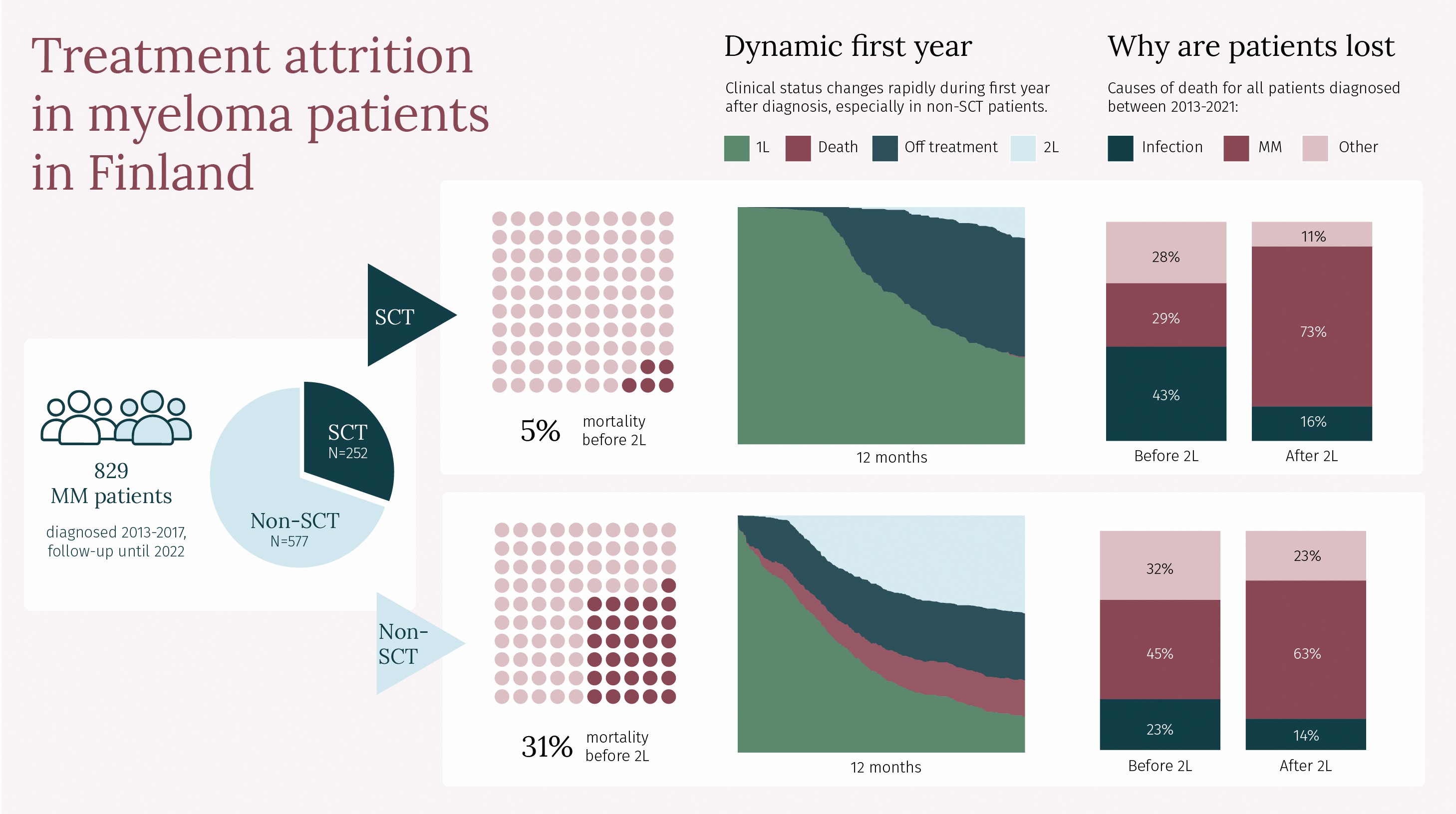
Results: By the end of follow-up 31% of patients without stem cell transplantation (non-SCT) had died before initiation of second line treatment (2L), compared with 5% of stem-cell transplant (SCT) patients. The factors associating with this early attrition in the non-SCT cohort were older age (over 75 years), higher comorbidity burden, International Staging System (ISS), and (R)-ISS scores (p < 0.001). Furthermore, non-SCT patients were more likely administered less intensive therapy during 1L (p < 0.001). During the first 6 months post diagnosis in the non-SCT cohort, the most common immediate cause of death was MM. Also, during later stages MM was responsible for 54% of deaths in the non-SCT and 68% in the SCT cohorts whereas infections were linked principally with early deaths before 2L treatment.
Interpretation: This study highlights significant treatment attrition across disease course and also early mortality especially in the non-SCT cohort resulting primarily from progressive MM or infections. The findings underscore the need for more tolerable and effective anti-myeloma treatments in earlier course of the disease to enhance patient survival.
Downloads
References
Yong K, Delforge M, Driessen C, Fink L, Flinois A, Gonzalez-McQuire S, et al. Multiple myeloma: patient outcomes in real-world practice. Br J Haematol. 2016;175(2):252–64. DOI: https://doi.org/10.1111/bjh.14213
Terpos E, Suzan F, Goldschmidt H. Going the distance: are we losing patients along the multiple myeloma treatment pathway? Crit Rev Oncol Hematol. 2018;126:19–23. DOI: https://doi.org/10.1016/j.critrevonc.2018.03.021
Morè S, Corvatta L, Manieri MV, Olivieri A, Offidani M. Real‐world assessment of treatment patterns and outcomes in patients with relapsed‐refractory multiple myeloma in an Italian haematological tertiary care centre. Br J Haematol. 2023;201(3):432–42. DOI: https://doi.org/10.1111/bjh.18658
Benda MA, Ulmer H, Weger R, Reimann P, Lang T, Pichler P, et al. Attrition rates in multiple myeloma treatment under real world conditions – an analysis from the Austrian Myeloma Registry (AMR). Cancers. 2023;15(3):962. DOI: https://doi.org/10.3390/cancers15030962
Rodríguez-Lobato LG, de Daniel A, Pereira A, Fernández de Larrea C, Tovar N, Cibeira MT, et al. Attrition rates and treatment outcomes in multiple myeloma: real-world data over a 40-year period. Blood Cancer J. 2025;15(1):103. DOI: https://doi.org/10.1038/s41408-025-01311-y
Perrot A, Raguideau F, Denis H, Prodel M, Javelot M, Pierres M, et al. Survival, years of life lost and attrition rates in multiple myeloma patients in France. Clin Lymphoma Myeloma Leuk. 2025;25(8):606–14.e1. DOI: https://doi.org/10.1016/j.clml.2025.03.004
Dhakal B, Einsele H, Schecter JM, Deraedt W, Lendvai N, Slaughter A, et al. Real-world treatment patterns and outcomes in relapsed/refractory multiple myeloma (1–3 prior lines): flatiron database. Blood Adv. 2024;8(19):5062–71. DOI: https://doi.org/10.1182/bloodadvances.2024012640
McCurdy A, Mian H, LeBlanc R, Jimenez-Zepeda VH, Su J, Masih-Khan E, et al. Redefining attrition in multiple myeloma (MM): a Canadian Myeloma Research Group (CMRG) analysis. Blood Cancer J. 2023;13(1):111. DOI: https://doi.org/10.1038/s41408-023-00883-x
Fonseca R, Usmani SZ, Mehra M, Slavcev M, He J, Cote S, et al. Frontline treatment patterns and attrition rates by subsequent lines of therapy in patients with newly diagnosed multiple myeloma. BMC Cancer. 2020;20(1):1087. DOI: https://doi.org/10.1186/s12885-020-07503-y
Mohty M, Cavo M, Fink L, Gonzalez‐McQuire S, Leleu H, Mateos M, et al. Understanding mortality in multiple myeloma: findings of a European retrospective chart review. Eur J Haematol. 2019;103(2):107–15. DOI: https://doi.org/10.1111/ejh.13264
Anttalainen A, Havula E, Kysenius K, Toppila I, Miettinen T, Lassenius M, et al. A real-world study on the impact of infection load on mortality in multiple myeloma patients in Finland. Ann Hematol. 2025;104(4):2373–85. DOI: https://doi.org/10.1007/s00277-024-06101-3
Brink M, Groen K, Sonneveld P, Minnema MC, Broijl A, Dinmohamed AG, et al. Decrease in early mortality for newly diagnosed multiple myeloma patients in the Netherlands: a population-based study. Blood Cancer J. 2021;11(11):178. DOI: https://doi.org/10.1038/s41408-021-00571-8
Grant SJ, Wildes TM, Rosko AE, Silberstein J, Giri S. A real-world data analysis of predictors of early mortality after a diagnosis of multiple myeloma. Cancer. 2023;129(13):2023–34. DOI: https://doi.org/10.1002/cncr.34760
Partanen A, Waltari M, Vikkula J, Mattila R, Närhi K, Eeva J, et al. Evolution of treatment practices and outcomes in multiple myeloma during 2013–2022: a Finnish real world registry study. Acta Oncol. 2025;64:598–606. DOI: https://doi.org/10.2340/1651-226X.2025.42647
Von Elm E, Altman DG, Egger M, Pocock SJ, Gøtzsche PC, Vandenbroucke JP, et al. The Strengthening the Reporting of Observational Studies in Epidemiology (STROBE) statement: guidelines for reporting observational studies. Ann Intern Med. 2007;147(8):573–7. DOI: https://doi.org/10.7326/0003-4819-147-8-200710160-00010
Rajkumar SV, Richardson P, San Miguel JF. Guidelines for determination of the number of prior lines of therapy in multiple myeloma. Blood. 2015;126(7):921–2. DOI: https://doi.org/10.1182/blood-2015-05-647636
Quan H, Li B, Couris CM, Fushimi K, Graham P, Hider P, et al. Updating and validating the Charlson Comorbidity Index and score for risk adjustment in hospital discharge abstracts using data from 6 countries. Am J Epidemiol. 2011;173(6):676–82. DOI: https://doi.org/10.1093/aje/kwq433
Manier S, Lambert J, Hulin C, Macro M, Laribi K, Araujo C, et al. Safety and efficacy of a dexamethasone-sparing regimen with daratumumab and lenalidomide in patients with frailty and newly diagnosed multiple myeloma (IFM2017-03): a phase 3, open-label, multicentre, randomised, controlled trial. Lancet Oncol. 2025;26(10):1323–33. DOI: https://doi.org/10.1016/S1470-2045(25)00280-3
Manier S, Dimopoulos M-A, Leleu XP, Moreau P, Cavo M, Goldschmidt H, et al. Isatuximab plus bortezomib, lenalidomide, and dexamethasone for transplant-ineligible newly diagnosed multiple myeloma patients: a frailty subgroup analysis of the IMROZ trial. Haematologica. 2025;110(9):2139–50. DOI: https://doi.org/10.3324/haematol.2024.287200
Dimopoulos MA, Terpos E, Boccadoro M, Moreau P, Mateos M-V, Zweegman S, et al. EHA–EMN evidence-based guidelines for diagnosis, treatment and follow-up of patients with multiple myeloma. Nat Rev Clin Oncol. 2025;22(9):680–700. DOI: https://doi.org/10.1038/s41571-025-01041-x
Moreau P, San Miguel J, Sonneveld P, Mateos MV, Zamagni E, Avet-Loiseau H, et al. Multiple myeloma: ESMO clinical practice guidelines for diagnosis, treatment and follow-up. Ann Oncol. 2017;28:iv52–61. DOI: https://doi.org/10.1093/annonc/mdx096
Blimark CH, Carlson K, Day C, Einarsdottir S, Juliusson G, Karma M, et al. Risk of infections in multiple myeloma. A populationbased study on 8,672 multiple myeloma patients diagnosed 2008–2021 from the Swedish Myeloma Registry. Haematologica. 2025;110(1):163–72. DOI: https://doi.org/10.3324/haematol.2024.285645
Additional Files
Published
How to Cite
License
Copyright (c) 2026 Mervi Putkonen, Katja Närhi, Johanna Vikkula, Riikka Mattila, Marika Waltari, Jonna Eeva, Anu Partanen

This work is licensed under a Creative Commons Attribution 4.0 International License.


