
Comparing people with persisting post-concussion symptoms from an emergency department-based research sample with patients in a clinical rehabilitation sample: an explorative, retrospective analysis
DOI:
https://doi.org/10.2340/jrm.v58.45004Keywords:
minimal head injury, mild head injury, mild traumatic brain injury, concussion, post commotio syndrome, rehabilitation, return to work, Rivermead Post-Concussion Symptoms Questionnaire, treatment-seeking patientsAbstract
Objective: To compare characteristics of people with persisting post-concussion symptoms in a sample referred for treatment and in a sample from a prospective research study.
Design: Observational study.
Subjects: Participants, aged 18–60 years, with persisting post-concussion symptoms 3–18 months after mild head injury, 92 with mild traumatic brain injury followed from the emergency department (“prospective emergency department sample”) and 106 patients with either mild traumatic brain injury or minimal head injury, referred to an outpatient rehabilitation clinic (“clinical rehabilitation sample”).
Methods: Persisting post-concussion symptoms were defined as having British Columbia Post-Concussion Symptom Inventory scores indicating at least moderate persisting post-concussion symptoms and/or Rivermead Post Concussion Symptoms Questionnaire (RPQ) scores ≥ 12. Symptoms, functional outcome, work/school participation, resilience, and fatigue were examined at 3–18 months post injury.
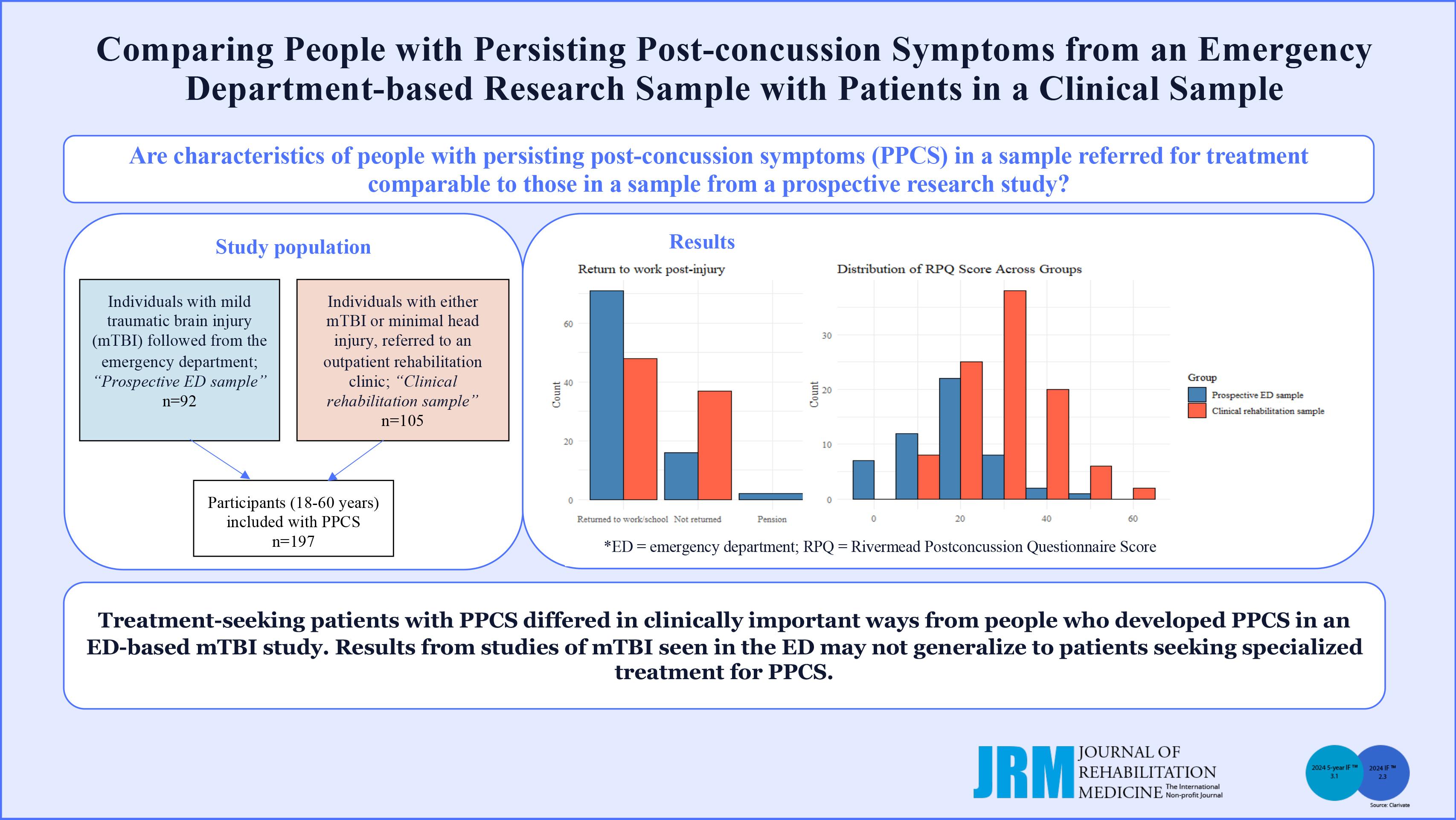
Results: Compared with the prospective emergency department sample, the clinical rehabilitation sample had higher education, higher RPQ scores (30 vs 17), lower Glasgow Outcome Scale Extended scores (median 6 vs 7), and more had not returned to work or school (43% vs 18%).
Conclusion: Treatment-seeking patients with persisting post-concussion symptoms differed in clinically important ways from people who developed persisting post-concussion symptoms in an emergency department-based mild traumatic brain injury study. Results from studies of mild traumatic brain injury seen in the emergency department may not generalize to patients seeking specialized treatment for persisting post-concussion symptoms.
Downloads
References
Cancelliere C, Verville L, Stubbs JL, Yu H, Hincapié CA, Cassidy JD, et al. Post-concussion symptoms and disability in adults with mild traumatic brain injury: a systematic review and meta-analysis. J Neurotrauma 2022; 40: 1045–1059. DOI: https://doi.org/10.1089/neu.2022.0185
Bloom B, Thomas S, Ahrensberg JM, Weaver R, Fowler A, Bestwick J, et al. A systematic review and meta-analysis of return to work after mild traumatic brain injury. Brain Inj 2018; 32: 1623–1636. DOI: https://doi.org/10.1080/02699052.2018.1532111
van der Vlegel M, Polinder S, Toet H, Panneman MJM, Haagsma JA. Prevalence of post-concussion-like symptoms in the general injury population and the association with health-related quality of life, health care use, and return to Work. J Clin Med 2021; 10. DOI: https://doi.org/10.3390/jcm10040806
Voormolen DC, Haagsma JA, Polinder S, Maas AIR, -Steyerberg EW, Vuleković P, et al. Post-concussion symptoms in complicated vs uncomplicated mild traumatic brain injury patients at three and six months post-injury: results from the CENTER-TBI Study. J Clin Med 2019; 8. DOI: https://doi.org/10.3390/jcm8111921
Karaliute M, Saksvik SB, Smevik H, Follestad T, Einarsen C, Vik A, et al. Methodology matters: comparing approaches for defining persistent symptoms after mild traumatic brain injury. Neurotrauma Reports 2021; 2: 603–617. DOI: https://doi.org/10.1089/neur.2021.0028
Lubbers VF, van den Hoven DJ, van der Naalt J, Jellema K, van den Brand C, et al. Emergency department risk factors for post-concussion syndrome after mild traumatic brain injury: a systematic review. J Neurotrauma 2024; 41: 1253–1270. DOI: https://doi.org/10.1089/neu.2023.0302
Gaudette É, Seabury SA, Temkin N, Barber J, DiGiorgio AM, Markowitz AJ, et al. Employment and economic outcomes of participants with mild traumatic brain injury in the TRACK-TBI Study. JAMA Network Open 2022; 5: e2219444–e2219444. DOI: https://doi.org/10.1001/jamanetworkopen.2022.19444
Iverson GL. Outcome from mild traumatic brain injury. Curr Opin Psychiatry 2005; 18: 301–317. DOI: https://doi.org/10.1097/01.yco.0000165601.29047.ae
Sosin DM, Sniezek JE, Thurman DJ. Incidence of mild and moderate brain injury in the United States, 1991. Brain Inj 1996; 10: 47–54. DOI: https://doi.org/10.1080/026990596124719
Fordal L, Iverson GL, Maietta JE, Olsen A, Einarsen C, Saksvik SB, et al. Examining and comparing the clinical characteristics of adults with persisting post-concussion symptoms presenting for outpatient rehabilitation following a mild traumatic brain injury or a minimal head injury. J Rehabil Med 2025; 57: jrm43506. DOI: https://doi.org/10.2340/jrm.v57.43506
Iverson GL. Network analysis and precision rehabilitation for the post-concussion syndrome. Front Neurol 2019; 10: 489. DOI: https://doi.org/10.3389/fneur.2019.00489
Coffeng SM, Jacobs B, Kim LJ, Ter Maaten JC, Van Der Naalt J. Incomplete recovery in patients with minor head injury directly discharged home from the emergency department: a prospective cohort follow-up study. BMJ Open 2022; 12: e057308. DOI: https://doi.org/10.1136/bmjopen-2021-057308
Skandsen T, Einarsen CE, Normann I, Bjøralt S, Karlsen RH, McDonagh D, et al. The epidemiology of mild traumatic brain injury: the Trondheim MTBI follow-up study. Scand J Trauma Resusc Emerg Med 2018; 26: 34. DOI: https://doi.org/10.1186/s13049-018-0495-0
Undén J, Ingebrigtsen T, Romner B, the Scandinavian Neurotrauma C. Scandinavian guidelines for initial -management of minimal, mild and moderate head injuries in adults: an evidence and consensus-based update. BMC Med 2013; 11: 50. DOI: https://doi.org/10.1186/1741-7015-11-50
Menon DK, Schwab K, Wright DW, Maas AI. Position statement: definition of traumatic brain injury. Arch Phys Med Rehabil 2010; 91: 1637–1640. DOI: https://doi.org/10.1016/j.apmr.2010.05.017
Carroll LJ, Cassidy JD, Holm L, Kraus J, Coronado VG. Methodological issues and research recommendations for mild traumatic brain injury: the WHO Collaborating Centre Task Force on Mild Traumatic Brain Injury. J Rehabil Med 2004; Suppl 43: 113–125. DOI: https://doi.org/10.1080/16501960410023877
Iverson GL, Lange RT. Examination of “postconcussion-like” symptoms in a healthy sample. Appl Neuropsychol 2003; 10: 137–144. DOI: https://doi.org/10.1207/S15324826AN1003_02
King NS, Crawford S, Wenden FJ, Moss NE, Wade DT. The Rivermead Post Concussion Symptoms Questionnaire: a measure of symptoms commonly experienced after head injury and its reliability. J Neurol 1995; 242: 587–592. DOI: https://doi.org/10.1007/BF00868811
Wilson L, Boase K, Nelson LD, Temkin NR, Giacino JT, Markowitz AJ, et al. A Manual for the Glasgow Outcome Scale-Extended Interview. J Neurotrauma 2021; 38: 2435–2446. DOI: https://doi.org/10.1089/neu.2020.7527
Friborg O, Hjemdal O, Rosenvinge JH, Martinussen M. A new rating scale for adult resilience: what are the central protective resources behind healthy adjustment? Int J Methods Psychiatr Res 2003; 12: 65–76. DOI: https://doi.org/10.1002/mpr.143
Krupp LB, LaRocca NG, Muir-Nash J, Steinberg AD. The fatigue severity scale: application to patients with multiple sclerosis and systemic lupus erythematosus. Arch Neurol 1989; 46: 1121–1123. DOI: https://doi.org/10.1001/archneur.1989.00520460115022
Lerdal A, Wahl A, Rustøen T, Hanestad BR, Moum T. Fatigue in the general population: a translation and test of the psychometric properties of the Norwegian version of the fatigue severity scale. Scand J Public Health 2005; 33: 123–130. DOI: https://doi.org/10.1080/14034940410028406
Déry J, Ouellet B, de Guise É, Bussières È-L, Lamontagne M-E. Prognostic factors for persistent symptoms in adults with mild traumatic brain injury: an overview of systematic reviews. Syst Rev 2023; 12: 127. DOI: https://doi.org/10.1186/s13643-023-02284-4
Thastum MM, Rask CU, Næss-Schmidt ET, Tuborgh A, Jensen JS, Svendsen SW, et al. Novel interdisciplinary intervention, GAIN, vs enhanced usual care to reduce high levels of post-concussion symptoms in adolescents and young adults 2–6 months post-injury: a randomised trial. EClinicalMedicine 2019; 17: 100214. DOI: https://doi.org/10.1016/j.eclinm.2019.11.007
Rytter HM, Klaus W, Henriette H, Peter C, Humle F. Specialized interdisciplinary rehabilitation reduces persistent post-concussive symptoms: a randomized clinical trial. Brain Inj 2019; 33: 266–281. DOI: https://doi.org/10.1080/02699052.2018.1552022
Conradsen I, Bang-Hansen VE, Sørensen AN, Rytter HM. Return to work in persons with persistent postconcussion symptoms: a survey study examining the perspectives of employees and managers. Brain Inj 2024; 38: 908–917. DOI: https://doi.org/10.1080/02699052.2024.2361620
Lucas S, Hoffman JM, Bell KR, Dikmen S. A prospective study of prevalence and characterization of headache following mild traumatic brain injury. Cephalalgia 2013; 34: 93–102. DOI: https://doi.org/10.1177/0333102413499645
Silverberg ND, Iverson GL, Cogan A, Dams OCK, Delmonico R, Graf MJP, et al. The American Congress of Rehabilitation Medicine Diagnostic Criteria for mild traumatic brain injury. Arch Phys Med Rehabil 2023; 104: 1343–1355. DOI: https://doi.org/10.1016/j.apmr.2023.03.036
Silverberg ND, Panenka WJ, Iverson GL. Work productivity loss after mild traumatic brain injury. Arch Phys Med -Rehabil 2018; 99: 250–256. DOI: https://doi.org/10.1016/j.apmr.2017.07.006
Dumke HA. Posttraumatic headache and its impact on -return to work after mild traumatic brain injury. J Head Trauma Rehabil 2017; 32: E55–E65. DOI: https://doi.org/10.1097/HTR.0000000000000244
Voormolen DC, Cnossen MC, Polinder S, von Steinbuechel N, Vos PE, Haagsma JA. Divergent classification methods of post-concussion syndrome after mild traumatic brain injury: prevalence rates, risk factors, and functional outcome. J Neurotrauma 2018; 35: 1233–1241. DOI: https://doi.org/10.1089/neu.2017.5257
Kersivien C, Doumit A, Gascoigne M, Wearne TA. The protective role of resilience in the reporting of post-concussive symptoms within a non-clinical sample. Clin Neuropsychol 2024; 38: 668–682. DOI: https://doi.org/10.1080/13854046.2023.2256949
Skandsen T, Stenberg J, Follestad T, Karaliute M, Saksvik SB, Einarsen CE, et al. Personal factors associated with postconcussion symptoms 3 months after mild traumatic brain injury. Arch Phys Med Rehabil 2021; 102: 1102–1112. DOI: https://doi.org/10.1016/j.apmr.2020.10.106
Sullivan KA, Kempe CB, Edmed SL, Bonanno GA. Resilience and other possible outcomes after mild traumatic brain injury: a systematic review. Neuropsychol Rev 2016; 26: 173–185. DOI: https://doi.org/10.1007/s11065-016-9317-1
Fordal L, Stenberg J, Iverson GL, Saksvik SB, Karaliute M, Vik A, et al. Trajectories of persistent postconcussion symptoms and factors associated with symptom reporting after mild traumatic brain injury. Arch Phys Med Rehabil 2022; 103: 313–322. DOI: https://doi.org/10.1016/j.apmr.2021.09.016
Kreutzer JS, Marwitz JH, Sima AP, Mills A, Hsu NH, Lukow HR 2nd. Efficacy of the resilience and adjustment intervention after traumatic brain injury: a randomized controlled trial. Brain Inj 2018; 32: 963–971. DOI: https://doi.org/10.1080/02699052.2018.1468577
Cancelliere C, Kristman VL, Cassidy JD, Hincapié CA, Côté P, Boyle E, et al. Systematic review of return to work after mild traumatic brain injury: results of the international collaboration on mild traumatic brain injury prognosis. Arch Phys Med Rehabil 2014; 95: S201–S209. DOI: https://doi.org/10.1016/j.apmr.2013.10.010
Fletcher JM, Frisvold DE. Higher education and health investments: does more schooling affect preventive health care use? J Hum Cap 2009; 3: 144–176. DOI: https://doi.org/10.1086/645090
van Doorslaer E, Koolman X, Jones AM. Explaining income-related inequalities in doctor utilisation in Europe. Health Econ 2004; 13: 629–647. DOI: https://doi.org/10.1002/hec.919
Smith NIJ, Hogarth L, Corrigan JD, Williams WH. Cumulative effects of mild traumatic brain injury in the general population: persistent post-concussion symptoms and post-traumatic stress. Brain Inj 2026 Feb 6 [Online ahead of print]. DOI: https://doi.org/10.1080/02699052.2026.2625366
McKinlay A, Horwood LJ, Fergusson DM. Accuracy of self-report as a method of screening for lifetime occurrence of traumatic brain injury events that resulted in hospitalization. J Int Neuropsychol Soc 2016; 22: 717–723. DOI: https://doi.org/10.1017/S1355617716000497
Daugherty J, Sarmiento K, Breiding M. Comparison of self-reported lifetime concussions and mild traumatic brain injuries among adults. Brain Inj 2023; 37: 222–229. DOI: https://doi.org/10.1080/02699052.2023.2175909
Additional Files
Published
How to Cite
Issue
Section
Categories
License
Copyright (c) 2026 Maria I. Sandboe, Linda Fordal, Alexander Olsen, Grant L. Iverson, Helge Skirbekk, Mille Møller Thastum, Jørgen Fældbæk Nielsen, Simen Berg Saksvik, Toril Skandsen

This work is licensed under a Creative Commons Attribution 4.0 International License.
All digitalized JRM contents is available freely online. The Foundation for Rehabilitation Medicine owns the copyright for all material published until volume 40 (2008), as from volume 41 (2009) authors retain copyright to their work and as from volume 49 (2017) the journal has been published Open Access, under CC-BY-NC licences (unless otherwise specified). The CC-BY-NC licenses allow third parties to copy and redistribute the material in any medium or format and to remix, transform, and build upon the material for non-commercial purposes, provided proper attribution to the original work.
From 2024, articles are published under the CC-BY licence. This license permits sharing, adapting, and using the material for any purpose, including commercial use, with the condition of providing full attribution to the original publication.






