
Impact of age and frailty on the effect of a multimodal individualized long-term intervention after stroke: the last-long trial
DOI:
https://doi.org/10.2340/jrm.v58.46250Keywords:
cerebrovascular disease, long-term care, post-stroke rehabilitation, community-based rehabilitation, multimodal rehabilitation, Frailty, Older adultsAbstract
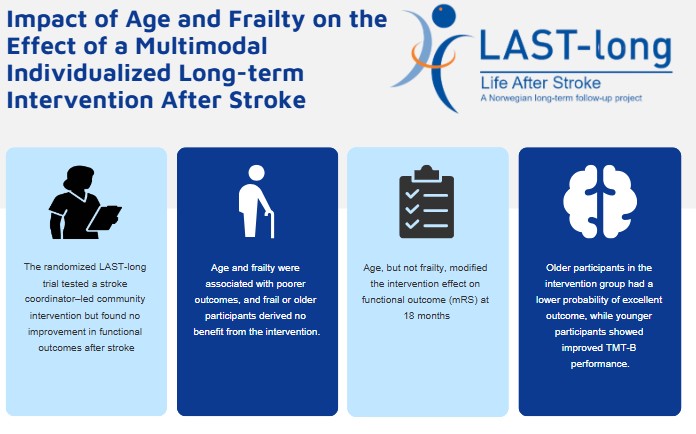
Background: The LAST-long randomized trial tested a multidimensional, stroke coordinator-led, community-based intervention and found no overall functional benefit. Because most participants had mild stroke symptoms, whether older or frailer subgroups benefited was examined.
Methods: In this single-blinded RCT at 4 Norwegian hospitals (2019–2022), 301 participants were randomized 1:1 to monthly stroke-coordinator meetings for 18 months (structured risk assessment and individualized goals) or to standard care. Primary outcome: modified Rankin Scale (mRS) at 18 months. Secondary outcomes: mortality, cognition, ADLs, physical function, fatigue, and quality of life. Older age: ≥ 80 years; frailty: Frailty Index ≥ 0.2. Linear and logistic regression tested age- and frailty-intervention interactions.
Results: mRS data were available for 268 participants (136 intervention, 132 control). Mean age 71.1 (SD 12.4); 66 (24.6%) ≥ 80; 89 (33.2%) frail. Age modified the intervention effect on mRS: among participants ≥ 80, favourable outcome was less likely with intervention vs control (23.4% vs 57.0%, p = 0.004). For secondary outcomes, the intervention improved Trail Making Test B in younger participants (−32.2 s, 95% CI −58.0 to −6.4, p = 0.015) with a significant age–intervention interaction (p = 0.019). No frailty–intervention interaction was found.
Conclusions: Age – but not frailty – modified response to the intervention, indicating differential effects in older participants.
Clinical Trials.gov identifier: NCT03859063
Downloads
References
Clegg A, Young J, Iliffe S, Rikkert MO, Rockwood K. Frailty in elderly people. Lancet (London, England) 2013; 381: 752–762. DOI: https://doi.org/10.1016/S0140-6736(12)62167-9
Seamon BA, Simpson KN. The effect of frailty on discharge location for Medicare beneficiaries after acute stroke. Arch Phys Med Rehabil 2019; 100: 1317–1323. DOI: https://doi.org/10.1016/j.apmr.2019.02.006
Taylor-Rowan M, Cuthbertson G, Keir R, Shaw R, Drozdowska B, Elliott E, et al. The prevalence of frailty among acute stroke patients, and evaluation of method of assessment. Clin Rehabil 2019; 33: 1688–1696. DOI: https://doi.org/10.1177/0269215519841417
Wæhler IS, Saltvedt I, Lydersen S, Fure B, Askim T, Einstad MS, et al. Association between in-hospital frailty and health-related quality of life after stroke: the Nor-COAST study. BMC Neurology 2021; 21: 100. DOI: https://doi.org/10.1186/s12883-021-02128-5
Burton JK, Stewart J, Blair M, Oxley S, Wass A, Taylor-Rowan M, et al. Prevalence and implications of frailty in acute stroke: systematic review & meta-analysis. Age and Ageing 2022; 51. DOI: https://doi.org/10.1093/ageing/afac064
Rothwell PM, Giles MF, Chandratheva A, Marquardt L, Geraghty O, Redgrave JN, et al. Effect of urgent treatment of transient ischaemic attack and minor stroke on early recurrent stroke (EXPRESS study): a prospective population-based sequential comparison. Lancet (London, England) 2007; 370: 1432–1442. DOI: https://doi.org/10.1016/S0140-6736(07)61448-2
Al AlShaikh S, Quinn T, Dunn W, Walters M, Dawson J. Multimodal interventions to enhance adherence to secondary preventive medication after stroke: a systematic review and meta-analyses. Cardiovasc Ther 2016; 34: 85–93. DOI: https://doi.org/10.1111/1755-5922.12176
Boehme C, Toell T, Lang W, Knoflach M, Kiechl S. Longer term patient management following stroke: a systematic review. Int J Stroke 2021; 16: 917–926. DOI: https://doi.org/10.1177/17474930211016963
Hall P, Lawrence M, Blake C, Lennon O. Interventions for behaviour change and self-management of risk in stroke secondary prevention: an overview of reviews. Cerebrovasc Dis 2023; 53: 1–13. DOI: https://doi.org/10.1159/000531138
Norrving B, Barrick J, Davalos A, Dichgans M, Cordonnier C, Guekht A, et al. Action plan for stroke in Europe 2018–2030. Eur Stroke J 2018; 3: 309–336. DOI: https://doi.org/10.1177/2396987318808719
Askim T, Langlo SR, Bergh E, Døhl Ø, Ellekjær H, Hokstad A, et al. A multimodal individualized long-term intervention to prevent functional decline after stroke (LAST-long): a single blinded randomised controlled trial. Lancet Reg Health Eur 2026; 61: 101531. DOI: https://doi.org/10.1016/j.lanepe.2025.101531
Hopewell S, Chan AW, Collins GS, Hróbjartsson A, Moher D, Schulz KF, et al. CONSORT 2025 Statement: Updated Guideline for Reporting Randomized Trials. JAMA 2025; 333: 1998–2005. DOI: https://doi.org/10.1001/jama.2025.4347
Askim T, Hokstad A, Bergh E, Døhl Ø, Ellekjær H, Ihle-Hansen H, et al. Multimodal individualised intervention to prevent functional decline after stroke: protocol of a randomised controlled trial on long-term follow-up after stroke (LAST-long). BMJ Open 2023; 13: e069656. DOI: https://doi.org/10.1136/bmjopen-2022-069656
Stuck AE, Siu AL, Wieland GD, Adams J, Rubenstein LZ. Comprehensive geriatric assessment: a meta-analysis of controlled trials. Lancet (London, England) 1993; 342: 1032–1036. DOI: https://doi.org/10.1016/0140-6736(93)92884-V
World Stroke Organization. Post-stroke checklist (PSC) Improving Life After Stroke. 2022 12.01. https://www.world-stroke.org/assets/downloads/psc-uk-version-wso-livery-03-20-13.pdf
Nasreddine ZS, Phillips NA, Bedirian V, Charbonneau S, Whitehead V, Collin I, et al. The Montreal Cognitive Assessment, MoCA: a brief screening tool for mild cognitive impairment. J Am Geriatr Soc 2005; 53: 695–699. DOI: https://doi.org/10.1111/j.1532-5415.2005.53221.x
Army Individual Test Battery. Manual of directions and scoring. 1944: Washington, DC: War Department, Adjutant General’s Office; 1944.
Guralnik JM, Ferrucci L, Simonsick EM, Salive ME, Wallace RB. Lower-extremity function in persons over the age of 70 years as a predictor of subsequent disability. New Engl J Med 1995; 332: 556–562. DOI: https://doi.org/10.1056/NEJM199503023320902
Gladman JR, Lincoln NB, Adams SA. Use of the extended ADL scale with stroke patients. Age Ageing 1993; 22: 419–424. DOI: https://doi.org/10.1093/ageing/22.6.419
Lerdal A, Kottorp A, Gay C, Aouizerat BE, Portillo CJ, Lee KA. A 7-item version of the fatigue severity scale has better psychometric properties among HIV-infected adults: an application of a Rasch model. Qual Life Res 2011; 20: 1447–1456. DOI: https://doi.org/10.1007/s11136-011-9877-8
Ludwig K, Graf von der Schulenburg JM, Greiner W. German Value Set for the EQ-5D-5L. Pharmacoeconomics 2018; 36: 663–674. DOI: https://doi.org/10.1007/s40273-018-0615-8
Kim DH, Afilalo J, Shi SM, Popma JJ, Khabbaz KR, Laham RJ, et al. Evaluation of changes in functional status in the year after aortic valve replacement. JAMA Intern Med 2019; 179: 383–391. DOI: https://doi.org/10.1001/jamainternmed.2018.6738
Clegg A, Bates C, Young J, Ryan R, Nichols L, Ann Teale E, et al. Development and validation of an electronic frailty index using routine primary care electronic health record data. Age Ageing 2016; 45: 353–360. DOI: https://doi.org/10.1093/ageing/afw039
Gallacher KI, Quinn T, Kidd L, Eton D, Dillon M, Elliot J, et al. Systematic review of patient-reported measures of treatment burden in stroke. BMJ Open 2019; 9: e029258. DOI: https://doi.org/10.1136/bmjopen-2019-029258
Gallacher KI, May CR, Langhorne P, Mair FS. A conceptual model of treatment burden and patient capacity in stroke. BMC Fam Pract 2018; 19: 9. DOI: https://doi.org/10.1186/s12875-017-0691-4
Gjellesvik TI, Becker F, Tjønna AE, Indredavik B, Lundgaard E, Solbakken H, et al. Effects of high-intensity interval training after stroke (The HIIT stroke study) on physical and cognitive function: a multicenter randomized controlled trial. Arch Phys Med Rehabil 2021; 102: 1683–1691. DOI: https://doi.org/10.1016/j.apmr.2021.05.008
Mijajlović MD, Pavlović A, Brainin M, Heiss WD, Quinn TJ, Ihle-Hansen HB, et al. Post-stroke dementia: a comprehensive review. BMC Med 2017; 15: 11. DOI: https://doi.org/10.1186/s12916-017-0779-7
Yang X, Han Y, Liu Y, Zhao N, He Y, Li F. Effects of transitional care interventions on rehospitalization, functional outcomes, and quality of life in stroke survivors: an updated systematic review and meta-analysis of randomized controlled trials. Front Neurol 2026; 17: 1769301. DOI: https://doi.org/10.3389/fneur.2026.1769301
Lee JY, Yang YS, Cho E. Transitional care from hospital to home for frail older adults: a systematic review and meta-analysis. Geriatr Nurs 2022; 43: 64–76. DOI: https://doi.org/10.1016/j.gerinurse.2021.11.003
Li J, Wan J, Wang H. Role of frailty in predicting outcomes after stroke: a systematic review and meta-analysis. Front Psychiatry 2024; 15: 1347476. DOI: https://doi.org/10.3389/fpsyt.2024.1347476
Munthe-Kaas R, Lydersen S, Quinn T, Aam S, Pendlebury ST, Ihle-Hansen H. Impact of pre-stroke frailty on outcome three years after acute stroke: the Nor-COAST study. Cerebrovasc Dis 2025; 54: 527–535. DOI: https://doi.org/10.1159/000541565
Mennema Å, Vliet Vlieland TPM, Achterberg WP, Oosterveer DM. Functioning and recovery during stroke rehabilitation: a comparison between pre-stroke frail and non-frail patients. Eur Geriatr Med 2023; 14: 1343–1351. DOI: https://doi.org/10.1007/s41999-023-00885-9
Downloads
Additional Files
Published
How to Cite
License
Copyright (c) 2026 Håkon Ihle-Hansen, Bente Thommessen, Sara Rise Langlo, Elin Bergh, Anne Hokstad, Stian Lydersen, Yngve Seljeseth, Ingvild Saltvedt, Torunn Askim

This work is licensed under a Creative Commons Attribution 4.0 International License.
All digitalized JRM contents is available freely online. The Foundation for Rehabilitation Medicine owns the copyright for all material published until volume 40 (2008), as from volume 41 (2009) authors retain copyright to their work and as from volume 49 (2017) the journal has been published Open Access, under CC-BY-NC licences (unless otherwise specified). The CC-BY-NC licenses allow third parties to copy and redistribute the material in any medium or format and to remix, transform, and build upon the material for non-commercial purposes, provided proper attribution to the original work.
From 2024, articles are published under the CC-BY licence. This license permits sharing, adapting, and using the material for any purpose, including commercial use, with the condition of providing full attribution to the original publication.






