
Systemic Treatments for Lichen Planopilaris and Frontal Fibrosing Alopecia: A Retrospective Study of 315 Patients
DOI:
https://doi.org/10.2340/actadv.v105.42465Keywords:
cicatricial alopecia, lichen planopilaris, frontal fibrosing alopecia, inflammatory hair disorder, hair loss, systemic treatmentAbstract
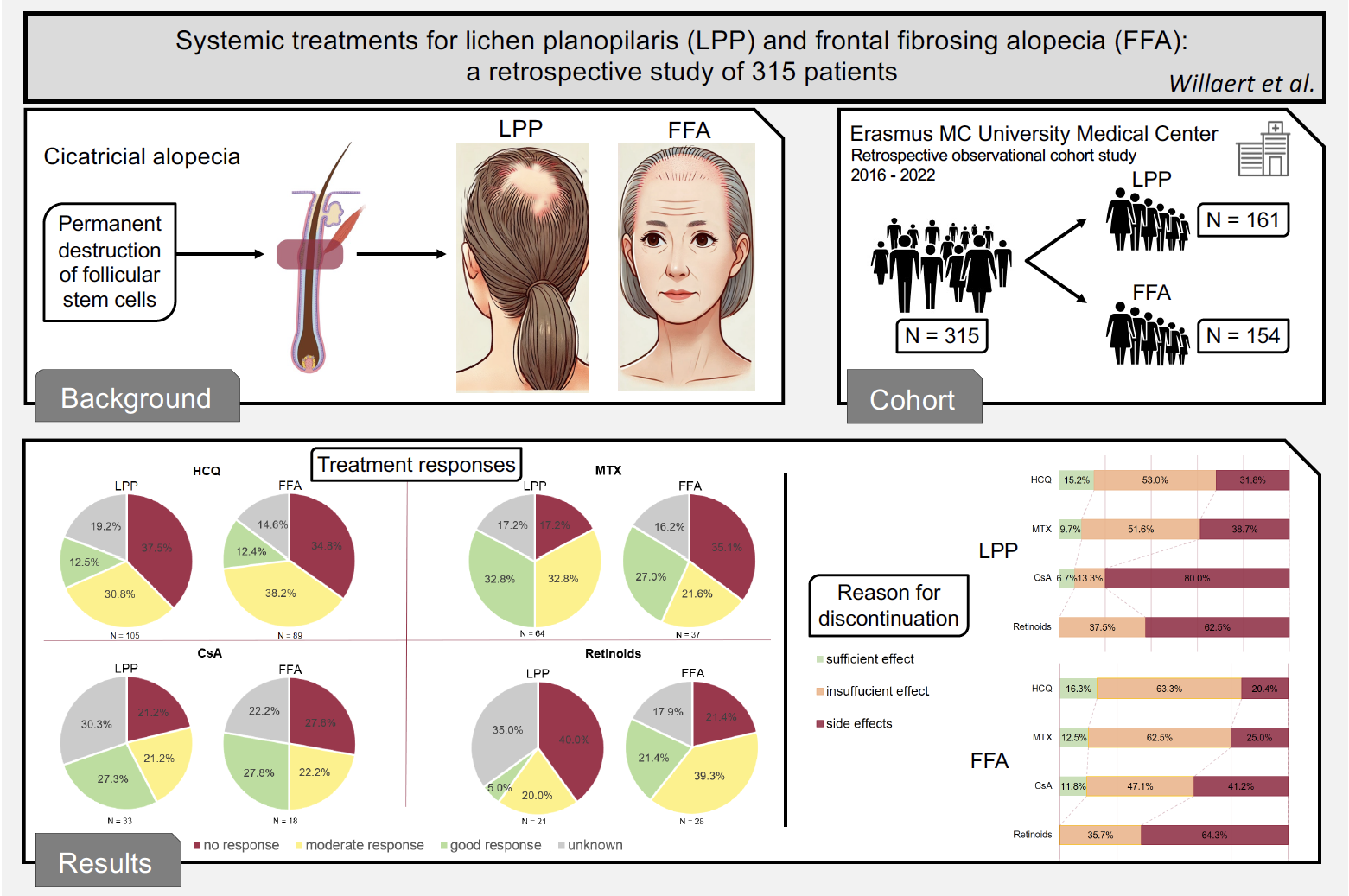
Lichen planopilaris and frontal fibrosing alopecia are common variants of primary lymphocytic cicatricial alopecia, leading to permanent hair loss. Despite widespread use of various systemic treatments, evidence-based guidelines for these conditions are lacking. This study investigates the effectiveness of systemic treatment options in patients with lichen planopilaris and frontal fibrosing alopecia through a retrospective cohort analysis. Medical records of patients treated at the Department of Dermatology between 2016 and 2022 at the Erasmus University Medical Center Rotterdam, the Netherlands were reviewed. Of 315 patients identified (161 lichen planopilaris and 154 frontal fibrosing alopecia), the majority were female (90.5%), with hydroxychloroquine being the most common systemic treatment, used by 65.2% of lichen planopilaris and 57.8% of frontal fibrosing alopecia patients. Methotrexate had the highest response rate for lichen planopilaris (79.2%), while retinoids showed the highest response for frontal fibrosing alopecia (73.9%). However, treatments with cyclosporine A and retinoids had higher discontinuation rates due to side effects. This study suggests methotrexate and cyclosporine A may be most effective for lichen planopilaris, and cyclosporine A and retinoids for frontal fibrosing alopecia, though side effects remain a concern. Limitations include the retrospective design and the absence of standardized outcomes. Prospective studies are recommended to validate these findings.
Downloads
References
Kanti V, Rowert-Huber J, Vogt A, Blume-Peytavi U. Cicatricial alopecia. J Dtsch Dermatol Ges 2018; 16: 435–461.
https://doi.org/10.1111/ddg.13498 DOI: https://doi.org/10.1111/ddg.13498
Harries MJ, Paus R. The pathogenesis of primary cicatricial alopecias. Am J Pathol 2010; 177: 2152–2162.
https://doi.org/10.2353/ajpath.2010.100454 DOI: https://doi.org/10.2353/ajpath.2010.100454
Filbrandt R, Rufaut N, Jones L, Sinclair R. Primary cicatricial alopecia: diagnosis and treatment. CMAJ 2013; 185: 1579–1585.
https://doi.org/10.1503/cmaj.111570 DOI: https://doi.org/10.1503/cmaj.111570
Olsen EA, Bergfeld WF, Cotsarelis G, Price VH, Shapiro J, Sinclair R, et al. Summary of North American Hair Research Society (NAHRS)-sponsored Workshop on Cicatricial Alopecia, Duke University Medical Center, February 10 and 11, 2001. J Am Acad Dermatol 2003; 48: 103–110.
https://doi.org/10.1067/mjd.2003.68 DOI: https://doi.org/10.1067/mjd.2003.68
Rongioletti F, Christana K. Cicatricial (scarring) alopecias: an overview of pathogenesis, classification, diagnosis, and treatment. Am J Clin Dermatol 2012; 13: 247–260.
https://doi.org/10.2165/11596960-000000000-00000 DOI: https://doi.org/10.2165/11596960-000000000-00000
Babahosseini H, Tavakolpour S, Mahmoudi H, Balighi K, Teimourpour A, Ghodsi SZ, et al. Lichen planopilaris: retrospective study on the characteristics and treatment of 291 patients. J Dermatolog Treat 2019; 30: 598–604.
https://doi.org/10.1080/09546634.2018.1542480 DOI: https://doi.org/10.1080/09546634.2018.1542480
Svigos K, Yin L, Fried L, Lo Sicco K, Shapiro J. A practical approach to the diagnosis and management of classic lichen planopilaris. Am J Clin Dermatol 2021; 22: 681–692.
https://doi.org/10.1007/s40257-021-00630-7 DOI: https://doi.org/10.1007/s40257-021-00630-7
Fechine COC, Valente NYS, Romiti R. Lichen planopilaris and frontal fibrosing alopecia: review and update of diagnostic and therapeutic features. An Bras Dermatol 2022; 97: 348–357.
https://doi.org/10.1016/j.abd.2021.08.008 DOI: https://doi.org/10.1016/j.abd.2021.08.008
Soares VC, Mulinari-Brenner F, Souza TE. Lichen planopilaris epidemiology: a retrospective study of 80 cases. An Bras Dermatol 2015; 90: 666–670.
https://doi.org/10.1590/abd1806-4841.20153923 DOI: https://doi.org/10.1590/abd1806-4841.20153923
Rajan A, Rudnicka L, Szepietowski JC, Lallas A, Rokni GR, Grabbe S, et al. Differentiation of frontal fibrosing alopecia and lichen planopilaris on trichoscopy: a comprehensive review. J Cosmet Dermatol 2022; 21: 2324–2330.
https://doi.org/10.1111/jocd.14457 DOI: https://doi.org/10.1111/jocd.14457
Iorizzo M, Tosti A. Frontal fibrosing alopecia: an update on pathogenesis, diagnosis, and treatment. Am J Clin Dermatol 2019; 20: 379–390.
https://doi.org/10.1007/s40257-019-00424-y DOI: https://doi.org/10.1007/s40257-019-00424-y
Ramot Y, Bertolini M, Boboljova M, Uchida Y, Paus R. PPAR-gamma signalling as a key mediator of human hair follicle physiology and pathology. Exp Dermatol 2020; 29: 312–321.
https://doi.org/10.1111/exd.14062 DOI: https://doi.org/10.1111/exd.14062
Harnchoowong S, Suchonwanit P. PPAR-gamma agonists and their role in primary cicatricial alopecia. PPAR Res 2017; 2017: 2501248.
https://doi.org/10.1155/2017/2501248 DOI: https://doi.org/10.1155/2017/2501248
Senna MM, Peterson E, Jozic I, Cheret J, Paus R. Frontiers in lichen planopilaris and frontal fibrosing alopecia research: pathobiology progress and translational horizons. JID Innov 2022; 2: 100113.
https://doi.org/10.1016/j.xjidi.2022.100113 DOI: https://doi.org/10.1016/j.xjidi.2022.100113
Racz E, Gho C, Moorman PW, Noordhoek Hegt V, Neumann HA. Treatment of frontal fibrosing alopecia and lichen planopilaris: a systematic review. J Eur Acad Dermatol Venereol 2013; 27: 1461–1470.
https://doi.org/10.1111/jdv.12139 DOI: https://doi.org/10.1111/jdv.12139
Nasimi M, Ahangari N, Lajevardi V, Mahmoudi H, Ghodsi SZ, Etesami I. Quality of life and mental health status in patients with lichen planopilaris based on Dermatology Life Quality Index and General Health Questionnaire-28 questionnaires. Int J Womens Dermatol 2020; 6: 399–403.
https://doi.org/10.1016/j.ijwd.2020.09.005 DOI: https://doi.org/10.1016/j.ijwd.2020.09.005
Suchonwanit P, Pakornphadungsit K, Leerunyakul K, Khunkhet S, Sriphojanart T, Rojhirunsakool S. Frontal fibrosing alopecia in Asians: a retrospective clinical study. Int J Dermatol 2020; 59: 184–190.
https://doi.org/10.1111/ijd.14672 DOI: https://doi.org/10.1111/ijd.14672
Lyakhovitsky A, Amichai B, Sizopoulou C, Barzilai A. A case series of 46 patients with lichen planopilaris: demographics, clinical evaluation, and treatment experience. J Dermatolog Treat 2015; 26: 275–279.
https://doi.org/10.3109/09546634.2014.933165 DOI: https://doi.org/10.3109/09546634.2014.933165
Cantwell HM, Wieland CN, Proffer SL, Imhof RL, Torgerson RR, Tolkachjov SN. Lichen planopilaris in men: a retrospective clinicopathologic study of 19 patients. Int J Dermatol 2021; 60: 482–488.
https://doi.org/10.1111/ijd.15285 DOI: https://doi.org/10.1111/ijd.15285
Bulbul Baskan E, Yazici S. Treatment of lichen planopilaris: methotrexate or cyclosporine A therapy? Cutan Ocul Toxicol 2018; 37: 196–199.
https://doi.org/10.1080/15569527.2017.1382503 DOI: https://doi.org/10.1080/15569527.2017.1382503
Errichetti E, Figini M, Croatto M, Stinco G. Therapeutic management of classic lichen planopilaris: a systematic review. Clin Cosmet Investig Dermatol 2018; 11: 91–102.
https://doi.org/10.2147/CCID.S137870 DOI: https://doi.org/10.2147/CCID.S137870
Ho A, Shapiro J. Medical therapy for frontal fibrosing alopecia: a review and clinical approach. J Am Acad Dermatol 2019; 81: 568–580.
https://doi.org/10.1016/j.jaad.2019.03.079 DOI: https://doi.org/10.1016/j.jaad.2019.03.079
Kerkemeyer KLS, Eisman S, Bhoyrul B, Pinczewski J, Sinclair RD. Frontal fibrosing alopecia. Clin Dermatol 2021; 39: 183–193.
https://doi.org/10.1016/j.clindermatol.2020.10.007 DOI: https://doi.org/10.1016/j.clindermatol.2020.10.007
Gamret AC, Potluri VS, Krishnamurthy K, Fertig RM. Frontal fibrosing alopecia: efficacy of treatment modalities. Int J Womens Health 2019; 11: 273–285.
https://doi.org/10.2147/IJWH.S177308 DOI: https://doi.org/10.2147/IJWH.S177308
Chiang C, Sah D, Cho BK, Ochoa BE, Price VH. Hydroxychloroquine and lichen planopilaris: efficacy and introduction of Lichen Planopilaris Activity Index scoring system. J Am Acad Dermatol 2010; 62: 387–392.
https://doi.org/10.1016/j.jaad.2009.08.054 DOI: https://doi.org/10.1016/j.jaad.2009.08.054
Holmes S, Ryan T, Young D, Harries M. Frontal Fibrosing Alopecia Severity Index (FFASI): a validated scoring system for assessing frontal fibrosing alopecia. Br J Dermatol 2016; 175: 203–207.
https://doi.org/10.1111/bjd.14445 DOI: https://doi.org/10.1111/bjd.14445
Additional Files
Published
How to Cite
License
Copyright (c) 2025 Mathias Willaert, Tristan H. van Dongen, Petra Dikrama, Tamar E.C. Nijsten, DirkJan Hijnen, Rick Waalboer-Spuij

This work is licensed under a Creative Commons Attribution-NonCommercial 4.0 International License.
All digitalized ActaDV contents is available freely online. The Society for Publication of Acta Dermato-Venereologica owns the copyright for all material published until volume 88 (2008) and as from volume 89 (2009) the journal has been published fully Open Access, meaning the authors retain copyright to their work.
Unless otherwise specified, all Open Access articles are published under CC-BY-NC licences, allowing third parties to copy and redistribute the material in any medium or format and to remix, transform, and build upon the material for non-commercial purposes, provided proper attribution to the original work.






