
European Expert Consensus on Essential Variables for Teledermatological Assessment of Skin Tumours
DOI:
https://doi.org/10.2340/actadv.v106.adv-2026-0512Keywords:
Teledermatology, teledermoscopy, Delphi, consensus, skin tumours, referral standardsAbstract
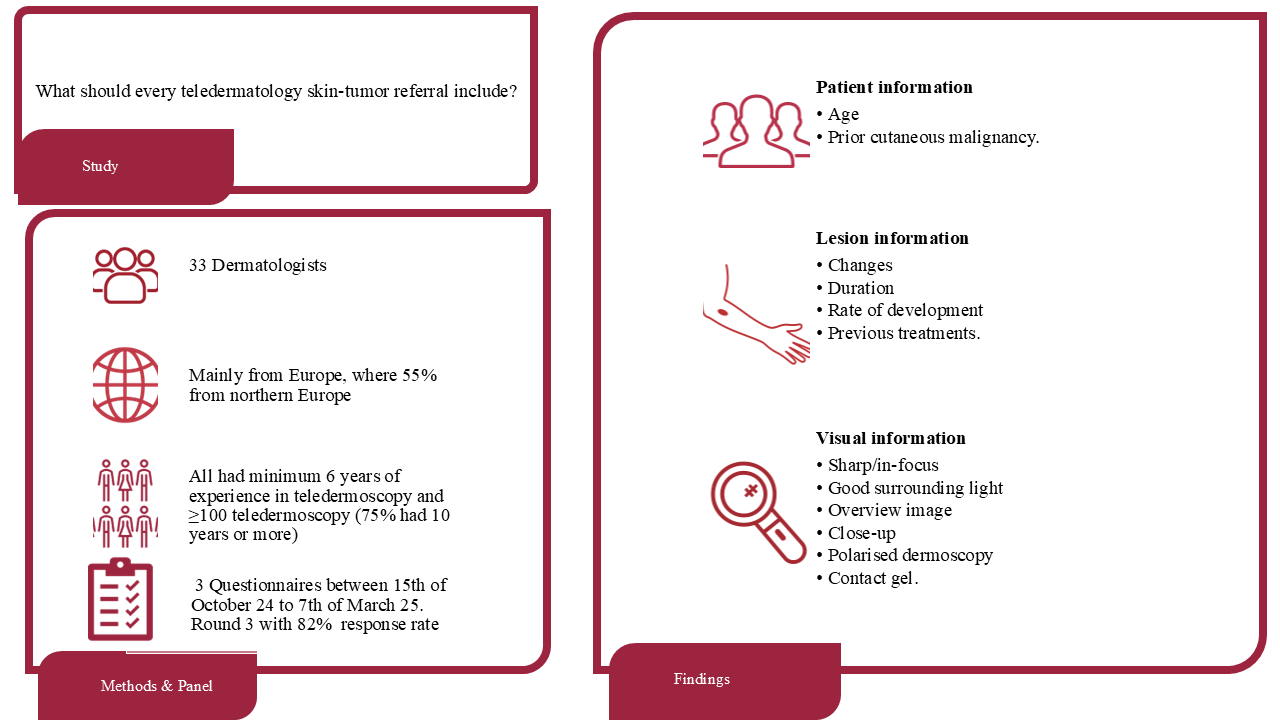
Teledermatology is increasingly used for the assessment of suspicious skin tumours, yet referral content remains poorly standardized. To develop a European expert consensus on the essential clinical and visual variables required for teledermatological assessment of primary skin tumours. A 3-round modified Delphi study was conducted among experienced dermatologists. In round 1, participants proposed essential variables. In round 2, variables were rated for essentiality, clinical relevance and feasibility. In round 3, binary voting was used to define final consensus. Consensus was predefined as ≥67% agreement. Interquatile ranges were calculated to assess response stability. A total of 47 variables were proposed in round 1. Following quantitative scoring, 34 variables progressed to round 3. Twelve variables met the predefined consensus threshold, primarily related to image quality and lesion characteristics. Sensitivity analyses using geographic subgroups and higher consensus thresholds demonstrated that image-quality variables were the most robust. This European expert consensus defines a focused and clinically practical core dataset for teledermatological assessment of skin tumours. These variables may support standardization of referrals and facilitate future validation and AI-assisted workflows.
Downloads
References
Wang M, Gao X, Zhang L. Recent global patterns in skin cancer incidence, mortality, and prevalence. Chin Med J (Engl) 2025; 138: 185–192. DOI: https://doi.org/10.1097/CM9.0000000000003416
Observatory Gc. Estimated number of new cases from 2022 to 2050, Males and Females, age [0-85+]. WHO; 2025.
Olsen CM, Wilson LF, Green AC, Bain CJ, Fritschi L, Neale RE, et al. Cancers in Australia attributable to exposure to solar ultraviolet radiation and prevented by regular sunscreen use. Aust N Z J Public Health 2015; 39: 471–476. DOI: https://doi.org/10.1111/1753-6405.12470
Belbasis L, Stefanaki I, Stratigos AJ, Evangelou E. Non-genetic risk factors for cutaneous melanoma and keratinocyte skin cancers: an umbrella review of meta-analyses. J Dermatol Sci 2016; 84: 330–339. DOI: https://doi.org/10.1016/j.jdermsci.2016.09.003
Vestergaard ME, Macaskill P, Holt PE, Menzies SW. Dermoscopy compared with naked eye examination for the diagnosis of primary melanoma: a meta-analysis of studies performed in a clinical setting. Br J Dermatol 2008; 159: 669–676. DOI: https://doi.org/10.1111/j.1365-2133.2008.08713.x
Kittler H, Pehamberger H, Wolff K, Binder M. Diagnostic accuracy of dermoscopy. Lancet Oncol 2002; 3: 159–165. DOI: https://doi.org/10.1016/S1470-2045(02)00679-4
Katragadda C, Finnane A, Soyer HP, Marghoob AA, Halpern A, Malvehy J, et al. Technique standards for skin lesion imaging: a Delphi consensus statement. JAMA Dermatol 2017; 153: 207–213. DOI: https://doi.org/10.1001/jamadermatol.2016.3949
Abbott LM, Miller R, Janda M, Bennett H, Taylor M, Arnold C, et al. Practice guidelines for teledermatology in Australia. Australas J Dermatol 2020; 61: e293–e302. DOI: https://doi.org/10.1111/ajd.13301
Lee KJ, Finnane A, Soyer HP. Recent trends in teledermatology and teledermoscopy. Dermatol Pract Concept 2018; 8: 214–223. DOI: https://doi.org/10.5826/dpc.0803a013
Wang RH, Barbieri JS, Nguyen HP, Stavert R, Forman HP, Bolognia JL, et al. Clinical effectiveness and cost-effectiveness of teledermatology: Where are we now, and what are the barriers to adoption? J Am Acad Dermatol 2020; 83: 299–307. DOI: https://doi.org/10.1016/j.jaad.2020.01.065
Giavina-Bianchi M, Santos AP, Cordioli E. Teledermatology reduces dermatology referrals and improves access to specialists. EClinicalMedicine 2020; 29–30: 100641. DOI: https://doi.org/10.1016/j.eclinm.2020.100641
Lim D, Oakley AMM, Rademaker M. Better, sooner, more convenient: a successful teledermoscopy service. Australas J Dermatol 2012; 53: 22–25. DOI: https://doi.org/10.1111/j.1440-0960.2011.00836.x
Whiting G, Stocks N, Morgan S, Tapley A, Henderson K, Holliday E, et al. General practice registrars’ use of dermoscopy: Prevalence, associations and influence on diagnosis and confidence. Aust J Gen Pract 2019; 48: 547–553. DOI: https://doi.org/10.31128/AJGP-11-18-4773
Moreno-Ramirez D, Ferrandiz L, Nieto-Garcia A, Carrasco R, Moreno-Alvarez P, Galdeano R, et al. Store-and-forward teledermatology in skin cancer triage: experience and evaluation of 2009 teleconsultations. Arch Dermatol 2007; 143: 479–484. DOI: https://doi.org/10.1001/archderm.143.4.479
Bourkas AN, Barone N, Bourkas MEC, Mannarino M, Fraser RDJ, Lorincz A, et al. Diagnostic reliability in teledermatology: a systematic review and a meta-analysis. BMJ Open 2023; 13: e068207. DOI: https://doi.org/10.1136/bmjopen-2022-068207
Abbott LM, Miller R, Janda M, Bennett H, Taylor ML, Arnold C, et al. A review of literature supporting the development of practice guidelines for teledermatology in Australia. Australas J Dermatol 2020; 61: e174–e183. DOI: https://doi.org/10.1111/ajd.13249
Group TWP. Service guidance and standards for the use of teledermatologyERVICE GUIDANCE AND STANDARDS FOR THE USE OF TELEDERMATOLOGY. British Association of Dermatologists: Transformation and Quality Improvement Unit 2024.
McKoy K, Antoniotti NM, Armstrong A, Bashshur R, Bernard J, Bernstein D, et al. Practice guidelines for teledermatology. Telemed J E Health 2016; 22: 981–990. DOI: https://doi.org/10.1089/tmj.2016.0137
Dovigi E, Kwok EYL, English JC 3rd. A framework-driven systematic review of the barriers and facilitators to teledermatology implementation. Curr Dermatol Rep 2020; 9: 353–361. DOI: https://doi.org/10.1007/s13671-020-00323-0
Nasa P, Jain R, Juneja D. Delphi methodology in healthcare research: How to decide its appropriateness. World J Methodol 2021; 11: 116–129. DOI: https://doi.org/10.5662/wjm.v11.i4.116
Barrett D, Heale R. What are Delphi studies? Evid Based Nurs 2020; 23: 68–69. DOI: https://doi.org/10.1136/ebnurs-2020-103303
Birko S, Dove ES, Özdemir V. Evaluation of nine consensus indices in Delphi foresight research and their dependency on delphi survey characteristics: a simulation study and debate on Delphi design and interpretation. PLoS One 2015; 10: e0135162. DOI: https://doi.org/10.1371/journal.pone.0135162
Nayahangan LJ, Stefanidis D, Kern DE, Konge L. How to identify and prioritize procedures suitable for simulation-based training: eExperiences from general needs assessments using a modified Delphi method and a needs assessment formula. Med Teach 2018; 40: 676–683. DOI: https://doi.org/10.1080/0142159X.2018.1472756
Russo T, Piccolo V, Moscarella E, Tschandl P, Kittler H, Paoli J, et al. Indications for digital monitoring of patients with multiple Nevi: recommendations from the international dermoscopy society. Dermatol Pract Concept 2022; 12: e2022182. DOI: https://doi.org/10.5826/dpc.1204a182
Blum A. Re: Expert consensus statement on proficiency standards for dermoscopy education in primary care. J Am Board Fam Med 2023; 36: 695. DOI: https://doi.org/10.3122/jabfm.2023.230138R0
Kashani-Sabet M, Leachman SA, Stein JA, Arbiser JL, Berry EG, Celebi JT, et al. Early detection and prognostic assessment of cutaneous melanoma: consensus on optimal practice and the role of gene expression profile testing. JAMA Dermatol 2023; 159: 545–553. DOI: https://doi.org/10.1001/jamadermatol.2023.0127
Nayahangan LJ, Van Herzeele I, Konge L, Koncar I, Cieri E, Mansilha A, et al. Achieving consensus to define curricular content for simulation based education in vascular surgery: a Europe wide needs assessment initiative. Eur J Vasc Endovasc Surg 2019; 58: 284–291. DOI: https://doi.org/10.1016/j.ejvs.2019.03.022
Vogel C, Zwolinsky S, Griffiths C, Hobbs M, Henderson E, Wilkins E. A Delphi study to build consensus on the definition and use of big data in obesity research. Int J Obes 2019; 43: 2573–2586. DOI: https://doi.org/10.1038/s41366-018-0313-9
Fried LJ, Tan A, Berry EG, Braun RP, Curiel-Lewandrowski C, Curtis J, et al. Dermoscopy proficiency expectations for US dermatology resident physicians: Results of a modified Delphi survey of pigmented lesion experts. JAMA Dermatol 2021; 157: 189–197. DOI: https://doi.org/10.1001/jamadermatol.2020.5213
Harris PA, Taylor R, Thielke R, Payne J, Gonzalez N, Conde JG. Research electronic data capture (REDCap)--a metadata-driven methodology and workflow process for providing translational research informatics support. J Biomed Inform 2009; 42: 377–381. DOI: https://doi.org/10.1016/j.jbi.2008.08.010
Harris PA, Taylor R, Minor BL, Elliott V, Fernandez M, O’Neal L, et al. The REDCap consortium: building an international community of software platform partners. J Biomed Inform 2019; 95: 103208. DOI: https://doi.org/10.1016/j.jbi.2019.103208
Gracht HA. Consensus measurement in Delphi studies: review and implications for future quality assurance. Technol Forecast Soc Change 2012; 79: 1525–1536. DOI: https://doi.org/10.1016/j.techfore.2012.04.013
Thomas J, Kumar P. The scope of teledermatology in India. Indian Dermatol Online J 2013; 4: 82–89. DOI: https://doi.org/10.4103/2229-5178.110579
Mu Z, Liu X, Li K, Zhang J. Teledermatology service during the COVID-19 pandemic in China: aA mobile application-based retrospective study. Clin Cosmet Investig Dermatol 2021; 14: 1119–1124. DOI: https://doi.org/10.2147/CCID.S326105
Alves J, Moreira D, Alves P, Rosado L, Vasconcelos MJM. Automatic focus assessment on dermoscopic images acquired with smartphones. Sensors (Basel) 2019; 19: 4957. DOI: https://doi.org/10.3390/s19224957
Börve A, Dahlén Gyllencreutz J, Terstappen K, Johansson Backman E, Aldenbratt A, Danielsson M, et al. Smartphone teledermoscopy referrals: a novel process for improved triage of skin cancer patients. Acta Derm Venereol 2015; 95: 186–190. DOI: https://doi.org/10.2340/00015555-1906
Vestergaard T, Andersen MK, Bygum A. Acceptance of teledermoscopy by general practitioners and dermatologists in Denmark. Dermatol Pract Concept 2021; 11: e2021033. DOI: https://doi.org/10.5826/dpc.1102a33
Additional Files
Published
How to Cite
License

This work is licensed under a Creative Commons Attribution-NonCommercial 4.0 International License.
All digitalized ActaDV contents is available freely online. The Society for Publication of Acta Dermato-Venereologica owns the copyright for all material published until volume 88 (2008) and as from volume 89 (2009) the journal has been published fully Open Access, meaning the authors retain copyright to their work.
Unless otherwise specified, all Open Access articles are published under CC-BY-NC licences, allowing third parties to copy and redistribute the material in any medium or format and to remix, transform, and build upon the material for non-commercial purposes, provided proper attribution to the original work.






