
Clinical Characterization and Outcomes of Dupilumab for Pemphigoid Gestationis: A Case Series of Five Patients and Literature Review
DOI:
https://doi.org/10.2340/actadv.v106.adv-2026-0669Keywords:
Autoimmune disease, Biomarkers, Immunobullous disease, PatientsAbstract
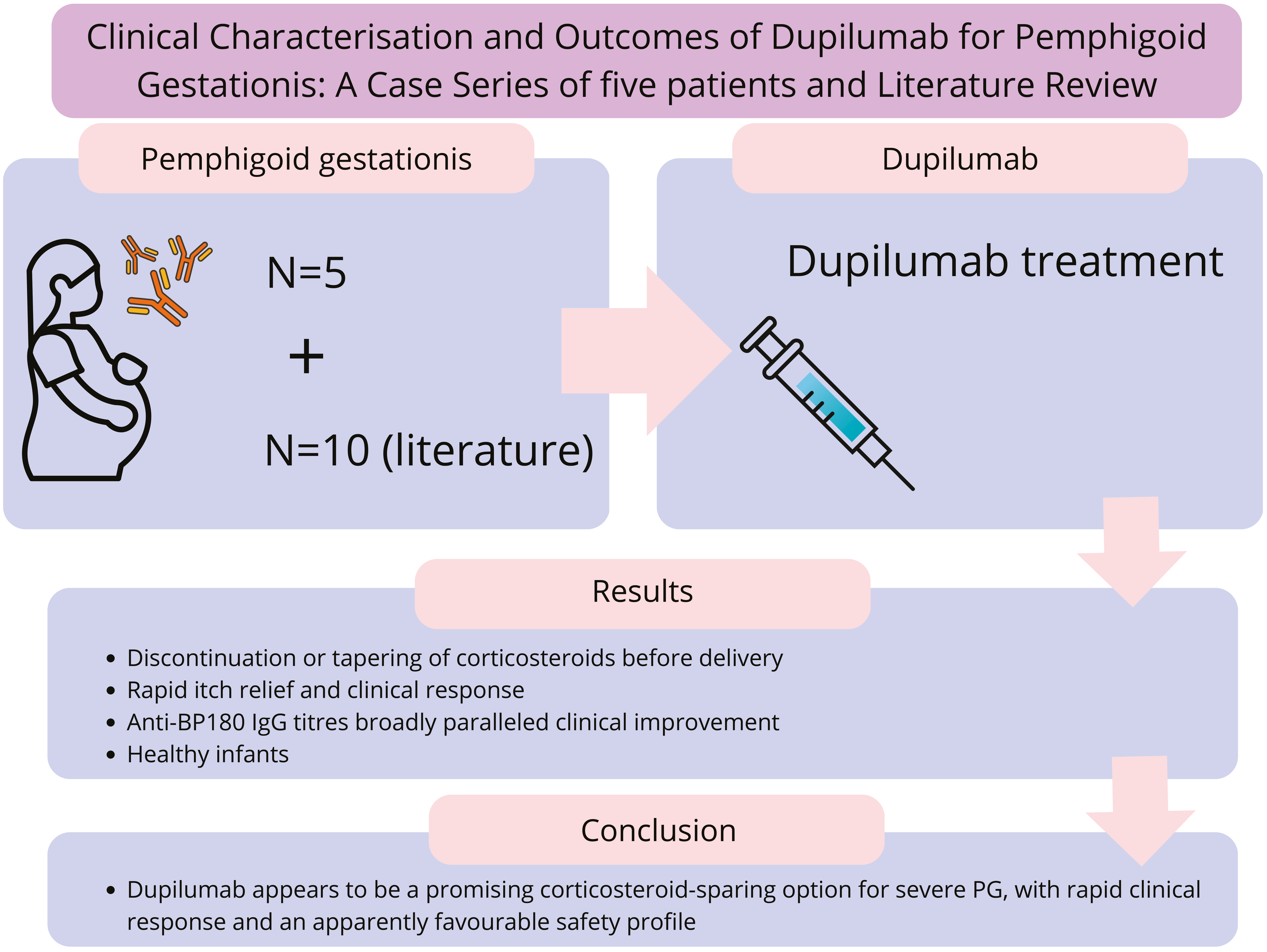
Treatment of pemphigoid gestationis (PG) mainly consists of systemic and potent topical corticosteroids. This retrospective case series describes patients with severe PG treated with dupilumab, including serological follow-up, and reviews all published cases. PG was confirmed by direct immunofluorescence (linear C3 and/or IgG deposition along the basement membrane zone) and serology (IgG epidermal staining on salt-split skin or anti-BP180 NC16A IgG ELISA). Pruritus, quality of life and anti-BP180 NC16A IgG and anti-BP180 NC16A IgE were monitored longitudinally. In 5 pregnant women, dupilumab was initiated with a 600 mg loading dose followed by 300 mg biweekly. Baseline pruritus was severe (NRS 8–10), with high DLQI scores (18–30). Blistering ceased within 1 week in 2 patients and within 4 weeks in 1. Two patients required weekly dosing for disease control. Systemic corticosteroids were discontinued in 3 patients and tapered to ≤10 mg/day in 2 before delivery. In one case, anti-BP180 IgG paralleled clinical improvement. Anti-BP180 IgE remained negative. All patients delivered healthy infants. In 10 reported cases, pruritus improved rapidly and systemic corticosteroids were tapered. These findings suggest dupilumab may be a promising corticosteroid-sparing option for PG, with rapid clinical response and a favourable safety profile, despite off-label use in pregnancy.
Downloads
References
Tani N, Kimura Y, Koga H, Kawakami T, Ohata C, Ishii N, et al. Clinical and immunological profiles of 25 patients with pemphigoid gestationis. Br J Dermatol 2015; 172: 120–129. DOI: https://doi.org/10.1111/bjd.13374
Huilaja L, Mäkikallio K, Sormunen R, Lohi J, Hurskainen T, Tasanen K. Gestational pemphigoid: placental morphology and function. Acta Derm Venereol 2013; 93: 33–38. DOI: https://doi.org/10.2340/00015555-1370
Cristescu MI, Tutunaru CV, Panaitescu A, Voiculescu VM. Gestational pemphigoid—from molecular mechanisms to clinical outcomes: a case report and review of literature. Life 2024; 14: 14. DOI: https://doi.org/10.3390/life14111427
Daniel BS, Murrell DF. Review of autoimmune blistering diseases: the pemphigoid diseases. J Eur Acad Dermatol Venereol 2019; 33: 1685–1694. DOI: https://doi.org/10.1111/jdv.15679
Genovese G, Derlino F, Cerri A, Moltrasio C, Muratori S, Berti E, et al. A systematic review of treatment options and clinical outcomes in pemphigoid gestationis. Front Med 2020; 7: 604945. DOI: https://doi.org/10.3389/fmed.2020.604945
Yaghi M, McMullan P, Truong TM, Rothe M, Murase J, Grant-Kels JM. Safety of dermatologic medications in pregnancy and lactation: an update-part II: lactation. J Am Acad Dermatol 2024; 91: 651–668. DOI: https://doi.org/10.1016/j.jaad.2023.10.071
Preuß SL, Vorobyev A, Moderegger EL, Terheyden P, Bieber K, Kridin K, et al. Pemphigoid gestationis is associated with an increased risk for adverse pregnancy outcomes: a large-scale propensity-matched retrospective cohort study. J Am Acad Dermatol 2024; 91: 748–750. DOI: https://doi.org/10.1016/j.jaad.2024.05.087
Riquelme-Mc Loughlin C, Mascaró JM Jr. Treatment of pemphigoid gestationis with dupilumab. Clin Exp Dermatol 2021; 46: 1578–1579. DOI: https://doi.org/10.1111/ced.14765
Chen RE, Yokoyama CC, Anadkat MJ. Pemphigoid gestationis treated with dupilumab. JAAD Case Rep 2023; 41: 10–12. DOI: https://doi.org/10.1016/j.jdcr.2023.08.013
Liu Y, Yuan J, Xia Y, Du X, Geng S. A case of pemphigoid gestationis successfully treated with dupilumab. Acad Dermatol Venereol 2023; 37: e1164–e1165. DOI: https://doi.org/10.1111/jdv.19171
Alvarez Martinez D, Russo G, Fontao L, Laffitte E. Successful therapy of pemphigoid gestationis with dupilumab-a new case. J Eur Acad Dermatol Venereol 2023; 37: e752–e753. DOI: https://doi.org/10.1111/jdv.18911
Thomas KV, Choi F, Le T, McGuire M, Ethington J, Arkin LM. Dupilumab in the treatment of pemphigoid gestationis. Cutis 2025; 115: 102–104. DOI: https://doi.org/10.12788/cutis.1176
Phong CH, Lee BA, Grando SA. Dupilumab as a novel steroid-sparing treatment for pemphigoid gestationis: a new case report and review of literature. JAAD Case Rep 2025; 60: 37–40. DOI: https://doi.org/10.1016/j.jdcr.2025.03.019
Calvo Arbeloa M, Arrondo Velasco A, Jimenez PR, Sarobe Carricas M. Effectiveness and safety of off-label dupilumab use for the treatment of pemphigoid gestationis: a new case report. Eur J Hosp Pharm 2025: ejhpharm-2025-004583. DOI: https://doi.org/10.1136/ejhpharm-2025-004583
Sun C, Zeng YP. A case of pemphigoid gestationis successfully treated with systemic corticosteroids combined with dupilumab. Eur J Dermatol 2025; 35: 320–321. DOI: https://doi.org/10.1684/ejd.2025.4912
Ryan SL, Alsharqi A. Successful use of dupilumab in the management of recalcitrant pemphigoid gestationis. Australas J Dermatol 2026; 67: 60–62. DOI: https://doi.org/10.1111/ajd.70007
Meijer JM, Diercks GFH, de Lang EWG, Pas HH, Jonkman MF. Assessment of diagnostic strategy for early recognition of bullous and nonbullous variants of pemphigoid. JAMA Dermatol 2019; 155: 158–165. DOI: https://doi.org/10.1001/jamadermatol.2018.4390
Phan NQ, Blome C, Fritz F, Gerss J, Reich A, Ebata T, et al. Assessment of pruritus intensity: prospective study on validity and reliability of the visual analogue scale, numerical rating scale and verbal rating scale in 471 patients with chronic pruritus. Acta Derm Venereol 2012; 92: 502–507. DOI: https://doi.org/10.2340/00015555-1246
Finlay AY, Khan GK. Dermatology Life Quality Index (DLQI)--a simple practical measure for routine clinical use. Clin Exp Dermatol 1994; 19: 210–216. DOI: https://doi.org/10.1111/j.1365-2230.1994.tb01167.x
Lamberts A, Kotnik N, Diercks GFH, Meijer JM, Di Zenzo G, Pas HH, et al. IgE autoantibodies in serum and skin of non-bullous and bullous pemphigoid patients. J Eur Acad Dermatol Venereol 2021; 35: 973–980. DOI: https://doi.org/10.1111/jdv.16996
Khong TY, Mooney EE, Ariel I, Balmus NCM, Boyd TK, Brundler MA, et al. Sampling and definitions of placental lesions: amsterdam Placental Workshop Group consensus statement. Arch Pathol Lab Med 2016; 140: 698–713. DOI: https://doi.org/10.5858/arpa.2015-0225-CC
Abdelhafez MMA, Ahmed KAM, Daud MNBM, Jeffree MS, Kadir F, Baharuddin DMP, et al. Pemphigoid Gestationis and adverse pregnancy outcomes: a literature review. J Gynecol Obstet Hum Reprod 2022; 51: 102370. DOI: https://doi.org/10.1016/j.jogoh.2022.102370
Atalay NE, Dağıstanlı F, Şimşek HU, Caliskan E. Evaluation of maternal and fetal findings in patients with pemphigoid gestationis. Int J Gynaecol Obstet 2025; 169: 274–278. DOI: https://doi.org/10.1002/ijgo.16086
Sánchez-García V, De-Miguel-Balsa E, Ramos-Rincón JM, Belinchón-Romero I. Safety of dupilumab therapy for atopic dermatitis during pregnancy: a systematic review and meta-analysis. Acta Derm Venereol 2025; 105: adv41307. DOI: https://doi.org/10.2340/actadv.v105.41307
Huilaja L, Hurskainen T, Autio-Harmainen H, Hofmann SC, Sormunen R, Räsänen J, et al. Pemphigoid gestationis autoantigen, transmembrane collagen XVII, promotes the migration of cytotrophoblastic cells of placenta and is a structural component of fetal membranes. Matrix Biol 2008; 27: 190–200. DOI: https://doi.org/10.1016/j.matbio.2007.10.007
Borthwick GM, Sunderland CA, Holmes RC, Black MM, Stirrat GM. Abnormal expression of HLA-DR antigen in the placenta of a patient with pemphigoid gestationis. J Reprod Immunol 1984; 6: 393–396. DOI: https://doi.org/10.1016/0165-0378(84)90048-2
Horiuchi Y. Th2 shift in pregnancy and labor: An immunological perspective to elucidate the pathogenesis onset of atopy. Am J Reprod Immunol 2023; 90: e13716. DOI: https://doi.org/10.1111/aji.13716
Administration USFaD. DUPIXENT® (dupilumab) injection, for subcutaneous use Initial U.S. Approval: 2017. 2015.
Additional Files
Published
How to Cite
License

This work is licensed under a Creative Commons Attribution-NonCommercial 4.0 International License.
All digitalized ActaDV contents is available freely online. The Society for Publication of Acta Dermato-Venereologica owns the copyright for all material published until volume 88 (2008) and as from volume 89 (2009) the journal has been published fully Open Access, meaning the authors retain copyright to their work.
Unless otherwise specified, all Open Access articles are published under CC-BY-NC licences, allowing third parties to copy and redistribute the material in any medium or format and to remix, transform, and build upon the material for non-commercial purposes, provided proper attribution to the original work.






