
Comparison of the ultrasonic, Masserann, and BTR-pen techniques for removing fractured instruments with dental microscope: a CBCT-based in vitro study
DOI:
https://doi.org/10.2340/aos.v85.46531Keywords:
Fractured instrument removal, ultrasonic technique, Masserann kit, BTR-Pen, cone-beam computed tomographyAbstract
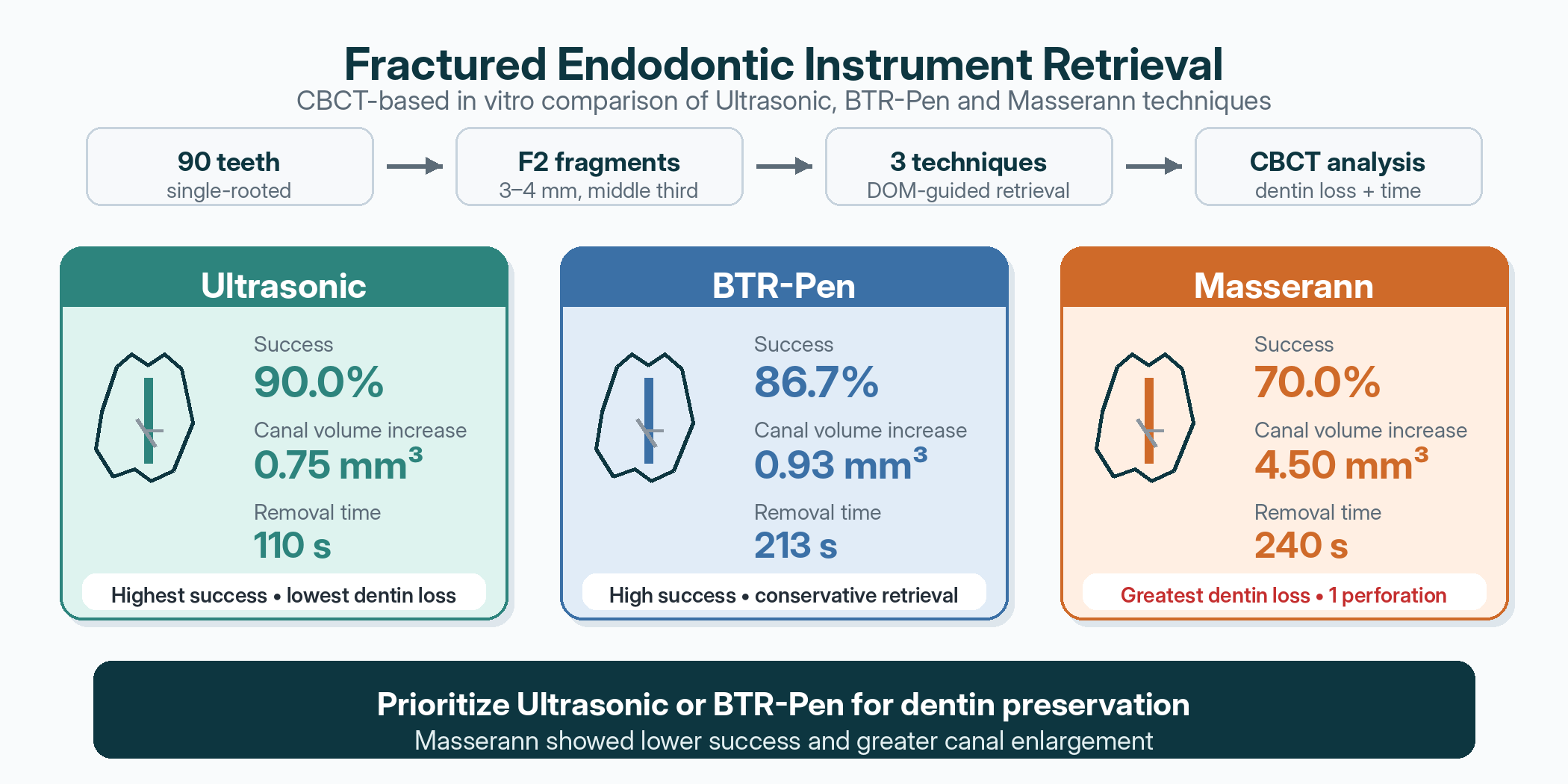
Objective: This in vitro study compared the efficacy, dentin loss, and outcomes of ultrasonic, Masserann, and Broken Tool Remover Pen (BTR-Pen) techniques for removing fractured endodontic instruments using cone-beam computed tomography (CBCT) analysis.
Materials and methods: Ninety extracted single-rooted teeth were randomly allocated into three groups (n = 30). ProTaper F2 instruments were intentionally fractured in the middle third of each canal, creating 3–4 mm fragments. Removal was performed using ultrasonic tips, Masserann trephine burs, or the BTR-Pen loop system. CBCT scans quantified dentin loss. Success rates, removal times, and complications were analyzed using one-way analysis of variance, Tukey honestly significant difference, chi-square, and likelihood-ratio chi-square tests (p < 0.05).
Results: Ultrasonic removal showed the highest success rate (90.0%), followed by BTR-Pen (86.7%) and Masserann (70.0%). Pairwise likelihood-ratio chi-square analysis showed lower success for Masserann than ultrasonic removal (p = 0.049). Masserann caused significantly greater canal volume increase (4.50 ± 0.50 mm³) than ultrasonic (0.75 ± 0.30 mm³) and BTR-Pen (0.93 ± 0.40 mm³) techniques (p < 0.001). Ultrasonic removal required the shortest time (110.0 ± 35.0 s), followed by BTR-Pen (213.4 ± 40.0 s) and Masserann (240.0 ± 50.0 s).
Conclusions: Ultrasonic and BTR-Pen techniques achieved high success with better dentin preservation than Masserann. When retrieval is indicated, techniques that maximize dentin preservation should be preferred to reduce the risk of root weakening and procedural complications.
Downloads
References
Plotino G, Grande NM, Sorci E, Malagnino VA, Somma F. Influence of a brushing working motion on the fatigue life of NiTi rotary instruments. Int Endod J. 2007;40(1):45–51. DOI: https://doi.org/10.1111/j.1365-2591.2006.01179.x
Peters OA. Current challenges and concepts in the preparation of root canal systems: a review. J Endod. 2004;30(8):559–67. DOI: https://doi.org/10.1097/01.DON.0000129039.59003.9D
Ward JR, Parashos P, Messer HH. Evaluation of an ultrasonic technique to remove fractured rotary nickel-titanium endodontic instruments from root canals: an experimental study. J Endod. 2003;29(11):756–63. DOI: https://doi.org/10.1097/00004770-200311000-00017
Friedman S, Stabholz A, Tamse A. Endodontic retreatment – case selection and technique. 3. Retreatment techniques. J Endod. 1990;16(11):543–9. DOI: https://doi.org/10.1016/S0099-2399(07)80219-6
Dulundu M, Helvacioglu-Yigit D. The efficiency of the BTR-Pen system in removing different types of broken instruments from root canals and its effect on the fracture resistance of roots. Materials. 2022;15(17):5816. DOI: https://doi.org/10.3390/ma15175816
Mangal S, Mathew S, Sreenivasa Murthy BV, Nagaraja S, Dinesh K, Ramesh P. Cone-beam computed tomographic evaluation of remaining dentin thickness in bifurcated roots of maxillary first premolars after rotary instrumentation and post space preparation: an in vitro study. J Conserv Dent. 2018;21(1):63–7.
Alapati SB, Brantley WA, Svec TA, Powers JM, Nusstein JM, Daehn GS. SEM observations of nickel-titanium rotary endodontic instruments that fractured during clinical Use. J Endod. 2005;31(1):40–3. DOI: https://doi.org/10.1097/01.DON.0000132301.87637.4A
Iqbal MK, Kohli MR, Kim JS. A retrospective clinical study of incidence of root canal instrument separation in an endodontics graduate program: a PennEndo database study. J Endod. 2006;32(11):1048–52. DOI: https://doi.org/10.1016/j.joen.2006.03.001
Fu M, Zhang Z, Hou B. Removal of broken files from root canals by using ultrasonic techniques combined with dental microscope: a retrospective analysis of treatment outcome. J Endod. 2011;37(5):619–22. DOI: https://doi.org/10.1016/j.joen.2011.02.016
Spili P, Parashos P, Messer HH. The impact of instrument fracture on outcome of endodontic treatment. J Endod. 2005;31(12):845–50. DOI: https://doi.org/10.1097/01.don.0000164127.62864.7c
Nevares G, Cunha RS, Zuolo ML, Bueno CE. Success rates for removing or bypassing fractured instruments: a prospective clinical study. J Endod. 2012;38(4):442–4. DOI: https://doi.org/10.1016/j.joen.2011.12.009
Cuje J, Bargholz C, Hulsmann M. The outcome of retained instrument removal in a specialist practice. Int Endod J. 2010;43(7):545–54. DOI: https://doi.org/10.1111/j.1365-2591.2009.01652.x
Suter B, Lussi A, Sequeira P. Probability of removing fractured instruments from root canals. Int Endod J. 2005;38(2):112–23. DOI: https://doi.org/10.1111/j.1365-2591.2004.00916.x
Tzanetakis GN, Kontakiotis EG, Maurikou DV, Marzelou MP. Prevalence and management of instrument fracture in the postgraduate endodontic program at the Dental School of Athens: a five-year retrospective clinical study. J Endod. 2008;34(6):675–8. DOI: https://doi.org/10.1016/j.joen.2008.02.039
Saad AY, Baraktat FT, Attia MI. Comparative analysis of the efficiency of the Broken Tool Remover-Pen versus Zumax kit in the removal of fractured NiTi files from the root canal system. An in vitro study. Saudi Endod J. 2024;14(3):348–55. DOI: https://doi.org/10.4103/sej.sej_33_24
Shajahan S, Dhanavel C, Raja SV, Sornamalar M, Balavaishnavi G. Comparative evaluation of the efficiency in retrieving separated reciprocating instruments using three different file retrieval systems in maxillary first molars: an in vitro study. J Pharm Bioallied Sci. 2024;16(Suppl 5):S4544–7. DOI: https://doi.org/10.4103/jpbs.jpbs_1195_24
Ruddle CJ. Nonsurgical retreatment. J Endod. 2004;30(12):827–45. DOI: https://doi.org/10.1097/01.don.0000145033.15701.2d
Hulsmann M. Removal of fractured root canal instruments using the Canal Finder System. Dtsch Zahnarztl Z. 1990;45(4):229–32.
Okiji T. Modified usage of the Masserann kit for removing intracanal broken instruments. J Endod. 2003;29(7):466–7. DOI: https://doi.org/10.1097/00004770-200307000-00010
Hashem AA. Ultrasonic vibration: temperature rise on external root surface during broken instrument removal. J Endod. 2007;33(9):1070–3. DOI: https://doi.org/10.1016/j.joen.2007.06.005
Saunders JL, Eleazer PD, Zhang P, Michalek S. Effect of a separated instrument on bacterial penetration of obturated root canals. J Endod. 2004;30(3):177–9. DOI: https://doi.org/10.1097/00004770-200403000-00012
Terauchi Y, Sexton C, Bakland LK, Bogen G. Factors affecting the removal time of separated instruments. J Endod. 2021;47(8):1245–52. DOI: https://doi.org/10.1016/j.joen.2021.05.003
Madarati AA, Qualtrough AJ, Watts DC. Factors affecting temperature rise on the external root surface during ultrasonic retrieval of intracanal separated files. J Endod. 2008;34(9):1089–92. DOI: https://doi.org/10.1016/j.joen.2008.05.018
Madarati AA, Qualtrough AJ, Watts DC. Efficiency of a newly designed ultrasonic unit and tips in reducing temperature rise on root surface during the removal of fractured files. J Endod. 2009;35(6):896–9. DOI: https://doi.org/10.1016/j.joen.2009.03.051
Budd JC, Gekelman D, White JM. Temperature rise of the post and on the root surface during ultrasonic post removal. Int Endod J. 2005;38(10):705–11. DOI: https://doi.org/10.1111/j.1365-2591.2005.01002.x
Hindlekar A, Kaur G, Kashikar R, Kotadia P. Retrieval of separated intracanal endodontic instruments: a series of four case reports. Cureus. 2023;15(3):e35694. DOI: https://doi.org/10.7759/cureus.35694
Keskin C, Keles A, Pirimoglu B, Toplu D. Endoscope-assisted retrieval of separated instruments: an ex vivo comparative study of Masserann, microsonic, and loop techniques. Proc Inst Mech Eng H. 2025;239:9544119251331711. DOI: https://doi.org/10.1177/09544119251331711
Aminsobhani M, Hashemi N, Hamidzadeh F, Sarraf P. Broken instrument removal methods with a minireview of the literature. Case Rep Dent. 2024;2024:9665987. DOI: https://doi.org/10.1155/2024/9665987
Published
Issue
Section
License
Copyright (c) 2026 Esra Balkanlıoğlu, Aliye Kamalak, Berkcan Güner

This work is licensed under a Creative Commons Attribution 4.0 International License.
 Acta Odontologica Scandinavica publishes high quality original research papers as well as critical reviews relevant on diseases of the oral cavity, their treatment, epidemiology and associated biomaterials and their development.


