
From gains to decline: effects of structured pre-dialytic exercise training and detraining on physical fitness, quality of life, and inflammation in haemodialysis patients
DOI:
https://doi.org/10.2340/jrm.v57.44067Keywords:
body composition, cardiorespiratory fitness, hemodialysis, muscle strength, peak oxygen consumptionAbstract
Objective: Pre-dialysis exercise training may benefit haemodialysis patients, but the effects of structured aerobic and resistance training remain unclear. This study evaluated the effects of a 6-month training performed 1–2 h before haemodialysis on muscle strength, cardiorespiratory fitness, quality of life, and systemic inflammation.
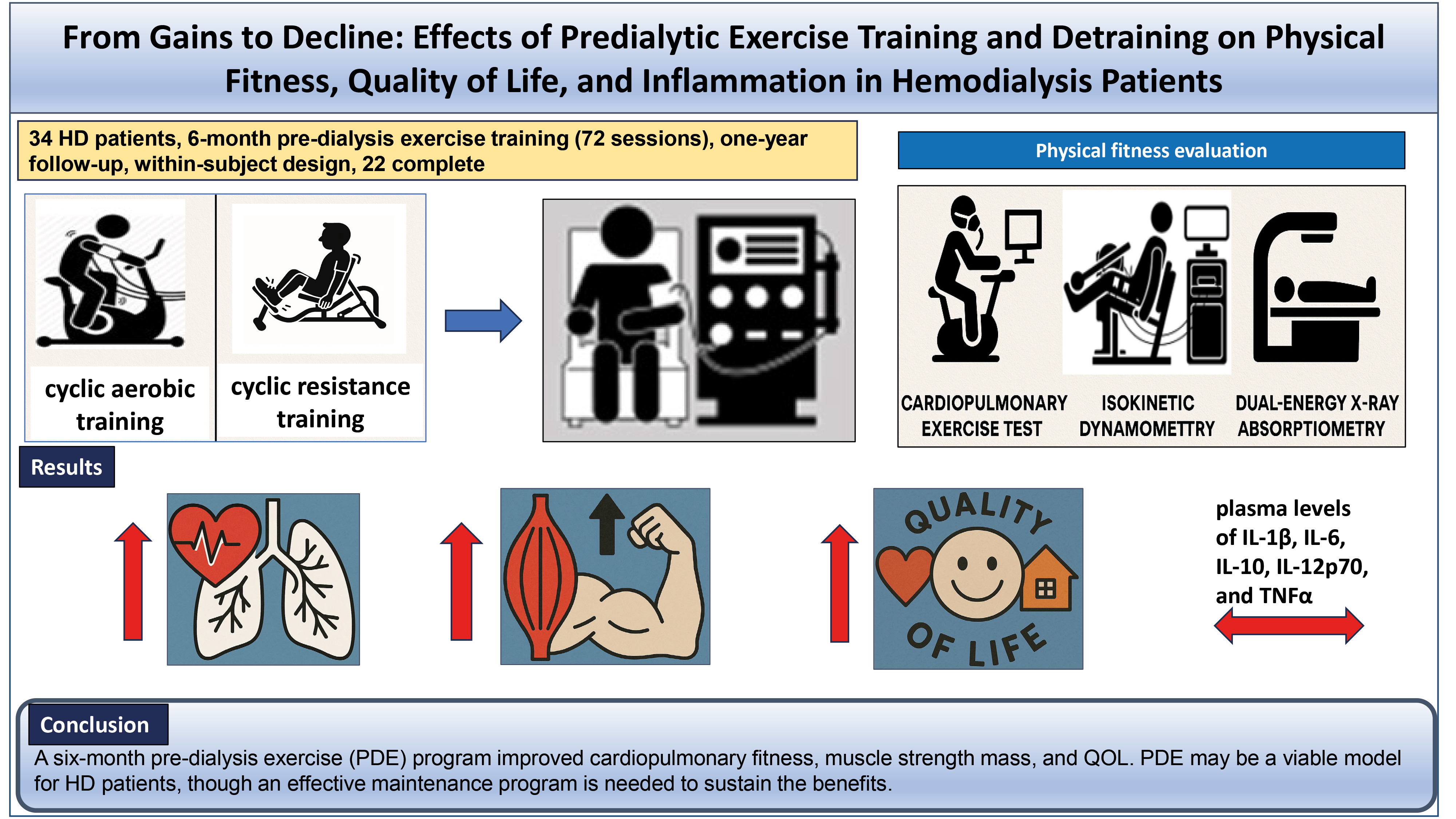
Design: A 3-phase self-controlled design: 3-month control, 6-month aerobic and resistance training (72 sessions) and nutrition counselling, and 3-month follow-up.
Patients: Haemodialysis patients > 3 months.
Methods: Assessments were performed every 3 months at 5 time points. Outcomes included physical fitness (dual-energy X-ray absorptiometry, isokinetic dynamometry, and cardiopulmonary exercise testing), Kidney Disease QOL questionnaire, International Physical Activity Questionnaire, nutrition, and plasma pro- and anti-inflammatory cytokines.
Results: Of 118 patients screened, 29 entered training and 22 completed 72 sessions (92% compliance). Pre-dialysis exercise training improved muscle mass, cardiorespiratory fitness, quadriceps strength, physical and mental components, and disease-specific quality of life; cardiorespiratory fitness and strength declined at 3-month follow-up, but muscle mass remained. Cytokine levels were unchanged, suggesting minimal pro- or anti-inflammatory effects.
Conclusion: A 6-month pre-dialysis exercise programme improved cardiorespiratory fitness, strength, muscle mass, and quality of life with high compliance. It may be viable for haemodialysis patients, though maintenance is needed to sustain benefits.
ClinicalTrials.gov ID: NCT05649657
Downloads
References
Jager KJ, Kovesdy C, Langham R, Rosenberg M, Jha V, Zoccali C. A single number for advocacy and communication: worldwide more than 850 million individuals have kidney diseases. Nephrol Dial Transplant 2019; 34: 1803–1805.
https://doi.org/10.1093/ndt/gfz174 DOI: https://doi.org/10.1093/ndt/gfz174
Clarkson MJ, Bennett PN, Fraser SF, Warmington SA. Exercise interventions for improving objective physical function in patients with end-stage kidney disease on dialysis: a systematic review and meta-analysis. Am J Physiol Renal Physiol 2019; 316: F856–872.
https://doi.org/10.1152/ajprenal.00317.2018 DOI: https://doi.org/10.1152/ajprenal.00317.2018
Al-Mallah MH, Sakr S, Al-Qunaibet A. Cardiorespiratory fitness and cardiovascular disease prevention: an update. Curr Atheroscler Rep 2018; 20: 1.
https://doi.org/10.1007/s11883-018-0711-4 DOI: https://doi.org/10.1007/s11883-018-0711-4
Wathanavasin W, Banjongjit A, Avihingsanon Y, Praditpornsilpa K, Tungsanga K, Eiam-Ong S, et al. Prevalence of sarcopenia and its impact on cardiovascular events and mortality among dialysis patients: a systematic review and meta-analysis. Nutrients 2022; 30; 14: 4077.
https://doi.org/10.3390/nu14194077 DOI: https://doi.org/10.3390/nu14194077
Wu YY, Li JY, Xia QJ, Gao YY, Zhang C, Xu PJ, et al. Analysis of risk factors of sarcopenia in patients with maintenance hemodialysis and its correlation with emotional status and quality of life. J Multidiscip Healthc 2024; 17: 3743–3751.
https://doi.org/10.2147/JMDH.S469900 DOI: https://doi.org/10.2147/JMDH.S469900
Johansen KL, Chertow GM, Ng AV, Mulligan K, Carey S, Schoenfeld PY, et al. Physical activity levels in patients on hemodialysis and healthy sedentary controls. Kidney Int 2000; 57: 2564–2570.
https://doi.org/10.1046/j.1523-1755.2000.00116.x DOI: https://doi.org/10.1046/j.1523-1755.2000.00116.x
Matsuzawa R, Hoshi K, Yoneki K, Harada M, Watanabe T, Shimoda T, et al. Exercise training in elderly people undergoing hemodialysis: a systematic review and meta-analysis. Kidney Int Rep 2017; 2: 1096–1110.
https://doi.org/10.1016/j.ekir.2017.06.008 DOI: https://doi.org/10.1016/j.ekir.2017.06.008
Jung TD, Park SH. Intradialytic exercise programs for hemodialysis patients. Chonnam Med J 2011; 47: 61–65.
https://doi.org/10.4068/cmj.2011.47.2.61 DOI: https://doi.org/10.4068/cmj.2011.47.2.61
Konstantinidou E, Koukouvou G, Kouidi E, Deligiannis A, Tourkantonis A. Exercise training in patients with end-stage renal disease on hemodialysis: comparison of three rehabilitation programs. J Rehabil Med 2002; 34: 40–45.
https://doi.org/10.1080/165019702317242695 DOI: https://doi.org/10.1080/165019702317242695
van Vilsteren MC, de Greef MH, Huisman RM. The effects of a low-to-moderate intensity pre-conditioning exercise programme linked with exercise counselling for sedentary haemodialysis patients in The Netherlands: results of a randomized clinical trial. Nephrol Dial Transplant 2005; 20: 141–146.
https://doi.org/10.1093/ndt/gfh560 DOI: https://doi.org/10.1093/ndt/gfh560
Dong J, Sundell MB, Pupim LB, Wu P, Shintani A, Ikizler TA. The effect of resistance exercise to augment long-term benefits of intradialytic oral nutritional supplementation in chronic hemodialysis patients. J Ren Nutr 2011; 21: 149–159.
https://doi.org/10.1053/j.jrn.2010.03.004 DOI: https://doi.org/10.1053/j.jrn.2010.03.004
Song WJ, Sohng KY. Effects of progressive resistance training on body composition, physical fitness and quality of life of patients on hemodialysis. J Korean Acad Nurs 2012; 42: 947–956.
https://doi.org/10.4040/jkan.2012.42.7.947 DOI: https://doi.org/10.4040/jkan.2012.42.7.947
Gadelha AB, Cesari M, Corrêa HL, Neves RVP, Sousa CV, Deus LA, et al. Effects of pre-dialysis resistance training on sarcopenia, inflammatory profile, and anemia biomarkers in older community-dwelling patients with chronic kidney disease: a randomized controlled trial. Int Urol Nephrol 2021; 53: 2137–2147.
https://doi.org/10.1007/s11255-021-02799-6 DOI: https://doi.org/10.1007/s11255-021-02799-6
Cho H, Sohng KY. The effect of a virtual reality exercise program on physical fitness, body composition, and fatigue in hemodialysis patients. J Phys Ther Sci 2014; 26: 1661–1665.
https://doi.org/10.1589/jpts.26.1661 DOI: https://doi.org/10.1589/jpts.26.1661
Sabatino A, Cuppari L, Stenvinkel P, Lindholm B, Avesani CM. Sarcopenia in chronic kidney disease: what have we learned so far? J Nephrol 2021; 34: 1347–1372.
https://doi.org/10.1007/s40620-020-00840-y DOI: https://doi.org/10.1007/s40620-020-00840-y
Meléndez Oliva E, Villafañe JH, Alonso Pérez JL, Alonso Sal A, Molinero Carlier G, Quevedo García A, et al. Effect of exercise on inflammation in hemodialysis patients: a systematic review. J Pers Med 2022; 12: 1188.
https://doi.org/10.3390/jpm12071188 DOI: https://doi.org/10.3390/jpm12071188
Brawner A. C. Exercise prescription for individuals with cardiovascular and pulmonary diseases. In: Riebe D, Ehrman JK, Liguori G, editors. ACSM’s guidelines for exercise testing and prescription, 11th ed. Baltimore: Lippincott Williams & Wilkins; 2021: p. 377–378.
Liguori G, Medicine ACoS. ACSM’s guidelines for exercise testing and prescription. Baltimore: Lippincott Williams & Wilkins; 2020.
Huang SC, Wong MK, Lin PJ, Tsai FC, Fu TC, Wen MS, et al. Modified high-intensity interval training increases peak cardiac power output in patients with heart failure. Eur J Appl Physiol 2014; 114: 1853–1862.
https://doi.org/10.1007/s00421-014-2913-y DOI: https://doi.org/10.1007/s00421-014-2913-y
Danneskiold-Samsøe B, Bartels EM, Bülow PM, Lund H, Stockmarr A, Holm CC, et al. Isokinetic and isometric muscle strength in a healthy population with special reference to age and gender. Acta Physiol 2009; 197: 1–68.
https://doi.org/10.1111/j.1748-1716.2009.02022.x DOI: https://doi.org/10.1111/j.1748-1716.2009.02022.x
Wilkinson TJ, Watson EL, Xenophontos S, Gould DW, Smith AC. The “minimum clinically important difference” in frequently reported objective physical function tests after a 12-week renal rehabilitation exercise intervention in nondialysis chronic kidney disease. Am J Phys Med Rehabil 2019; 98: 431–437.
https://doi.org/10.1097/PHM.0000000000001080 DOI: https://doi.org/10.1097/PHM.0000000000001080
Gomes Neto M, de Lacerda FFR, Lopes AA, Martinez BP, Saquetto MB. Intradialytic exercise training modalities on physical functioning and health-related quality of life in patients undergoing maintenance hemodialysis: systematic review and meta-analysis. Clin Rehabil 2018; 32: 1189–1202.
https://doi.org/10.1177/0269215518760380 DOI: https://doi.org/10.1177/0269215518760380
Lu Y, Wang Y, Lu Q. Effects of exercise on muscle fitness in dialysis patients: a systematic review and meta-analysis. Am J Nephrol 2019; 50: 291–302.
https://doi.org/10.1159/000502635 DOI: https://doi.org/10.1159/000502635
Hecking M, Karaboyas A, Antlanger M, Saran R, Wizemann V, Chazot C, et al. Significance of interdialytic weight gain versus chronic volume overload: consensus opinion. Am J Nephrol 2013; 38: 78–90.
https://doi.org/10.1159/000353104 DOI: https://doi.org/10.1159/000353104
Wilund KR, Jeong JH, Greenwood SA. Addressing myths about exercise in hemodialysis patients. Semin Dial 2019; 32: 297–302.
https://doi.org/10.1111/sdi.12815 DOI: https://doi.org/10.1111/sdi.12815
Hsiao CC, Chou CY, Fang JT, Chang SC, Liu KC, Huang SC. Cardiopulmonary response to acute exercise before hemodialysis: a pilot study. Kidney Blood Press Res 2024; 49: 735–744.
https://doi.org/10.1159/000540767 DOI: https://doi.org/10.1159/000540767
Ren N, Yang H, Cai Z, Wang R, Wang Z, Zhao Y, et al. Comparative efficacy of nine exercise methods on the prognosis in chronic kidney disease patients with hemodialysis: a systematic review and network meta-analysis. Eur J Med Res 2023; 28: 401.
https://doi.org/10.1186/s40001-023-01270-9 DOI: https://doi.org/10.1186/s40001-023-01270-9
Burnet K, Kelsch E, Zieff G, Moore JB, Stoner L. How fitting is F.I.T.T.?: A perspective on a transition from the sole use of frequency, intensity, time, and type in exercise prescription. Physiol Behav 2019; 199: 33–34.
https://doi.org/10.1016/j.physbeh.2018.11.007 DOI: https://doi.org/10.1016/j.physbeh.2018.11.007
Hu H, Wu C, Kwok JYY, Ho MH, Chau PH, Lok KYW, et al. Effects of different exercises on physical function, dialysis adequacy, and health-related quality of life in maintenance hemodialysis patients: a systematic review and network meta-analysis. Am J Nephrol 2023; 54: 379–390.
https://doi.org/10.1159/000532109 DOI: https://doi.org/10.1159/000532109
Stewart AL, Greenfield S, Hays RD, Wells K, Rogers WH, Berry SD, et al. Functional status and well-being of patients with chronic conditions: results from the Medical Outcomes Study. JAMA 1989; 262: 907–913.
https://doi.org/10.1001/jama.1989.03430070055030 DOI: https://doi.org/10.1001/jama.1989.03430070055030
Strand V, Boers M, Idzerda L, Kirwan JR, Kvien TK, Tugwell PS, et al. It’s good to feel better but it’s better to feel good and even better to feel good as soon as possible for as long as possible: response criteria and the importance of change at OMERACT 10. J Rheumatol 2011; 38: 1720–1727.
https://doi.org/10.3899/jrheum.110392 DOI: https://doi.org/10.3899/jrheum.110392
Hays RD, Kallich J, Mapes D, Coons S, Amin N, Carter W, et al. Kidney disease quality of life short form (KDQOL-SF™), version 1.3: a manual for use and scoring. Santa Monica, CA: Rand; 1997.
Martin WH 3rd, Coyle EF, Bloomfield SA, Ehsani AA. Effects of physical deconditioning after intense endurance training on left ventricular dimensions and stroke volume. J Am Coll Cardiol 1986; 7: 982–989.
https://doi.org/10.1016/S0735-1097(86)80215-7 DOI: https://doi.org/10.1016/S0735-1097(86)80215-7
Mora-Rodriguez R, Ortega JF, Hamouti N, Fernandez-Elias VE, Cañete Garcia-Prieto J, Guadalupe-Grau A, et al. Time-course effects of aerobic interval training and detraining in patients with metabolic syndrome. Nutr Metab Cardiovasc Dis 2014; 24: 792–798.
https://doi.org/10.1016/j.numecd.2014.01.011 DOI: https://doi.org/10.1016/j.numecd.2014.01.011
Mujika I, Padilla S. Cardiorespiratory and metabolic characteristics of detraining in humans. Med Sci Sports Exerc 2001; 33: 413–421.
https://doi.org/10.1097/00005768-200103000-00013 DOI: https://doi.org/10.1097/00005768-200103000-00013
Correa CS, Baroni BM, Radaelli R, Lanferdini FJ, Cunha Gdos S, Reischak-Oliveira Á, et al. Effects of strength training and detraining on knee extensor strength, muscle volume and muscle quality in elderly women. Age (Dordr) 2013; 35: 1899–1904.
https://doi.org/10.1007/s11357-012-9478-7 DOI: https://doi.org/10.1007/s11357-012-9478-7
Connelly DM, Vandervoort AA. Effects of detraining on knee extensor strength and functional mobility in a group of elderly women. J Orthop Sports Phys Ther 1997; 26: 340–346.
https://doi.org/10.2519/jospt.1997.26.6.340 DOI: https://doi.org/10.2519/jospt.1997.26.6.340
Grgic J. Use it or lose it? A meta-analysis on the effects of resistance training cessation (detraining) on muscle size in older adults. Int J Environ Res Public Health 2022; 28: 19.
https://doi.org/10.3390/ijerph192114048 DOI: https://doi.org/10.3390/ijerph192114048
Bogataj Š, Pajek J, Slonjšak B, Peršič V. Prevalence of impaired physical mobility in dialysis patients: a single-centre cross-sectional study. J Clin Med 2023; 20: 12.
https://doi.org/10.3390/jcm12206634 DOI: https://doi.org/10.3390/jcm12206634
Craig CL, Marshall AL, Sjöström M, Bauman AE, Booth ML, Ainsworth BE, et al. International physical activity questionnaire: 12-country reliability and validity. Med Sci Sports Exerc 2003; 35: 1381–1395.
https://doi.org/10.1249/01.MSS.0000078924.61453.FB DOI: https://doi.org/10.1249/01.MSS.0000078924.61453.FB
Huang S-C, Wong M-K, Lin P-J, Tsai F-C, Chu J-J, Wu M-Y, et al. Short-term intensive training attenuates the exercise-induced interaction of mono-1/2 cells and platelets after coronary bypass in cardiac patients. J Thromb Haemost 2017; 117: 1761–1771.
https://doi.org/10.1160/TH17-03-0184 DOI: https://doi.org/10.1160/TH17-03-0184
Huang S-C, Hsu C-C, Fu T-C, Chen CP, Liao M-F, Hsu C-Y, et al. Stepper-based training improves monocyte-platelet aggregation and thrombin generation in nonambulatory hemiplegic patients. Med Sci Sports Exerc 2022; 54: 821–829.
https://doi.org/10.1249/MSS.0000000000002846 DOI: https://doi.org/10.1249/MSS.0000000000002846
Additional Files
Published
How to Cite
License
Copyright (c) 2025 Shu-Chun Huang, Ji-Tseng Fang, Yu-Chieh Huang, Chun-Yueh Lin, Ching-Chung Hsiao

This work is licensed under a Creative Commons Attribution 4.0 International License.
All digitalized JRM contents is available freely online. The Foundation for Rehabilitation Medicine owns the copyright for all material published until volume 40 (2008), as from volume 41 (2009) authors retain copyright to their work and as from volume 49 (2017) the journal has been published Open Access, under CC-BY-NC licences (unless otherwise specified). The CC-BY-NC licenses allow third parties to copy and redistribute the material in any medium or format and to remix, transform, and build upon the material for non-commercial purposes, provided proper attribution to the original work.
From 2024, articles are published under the CC-BY licence. This license permits sharing, adapting, and using the material for any purpose, including commercial use, with the condition of providing full attribution to the original publication.






