
Patient-reported Impact of Menopause and Hormone Replacement Therapy on Psoriasis
DOI:
https://doi.org/10.2340/actadv.v105.42843Keywords:
Hormone replacement therapy, menopause, psoriasisAbstract
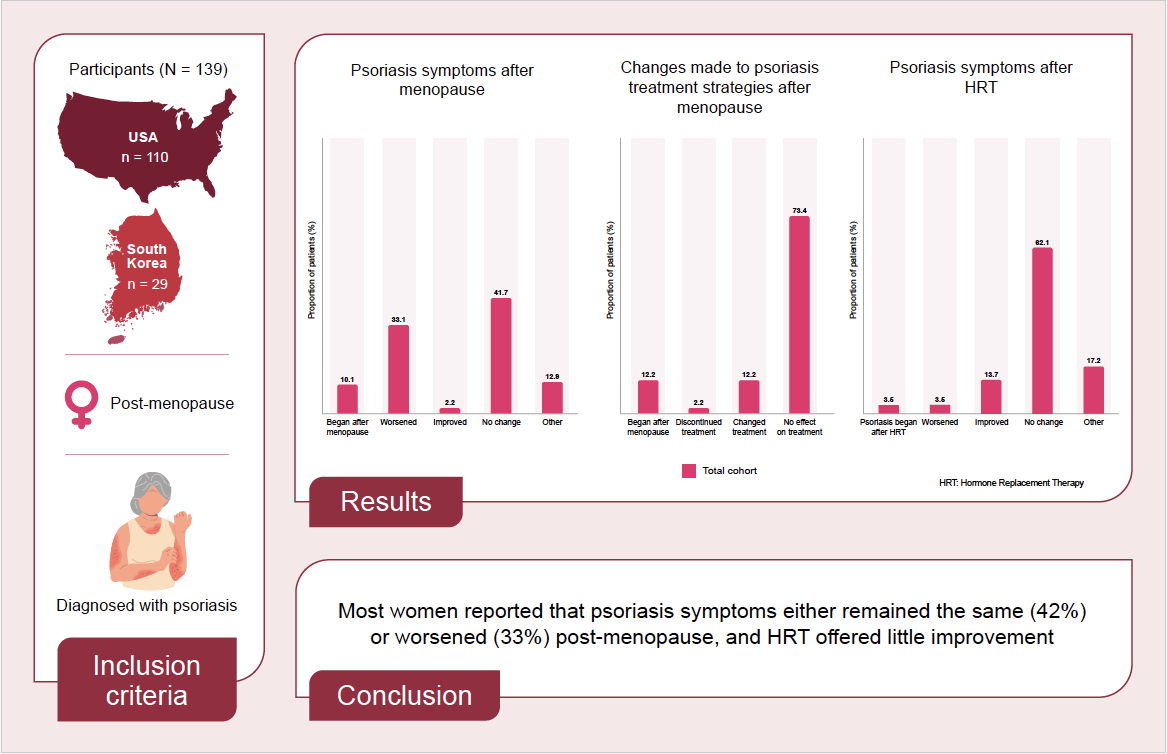
Menopause’s impact on psoriasis remains unclear. This study’s aim was to gather information on patient perception of the impact of menopause and hormone replacement therapy (HRT) on psoriasis. This survey-based study analysed 139 postmenopausal women with psoriasis from the USA and South Korea. In the combined cohort, most women reported menopause either had no effect on their psoriasis (41.7%) or worsened their psoriasis (33.1%). In the combined cohort, a majority of women (73.4%) reported that there was no change in their psoriasis treatment with menopause. Of the women receiving HRT (n = 29), the majority reported no effect on psoriasis (62.1%). In multivariate analysis, alcohol consumption was protective against worsening of psoriasis with menopause (OR 0.19 [95% CI 0.06–0.59], p = 0.004). In summary, this study showed that menopause is likely to have a neutral to negative effect on psoriasis. HRT was found to have no effect on the course of psoriasis in the majority of cases.
Downloads
References
Yan D, Blauvelt A, Dey AK, Golpanian RS, Hwang ST, Mehta NN, et al. New frontiers in psoriatic disease research, part II: comorbidities and targeted therapies. J Invest Dermatol 2021; 141: 2328–2337.
https://doi.org/10.1016/j.jid.2021.02.743 DOI: https://doi.org/10.1016/j.jid.2021.02.743
Gartlehner G, Patel SV, Reddy S, Rains C, Schwimmer M, Kahwati L. Hormone therapy for the primary prevention of chronic conditions in postmenopausal persons: updated evidence report and systematic review for the US Preventive Services Task Force. JAMA 2022; 328: 1747–1765.
https://doi.org/10.1001/jama.2022.18324 DOI: https://doi.org/10.1001/jama.2022.18324
Rossouw JE, Anderson GL, Prentice RL, LaCroix AZ, Kooperberg C, Stefanick ML, et al. Risks and benefits of estrogen plus progestin in healthy postmenopausal women: principal results from the Women’s Health Initiative randomized controlled trial. JAMA 2002; 288: 321–333.
https://doi.org/10.1001/jama.288.3.321 DOI: https://doi.org/10.1001/jama.288.3.321
Kamp E, Ashraf M, Musbahi E, DeGiovanni C. Menopause, skin and common dermatoses. Part 2: skin disorders. Clin Exp Dermatol 2022; 47: 2117–2122.
https://doi.org/10.1111/ced.15308 DOI: https://doi.org/10.1111/ced.15308
Murase JE, Wu JJ, Weinstein GD. Estrogen and the skin. J Am Acad Dermatol 2006; 55: 1115–1156.
https://doi.org/10.1016/j.jaad.2006.02.025 DOI: https://doi.org/10.1016/j.jaad.2006.02.025
Murase JE, Chan KK, Garite TJ, Cooper DM, Weinstein GD. Hormonal effect on psoriasis in pregnancy and postpartum. Arch Dermatol 2005; 141: 601–606.
https://doi.org/10.1001/archderm.141.5.601 DOI: https://doi.org/10.1001/archderm.141.5.601
Wu S, Cho E, Li W, Grodstein F, Qureshi AA. Hormonal factors and risk of psoriasis in women: a cohort study. Acta Derm Venereol 2016; 96: 927–931.
https://doi.org/10.2340/00015555-2312 DOI: https://doi.org/10.2340/00015555-2312
Chan AA, Noguti J, Yang CT, Feldman SR, Wallace RB, Shadyab AH, et al. Association between menopausal hormone therapy and incidence of psoriasis: a secondary analysis from the Women’s Health Initiative randomized clinical trials. Br J Dermatol 2021; 185: 669–671.
https://doi.org/10.1111/bjd.20410 DOI: https://doi.org/10.1111/bjd.20410
Go GM, Oh HJ, Han K, Kim YH, Lee HJ, Lee JH. Hormone replacement therapy and psoriasis risk: a nationwide population-based cohort study. J Korean Med Sci 2023; 38: e377.
https://doi.org/10.3346/jkms.2023.38.e377 DOI: https://doi.org/10.3346/jkms.2023.38.e377
Ferrandiz C, Pujol RM, Garcia-Patos V, Bordas X, Smandía JA. Psoriasis of early and late onset: a clinical and epidemiologic study from Spain. J Am Acad Dermatol 2002; 46: 867–873.
https://doi.org/10.1067/mjd.2002.120470 DOI: https://doi.org/10.1067/mjd.2002.120470
Altobelli E, Petrocelli R, Marziliano C, Fargnoli MC, Maccarone M, Chimenti S, et al. Family history of psoriasis and age at disease onset in Italian patients with psoriasis. Br J Dermatol 2007; 156: 1400–1401.
https://doi.org/10.1111/j.1365-2133.2007.07906.x DOI: https://doi.org/10.1111/j.1365-2133.2007.07906.x
Na SJ, Jo SJ, Youn JI. Clinical study on psoriasis patients for past 30 years (1982–2012) in Seoul National University Hospital Psoriasis Clinic. J Dermatol 2013; 40: 731–735.
https://doi.org/10.1111/1346-8138.12224 DOI: https://doi.org/10.1111/1346-8138.12224
Lew W, Lee E, Krueger JG. Psoriasis genomics: analysis of proinflammatory (type 1) gene expression in large plaque (Western) and small plaque (Asian) psoriasis vulgaris. Br J Dermatol 2004; 150: 668–676.
https://doi.org/10.1111/j.0007-0963.2004.05891.x DOI: https://doi.org/10.1111/j.0007-0963.2004.05891.x
Kim J, Oh CH, Jeon J Baek Y, Ahn J, Kim DJ, et al. Molecular phenotyping small (Asian) versus large (Western) plaque psoriasis shows common activation of IL-17 pathway genes but different regulatory gene sets. J Invest Dermatol 2016; 136: 161–172.
https://doi.org/10.1038/JID.2015.378 DOI: https://doi.org/10.1038/JID.2015.378
Naldi L. Epidemiology of psoriasis. Curr Drug Targets Inflamm Allergy 2004; 3: 121–128.
https://doi.org/10.2174/1568010043343958 DOI: https://doi.org/10.2174/1568010043343958
Monteleone P, Mascagni G, Giannini A, Genazzani AR, Simoncini T. Symptoms of menopause: global prevalence, physiology and implications. Nat Rev Endocrinol 2018; 14: 199–215.
https://doi.org/10.1038/nrendo.2017.180 DOI: https://doi.org/10.1038/nrendo.2017.180
Stanczyk FZ, Clarke NJ. Measurement of estradiol: challenges ahead. J Clin Endocrinol Metab 2014; 99: 56–58.
https://doi.org/10.1210/jc.2013-2905 DOI: https://doi.org/10.1210/jc.2013-2905
Mowad CM, Margolis DJ, Halpern AC, Suri B, Synnestvedt M, Guzzo CA. Hormonal influences on women with psoriasis. Cutis 1998; 61: 257–260.
Xiao Y, Yi Y, Jing D, Yang S, Guo Y, Xiao H, et al. Age at natural menopause, reproductive lifespan, and the risk of late-onset psoriasis and psoriatic arthritis in women: a prospective cohort study. J Invest Dermatol 2024; 144: 1273–1281.e5.
https://doi.org/10.1016/j.jid.2023.11.010 DOI: https://doi.org/10.1016/j.jid.2023.11.010
Gavaler JS, Van Thiel DH. The association between moderate alcoholic beverage consumption and serum estradiol and testosterone levels in normal postmenopausal women: relationship to the literature. Alcohol Clin Exp Res 1992; 16: 87–92.
https://doi.org/10.1111/j.1530-0277.1992.tb00642.x DOI: https://doi.org/10.1111/j.1530-0277.1992.tb00642.x
Kanda N, Watanabe S. 17beta-estradiol inhibits the production of RANTES in human keratinocytes. J Invest Dermatol 2003; 120: 420–427.
https://doi.org/10.1046/j.1523-1747.2003.12067.x DOI: https://doi.org/10.1046/j.1523-1747.2003.12067.x
Kanda N, Watanabe S. 17beta-estradiol inhibits the production of interferon-induced protein of 10 kDa by human keratinocytes. J Invest Dermatol 2003; 120: 411–419.
https://doi.org/10.1046/j.1523-1747.2003.12066.x DOI: https://doi.org/10.1046/j.1523-1747.2003.12066.x
Lelu K, Laffont S, Delpy L, Paulet P-E, Périnat T, Tschanz SA, et al. Estrogen receptor alpha signaling in T lymphocytes is required for estradiol-mediated inhibition of Th1 and Th17 cell differentiation and protection against experimental autoimmune encephalomyelitis. J Immunol 2011; 187: 2386–2393.
https://doi.org/10.4049/jimmunol.1101578 DOI: https://doi.org/10.4049/jimmunol.1101578
Adachi A, Honda T, Egawa G, Kanameishi S, Takimoto R, Miyake T, et al. Estradiol suppresses psoriatic inflammation in mice by regulating neutrophil and macrophage functions. J Allergy Clin Immunol 2022; 150: 909–919. e8.
https://doi.org/10.1016/j.jaci.2022.03.028 DOI: https://doi.org/10.1016/j.jaci.2022.03.028
Manson JE, Chlebowski RT, Stefanick ML, Aragaki AK, Rossouw JE, Prentice RL, et al. Menopausal hormone therapy and health outcomes during the intervention and extended poststopping phases of the Women’s Health Initiative randomized trials. JAMA 2013; 310: 1353–1368. DOI: https://doi.org/10.1001/jama.2013.278040
Additional Files
Published
How to Cite
License
Copyright (c) 2025 Bo Young Chung, Chandler Johnson, Jin Seo Park, Kathryn Haran , Payton Smith, Allison Kranyak , Tina Bhutani, Wilson Liao

This work is licensed under a Creative Commons Attribution-NonCommercial 4.0 International License.
All digitalized ActaDV contents is available freely online. The Society for Publication of Acta Dermato-Venereologica owns the copyright for all material published until volume 88 (2008) and as from volume 89 (2009) the journal has been published fully Open Access, meaning the authors retain copyright to their work.
Unless otherwise specified, all Open Access articles are published under CC-BY-NC licences, allowing third parties to copy and redistribute the material in any medium or format and to remix, transform, and build upon the material for non-commercial purposes, provided proper attribution to the original work.






