
Long-term Progressive Improvement of Atopic Dermatitis by an Herbal Emollient Plus Combination in a 12-week Clinical Trial
DOI:
https://doi.org/10.2340/actadv.v105.43026Keywords:
Atopic dermatitis, Basic emollient therapy, Clinical trial, Emollient plus, Herbal ingredients, PhytochemicalsAbstract
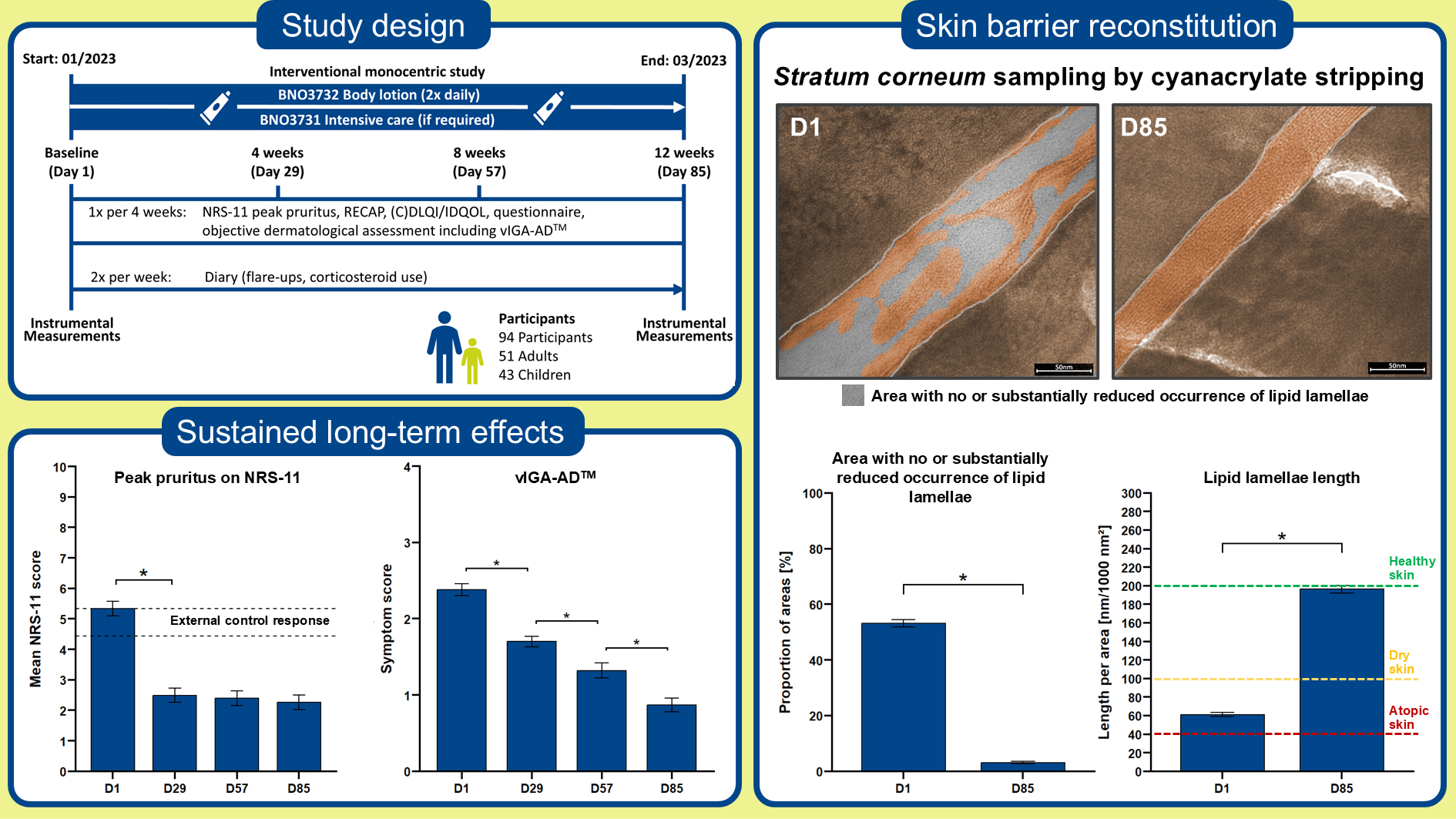
Atopic dermatitis is a chronic inflammatory skin disease characterized by flare-ups of inflamed, dry, and itchy skin affecting over 200 million people worldwide. “Emollients plus” containing active cosmetic ingredients such as herbal extracts and phytochemicals have the potential to surpass the efficacy of conventional emollients, while avoiding side effects associated with pharmacological interventions. The reported 12-week clinical trial (NCT05790083) evaluated long-term efficacy and tolerability of oil-in-water emulsions BNO 3731 and BNO 3732 containing ginger extract and cannabidiol as basic emollient therapy for atopic dermatitis. A total of 100 adults and children with a history of atopic dermatitis were included and applied BNO 3732 (body lotion) twice daily and BNO 3731 (intensive care product) as needed. Over 12 weeks the emollients plus combination led to sustained improvement of peak pruritus and patient-reported outcome measures, i.e., “Recap of atopic eczema”. Objective dermatological evaluation showed progressive improvements for vIGA-ADTM and isolated symptoms, i.e., erythema and dryness. Instrumental analysis of intercellular lipid contents and lipid lamellae organization in the stratum corneum demonstrated recovery of the epidermal barrier integrity. The clinical results provide evidence on the efficacy of herbal emollients plus beyond mere moisturizing and occlusive properties. BNO 3731 and BNO 3732 were very well tolerated.
Downloads
References
Tian J, Zhang D, Yang Y, Huang Y, Wang L, Yao X, et al. Global epidemiology of atopic dermatitis: a comprehensive systematic analysis and modelling study. Br J Dermatol 2024; 190: 55–61.
https://doi.org/10.1093/bjd/ljad339 DOI: https://doi.org/10.1093/bjd/ljad339
Saeki H, Ohya Y, Furuta J, Arakawa H, Ichiyama S, Katsunuma T, et al. English version of Clinical Practice Guidelines for the Management of Atopic Dermatitis 2021. J Dermatol 2022; 49: e315–e375.
https://doi.org/10.1111/1346-8138.16527 DOI: https://doi.org/10.1111/1346-8138.16527
Silverberg JI, Mohawk JA, Cirulli J, Nograles K, Punzalan JC, Kelly KM, et al. Burden of disease and unmet needs in atopic dermatitis: results from a patient survey. Dermatitis 2023; 34: 135–144.
https://doi.org/10.1089/derm.2022.29015.jsi DOI: https://doi.org/10.1089/derm.2022.29015.jsi
Yosipovitch G, Misery L, Proksch E, Metz M, Ständer S, Schmelz M. Skin barrier damage and itch: review of mechanisms, topical management and future directions. Acta Derm Venereol 2019; 99: 1201–1209.
https://doi.org/10.2340/00015555-3296 DOI: https://doi.org/10.2340/00015555-3296
Fölster-Holst R, Reimer R, Neumann C, Proksch E, Rodriguez E, Weidinger S, et al. Comparison of epidermal barrier integrity in adults with classic atopic dermatitis, atopic prurigo and non-atopic prurigo nodularis. Biology 2021; 10: 1008.
https://doi.org/10.3390/biology10101008 DOI: https://doi.org/10.3390/biology10101008
Fujii M. The pathogenic and therapeutic implications of ceramide abnormalities in atopic dermatitis. Cells 2021; 10: 2386.
https://doi.org/10.3390/cells10092386 DOI: https://doi.org/10.3390/cells10092386
Daehnhardt-Pfeiffer S, Surber C, Wilhelm KP, Daehnhardt D, Springmann G, Boettcher M, et al. Noninvasive stratum corneum sampling and electron microscopical examination of skin barrier integrity: pilot study with a topical glycerin formulation for atopic dermatitis. Skin Pharmacol Physiol 2012; 25: 155–161.
https://doi.org/10.1159/000336789 DOI: https://doi.org/10.1159/000336789
Dähnhardt D, Surber C, Dähnhardt-Pfeiffer S. Influence of topical formulations: lipid lamella organization and lipid composition of stratum corneum as a surrogate marker for barrier integrity. pH of the skin: issues and challenges. Basel: Karger AG, 2018: p. 166–172. DOI: https://doi.org/10.1159/000489530
Blaak J, Dähnhardt D, Bielfeldt S, Theiss C, Simon I, Wilhelm K-P, et al. Improvement of human epidermal barrier structure and lipid profile in xerotic- and atopic-prone skin via application of a plant-oil and urea containing pH 4.5 emulsion. Cosmetics 2023; 10: 95.
https://doi.org/10.3390/cosmetics10040095 DOI: https://doi.org/10.3390/cosmetics10040095
Oláh A, Szabó-Papp J, Soeberdt M, Knie U, Dähnhardt-Pfeiffer S, Abels C, et al. Echinacea purpurea-derived alkylamides exhibit potent anti-inflammatory effects and alleviate clinical symptoms of atopic eczema. J Dermatol Sci 2017; 88: 67–77.
https://doi.org/10.1016/j.jdermsci.2017.05.015 DOI: https://doi.org/10.1016/j.jdermsci.2017.05.015
Hirao T, Terui T, Takeuchi I, Kobayashi H, Okada M, Takahashi M, et al. Ratio of immature cornified envelopes does not correlate with parakeratosis in inflammatory skin disorders. Exp Dermatol 2003; 12: 591–601.
https://doi.org/10.1034/j.1600-0625.2003.00007.x DOI: https://doi.org/10.1034/j.1600-0625.2003.00007.x
Araviiskaia E, Pincelli C, Sparavigna A, Luger T. The role of a novel generation of emollients, ‘emollients plus’, in atopic dermatitis. Clin Cosmet Investig Dermatol 2022; 15: 2705–2719.
https://doi.org/10.2147/CCID.S389697 DOI: https://doi.org/10.2147/CCID.S389697
Wollenberg A, Kinberger M, Arents B, Aszodi N, Avila Valle G, Barbarot S, et al. European guideline (EuroGuiDerm) on atopic eczema – part II: non-systemic treatments and treatment recommendations for special AE patient populations. J Eur Acad Dermatol Venereol 2022; 36: 1904–1926.
https://doi.org/10.1111/jdv.18429 DOI: https://doi.org/10.1111/jdv.18429
European Federation of Allergy and Airways Diseases Patients’ Associations. The burden of atopic eczema. European consensus report 2022. 2022 [last accessed 24 September 2024]. Available from: https://www.efanet.org/inform/patient-evidence/atopic-eczema-consensus-europe/report
Arora P, Shiveena B, Garg M, Kumari S, Goyal A. Curative potency of medicinal plants in management of eczema: a conservative approach. Phytomedicine Plus 2022; 2: 100256.
https://doi.org/10.1016/j.phyplu.2022.100256 DOI: https://doi.org/10.1016/j.phyplu.2022.100256
Angelova-Fischer I, Rippke F, Richter D, Filbry A, Arrowitz C, Weber T, et al. Stand-alone emollient treatment reduces flares after discontinuation of topical steroid treatment in atopic dermatitis: a double-blind, randomized, vehicle-controlled, left–right comparison study. Acta Derm Venereol 2018; 98: 517–523.
https://doi.org/10.2340/00015555-2882 DOI: https://doi.org/10.2340/00015555-2882
Neubauer C, Kragl M, Braun T, Filipek P, Rad EB, Grander J, et al. An oil-in-water emulsion containing a combination of ginger extract and synthetic cannabidiol with potent in vitro anti-inflammatory effects ameliorates symptoms of atopic dermatitis in a clinical trial. Eur J Dermatol 2024; 34: 416–424.
https://doi.org/10.1684/ejd.2024.4738 DOI: https://doi.org/10.1684/ejd.2024.4738
Blicharz L, Rudnicka L, Czuwara J, Waśkiel-Burnat A, Goldust M, Olszewska M, et al. The influence of microbiome dysbiosis and bacterial biofilms on epidermal barrier function in atopic dermatitis: an update. Int J Mol Sci 2021; 22: 8403.
https://doi.org/10.3390/ijms22168403 DOI: https://doi.org/10.3390/ijms22168403
Andreev S, Neubauer C, Mähler N, Moritz K, Ziegler R, Apfelbacher C, et al. 50th Annual Meeting of the Arbeitsgemeinschaft Dermatologische Forschung (ADF): Therapeutic effects and impact of individual skin care regimes as basic therapy in the management of atopic dermatitis: a remote prospective observational study in adults and children suffering from AD. Exp Dermatol 2024; 33: e14994, P14059.
https://doi.org/10.1111/exd.14994 DOI: https://doi.org/10.1111/exd.14994
Howells LM, Chalmers JR, Gran S, Ahmed A, Apfelbacher C, Burton T, et al. Development and initial testing of a new instrument to measure the experience of eczema control in adults and children: recap of atopic eczema (RECAP). Br J Dermatol 2020; 183: 524–536.
https://doi.org/10.1111/bjd.18780 DOI: https://doi.org/10.1111/bjd.18780
Basra MKA, Fenech R, Gatt RM, Salek MS, Finlay AY. The Dermatology Life Quality Index 1994–2007: a comprehensive review of validation data and clinical results. Br J Dermatol 2008; 159: 997–1035.
https://doi.org/10.1111/j.1365-2133.2008.08832.x DOI: https://doi.org/10.1111/j.1365-2133.2008.08832.x
Lewis-Jones MS, Finlay AY. The Children’s Dermatology Life Quality Index (CDLQI): initial validation and practical use. Br J Dermatol 1995; 132: 942–949.
https://doi.org/10.1111/j.1365-2133.1995.tb16953.x DOI: https://doi.org/10.1111/j.1365-2133.1995.tb16953.x
Lewis-Jones MS, Finlay AY, Dykes PJ. The Infants’ Dermatitis Quality of Life Index. Br J Dermatol 2001; 144: 104–110.
https://doi.org/10.1046/j.1365-2133.2001.03960.x DOI: https://doi.org/10.1046/j.1365-2133.2001.03960.x
Yosipovitch G, Reaney M, Mastey V, Eckert L, Abbé A, Nelson L, et al. Peak Pruritus Numerical Rating Scale: psychometric validation and responder definition for assessing itch in moderate-to-severe atopic dermatitis. Br J Dermatol 2019; 181: 761–769.
https://doi.org/10.1111/bjd.17744 DOI: https://doi.org/10.1111/bjd.17744
Thomas KS, Apfelbacher CA, Chalmers JR, Simpson E, Spuls PI, Gerbens LAA, et al. Recommended core outcome instruments for health-related quality of life, long-term control and itch intensity in atopic eczema trials: results of the HOME VII consensus meeting. Br J Dermatol 2021; 185: 139–146.
https://doi.org/10.1111/bjd.19751 DOI: https://doi.org/10.1111/bjd.19751
Simpson EL, Bissonnette R, Paller AS, King B, Silverberg JI, Reich K, et al. The Validated Investigator Global Assessment for Atopic Dermatitis (vIGA-AD™): a clinical outcome measure for the severity of atopic dermatitis. Br J Dermatol 2022; 187: 531–538.
https://doi.org/10.1111/bjd.21615 DOI: https://doi.org/10.1111/bjd.21615
Hirao T, Denda M, Takahashi M. Identification of immature cornified envelopes in the barrier-impaired epidermis by characterization of their hydrophobicity and antigenicities of the components. Exp Dermatol 2001; 10: 35–44.
https://doi.org/10.1034/j.1600-0625.2001.100105.x DOI: https://doi.org/10.1034/j.1600-0625.2001.100105.x
R Core Team (2022). R: A language and environment for statistical computing. R Foundation for Statistical Computing, Vienna, Austria. URL https://www.R-project.org/.
Bhanot A, Peters TJ, Ridd MJ. Assessing the validity, responsiveness and reliability of the Recap measure of eczema control. Br J Dermatol 2021; 184: 955–957.
https://doi.org/10.1111/bjd.19709 DOI: https://doi.org/10.1111/bjd.19709
Zhang J, Ragamin A, Romeijn GLE, Loman L, Oosterhaven JAF, Schuttelaar MLA. Validity, reliability, responsiveness and interpretability of the Recap of atopic eczema (RECAP) questionnaire. Br J Dermatol 2023; 189: 578–587.
https://doi.org/10.1093/bjd/ljad247 DOI: https://doi.org/10.1093/bjd/ljad247
Hongbo Y, Thomas CL, Harrison MA, Sam Salek M, Finlay AY. Translating the science of quality of life into practice: what do dermatology life quality index scores mean? J Invest Dermatol 2005; 125: 659–664.
https://doi.org/10.1111/j.0022-202X.2005.23621.x DOI: https://doi.org/10.1111/j.0022-202X.2005.23621.x
Waters A, Sandhu D, Beattie P, Ezughah F, Lewis-Jones S. PA-8: Severity stratification of Children’s Dermatology Life Quality Index (CDLQI) scores. Br J Dermatol 2010; 163: 118–130.
https://doi.org/10.1111/j.1365-2133.2010.09733.x DOI: https://doi.org/10.1111/j.1365-2133.2010.09733.x
Kottner J, Lichterfeld A, Blume-Peytavi U. Transepidermal water loss in young and aged healthy humans: a systematic review and meta-analysis. Arch Dermatol Res 2013; 305: 315–323.
https://doi.org/10.1007/s00403-012-1313-6 DOI: https://doi.org/10.1007/s00403-012-1313-6
Akdeniz M, Gabriel S, Lichterfeld-Kottner A, Blume-Peytavi U, Kottner J. Transepidermal water loss in healthy adults: a systematic review and meta-analysis update. Br J Dermatol 2018; 179: 1049–1055.
https://doi.org/10.1111/bjd.17025 DOI: https://doi.org/10.1111/bjd.17025
Boer M, Duchnik E, Maleszka R, Marchlewicz M. Structural and biophysical characteristics of human skin in maintaining proper epidermal barrier function. Adv Dermatol Allergol 2016; 1: 1–5.
https://doi.org/10.5114/pdia.2015.48037 DOI: https://doi.org/10.5114/pdia.2015.48037
Quadri M, Lotti R, Bonzano L, Ciardo S, Guanti MB, Pellacani G, et al. A novel multi-action emollient plus cream improves skin barrier function in patients with atopic dermatitis: in vitro and clinical evidence. Skin Pharmacol Physiol 2021; 34: 8–18.
https://doi.org/10.1159/000513055 DOI: https://doi.org/10.1159/000513055
Magnolo N, Jaenicke T, Tsianakas A, Czech W, Thaçi D, Pinter A, et al. Comparison of different skin care regimens in patients with moderate to severe atopic dermatitis receiving systemic treatment: a randomized controlled trial. J Eur Acad Dermatol Venereol 2023; 37: 18–26.
https://doi.org/10.1111/jdv.18949 DOI: https://doi.org/10.1111/jdv.18949
Bouwstra JA, Nădăban A, Bras W, McAbe C, Bunge A, Gooris GS. The skin barrier: an extraordinary interface with an exceptional lipid organization. Prog Lipid Res 2023; 92: 101252.
https://doi.org/10.1016/j.plipres.2023.101252 DOI: https://doi.org/10.1016/j.plipres.2023.101252
Murphy B, Grimshaw S, Hoptroff M, Paterson S, Arnold D, Cawley A, et al. Alteration of barrier properties, stratum corneum ceramides and microbiome composition in response to lotion application on cosmetic dry skin. Sci Rep 2022; 12: 5223.
https://doi.org/10.1038/s41598-022-09231-8 DOI: https://doi.org/10.1038/s41598-022-09231-8
Tier HL, Balogh EA, Bashyam AM, Fleischer AB, Spergel JM, Masicampo EJ, et al. Tolerability of and adherence to topical treatments in atopic dermatitis: a narrative review. Dermatol Ther 2021; 11: 415–431.
https://doi.org/10.1007/s13555-021-00500-4 DOI: https://doi.org/10.1007/s13555-021-00500-4
Maleki-Yazdi KA, Heen AF, Zhao IX, Guyatt GH, Suzumura EA, Makhdami N, et al. Values and preferences of patients and caregivers regarding treatment of atopic dermatitis (eczema): a systematic review. JAMA Dermatology 2023; 159: 320–330.
https://doi.org/10.1001/jamadermatol.2022.6045 DOI: https://doi.org/10.1001/jamadermatol.2022.6045
Additional Files
Published
How to Cite
License
Copyright (c) 2025 Lars Herrmann, Stanislav Andreev, Ramona Ziegler, Christine Neubauer, Kathrin Moritz, Nicole Maehler, Hubert Steindl, Stephan Daehnhardt-Pfeiffer, Christoph Abels

This work is licensed under a Creative Commons Attribution-NonCommercial 4.0 International License.
All digitalized ActaDV contents is available freely online. The Society for Publication of Acta Dermato-Venereologica owns the copyright for all material published until volume 88 (2008) and as from volume 89 (2009) the journal has been published fully Open Access, meaning the authors retain copyright to their work.
Unless otherwise specified, all Open Access articles are published under CC-BY-NC licences, allowing third parties to copy and redistribute the material in any medium or format and to remix, transform, and build upon the material for non-commercial purposes, provided proper attribution to the original work.






