
Risk of Death, Infections, and Hyperthermia in Ectodermal Dysplasias: A Nationwide Study
DOI:
https://doi.org/10.2340/actadv.v105.43101Keywords:
ectodermal dysplasia, epidemiology, hyperthermia, infectious disease, mortality, prognosisAbstract
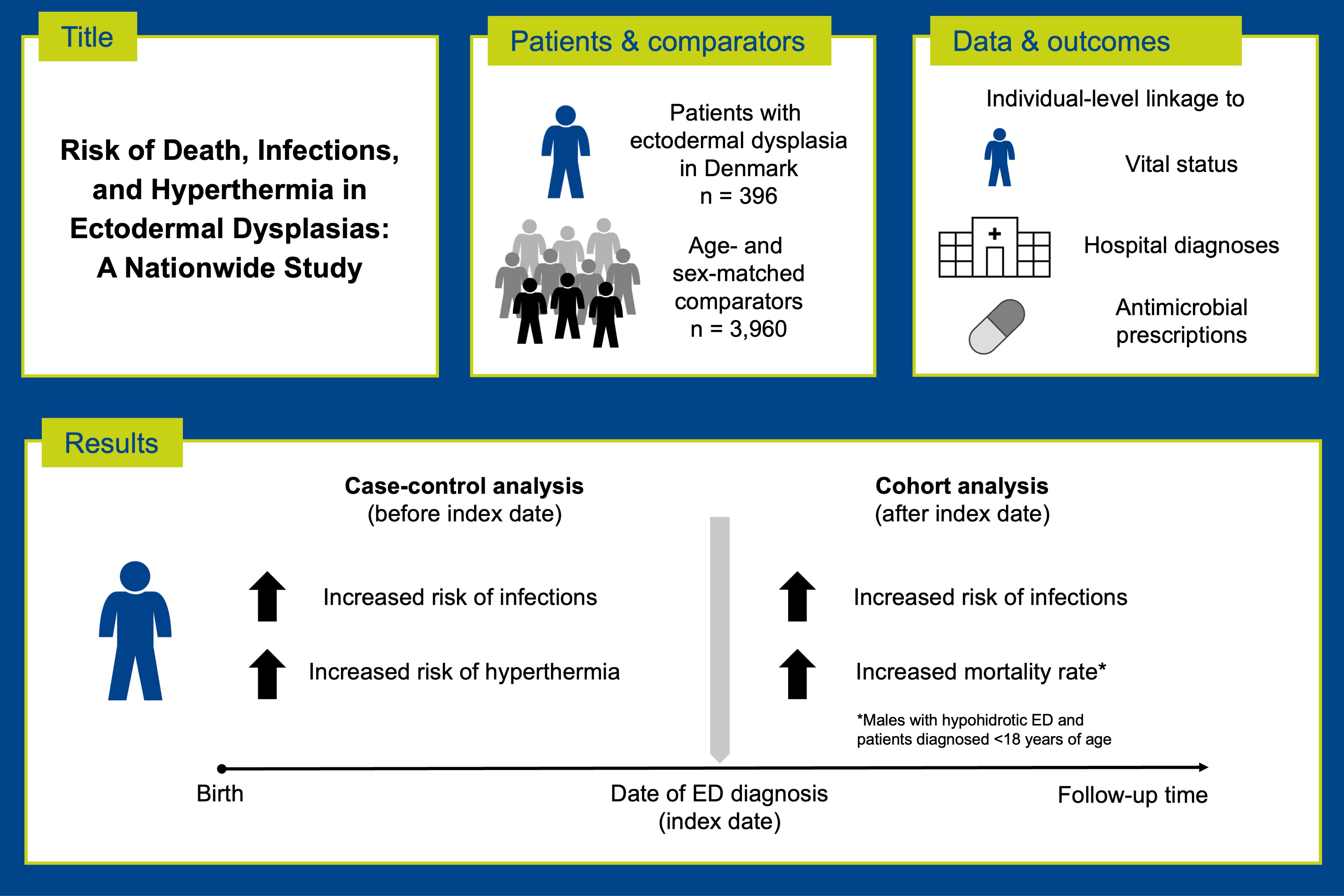
This nationwide population-based study investigated the risk of death, infections, and hyperthermia in Danish patients with ectodermal dysplasia (ED). A validated cohort of ED patients (n = 396) and matched population comparators (n = 3960) was compared to assess these risks before (case-control analysis) and after ED diagnosis (cohort analysis). Using matched comparators as a reference, the overall hazard ratio (HR) for death was 1.33 (95% confidence interval [CI] 0.70–2.55) in ED patients, and particularly high in males with hypohidrosis (HR 3.77, 95% CI 1.57–9.03) and individuals diagnosed before age 18 (HR 6.53, 95% CI 1.84–23.13). ED was associated with an increased risk of hospital-diagnosed infections before (odds ratio [OR] 2.27, 95% CI 1.81–2.85) and after (HR 2.06, 95% CI 1.74–2.45) diagnosis, varying across subtypes. Sensitivity analyses supported these findings, e.g., using antimicrobial prescriptions to identify infections. An association between hypohidrosis and previous hyperthermia (OR 7.11, 95% CI 3.26–15.51) diminished after diagnosis (HR 1.38, 95% CI 0.54–3.53). This study found an increased mortality risk in males with hypohidrosis and those diagnosed in childhood, and infection and hyperthermia risks depending on ED subtype. These data enhance understanding of ED’s clinical course, informing patient management and counselling.
Downloads
References
Wright JT, Fete M, Schneider H, Zinser M, Koster MI, Clarke AJ, et al. Ectodermal dysplasias: classification and organization by phenotype, genotype and molecular pathway. Am J Med Genet A 2019; 179: 442–447.
https://doi.org/10.1002/ajmg.a.61045 DOI: https://doi.org/10.1002/ajmg.a.61045
Biggs LC, Mikkola ML. Early inductive events in ectodermal appendage morphogenesis. Semin Cell Dev Biol 2014; 25–26: 11–21.
https://doi.org/10.1016/j.semcdb.2014.01.007 DOI: https://doi.org/10.1016/j.semcdb.2014.01.007
Freire-Maia N. Ectodermal dysplasias. Hum Hered 1971; 21: 309–312.
https://doi.org/10.1159/000152419 DOI: https://doi.org/10.1159/000152419
Fete TJ, Grange DK. Ectodermal dysplasias. In: UpToDate, Connor RF (Ed), Wolters Kluwer. [Accessed on May 5, 2023]
Fete M, Hermann J, Behrens J, Huttner KM. X-linked hypohidrotic ectodermal dysplasia (XLHED): clinical and diagnostic insights from an international patient registry. Am J Med Genet A 2014; 164a: 2437–2442.
https://doi.org/10.1002/ajmg.a.36436 DOI: https://doi.org/10.1002/ajmg.a.36436
Wohlfart S, Meiller R, Hammersen J, Park J, Menzel-Severing J, Melichar VO, et al. Natural history of X-linked hypohidrotic ectodermal dysplasia: a 5-year follow-up study. Orphanet J Rare Dis 2020; 15: 7.
https://doi.org/10.1186/s13023-019-1288-x DOI: https://doi.org/10.1186/s13023-019-1288-x
Herlin LK, Schmidt SAJ, Hermann XB, Rønholt K, Bygum A, Schuster A, et al. Prevalence and patient characteristics of ectodermal dysplasias in Denmark. JAMA Dermatol 2024; 160: 502–510.
https://doi.org/10.1001/jamadermatol.2024.0036 DOI: https://doi.org/10.1001/jamadermatol.2024.0036
Peschel N, Wright JT, Koster MI, Clarke AJ, Tadini G, Fete M, et al. Molecular pathway-based classification of ectodermal dysplasias: first five-yearly update. Genes (Basel) 2022; 13: 2327.
https://doi.org/10.3390/genes13122327 DOI: https://doi.org/10.3390/genes13122327
Fete T. Respiratory problems in patients with ectodermal dysplasia syndromes. Am J Med Genet A 2014; 164a: 2478–2481.
https://doi.org/10.1002/ajmg.a.36600 DOI: https://doi.org/10.1002/ajmg.a.36600
Yang R, Mei Y, Jiang Y, Li H, Zhao R, Sima J, et al. Ectodysplasin A (EDA) signaling: from skin appendage to multiple diseases. Int J Mol Sci 2022; 23: 8911.
https://doi.org/10.3390/ijms23168911 DOI: https://doi.org/10.3390/ijms23168911
D’Assante R, Fusco A, Palamaro L, Giardino G, Gallo V, Cirillo E, et al. Unraveling the link between ectodermal disorders and primary immunodeficiencies. Int Rev Immunol 2016; 35: 25–38.
Mark BJ, Becker BA, Halloran DR, Bree AF, Sindwani R, Fete MD, et al. Prevalence of atopic disorders and immunodeficiency in patients with ectodermal dysplasia syndromes. Ann Allergy Asthma Immunol 2012; 108: 435–438.
https://doi.org/10.1016/j.anai.2012.04.010 DOI: https://doi.org/10.1016/j.anai.2012.04.010
Jørgensen SE, Bøttger P, Kofod-Olsen E, Holm M, Mørk N, Ørntoft TF, et al. Ectodermal dysplasia with immunodeficiency caused by a branch-point mutation in IKBKG/NEMO. J Allergy Clin Immunol 2016; 138: 1706–1709.e1704.
https://doi.org/10.1016/j.jaci.2016.05.030 DOI: https://doi.org/10.1016/j.jaci.2016.05.030
Herlin LK, Sørensen SB, Graakjaer JA, Andersen S, Schmidt SAJ, Sommerlund M, et al. NF-κB activation and X-inactivation in females with incontinentia pigmenti and recurrent infections. J Clin Immunol 2024; 44: 136.
https://doi.org/10.1007/s10875-024-01737-2 DOI: https://doi.org/10.1007/s10875-024-01737-2
Mills R, Montague ML, Naysmith L. Ear, nose and throat manifestations of ectodermal dysplasia. J Laryngol Otol 2004; 118: 406–408.
https://doi.org/10.1258/002221504323219482 DOI: https://doi.org/10.1258/002221504323219482
Blüschke G, Nüsken KD, Schneider H. Prevalence and prevention of severe complications of hypohidrotic ectodermal dysplasia in infancy. Early Hum Dev 2010; 86: 397–399.
https://doi.org/10.1016/j.earlhumdev.2010.04.008 DOI: https://doi.org/10.1016/j.earlhumdev.2010.04.008
Motil KJ, Fete M, Fete TJ. Growth, nutritional, and gastrointestinal aspects of focal dermal hypoplasia (Goltz-Gorlin syndrome). Am J Med Genet C Semin Med Genet 2016; 172c: 29–33.
https://doi.org/10.1002/ajmg.c.31468 DOI: https://doi.org/10.1002/ajmg.c.31468
Clarke A, Phillips DI, Brown R, Harper PS. Clinical aspects of X-linked hypohidrotic ectodermal dysplasia. Arch Dis Child 1987; 62: 989–996.
https://doi.org/10.1136/adc.62.10.989 DOI: https://doi.org/10.1136/adc.62.10.989
Salisbury DM, Stothers JK. Hypohidrotic ectodermal dysplasia and sudden infant death. Lancet 1981; 1: 153–154.
https://doi.org/10.1016/S0140-6736(81)90736-4 DOI: https://doi.org/10.1016/S0140-6736(81)90736-4
Frank L. Epidemiology. When an entire country is a cohort. Science 2000; 287: 2398–2399.
https://doi.org/10.1126/science.287.5462.2398 DOI: https://doi.org/10.1126/science.287.5462.2398
Schmidt M, Schmidt SAJ, Adelborg K, Sundbøll J, Laugesen K, Ehrenstein V, et al. The Danish health care system and epidemiological research: from health care contacts to database records. Clin Epidemiol 2019; 11: 563–591.
https://doi.org/10.2147/CLEP.S179083 DOI: https://doi.org/10.2147/CLEP.S179083
Schmidt M, Pedersen L, Sørensen HT. The Danish Civil Registration System as a tool in epidemiology. Eur J Epidemiol 2014; 29: 541–549.
https://doi.org/10.1007/s10654-014-9930-3 DOI: https://doi.org/10.1007/s10654-014-9930-3
Helweg-Larsen K. The Danish Register of Causes of Death. Scand J Public Health 2011; 39: 26–29.
https://doi.org/10.1177/1403494811399958 DOI: https://doi.org/10.1177/1403494811399958
Schmidt M, Schmidt SA, Sandegaard JL, Ehrenstein V, Pedersen L, Sørensen HT. The Danish National Patient Registry: a review of content, data quality, and research potential. Clin Epidemiol 2015; 7: 449–490.
https://doi.org/10.2147/CLEP.S91125 DOI: https://doi.org/10.2147/CLEP.S91125
Pedersen MK, Eriksson R, Reguant R, Collin C, Pedersen HK, Sørup FKH, et al. A unidirectional mapping of ICD-8 to ICD-10 codes, for harmonized longitudinal analysis of diseases. Eur J Epidemiol 2023; 38: 1043–1052.
https://doi.org/10.1007/s10654-023-01027-y DOI: https://doi.org/10.1007/s10654-023-01027-y
Pottegård A, Schmidt SAJ, Wallach-Kildemoes H, Sørensen HT, Hallas J, Schmidt M. Data resource profile: the Danish National Prescription Registry. Int J Epidemiol 2017; 46: 798–798f.
https://doi.org/10.1093/ije/dyw213 DOI: https://doi.org/10.1093/ije/dyw213
Jensen VM, Rasmussen AW. Danish education registers. Scand J Public Health 2011; 39: 91–94.
https://doi.org/10.1177/1403494810394715 DOI: https://doi.org/10.1177/1403494810394715
Andersen PK, Gill RD. Cox’s regression model for counting processes: a large sample study. Ann Stat 1982; 10: 1100–1120, 1121.
https://doi.org/10.1214/aos/1176345976 DOI: https://doi.org/10.1214/aos/1176345976
Fusco F, Paciolla M, Conte MI, Pescatore A, Esposito E, Mirabelli P, et al. Incontinentia pigmenti: report on data from 2000 to 2013. Orphanet J Rare Dis 2014; 9: 93.
https://doi.org/10.1186/1750-1172-9-93 DOI: https://doi.org/10.1186/1750-1172-9-93
Herlin LK, Schmidt SAJ, Mogensen TH, Sommerlund M. Prevalence and clinical characteristics of incontinentia pigmenti: a nationwide population-based study. Orphanet J Rare Dis 2024; 19: 454.
https://doi.org/10.1186/s13023-024-03480-8 DOI: https://doi.org/10.1186/s13023-024-03480-8
Ohnishi H, Kishimoto Y, Taguchi T, Kawamoto N, Nakama M, Kawai T, et al. Immunodeficiency in two female patients with incontinentia pigmenti with heterozygous NEMO mutation diagnosed by LPS unresponsiveness. J Clin Immunol 2017; 37: 529–538.
https://doi.org/10.1007/s10875-017-0417-3 DOI: https://doi.org/10.1007/s10875-017-0417-3
Rosain J, Le Voyer T, Liu X, Gervais A, Polivka L, Cederholm A, et al. Incontinentia pigmenti underlies thymic dysplasia, autoantibodies to type I IFNs, and viral diseases. J Exp Med 2024; 221: e20231152.
Additional Files
Published
How to Cite
Issue
Section
Categories
License
Copyright (c) 2025 Laura Krogh Herlin, Sigrún A.J. Schmidt, Trine H. Mogensen, Mette Sommerlund

This work is licensed under a Creative Commons Attribution-NonCommercial 4.0 International License.
All digitalized ActaDV contents is available freely online. The Society for Publication of Acta Dermato-Venereologica owns the copyright for all material published until volume 88 (2008) and as from volume 89 (2009) the journal has been published fully Open Access, meaning the authors retain copyright to their work.
Unless otherwise specified, all Open Access articles are published under CC-BY-NC licences, allowing third parties to copy and redistribute the material in any medium or format and to remix, transform, and build upon the material for non-commercial purposes, provided proper attribution to the original work.






