
Characterization of Contact Urticaria Syndrome Phenotypes: A Retrospective Study of 95 Cases
DOI:
https://doi.org/10.2340/actadv.v105.43837Keywords:
contact urticaria, protein contact dermatitis, immediate skin reaction, immediate allergy, prick test, occupationalAbstract
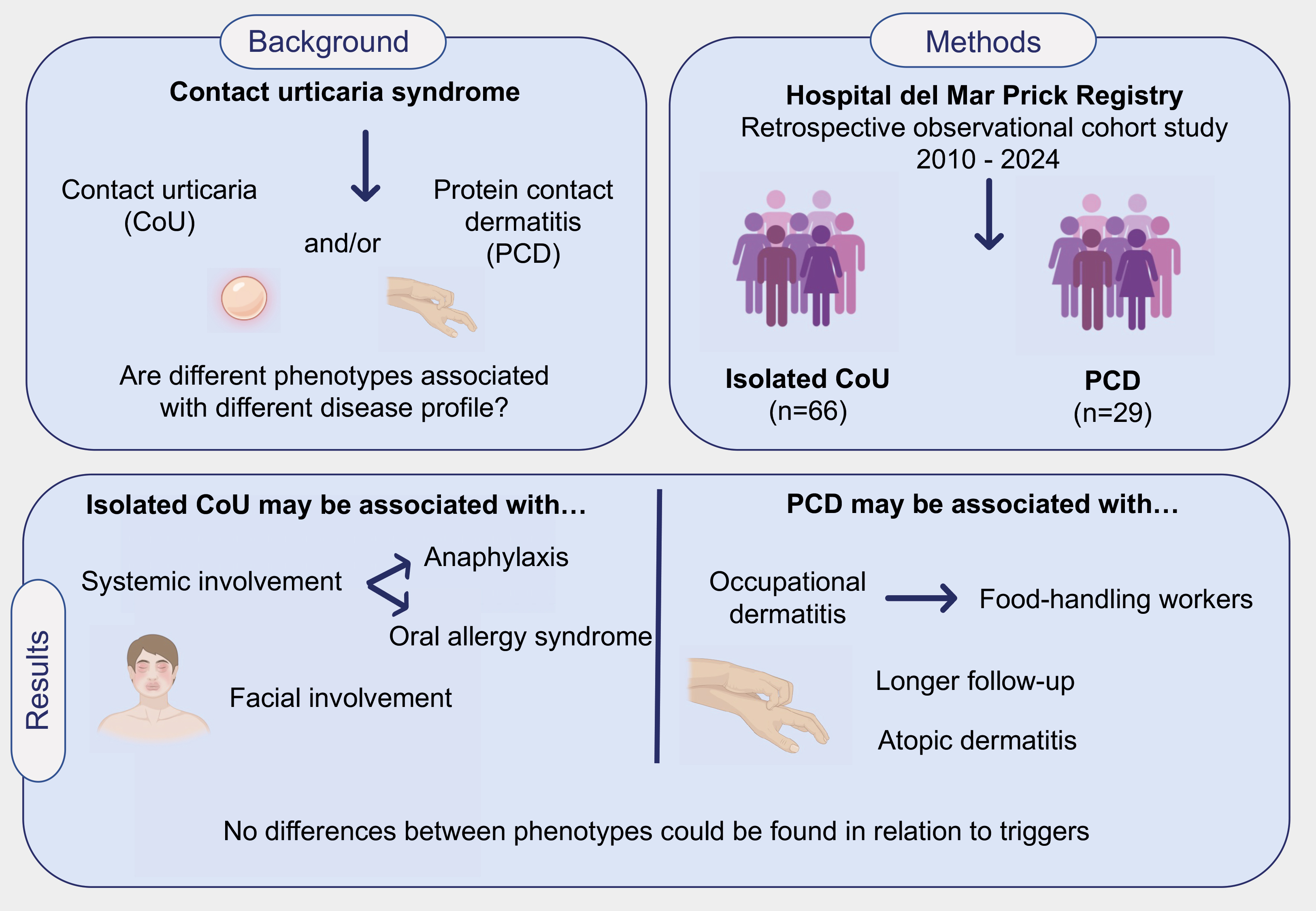
Contact urticaria syndrome, encompassing immunological contact urticaria and protein contact dermatitis, comprises immediate cutaneous reactions with potential systemic manifestations, including anaphylaxis. These conditions are frequently underdiagnosed despite their significant occupational impact. This study aimed to evaluate the clinical and laboratory features associated with distinct phenotypes of contact urticaria syndrome. A retrospective, observational analysis was performed at Hospital del Mar (Barcelona) from January 2010 to January 2024, including adult patients diagnosed with immunological contact urticaria and/or protein contact dermatitis and a positive prick test. Demographic data, clinical data, and complementary test results, including culprit agents, were compared between patients with isolated contact urticaria and those with protein contact dermatitis. A total of 95 patients were included. Results indicated that isolated contact urticaria was more frequently associated with facial involvement (n = 19, 28.8%) and a higher rate of systemic reactions (n = 18, 27.3%), including anaphylaxis, whereas protein contact dermatitis was frequently occupational-related (n = 19, 65.5%), and with a trend toward higher atopic dermatitis comorbidity (n = 12, 41.4%). These findings emphasize the heterogeneity of contact urticaria syndrome and underscore the importance of comprehensive clinical evaluation for effective diagnosis and management.
Downloads
References
Giménez-Arnau AM, Pesqué D, Maibach HI. Contact urticaria syndrome: a comprehensive review. Curr Derm Rep 2022; 11: 194–201. DOI: https://doi.org/10.1007/s13671-022-00379-0
Grattan CE, Mahler V. Immediate contact reactions: pathomechanisms and clinical presentation. In: Johansen JD, Mahler V, Lepoittevin J-P, Frosch PJ, editors. Contact dermatitis. Cham: Springer International Publishing, 2020; p. 1–16. DOI: https://doi.org/10.1007/978-3-319-72451-5_60-1
Bizjak M, Aerts O, Pesqué D, Muñoz M, Asero R, Gonçalo M, et al. Contact urticaria and related conditions: clinical review. Contact Dermatitis 2025; 93: 87-107. DOI: https://doi.org/10.1111/cod.14794
Gimenez-Arnau AM, Maibach H. Contact urticaria. Immunol Allergy Clin North Am 2021; 41: 467–480. DOI: https://doi.org/10.1016/j.iac.2021.04.007
Barbaud A, Poreaux C, Penven E, Waton J. Occupational protein contact dermatitis. Eur J Dermatol 2015; 25: 527–534. DOI: https://doi.org/10.1684/ejd.2015.2593
Pesonen M, Koskela K, Aalto-Korte K. Contact urticaria and protein contact dermatitis in the Finnish Register of Occupational Diseases in a period of 12 years. Contact Dermatitis 2020; 83: 1–7. DOI: https://doi.org/10.1111/cod.13547
Pesqué D, Aerts O, Bizjak M, Gonçalo M, Dugonik A, Simon D, et al. Differential diagnosis of contact dermatitis: a practical-approach review by the EADV Task Force on contact dermatitis. J Eur Acad Dermatol Venereol 2024; 38: 1704–1722. DOI: https://doi.org/10.1111/jdv.20052
Lukács J, Schliemann S, Elsner P. Occupational contact urticaria caused by food: a systematic clinical review. Contact Dermatitis 2016; 75: 195–204. DOI: https://doi.org/10.1111/cod.12653
Onesimo R, Giorgio V, Pill S, Monaco S, Sopo SM. Isolated contact urticaria caused by immunoglobulin E-mediated fish allergy. Isr Med Assoc J 2012; 14: 11–13.
Schweitzer JA, Maibach HI. Immediate-type testing: immunologic contact urticaria and immunologic contact urticaria dermatitis. In: Lachapelle J-M, Bruze M, Elsner PU, editors. Patch testing tips. Berlin, Heidelberg: Springer Berlin Heidelberg, 2014; p. 161–165. DOI: https://doi.org/10.1007/978-3-642-45395-3_15
Johansen JD, Aalto-Korte K, Agner T, Andersen KE, Bircher A, Bruze M, et al. European Society of Contact Dermatitis guideline for diagnostic patch testing: recommendations on best practice. Contact Dermatitis 2015; 73: 195–221. DOI: https://doi.org/10.1111/cod.12432
Pesqué D, Ciudad A, Andrades E, Soto D, Gimeno R, Pujol RM, et al. Solar urticaria: an ambispective study in a long-term follow-up cohort with emphasis on therapeutic predictors and outcomes. Acta Derm Venereol 2024; 104: adv25576. DOI: https://doi.org/10.2340/actadv.v104.25576
Kanerva L, Toikkanen J, Jolanki R, Estlander T. Statistical data on occupational contact urticaria. Contact Dermatitis 1996; 35: 229–233. DOI: https://doi.org/10.1111/j.1600-0536.1996.tb02363.x
Wakelin SH. Contact urticaria. Clin Exp Dermatol 2001; 26: 132–136. DOI: https://doi.org/10.1046/j.1365-2230.2001.00780.x
Chang YC, George SJ, Hsu S. Oral allergy syndrome and contact urticaria to apples. J Am Acad Dermatol 2005; 53: 736–737. DOI: https://doi.org/10.1016/j.jaad.2004.09.041
Konstantinou GN, Grattan CEH. Food contact hypersensitivity syndrome: the mucosal contact urticaria paradigm. Clin Exp Dermatol 2008; 33: 383–389. DOI: https://doi.org/10.1111/j.1365-2230.2008.02893.x
Pesqué D, Canal-Garcia E, Rozas-Muñoz E, Pujol RM, Giménez-Arnau AM. Non-occupational protein contact dermatitis induced by mango fruit. Contact Dermatitis 2021; 84: 458–460. DOI: https://doi.org/10.1111/cod.13758
Pesqué D, Silvestre-Salvador JF, Figueiredo AC, Pujol RM, Gonçalo M, Giménez-Arnau AM. A review of hand eczema subtypes: clinical features, biomarkers and treatment strategies. Contact Dermatitis 2025; 92: 421–435. DOI: https://doi.org/10.1111/cod.14775
Loverre T, Casella R, Miniello A, Di Bona D, Nettis E. Latex allergy: from discovery to component-resolved diagnosis. EMIDDT 2024; 24: 541–548. DOI: https://doi.org/10.2174/1871530323666230901102131
Gowda VMV, Shenoi SD, Augustine KM. Anaphylactic shock secondary to topical EMLA. J Cutan Aesthet Surg 2025; 18: 120–122.
Piirilä P, Kanerva L, Alanko K, Estlander T, Keskinen H, Pajari-Backas M, et al. Occupational IgE-mediated asthma, rhinoconjunctivitis, and contact urticaria caused by Easter lily (Lilium longiflorum) and tulip. Allergy 1999; 54: 273–277. DOI: https://doi.org/10.1034/j.1398-9995.1999.00947.x
Amaro C, Goossens A. Immunological occupational contact urticaria and contact dermatitis from proteins: a review. Contact Dermatitis 2008; 58: 67–75. DOI: https://doi.org/10.1111/j.1600-0536.2007.01267.x
Amat-Samaranch V, Silvestre Salvador JF. [Translated article] Haptens, proteins, and atopic dermatitis. Actas Dermosifiliogr 2023; 114: T308–T317. DOI: https://doi.org/10.1016/j.ad.2023.02.011
Azevedo J, Regateiro F, Gouveia M, Ramos L, Gonçalo M. Immediate testing in patients with hand eczema. SPDV 2018; 76: 143–150. DOI: https://doi.org/10.29021/spdv.76.2.896
Ansotegui IJ, Melioli G, Canonica GW, Caraballo L, Villa E, Ebisawa M, et al. IgE allergy diagnostics and other relevant tests in allergy, a World Allergy Organization position paper. World Allergy Organ J 2020; 13: 100080. DOI: https://doi.org/10.1016/j.waojou.2019.100080
Additional Files
Published
How to Cite
Issue
Section
Categories
License
Copyright (c) 2025 David Pesqué, Paloma Torros-Bosó, Evelyn Andrades, Ramon M. Pujol, Fernando Gallardo, Ana M. Gimenez-Arnau

This work is licensed under a Creative Commons Attribution-NonCommercial 4.0 International License.
All digitalized ActaDV contents is available freely online. The Society for Publication of Acta Dermato-Venereologica owns the copyright for all material published until volume 88 (2008) and as from volume 89 (2009) the journal has been published fully Open Access, meaning the authors retain copyright to their work.
Unless otherwise specified, all Open Access articles are published under CC-BY-NC licences, allowing third parties to copy and redistribute the material in any medium or format and to remix, transform, and build upon the material for non-commercial purposes, provided proper attribution to the original work.






