
Epidemiology and Comorbidity of Vitiligo in Germany: A Claims Data Analysis
DOI:
https://doi.org/10.2340/actadv.v106.44468Keywords:
Prevalence, Incidence, Skin Diseases/epidemiology, Insurance Claim ReportingAbstract
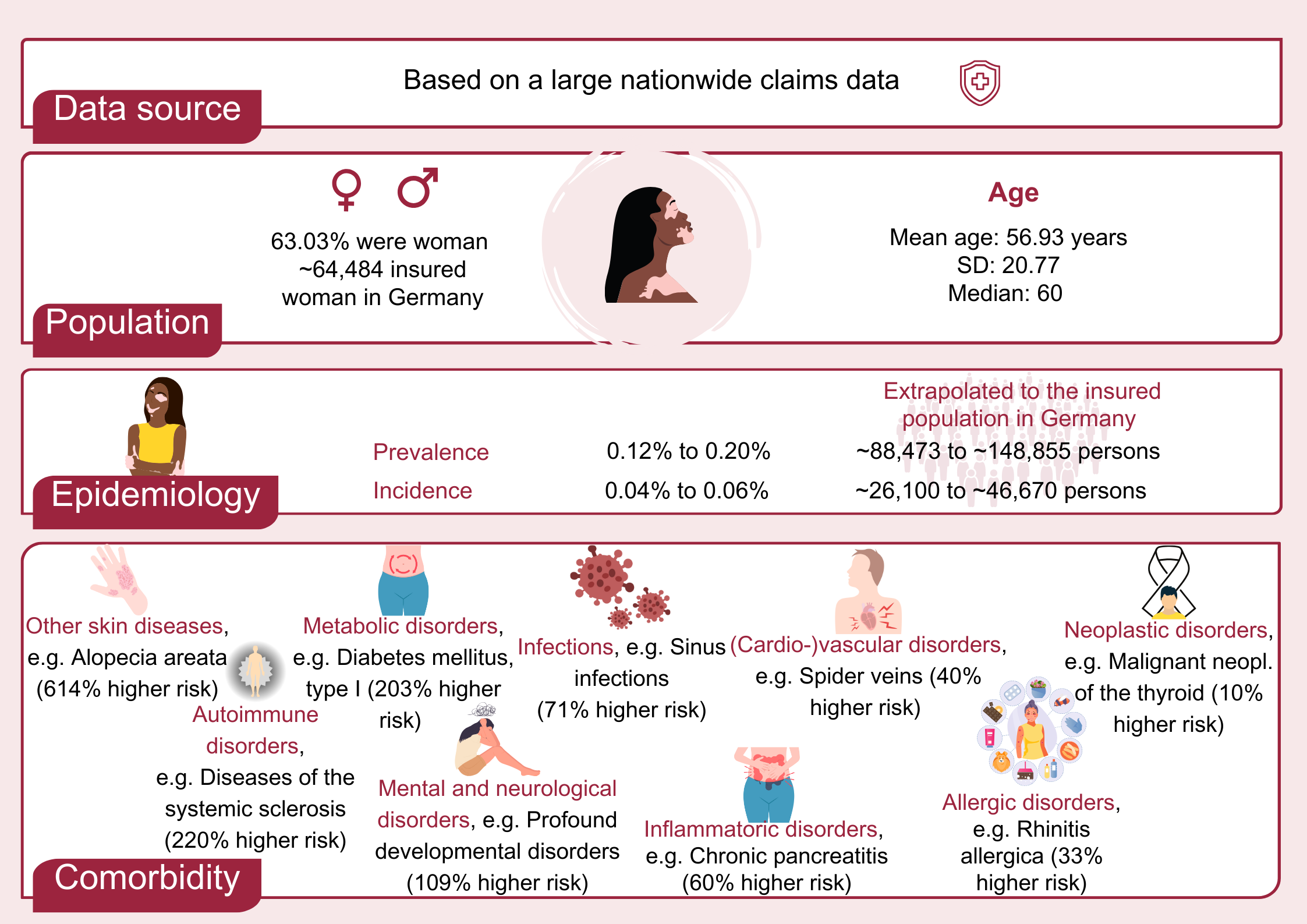
Vitiligo is a chronic skin disease resulting in destruction of melanocytes and loss of pigmentation. Little is known about epidemiology and comorbidity in Germany. This retrospective cohort analysis used nationwide statutory health insurance data (2016 to 2020). Disease rates were calculated using varying case definitions. Comorbidity was assessed against 3 control groups: persons without vitiligo, with atopic dermatitis, and with psoriasis (1:3 propensity score matching). In 2020, 4,631 persons were diagnosed with vitiligo in DAK-Gesundheit (DAK-G, mean age 56.93 years, ~148,437) and 5,820 persons in the German Analysis Database for Evaluation and Health Services Research (~144,855). Prevalence ranged from 0.12% (confidence interval [CI] 0.12–0.12) to 0.20% (CI 0.19–0.20), and incidence from 0.04% (CI 0.03–0.04) to 0.06% (CI 0.06–0.06). Rates increased with age. Women (mean age 58.60 years) were more frequently affected. Vitiligo was associated with alopecia areata (relative risk 7.14, CI 4.63–11.00) and systemic sclerosis (relative risk 3.20, CI 1.58–6.47). Several mental illnesses (depression: relative risk = 1.23, CI 1.15–1.32, anxiety: relative risk = 1.32, CI 1.19–1.47), were linked to skin diseases like vitiligo, atopic dermatitis, or psoriasis. Vitiligo affects a notable proportion of the population, with detected comorbidities supporting prior findings. To ensure reliable results, claims data should be validated through primary data linkage or sensitivity testing.
Downloads
References
Taïeb A, Picardo M. The definition and assessment of vitiligo: a consensus report of the Vitiligo European Task Force. Pigment Cell Res 2007; 20: 27–35. DOI: https://doi.org/10.1111/j.1600-0749.2006.00355.x
Krüger C, Schallreuter KU. A review of the worldwide prevalence of vitiligo in children/adolescents and adults. Int J Dermatol 2012; 51: 1206–1212. 1206–1212. DOI: https://doi.org/10.1111/j.1365-4632.2011.05377.x
Haulrig MB, Al-Sofi R, Baskaran S, Bergmann MS, Løvendorf M, Dyring-Andersen B, et al. The global epidemiology of vitiligo: a systematic review and meta-analysis of the incidence and prevalence. JEADV Clin Pract 2024; 3: 1410–1419. DOI: https://doi.org/10.1002/jvc2.526
Zhang Y, Cai Y, Shi M, Jiang S, Cui S, Wu Y, et al. The prevalence of vitiligo: a meta-analysis. PloS One 2016; 11: e0163806. DOI: https://doi.org/10.1371/journal.pone.0163806
Mohr N, Petersen J, Kirsten N, Augustin M. Epidemiology of vitiligo: a dual population-based approach. Clin Epidemiol 2021; 13: 373–382. DOI: https://doi.org/10.2147/CLEP.S304155
Abbas S, Ihle P, Köster I, Schubert I. Estimation of disease incidence in claims data dependent on the length of follow-up: a methodological approach. Health Serv Res 2012; 47: 746–755. DOI: https://doi.org/10.1111/j.1475-6773.2011.01325.x
Tang L, Li F, Xu F, Yan S, Zhou J, Li J, et al. Prevalence of vitiligo and associated comorbidities in adults in Shanghai, China: a community-based, cross-sectional survey. Ann Palliat Med 2021; 10: 8103–8111. DOI: https://doi.org/10.21037/apm-21-1738
Li C-Y, Dai Y-X, Chen Y-J, Chu S-Y, Chen T-J, Wu C-Y, et al. Cancer risks in vitiligo patients: a nationwide population-based study in Taiwan. Int J Environ Res Public Health 2018; 15. DOI: https://doi.org/10.3390/ijerph15091847
Morrison B, Burden-Teh E, Batchelor JM, Mead E, Grindlay D, Ratib S. Quality of life in people with vitiligo: a systematic review and meta-analysis. Br J Dermatol 2017; 177: e338–e339. DOI: https://doi.org/10.1111/bjd.15933
Wang G, Qiu D, Yang H, Liu W. The prevalence and odds of depression in patients with vitiligo: a meta-analysis. J Eur Acad Dermatol Venereol 2018; 32: 1343–1351. DOI: https://doi.org/10.1111/jdv.14739
Kussainova A, Kassym L, Akhmetova A, Glushkova N, Sabirov U, Adilgozhina S, et al. Vitiligo and anxiety: a systematic review and meta-analysis. PloS One 2020; 15: e0241445. DOI: https://doi.org/10.1371/journal.pone.0241445
Ezzedine K, Eleftheriadou V, Jones H, Bibeau K, Kuo FI, Sturm D, et al. Psychosocial effects of vitiligo: a systematic literature review. Am J Clin Dermatol 2021; 22: 757–774. DOI: https://doi.org/10.1007/s40257-021-00631-6
Fabrazzo M, Cipolla S, Signoriello S, Camerlengo A, Calabrese G, Giordano GM, et al. A systematic review on shared biological mechanisms of depression and anxiety in comorbidity with psoriasis, atopic dermatitis, and hidradenitis suppurativa. Eur Psychiatry 2021; 64: e71. DOI: https://doi.org/10.1192/j.eurpsy.2021.2249
Wilson EB. On confidence intervals. Proc Natl Acad Sci U S A 1942; 28: 88–93. DOI: https://doi.org/10.1073/pnas.28.3.88
Tsadik AG, Legesse GF, Desta DM, Assefa BT, Kidanemariam HG, Gidey MT. Clinico-epidemiological profile and treatment pattern of vitiligo in selected dermatological clinics of Mekelle City, Northern Ethiopia. Dermatol Res Pract 2020; 2020: 3625753. DOI: https://doi.org/10.1155/2020/3625753
Gandhi K, Ezzedine K, Anastassopoulos KP, Patel R, Sikirica V, Daniel SR, et al. Prevalence of vitiligo among adults in the United States. JAMA Dermatol 2022; 158: 43–50. DOI: https://doi.org/10.1001/jamadermatol.2021.4724
Radtke MA, Schäfer I, Gajur AI, Augustin M. Clinical features and treatment outcomes of vitiligo from the patients’ perspective: results of a national survey in Germany. Dermatology (Basel, Switzerland) 2010; 220: 194–200. DOI: https://doi.org/10.1159/000275657
Migayron L, Boniface K, Seneschal J. Vitiligo, from physiopathology to emerging treatments: a review. Dermatol Ther (Heidelb) 2020; 10: 1185–1198. DOI: https://doi.org/10.1007/s13555-020-00447-y
Schubert I, Ihle P, Köster I. Interne Validierung von Diagnosen in GKV-Routinedaten: Konzeption mit Beispielen und Falldefinition. Gesundheitswesen 2010; 72: 316–322. DOI: https://doi.org/10.1055/s-0030-1249688
Radtke MA, Schäfer I, Gajur A, Langenbruch A, Augustin M. Willingness-to-pay and quality of life in patients with vitiligo. Br J Dermatol 2009; 161: 134–139. DOI: https://doi.org/10.1111/j.1365-2133.2009.09091.x
Augustin M, Gajur AI, Reich C, Rustenbach SJ, Schaefer I. Benefit evaluation in vitiligo treatment: development and validation of a patient-defined outcome questionnaire. Dermatology (Basel) 2008; 217: 101–106. DOI: https://doi.org/10.1159/000128992
Choi CW, Eun SH, Choi KH, Bae JM. Increased risk of comorbid rheumatic disorders in vitiligo patients: a nationwide population-based study. J Dermatol 2017; 44: 909–913. DOI: https://doi.org/10.1111/1346-8138.13846
Dsouza PA, Monteiro RC, Dias M, Prabhu SH, Bhat RM, Jayaraman J, et al. Beyond the surface: decoding pityriasis versicolor through clinical, dermoscopic and microbiological exploration. Indian J Dermatol 2025; 70: 6–10. DOI: https://doi.org/10.4103/ijd.ijd_391_24
Leung DYM. New insights into atopic dermatitis: role of skin barrier and immune dysregulation. Allergol Int2013; 62: 151–161. DOI: https://doi.org/10.2332/allergolint.13-RAI-0564
Li X, Kong L, Li F, Chen C, Xu R, Wang H, et al. Association between psoriasis and chronic obstructive pulmonary disease: a systematic review and meta-analysis. PloS One 2015; 10: e0145221. DOI: https://doi.org/10.1371/journal.pone.0145221
Klinger T, Augustin M, Leicht G, Moritz S, Hagenström K. Prevalence and comparative risk of mental health disorders in persons with vitiligo: a retrospective matched cohort study using claims data with expert-informed case validation. BMJ Open 2026; 16: e106687. DOI: https://doi.org/10.1136/bmjopen-2025-106687
Montgomery SN, Syder N, Barajas G, Elbuluk N. Psychological comorbidities of vitiligo: a retrospective cross-sectional analysis in an urban population. Arch Dermatol Res 2023; 316: 14. DOI: https://doi.org/10.1007/s00403-023-02771-7
Rosenbaum PR, Rubin DB. The central role of the propensity score in observational studies for causal effects. Biometrika 1983; 70: 41–55. DOI: https://doi.org/10.1093/biomet/70.1.41
Mei H, Xu Y, Wang J, Ma S. Evaluation of survival outcomes of endovascular versus open aortic repair for abdominal aortic aneurysms with a big data approach. Entropy (Basel) 2020; 22. DOI: https://doi.org/10.3390/e22121349
Wang C, Chen M-H, Schifano E, Wu J, Yan J. Statistical methods and computing for big data. Stat Interface 2016; 9: 399–414. DOI: https://doi.org/10.4310/SII.2016.v9.n4.a1
Wagner C. Die Population unter Risiko bei Prävalenz- und Inzidenzschätzungen – Nennerkonzepte. In: Routinedaten im Gesundheitswesen: Handbuch Sekundärdatenanalyse: Grundlagen, Methoden und Perspektiven. Bern: Hans Huber; 2014: p. 424–432.
Swart E, Gothe H, Geyer S, Jaunzeme J, Maier B, Grobe TG, et al. Gute Praxis Sekundärdatenanalyse (GPS): Leitlinien und Empfehlungen. Gesundheitswesen 2015; 77: 120–126. DOI: https://doi.org/10.1055/s-0034-1396815
Hagenström K, Protz K, Petersen J, Augustin M. Development of a model to predict closure of chronic wounds in Germany: claims data analysis. Int Wound J 2022; 19: 76–85. DOI: https://doi.org/10.1111/iwj.13599
Busse R, Blümel M, Knieps F, Bärnighausen T. Statutory health insurance in Germany: a health system shaped by 135 years of solidarity, self-governance, and competition. Lancet 2017; 390: 882–897. DOI: https://doi.org/10.1016/S0140-6736(17)31280-1
Swart E, editor. Health care utilization research using secondary data. New York: Springer; 2014. DOI: https://doi.org/10.1007/978-1-4614-9191-0_5
Swart E, Schmitt J. Standardized Reporting Of Secondary data Analyses (STROSA) – Vorschlag für ein Berichtsformat für Sekundärdatenanalysen. Z Evid Fortbild Qual Gesundhwes 2014; 108: 511–516. DOI: https://doi.org/10.1016/j.zefq.2014.08.022
Arbeitsgruppe Epidemiologische Methoden der Deutschen Arbeitsgemeinschaft für Epidemiologie (DAE). Leitlinien und Empfehlungen – Deutsche Gesellschaft für Epidemiologie; 2023 [cited 2023 Oct 19]. Available from: https://www.dgepi.de/de/berichte-und-publikationen/leitlinien-und-empfehlungen/
Downloads
Additional Files
Published
How to Cite
License
Copyright (c) 2026 Theresa Klinger, Matthias Augustin, Susanne Baumeister, Jennifer Riedel, Claudia Grellmann, Anja Kamps, Markus Böhm, Kristina Hagenström

This work is licensed under a Creative Commons Attribution-NonCommercial 4.0 International License.
All digitalized ActaDV contents is available freely online. The Society for Publication of Acta Dermato-Venereologica owns the copyright for all material published until volume 88 (2008) and as from volume 89 (2009) the journal has been published fully Open Access, meaning the authors retain copyright to their work.
Unless otherwise specified, all Open Access articles are published under CC-BY-NC licences, allowing third parties to copy and redistribute the material in any medium or format and to remix, transform, and build upon the material for non-commercial purposes, provided proper attribution to the original work.






