
TRPM8 Agonist (Cryosim-1) Cream for Chronic Prurigo: A Randomized, Vehicle-controlled Trial
DOI:
https://doi.org/10.2340/actadv.v105.44488Keywords:
chronic prurigo, TRPM8 agonist, topical therapy, antipruriticv, skin barrierAbstract
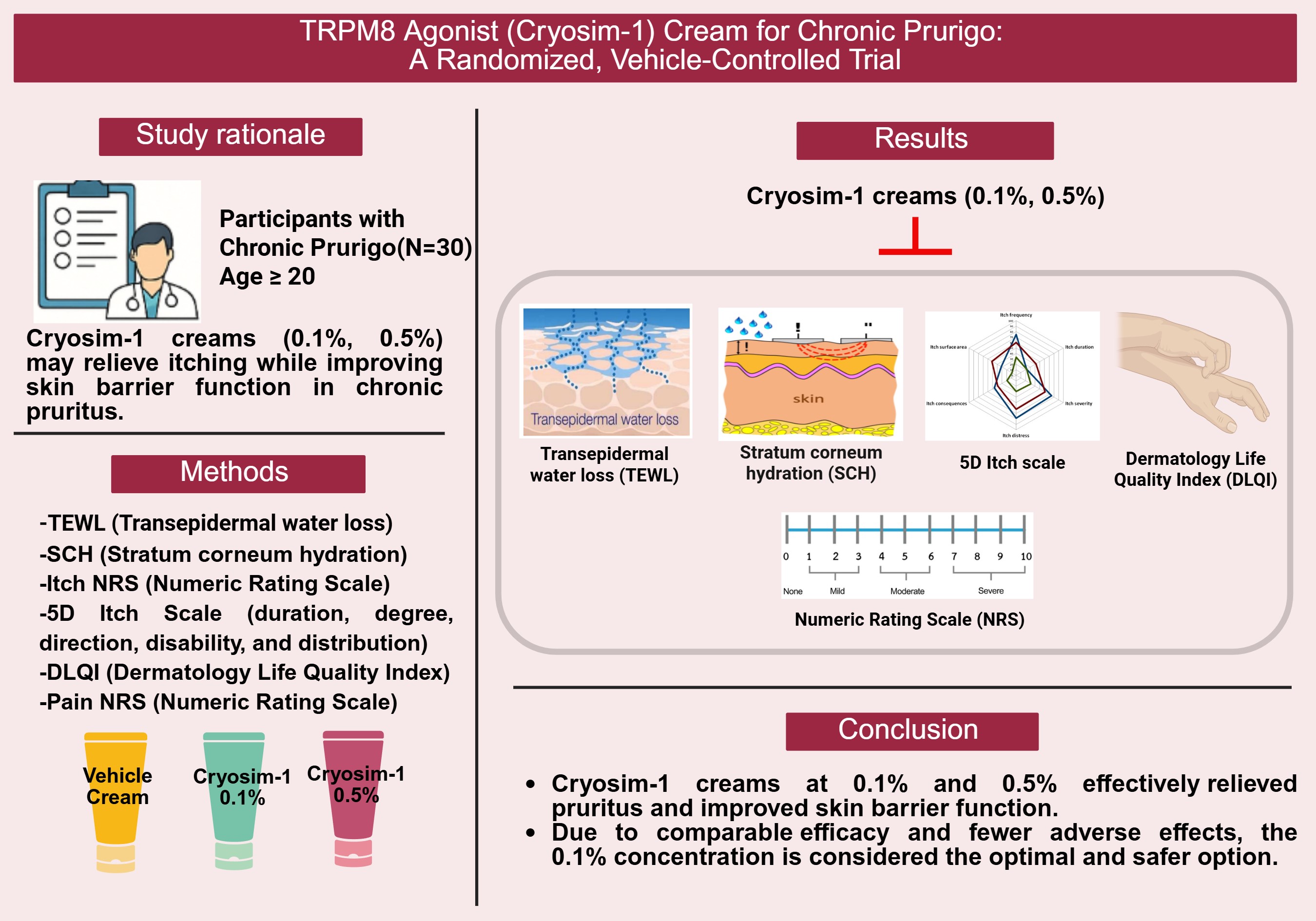
Chronic prurigo (CP) is a distressing dermatological condition lacking effective topical therapies. This randomized, double-blind, vehicle-controlled trial evaluated the efficacy and safety of Cryosim-1, a TRPM8 agonist cream, in 30 adults with CP. Participants were assigned to apply Cryosim-1 0.1%, 0.5%, or vehicle cream 3 times daily for 4 weeks. Both active formulations significantly reduced Prurigo Activity Score (PAS) compared with vehicle, with 0.1% Cryosim-1 showing a mean PAS reduction of −7.3 (p < 0.001). Significant improvements were observed in 24-h itch intensity, quality of life (DLQI), transepidermal water loss, and stratum corneum hydration. While both concentrations were effective, the 0.1% formulation showed superior tolerability with fewer reports of stinging and erythema. These findings support the potential of TRPM8-targeted therapy in managing CP through dual mechanisms of itch inhibition and skin barrier restoration.
Downloads
References
Ständer S, Weisshaar E, Mettang T, Szepietowski JC, Carstens E, Ikoma A, et al. Clinical classification of itch: a position paper of the International Forum for the Study of Itch. Acta Derm Venereol 2007; 87: 291–294. DOI: https://doi.org/10.2340/00015555-0305
Yosipovitch G, Bernhard JD. Clinical practice. Chronic pruritus. N Engl J Med 2013; 368: 1625–1634. DOI: https://doi.org/10.1056/NEJMcp1208814
McMahon SB, Koltzenburg M, Tracey I, Turk DC. Wall & Melzack’s textbook of pain. 6th ed. Philadelphia: Elsevier Saunders, 2013.
Weisshaar E, Szepietowski JC, Darsow U, Misery L, Wallengren J, Mettang T, et al. European guideline on chronic pruritus. Acta Derm Venereol 2012; 92: 563–581. DOI: https://doi.org/10.2340/00015555-1400
Kwatra S, Yosipovitch G, Legat FJ, Silverberg JI, Ständer S, Draelos ZD, et al. Phase 3 trial of nemolizumab in patients with prurigo nodularis. N Engl J Med 2023; 389: 1579–1589. DOI: https://doi.org/10.1056/NEJMoa2301333
Yosipovitch G, Mollanazar N, Ständer S, Legat FJ, Kwatra SG, Silverberg JI, et al. Dupilumab improves pruritus and skin lesions in patients with prurigo nodularis: pooled results from 2 phase 3 trials (LIBERTY-PN PRIME and PRIME2). JAAD Int 2024; 16: 163–174. DOI: https://doi.org/10.1016/j.jdin.2024.03.025
Peier AM, Moqrich A, Hergarden AC, Reeve AJ, Andersson DA, Story GM, et al. A TRP channel that senses cold stimuli and menthol. Cell 2002; 108: 705–715. DOI: https://doi.org/10.1016/S0092-8674(02)00652-9
Wei ET, Seid DA. AG-3-5: a chemical producing sensations of cold. J Pharm Pharmacol 1983; 35: 110–112. DOI: https://doi.org/10.1111/j.2042-7158.1983.tb04279.x
Lee S, Wei ET, Selescu T, Kim H, Park Y, Kim HJ, et al. Histamine- and pruritogen-induced itch is inhibited by a TRPM8 agonist: a randomized vehicle-controlled human trial. Br J Dermatol 2024; 190: 885–894. DOI: https://doi.org/10.1093/bjd/ljae054
FDA approves first-in-class TRPM8 ion channel agonist for dry eye disease. Silver Spring, MD: U.S. Food and Drug Administration, 2024.
Choi J, Kim HO, Park YM, Lee DH, Han JH, Kim BS, et al. A randomized, double-blinded, vehicle-controlled clinical trial of topical cryosim-1, a synthetic TRPM8 agonist, in prurigo nodularis. J Cosmet Dermatol 2024; 23: 123–131. DOI: https://doi.org/10.1111/jocd.16079
Zeidler C, Ständer S, Rhoten S, Legat FJ, Yosipovitch G, Silverberg JI, et al. Validation of a scoring algorithm for the clinician-reported outcome tool ‘Prurigo Activity and Severity (PAS)’ based on clinical studies of dupilumab in adults with prurigo nodularis. J Eur Acad Dermatol Venereol 2024; 38: 1954–1964. DOI: https://doi.org/10.1111/jdv.19961
Proksch E, Brandner JM, Jensen JM. The skin: an indispensable barrier. Exp Dermatol 2008; 17: 1063–1072. DOI: https://doi.org/10.1111/j.1600-0625.2008.00786.x
Ständer S, Ständer H, Schaller J, Weisshaar E, Mettang T, Szepietowski JC, et al. Novel TRPM8 agonist Cooling Compound against chronic itch: results from a randomized, double-blind, controlled pilot study in dry skin. ResearchGate 2017. DOI: https://doi.org/10.1111/jdv.14041
Fölster-Holst R, Müller F, Schnopp N, Brauns R, Weidinger S, Thaçi D, et al. Comparison of epidermal barrier integrity in adults with classic atopic dermatitis, atopic prurigo and non-atopic prurigo nodularis. Biology 2021; 10: 1008. DOI: https://doi.org/10.3390/biology10101008
FDA Drug Safety Communication: Rare cases of serious burns with the use of over-the-counter topical muscle and joint pain relievers. Silver Spring, MD: U.S. Food and Drug Administration, 2012.
Recent progress in TRPM8 modulation: an update. Int J Mol Sci 2019; 20: 2618. DOI: https://doi.org/10.3390/ijms20112618
Weisshaar E, Szepietowski JC, Dalgard FJ, Garcovich S, Gieler U, Giménez-Arnau AM, et al. European S2k Guideline on chronic pruritis. Acta Derm Venereol 2019; 99: 469–506. DOI: https://doi.org/10.2340/00015555-3164
Kang SY, Choi MG, Wei ET, Selescu T, Lee SY, Kim JC, et al. TRPM8 agonist (cryosim-1) gel for scalp itch: a randomised, vehicle-controlled clinical trial.J Eur Acad Dermatol Venereol 2022; 36: e588-e9. DOI: https://doi.org/10.1111/jdv.18080
Szepietowski JC, Szepietowska M, Czajkowski R, Bielicka E, Nowak J, Reich A, et al. Palmitoylethanolamide in the treatment of pruritus in patients with chronic kidney disease. J Dermatolog Treat 2019; 30: 592–598.
Draelos ZD. The role of barrier repair moisturizers in treating pruritus: recent advances in components and mechanisms. J Cosmet Dermatol 2024; 23: 31–41.
Additional Files
Published
How to Cite
Issue
Section
Categories
License
Copyright (c) 2025 Ji Young Um, Han Bi Kim, So Yeon Lee, Bo Young Chung, Chun Wook Park, Hye One Kim

This work is licensed under a Creative Commons Attribution-NonCommercial 4.0 International License.
All digitalized ActaDV contents is available freely online. The Society for Publication of Acta Dermato-Venereologica owns the copyright for all material published until volume 88 (2008) and as from volume 89 (2009) the journal has been published fully Open Access, meaning the authors retain copyright to their work.
Unless otherwise specified, all Open Access articles are published under CC-BY-NC licences, allowing third parties to copy and redistribute the material in any medium or format and to remix, transform, and build upon the material for non-commercial purposes, provided proper attribution to the original work.






