
Comparison of the Burden of Acne Vulgaris in China vs Globally: Insights from the Global Burden of Disease Study (2021) and Projections to 2050
DOI:
https://doi.org/10.2340/actadv.v106.adv-2025-0131Keywords:
Acne vulgaris, Public health, China, Global, BurdenAbstract
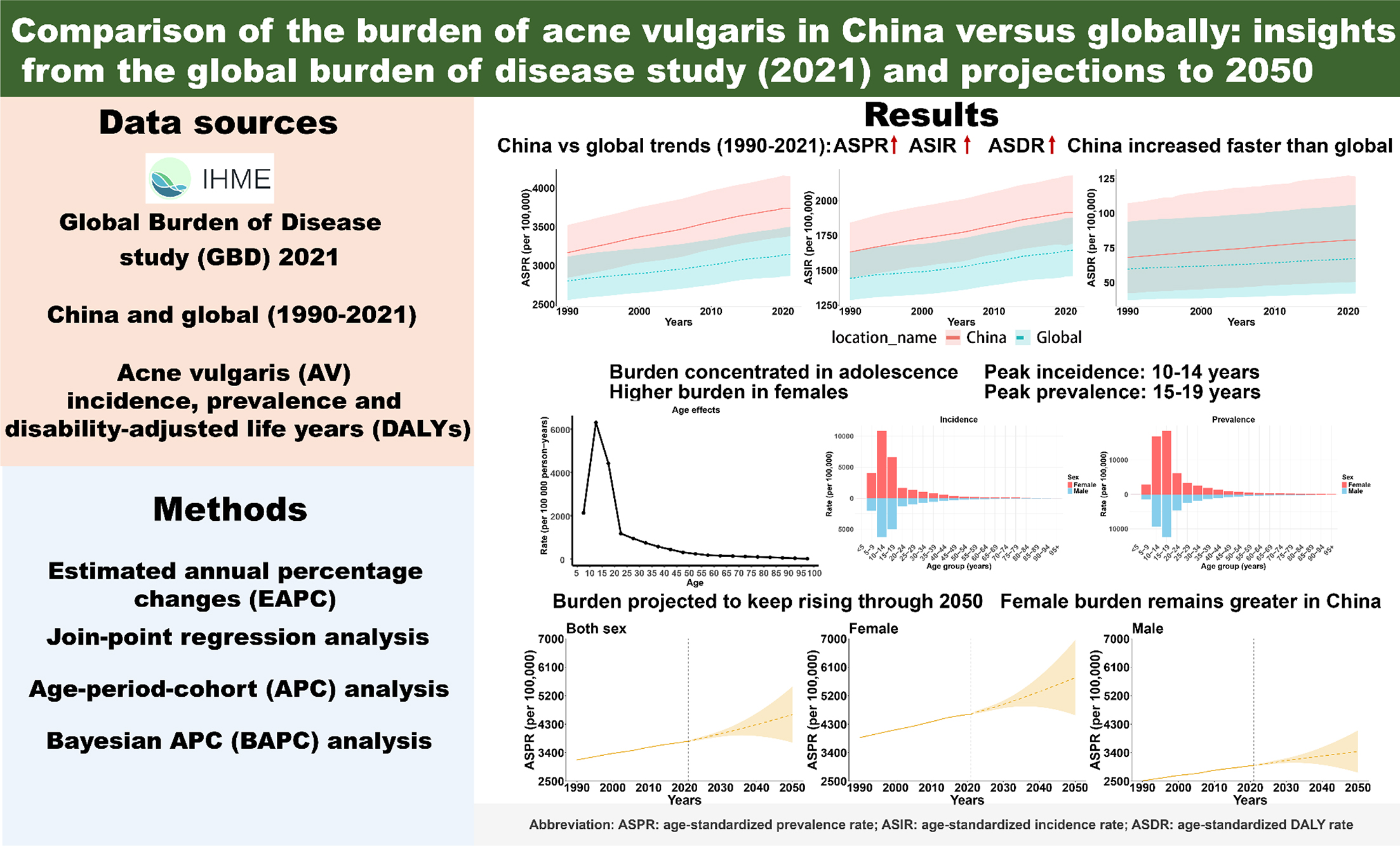
Acne vulgaris (AV) poses a significant health challenge in China, adversely affecting patients’ quality of life and mental health. Updated evidence on acne burden in China integrating temporal trends, China–global comparisons, change-point patterns, and future projections remains limited. This study aimed to provide an updated assessment of AVacne vulgaris burden in China, including temporal trends and future projections, and to clarify its public health implications. Using data from the 2021 Global Burden of Disease (GBD) study, estimated annual percentage changes (EAPCs) for AVacne vulgaris were calculated for China and globally, while change-point patterns were assessed using joinpoint regression. An age–period–cohort (APC) analysis was subsequently performed, followed by Bayesian age-period-cohort (BAPC) projection of China’s AVacne vulgaris burden to 2050. From 1990 to 2021, the prevalence, incidence, and disability-adjusted life years (DALYs) associated with AVacne vulgaris in China exhibited sustained increases, outpacing global rates. APCAge–period–cohort analysis revealed a peak incidence at ages 10–14 years. Overall, the main burden was concentrated in adolescence. BAPCBayesian age-period-cohort projections indicated that China’s AVacne vulgaris burden will continue to rise from 2022 to 2050,, with a disproportionately greater impact on females. These findings support prioritising evidence-based prevention, early recognition, and management strategies for adolescents and for females in China.
Downloads
References
Shen Y, Wang T, Zhou C, Wang X, Ding X, Tian S, et al. Prevalence of acne vulgaris in Chinese adolescents and adults: a community-based study of 17,345 subjects in six cities. Acta Derm Venereol 2012; 92: 40–44. DOI: https://doi.org/10.2340/00015555-1164
Tunca M, Balik ZB, Uncu HB, Botsali A. Stigmatization and psychosocial burden in acne pati-ents. J Cosmet Dermatol 2025; 24: e16678. DOI: https://doi.org/10.1111/jocd.16678
Zhu Z, Zhong X, Luo Z, Liu M, Zhang H, Zheng H, et al. Global, regional and national burdens of acne vulgaris in adolescents and young adults aged 10-24 years from 1990 to 2021: a trend analysis. Br J Dermatol 2025; 192: 228–237. DOI: https://doi.org/10.1093/bjd/ljae352
Wang Y, Xiao S, Ren J, Zhang Y. Analysis of the epidemiological burden of acne vulgaris in China based on the data of global burden of disease 2019. Front Med 2022; 9: 939584. DOI: https://doi.org/10.3389/fmed.2022.939584
Yang J, Yang H, Xu A, He L. A review of advancement on influencing factors of acne: an emphasis on environment characteristics. Front Public Health 2020; 8: 450. DOI: https://doi.org/10.3389/fpubh.2020.00450
Han HS, Seok J, Park KY. Air pollution and skin diseases. Ann Dermatol 2025; 37: 53–67. DOI: https://doi.org/10.5021/ad.24.159
GBD 2021 Diseases and Injuries Collaborators. Global incidence, prevalence, years lived with disability (YLDs), disability-adjusted life-years (DALYs), and healthy life expectancy (HALE) for 371 diseases and injuries in 204 countries and territories and 811 subnational locations, 1990–2021: a systematic analysis for the Global Burden of Disease Study 2021. Lancet 2024; 403: 2133–2161. DOI: https://doi.org/10.1016/S0140-6736(24)00757-8
Hu Y, Connor DS, Stuhlmacher M, Peng J, Turner II BL. More urbanization, more polarization: evidence from two decades of urban expansion in China. Npj Urban Sustain 2024; 4: 33. DOI: https://doi.org/10.1038/s42949-024-00170-z
Liu H, Chen W, Sun S, Yu J, Zhang Y, Ye C. Revisiting China’s urban transition from the per-spective of urbanisation: a critical review and analysis. Sustainability 2024; 16: 4122. DOI: https://doi.org/10.3390/su16104122
Gong P, Liang S, Carlton EJ, Jiang Q, Wu J, Wang L, et al. Urbanisation and health in China. Lancet 2012; 379: 843–852. DOI: https://doi.org/10.1016/S0140-6736(11)61878-3
Yang H, Cui X, Wang H, Helbich M, Yin C, Chen X, et al. Machine learning-based assessment of the built environment on prevalence and severity risks of acne. Cell Rep Sustain 2024; 1: 100235. DOI: https://doi.org/10.1016/j.crsus.2024.100235
Juhl CR, Bergholdt HKM, Miller IM, Jemec GBE, Kanters JK, Ellervik C. Dairy intake and acne vulgaris: a systematic review and meta-analysis of 78,529 children, adolescents, and young adults. Nutrients 2018; 10: 1049. DOI: https://doi.org/10.3390/nu10081049
Meixiong J, Ricco C, Vasavda C, Ho BK. Diet and acne: a systematic review. JAAD Int 2022; 7: 95–112. DOI: https://doi.org/10.1016/j.jdin.2022.02.012
Downloads
Additional Files
Published
How to Cite
License

This work is licensed under a Creative Commons Attribution-NonCommercial 4.0 International License.
All digitalized ActaDV contents is available freely online. The Society for Publication of Acta Dermato-Venereologica owns the copyright for all material published until volume 88 (2008) and as from volume 89 (2009) the journal has been published fully Open Access, meaning the authors retain copyright to their work.
Unless otherwise specified, all Open Access articles are published under CC-BY-NC licences, allowing third parties to copy and redistribute the material in any medium or format and to remix, transform, and build upon the material for non-commercial purposes, provided proper attribution to the original work.






