
Perceived Stress, Illness and Stigma in Patients with Alopecia Areata
DOI:
https://doi.org/10.2340/actadv.v106.adv-2025-0212Keywords:
adaptation, psychological, alopecia areata, stigmaAbstract
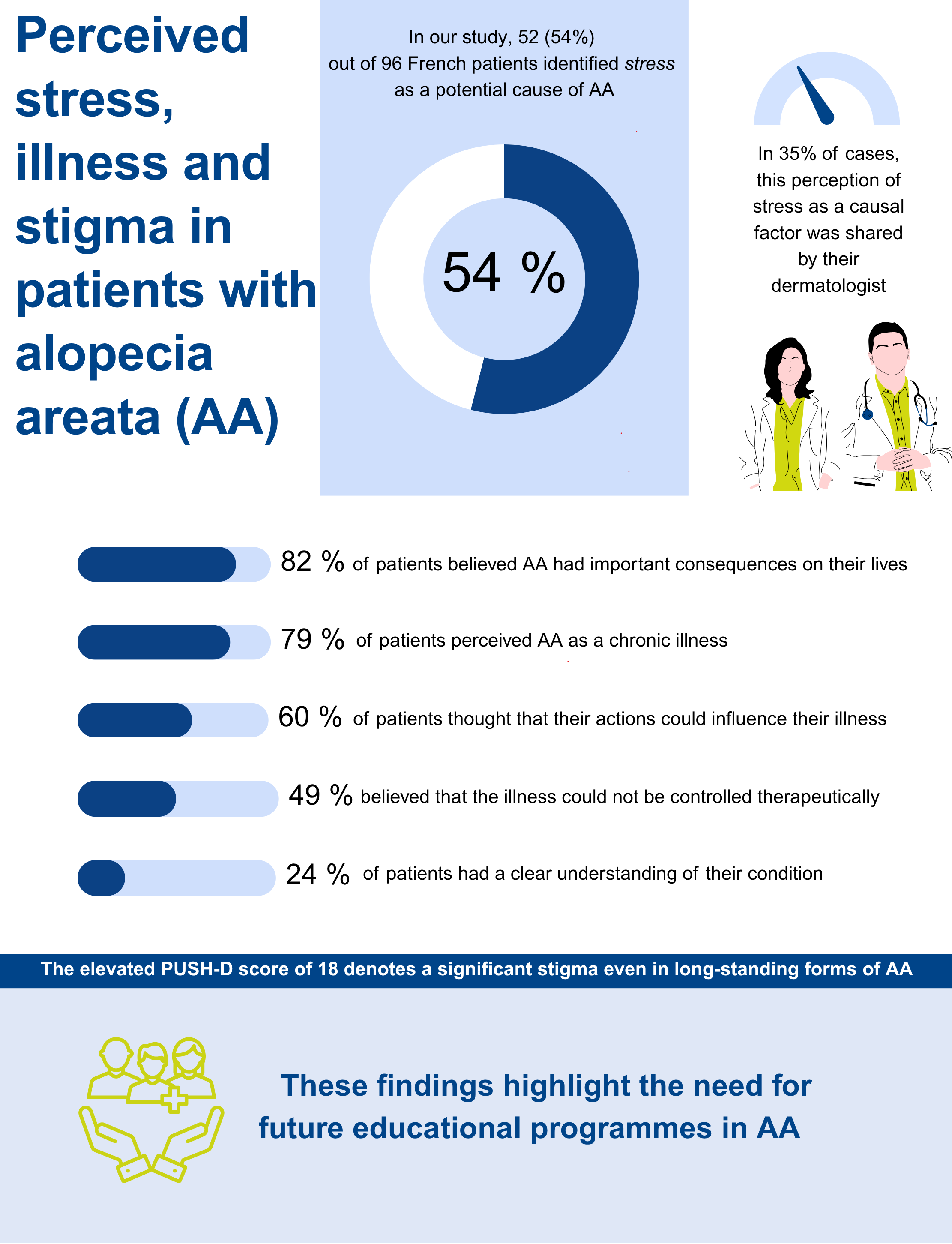
Alopecia areata is a nonscarring autoimmune hair loss disorder. Little is known about patients’ perceptions of their condition. This French cross-sectional online study primarily aimed to assess patients’ perception of stress as a causal factor, with secondary objectives examining illness perception and stigma. Adults aged ≥18 years with a confirmed alopecia areata diagnosis were included.
The primary outcome was patients” attribution of stress as a cause of alopecia areata, while secondary outcomes included IPQ-R and PUSHD scores. Among 96 participants, there was a strong female predominance (15.6 : 1) and a high proportion of alopecia totalis (65%). Stress was identified as a cause by 52 patients (54%), and this belief was shared by their dermatologist in 18 cases (35%). Patients reported significant emotional consequences, major life impact and a chronic course. Those attributing alopecia areata
to stress showed higher perceived personal control (15.3±4.9 vs. 12.7±4.3; p=0.006). The mean PUSHD score was 18. Poorer perceived consequences and stronger emotional representations correlated with greater stigma (ρ=0.56; ρ=0.59; p<0.05), while lower disease understanding correlated with higher stigma (ρ=−0.34; p<0.05). Integrating educational programmes into routine care may enhance patients with alopecia areata understanding and coping.
Downloads
References
Ahn D, Kim H, Lee B, Hahm DH. Psychological stress-induced pathogenesis of alopecia areata: autoimmune and apoptotic pathways. Int J Mol Sci 2023; 24: 11711. DOI: https://doi.org/10.3390/ijms241411711
Bertolini M, McElwee K, Gilhar A, Bulfone-Paus S, Paus R. Hair follicle immune privilege and its collapse in alopecia areata. Exp Dermatol 2020; 29: 703–725. DOI: https://doi.org/10.1111/exd.14155
Bour C, Ahne A, Schmitz S, Perchoux C, Dessenne C, Fagherazzi G. The use of social media for health research purposes: scoping review. J Med Internet Res 2021; 23: e25736. DOI: https://doi.org/10.2196/25736
Broadbent E, Petrie KJ, Main J, Weinman J. The brief illness perception questionnaire. J Psychosom Res 2006; 60: 631–637. DOI: https://doi.org/10.1016/j.jpsychores.2005.10.020
Christou E, Lalagianni N, McSweeney SM, Cotter C, Ung CY, Walburn J, et al. Psychosocial burden and the impact of illness perceptions and stigma on quality of life, anxiety and depression in alopecia areata: results from the Alopecia + Me study. Br J Dermatol 2025; 193: 458–467. DOI: https://doi.org/10.1093/bjd/ljaf189
Darko EM, Kleib M, Olson J. Social media use for research participant recruitment: integrative literature review. J Med Internet Res 2022; 24: e38015. DOI: https://doi.org/10.2196/38015
Elenkov IJ, Chrousos GP. Stress hormones, proinflammatory and antiinflammatory cytokines, and autoimmunity. Ann N Y Acad Sci 2002; 966: 290–303. DOI: https://doi.org/10.1111/j.1749-6632.2002.tb04229.x
Ezzedine K, Shourick J, Bergqvist C, Misery L, Chuberre B, Kerob D, et al. Patient Unique Stigmatization Holistic tool in dermatology (PUSH‐D): development and validation of a dermatology‐specific stigmatization assessment tool. Acad Dermatol Venereol 2023; 37: 443–450. DOI: https://doi.org/10.1111/jdv.18641
Fakih A, Tannous R, Lajnef M, Seneschal J, Andreu N, Tran VT, et al. Stigma in vitiligo: associated factors and severity strata of the Patient Unique Stigmatization Holistic tool in Dermatology (PUSH-D) score. Br J Dermatol 2024; 190: 712–717. DOI: https://doi.org/10.1093/bjd/ljae020
Firooz A, Firoozabadi MR, Ghazisaidi B, Dowlati Y. Concepts of patients with alopecia areata about their disease. BMC Dermatol 2005; 5: 1. DOI: https://doi.org/10.1186/1471-5945-5-1
Fortune DG, Richards HL, Griffiths CEM, Main CJ. Psychological stress, distress and disability in patients with psoriasis: consensus and variation in the contribution of illness perceptions, coping and alexithymia. Br J Clin Psychol 2002; 41: 157–174. DOI: https://doi.org/10.1348/014466502163949
Goldman N, Willem T, Buyx A, Zimmermann BM. Practical benefits, challenges, and recommendations on social media recruitment: multi-stakeholder interview study. J Med Internet Res 2023; 25: e44587. DOI: https://doi.org/10.2196/44587
Hagger MS, Orbell S. The common sense model of illness self-regulation: a conceptual review and proposed extended model. Health Psychol Rev 2022; 16: 347–377. DOI: https://doi.org/10.1080/17437199.2021.1878050
Halioua B, Merhand S, Ben Hayoun Y, Gueret A, Taieb C. Facteurs prédictifs des sentiments de stigmatisation chez les adultes souffrant de dermatite atopique: étude de 1250 personnes. Ann Dermatol Venereol 2023; 3: A278–A279. DOI: https://doi.org/10.1016/j.fander.2023.09.441
Hill S. The Illness Perceptions Questionnaire-Revised (IPQ-R). J Physiother 2010; 56: 280. DOI: https://doi.org/10.1016/S1836-9553(10)70062-X
Islam N, Leung PSC, Huntley AC, Gershwin ME. The autoimmune basis of alopecia areata: a comprehensive review. Autoimmun Rev 2015; 14: 81–89. DOI: https://doi.org/10.1016/j.autrev.2014.10.014
King B, Ohyama M, Kwon O, Zlotogorski A, Ko J, Mesinkovska NA, et al. Two phase 3 trials of baricitinib for alopecia areata. N Engl J Med 2022; 386: 1687–1699. DOI: https://doi.org/10.1056/NEJMoa2110343
Lee S, Torok M, Shand F, Chen N, McGillivray L, Burnett A, et al. Performance, cost-effectiveness, and representativeness of Facebook recruitment to suicide prevention research: online survey study. JMIR Ment Health 2020; 7: e18762. DOI: https://doi.org/10.2196/18762
Matzer F, Egger JW, Kopera D. Psychosocial stress and coping in alopecia areata: a questionnaire survey and qualitative study among 45 patients. Acta Derm Venereol 2011; 91: 318–327. DOI: https://doi.org/10.2340/00015555-1031
Moss-Morris R, Weinman J, Petrie K, Horne R, Cameron L, Buick D. The Revised Illness Perception Questionnaire (IPQ-R). Psychol Health 2002; 17: 1–16. DOI: https://doi.org/10.1080/08870440290001494
Mulinari-Brenner F. Psychosomatic aspects of alopecia areata. Clin Dermatol 2018; 36: 709–713. DOI: https://doi.org/10.1016/j.clindermatol.2018.08.011
Nasimi M, Abedini R, Ghandi N, Manuchehr F, Kazemzadeh Houjaghan A, Shakoei S. Illness perception in patients with alopecia areata under topical immunotherapy. Dermatol Ther 2021; 34: e14748. DOI: https://doi.org/10.1111/dth.14748
Richard MA, Ezzedine K. Agreement between self-reported and dermatologists’ diagnosis for alopecia areata and atopic dermatitis: a bi-centric prospective study. Acta Derm Venereol 2019; 99: 618–619. DOI: https://doi.org/10.2340/00015555-3135
Titeca G, Goudetsidis L, Francq B, Sampogna F, Gieler U, Tomas-Aragones L, et al. “The psychosocial burden of alopecia areata and androgenetica”: a cross-sectional multicentre study among dermatological out-patients in 13 European countries. J Eur Acad Dermatol Venereol 2020; 34: 406–411. DOI: https://doi.org/10.1111/jdv.15927
Tsyglakova M, McDaniel D, Hodes GE. Immune mechanisms of stress susceptibility and resilience: Lessons from animal models. Front Neuroendocrinol 2019; 54: 100771. DOI: https://doi.org/10.1016/j.yfrne.2019.100771
Van Beugen S, Schut C, Kupfer J, Bewley AP, Finlay AY, Gieler U, et al. Perceived stigmatization among dermatological outpatients compared with controls: an observational multicentre study in 17 European countries. Acta Derm Venereol 2023; 103: adv6485. DOI: https://doi.org/10.2340/actadv.v103.6485
Villasante Fricke AC, Miteva M. Epidemiology and burden of alopecia areata: a systematic review. Clin Cosmet Investig Dermatol 2015; 8: 397–403. DOI: https://doi.org/10.2147/CCID.S53985
Willemse H, van der Doef M, van Middendorp H. Applying the common sense model to predicting quality of life in alopecia areata: the role of illness perceptions and coping strategies. J Health Psychol 2019; 24: 1461–1472. DOI: https://doi.org/10.1177/1359105317752826
Additional Files
Published
How to Cite
License

This work is licensed under a Creative Commons Attribution-NonCommercial 4.0 International License.
All digitalized ActaDV contents is available freely online. The Society for Publication of Acta Dermato-Venereologica owns the copyright for all material published until volume 88 (2008) and as from volume 89 (2009) the journal has been published fully Open Access, meaning the authors retain copyright to their work.
Unless otherwise specified, all Open Access articles are published under CC-BY-NC licences, allowing third parties to copy and redistribute the material in any medium or format and to remix, transform, and build upon the material for non-commercial purposes, provided proper attribution to the original work.






