
Recurrence of Basal Cell Carcinoma across Different Treatment Modalities: A Nationwide Study with 8 Years of Follow-up and Modelled Prediction
DOI:
https://doi.org/10.2340/actadv.v106.adv-2025-0064Keywords:
Basal cell carcinoma, Epidemiology, Keratinocyte carcinoma, Nonmelanoma skin cancer, Machine learning, Recurrence, TreatmentAbstract
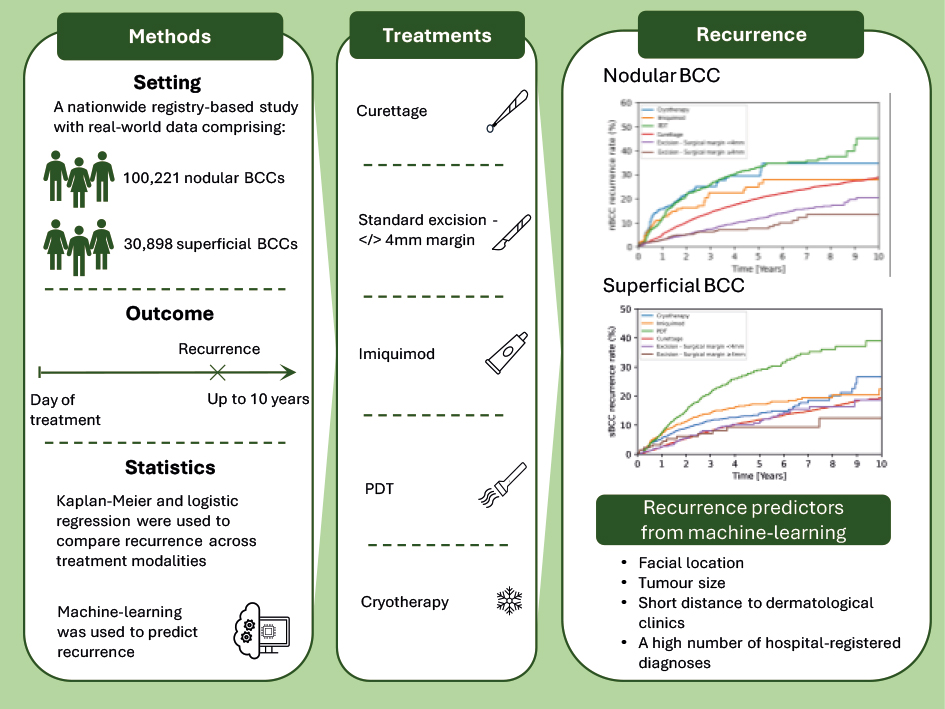
Despite the rising incidence of basal cell carcinoma (BCC), few studies have compared treatment outcomes or predicted recurrences using nationwide real-world datasets. Hence, the objective was to investigate and compare recurrence rates of nodular BCC (nBCC) and superficial BCC (sBCC) following treatment with standard excision (SE), curettage, cryotherapy, photodynamic therapy and imiquimod. Additionally, we identified predictors of BCC 2 year recurrence using machine-learning. The study examined BCCs treated in state-funded, office-based dermatology practices registered in the Danish Skin Cancer Registry from 2014 to 2024. A total of 131,119 tumours were included, comprising 100,221 nBCCs and 30,898 sBCCs. For nBCC, the lowest rate of recurrence was observed for SE, with an 8-year cumulative recurrence rate (CRR) of 16.5% (95% confidence interval: 14.4–19.0%) and hazard ratio of 0.80 (0.76–0.84) compared with curettage. For sBCC, both SE and curettage had similarly low 8 year CRRs of 16.3% (12.7–20.8%) and 16.3% (15.2 17.5%), respectively, with no significant difference in hazard. The machine-learning model identified key predictors of BCC recurrence, including facial location, larger tumour size, having a high number of hospital-registered diagnoses and short distance to dermatological clinics. These findings highlight the impact of treatment selection and patient-specific factors in guiding dermatologists towards optimal BCC management.
Downloads
References
Lomas A, Leonardi-Bee J, Bath-Hextall F. A systematic review of worldwide incidence of nonmelanoma skin cancer. Br J Dermatol 2012; 166: 1069–1080. DOI: https://doi.org/10.1111/j.1365-2133.2012.10830.x
Wang R, Chen Y, Shao X, Chen T, Zhong J, Ou Y, et al. Burden of skin cancer in older adults from 1990 to 2021 and modelled projection to 2050. JAMA Dermatol 2025; 161: 715–722. DOI: https://doi.org/10.1001/jamadermatol.2025.1276
Sieborg J, Haedersdal M, Lei U, Sølvsten H, Olesen AB, Vinding GR, et al. Incidence and geographic differences in keratinocyte carcinoma and Bowen’s disease in office‐based dermatological practice between 2013 and 2022: a nationwide Danish registry‐based study. JEADV Clin Pr 2024; 3: 1164–1174. DOI: https://doi.org/10.1002/jvc2.478
Kim DP, Kus KJB, Ruiz E. Basal cell carcinoma review. Hematol Oncol Clin North Am 2019; 33: 13–24. DOI: https://doi.org/10.1016/j.hoc.2018.09.004
Silverman MK, Kopf AW, Grin CM, Bart RS, Levenstein MJ. Recurrence rates of treated basal cell carcinomas. Part 2: curettage-electrodesiccation. J Dermatol Surg Oncol 1991; 17: 720–726. DOI: https://doi.org/10.1111/j.1524-4725.1991.tb03425.x
Manoli SM, Moutsoudis A, Papageorgiou C, Lallas K, Rigas HM, Kyrmanidou E, et al. Real-life data on basal cell carcinoma treatment: insights on clinicians’ therapeutic choices from an institutional hospital registry. Dermatol Ther 2020; 33: e14414. DOI: https://doi.org/10.1111/dth.14414
Codazzi D, Van Der Velden J, Carminati M, Bruschi S, Bocchiotti MA, Di Serio C, et al. Positive compared with negative margins in a single-centre retrospective study on 3957 consecutive excisions of basal cell carcinomas. Associated risk factors and preferred surgical management. J Plast Surg Hand Surg 2014; 48: 38–43. DOI: https://doi.org/10.3109/2000656X.2013.800526
Peris K, Fargnoli MC, Kaufmann R, Arenberger P, Bastholt L, Seguin NB, et al. European consensus-based interdisciplinary guideline for diagnosis and treatment of basal cell carcinoma-update 2023. Eur J Cancer 2023; 192: 113254. DOI: https://doi.org/10.1016/j.ejca.2023.113254
van Loo E, Mosterd K, Krekels GAM, Roozeboom MH, Ostertag JU, Dirksen CD, et al. Surgical excision versus Mohs’ micrographic surgery for basal cell carcinoma of the face: a randomised clinical trial with 10 year follow-up. Eur J Cancer 2014; 50: 3011–3020. DOI: https://doi.org/10.1016/j.ejca.2014.08.018
Wetzig T, Woitek M, Eichhorn K, Simon JC, Paasch U. Surgical excision of basal cell carcinoma with complete margin control: outcome at 5-year follow-up. Dermatology 2010; 220: 363–369. DOI: https://doi.org/10.1159/000300116
Telfer NR, Colver GB, Morton CA, British Association of Dermatologists. Guidelines for the management of basal cell carcinoma. Br J Dermatol 2008; 159: 35–48. DOI: https://doi.org/10.1111/j.1365-2133.2008.08666.x
Rodriguez-Vigil T, Vázquez-López F, Perez-Oliva N. Recurrence rates of primary basal cell carcinoma in facial risk areas treated with curettage and electrodesiccation. J Am Acad Dermatol 2007; 56: 91–95. DOI: https://doi.org/10.1016/j.jaad.2006.07.007
Werlinger KD, Upton G, Moore AY. Recurrence rates of primary nonmelanoma skin cancers treated by surgical excision compared to electrodesiccation-curettage in a private dermatological practice. Dermatol Surg 2002; 28: 1138–1142. DOI: https://doi.org/10.1046/j.1524-4725.2002.02110.x
Samain A, Boullié MC, Duval-Modeste AB, Joly P. Cryosurgery and curettage-cryosurgery for basal cell carcinomas of the mid-face. J Eur Acad Dermatol Venereol 2015; 29: 1291–1296. DOI: https://doi.org/10.1111/jdv.12798
Wang I, Bendsoe N, Klinteberg CA, Enejder AM, Andersson-Engels S, Svanberg S, et al. Photodynamic therapy vs. cryosurgery of basal cell carcinomas: results of a phase III clinical trial. Br J Dermatol 2001; 144: 832–840. DOI: https://doi.org/10.1046/j.1365-2133.2001.04141.x
Kuflik EG, Gage AA. The five-year cure rate achieved by cryosurgery for skin cancer. J Am Acad Dermatol 1991; 24: 1002–1004. DOI: https://doi.org/10.1016/0190-9622(91)70160-4
Buckley D, Marczuk C, Kennedy T. Cryosurgery for basal cell carcinoma treated in primary care. Ir J Med Sci 2020; 189: 1183–1187. DOI: https://doi.org/10.1007/s11845-020-02188-5
Rhodes LE, de Rie MA, Leifsdottir R, Yu RC, Bachmann I, Goulden V, et al. Five-year follow-up of a randomized, prospective trial of topical methyl aminolevulinate photodynamic therapy vs surgery for nodular basal cell carcinoma. Arch Dermatol 2007; 143: 1131–1136. DOI: https://doi.org/10.1001/archderm.143.9.1131
Jansen MHE, Mosterd K, Arits AHMM, Roozeboom MH, Sommer A, Essers BAB, et al. Five-year results of a randomized controlled trial comparing effectiveness of photodynamic therapy, topical imiquimod, and topical 5-fluorouracil in patients with superficial basal cell carcinoma. J Invest Dermatol 2018; 138: 527–533. DOI: https://doi.org/10.1016/j.jid.2017.09.033
Roozeboom MH, Arits AHMM, Mosterd K, Sommer A, Essers BAB, de Rooij MJM, et al. Three-year follow-up results of photodynamic therapy vs. imiquimod vs. fluorouracil for treatment of superficial basal cell carcinoma: a single-blind, noninferiority, randomized controlled trial. J Invest Dermatol 2016; 136: 1568–1574. DOI: https://doi.org/10.1016/j.jid.2016.03.043
Wang H, Li Y, Khan SA, Luo Y. Prediction of breast cancer distant recurrence using natural language processing and knowledge-guided convolutional neural network. Artif Intell Med 2020; 110: 101977. DOI: https://doi.org/10.1016/j.artmed.2020.101977
Zuo D, Yang L, Jin Y, Qi H, Liu Y, Ren L. Machine learning-based models for the prediction of breast cancer recurrence risk. BMC Med Inform Decis Mak 2023; 23: 276. DOI: https://doi.org/10.1186/s12911-023-02377-z
Kim W, Kim KS, Lee JE, Noh DY, Kim SW, Jung YS, et al. Development of novel breast cancer recurrence prediction model using support vector machine. J Breast Cancer 2012; 15: 230–238. DOI: https://doi.org/10.4048/jbc.2012.15.2.230
Lamberg AL, Sølvsten H, Lei U, Vinding GR, Stender IM, Jemec GBE, et al. The Danish nonmelanoma skin cancer dermatology database. Clin Epidemiol 2016; 8: 633–636. DOI: https://doi.org/10.2147/CLEP.S99464
Schmidt M, Schmidt SAJ, Adelborg K, Sundbøll J, Laugesen K, Ehrenstein V, et al. The Danish health care system and epidemiological research: from health care contacts to database records. Clin Epidemiol 2019; 11: 563–591. DOI: https://doi.org/10.2147/CLEP.S179083
Cramers M, Gniadecki R, Jemec G, Lamberg A, Larsen FG, Lorentzen H, et al. Basalcelle carcinom (BCC). Dansk Dermatologisk Selsk; 2008. [cited 2026 May 5].
Hædersdal M, Mosegaard M, Lamberg A, Olesen AB, Jemec GBE, Lorentzen HF, et al. Guidelines vedrørende behandling af basalcellecarcinomer. 2019. [cited 2025 February 26].
Schmults CD, Blitzblau R, Aasi SZ, Alam M, Amini A, Bibee K, et al. Basal cell skin cancer, version 2.2024, NCCN clinical practice guidelines in oncology. J Natl Compr Canc Netw 2023; 21: 1181–1203. DOI: https://doi.org/10.6004/jnccn.2023.0056
Nasr I, McGrath EJ, Harwood CA, Botting J, Buckley P, Budny PG, et al. British Association of Dermatologists guidelines for the management of adults with basal cell carcinoma 2021. Br J Dermatol 2021; 185: 899–920. DOI: https://doi.org/10.1111/bjd.20524
Danske Regioner. Find behandler. Sundhed.dk; 2023. [cited 2023 November 10].
Kuijpers DIM, Thissen M, Berretty PJM, Ideler F, Nelemans PJ, Neumann MHAM. Surgical excision versus curettage plus cryosurgery in the treatment of basal cell carcinoma. Dermatol Surg 2007; 33: 579–587. DOI: https://doi.org/10.1111/j.1524-4725.2007.33117.x
Mosterd K, Thissen MRTM, Nelemans P, Kelleners-Smeets NWJ, Janssen RLLT, Broekhof KGME, et al. Fractionated 5-aminolaevulinic acid-photodynamic therapy vs. surgical excision in the treatment of nodular basal cell carcinoma: results of a randomized controlled trial. Br J Dermatol 2008; 159: 864–870. DOI: https://doi.org/10.1111/j.1365-2133.2008.08787.x
Bath-Hextall F, Ozolins M, Armstrong SJ, Colver GB, Perkins W, Miller PSJ, et al. Surgical excision versus imiquimod 5% cream for nodular and superficial basal-cell carcinoma (SINS): a multicentre, non-inferiority, randomised controlled trial. Lancet Oncol 2014; 15: 96–105. DOI: https://doi.org/10.1016/S1470-2045(13)70530-8
Szeimies RM, Ibbotson S, Murrell DF, Rubel D, Frambach Y, de Berker D, et al. A clinical study comparing methyl aminolevulinate photodynamic therapy and surgery in small superficial basal cell carcinoma (8-20 mm), with a 12-month follow-up. J Eur Acad Dermatol Venereol 2008; 22: 1302–1311. DOI: https://doi.org/10.1111/j.1468-3083.2008.02803.x
Backman EJ, Polesie S, Berglund S, Gillstedt M, Sjöholm A, Modin M, et al. Curettage vs. cryosurgery for superficial basal cell carcinoma: a prospective, randomised and controlled trial. J Eur Acad Dermatol Venereol 2022; 36: 1758–1765. DOI: https://doi.org/10.1111/jdv.18209
Rahman SA, Walker RC, Lloyd MA, Grace BL, van Boxel GI, Kingma BF, et al. Machine learning to predict early recurrence after oesophageal cancer surgery. Br J Surg 2020; 107: 1042–1052. DOI: https://doi.org/10.1002/bjs.11461
Roozeboom MH, Aardoom MA, Nelemans PJ, Thissen MRTM, Kelleners-Smeets NWJ, Kuijpers DIM, et al. Fractionated 5-aminolevulinic acid photodynamic therapy after partial debulking versus surgical excision for nodular basal cell carcinoma: a randomized controlled trial with at least 5-year follow-up. J Am Acad Dermatol 2013; 69: 280–287. DOI: https://doi.org/10.1016/j.jaad.2013.02.014
Additional Files
Published
How to Cite
License

This work is licensed under a Creative Commons Attribution-NonCommercial 4.0 International License.
All digitalized ActaDV contents is available freely online. The Society for Publication of Acta Dermato-Venereologica owns the copyright for all material published until volume 88 (2008) and as from volume 89 (2009) the journal has been published fully Open Access, meaning the authors retain copyright to their work.
Unless otherwise specified, all Open Access articles are published under CC-BY-NC licences, allowing third parties to copy and redistribute the material in any medium or format and to remix, transform, and build upon the material for non-commercial purposes, provided proper attribution to the original work.






