
Hazard assessment of resin-based dental monomers: directions for greener dental material development
DOI:
https://doi.org/10.2340/biid.v13.46213Keywords:
Dental resin monomers, bisphenol A, Artemia salina, developmental toxicity, metabolic effects , environmental safetyAbstract
Introduction: The increasing use of resin-based dental materials has prompted questions about their environmental footprint. During clinical procedures, small amounts of unpolymerized monomers may enter wastewater systems, and their possible effects on aquatic invertebrates remain insufficiently explored. We hypothesized that commonly used resin-based dental monomers could exert developmental and cellular effects in an aquatic invertebrate model.
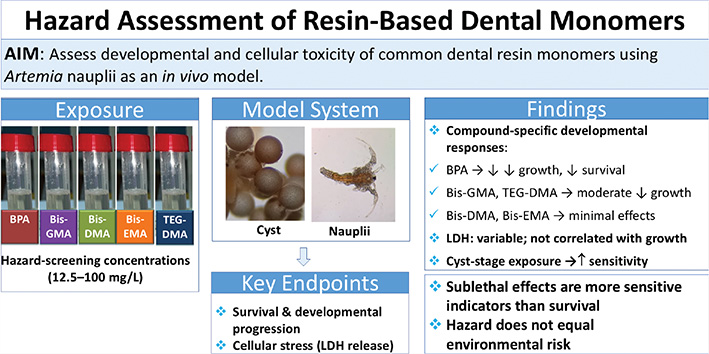
Materials and Methods: The acute and sublethal effects of five monomers associated with dental composites, namely – BPA (bisphenol A), Bis-DMA (bisphenol A dimethacrylate), Bis-GMA (bisphenol A-glycidyl methacrylate), Bis-EMA (bisphenol A ethoxylate dimethacrylate), and TEG-DMA (triethylene glycol dimethacrylate) – were evaluated in Artemia salina at both cyst and naupliar stages. The effects on naupliar survival, body length, and Lactate dehydrogenase (LDH) activity were measured to assess compound-specific biological responses.
Results: Bis-GMA, Bis-DMA, and BPA significantly reduced survival, while Bis-EMA caused modest mortality, and TEG-DMA had no effect. Despite these differences in survival, most monomers affected naupliar growth, with greater developmental sensitivity observed following cyst-stage exposure. However, growth responses were compound specific and not uniformly dose-dependent across all monomers. LDH responses were monomer specific: Bis-GMA and Bis-DMA increased LDH activity, although Bis-DMA showed no consistent effect on growth, whereas BPA and TEG-DMA showed reductions in LDH activity, despite observed growth inhibition, and Bis-EMA showed no significant change.
Conclusion: Taken together, our findings show that dental resin monomers differ in their developmental and metabolic impacts, highlighting the importance of considering safety alongside clinical performance when designing and selecting dental biomaterials. As the concentrations used were for hazard screening, these results indicate possible biological effects under controlled conditions but do not necessarily reflect environmental exposure scenarios or ecological risk. Additional studies at environmentally relevant exposure levels are needed to better evaluate ecological safety and support the development of more sustainable dental materials.
Downloads
References
Mulligan S, Ojeda JJ, Kakonyi G, Thornton SF, Moharamzadeh K, Martin N. Characterisation of microparticle waste from dental resin-based composites. Materials. 2021;14: 4440. DOI: https://doi.org/10.3390/ma14164440
Mulligan S, Hatton PV, Martin N. Resin-based composite materials: elution and pollution. Br Dent J. 2022;232:644–52. DOI: https://doi.org/10.1038/s41415-022-4241-7
Barutcigil K, Dündar A, Batmaz SG, Yıldırım K, Barutçugil Ç. Do resin-based composite CAD/CAM blocks release monomers? Clin Oral Investig. 2021;25:329–36. DOI: https://doi.org/10.1007/s00784-020-03377-3
Polydorou O, Schmidt OC, Spraul M, Vach K, Schulz SD, König A, et al. Detection of Bisphenol A in dental wastewater after grinding of dental resin composites. Dent Mater. 2020;36:1009–18. DOI: https://doi.org/10.1016/j.dental.2020.04.025
Reidelbach C, Garcia-Käufer M, Wingert N, Arif A, Vach K, Hellwig E, et al. Cytotoxicity and estrogenicity in simulated dental wastewater after grinding of resin-based materials. Dent Mater. 2021;37: 1486–97. DOI: https://doi.org/10.1016/j.dental.2021.07.003
Van Landuyt KL, Hellack B, Van Meerbeek B, Peumans M, Hoet P, Wiemann M, et al. Nanoparticle release from dental composites. Acta Biomater. 2014;10:365–74. DOI: https://doi.org/10.1016/j.actbio.2013.09.044
Cramer NB, Stansbury JW, Bowman CN. Recent advances and developments in composite dental restorative materials. J Dent Res. 2011;90:402–16. DOI: https://doi.org/10.1177/0022034510381263
Catalán A, Martínez A, Muñoz C, Medina C, Marzialetti T, Montaño M, et al. The effect of preheating of nano-filler composite resins on their degree of conversion and microfiltration in dental fillings. Polymer Bull. 2022;79:10707–22. DOI: https://doi.org/10.1007/s00289-021-03880-x
Peutzfeldt A. Resin composites in dentistry: the monomer systems. Eur J Oral Sci. 1997;105:97–116. DOI: https://doi.org/10.1111/j.1600-0722.1997.tb00188.x
Söderholm K-J, Mariotti A. BIS-GMA–based resins in dentistry: are they safe? J Am Dent Assoc. 1999;130:201–9. DOI: https://doi.org/10.14219/jada.archive.1999.0169
Fugolin APP, Pfeifer CS. New resins for dental composites. J Dent Res. 2017;96:1085–91. DOI: https://doi.org/10.1177/0022034517720658
Schmalz G, Widbiller M. Biocompatibility of amalgam vs composite – a review. Oral Health Prev Dent. 2022;20:149–56.
Seo H, Ahn Y-J, Seo H, Seo A, Lee H, Lee S-H, et al. Comprehensive assessment of the estrogenic activity of resin composites. Chemosphere. 2023;343:140104. DOI: https://doi.org/10.1016/j.chemosphere.2023.140104
Akhtar N, Tahir A, Qadir A, Masood R, Gulzar Z, Arshad M. Profusion of microplastics in dental healthcare units; morphological, polymer, and seasonal trends with hazardous consequences for humans. J Hazard Mater. 2024;479:135563. DOI: https://doi.org/10.1016/j.jhazmat.2024.135563
Gioka C, Eliades T, Zinelis S, Pratsinis H, Athanasiou AE, Eliades G, et al. Characterization and in vitro estrogenicity of orthodontic adhesive particulates produced by simulated debonding. Dent Mater. 2009;25:376–82. DOI: https://doi.org/10.1016/j.dental.2008.08.010
Barahona MV, Sánchez-Fortún S. Comparative sensitivity of three age classes of Artemia salina larvae to several phenolic compounds. Bull Environ Contam Toxicol. 1996;56:271–8. DOI: https://doi.org/10.1007/s001289900041
Caldwell GS, Bentley MG, Olive PJW. The use of a brine shrimp (Artemia salina) bioassay to assess the toxicity of diatom extracts and short chain aldehydes. Toxicon. 2003;42:301–6. DOI: https://doi.org/10.1016/S0041-0101(03)00147-8
Libralato G. The case of Artemia spp. in nanoecotoxicology. Mar Environ Res. 2014;101:38–43. DOI: https://doi.org/10.1016/j.marenvres.2014.08.002
Pelka M, Danzl C, Distler W, Petschelt A. A new screening test for toxicity testing of dental materials. J Dent. 2000;28:341–5. DOI: https://doi.org/10.1016/S0300-5712(00)00007-5
Milhem MM, Al-Hiyasat AS, Darmani H. Toxicity testing of restorative dental materials using brine shrimp larvae (Artemia salina). J Appl Oral Sci. 2008;16:297–301. DOI: https://doi.org/10.1590/S1678-77572008000400013
Darmani H, Al-Saleh DRH. Lower concentrations of the glyphosate-based herbicide Roundup® cause developmental defects in Artemia salina. Environ Toxicol Chem. 2023;42(7):1586-1594.. DOI: https://doi.org/10.1002/etc.5639
Soose LJ, Hügl KS, Oehlmann J, Schiwy A, Hollert H, Jourdan J. A novel approach for the assessment of invertebrate behavior and its use in behavioral ecotoxicology. Sci Total Environ. 2023;897:165418. DOI: https://doi.org/10.1016/j.scitotenv.2023.165418
Landis WG, Sofield RM, Yu M-H. Boca Raton, FL: Introduction to environmental toxicology. 5th ed. CRC Press; 2017. DOI: https://doi.org/10.1201/9781315117867
Staples CA, Dorn PB, Klecka GM, O’Block ST, Harris LR. A review of the environmental fate, effects, and exposures of bisphenol A. Chemosphere. 1998;36:2149–73. DOI: https://doi.org/10.1016/S0045-6535(97)10133-3
Geurtsen W. Biocompatibility of resin-modified filling materials. Crit Rev Oral Biol Med. 2000;11:333–55. DOI: https://doi.org/10.1177/10454411000110030401
Diogo BS, Antunes SC, Rodrigues S. Are biopesticides safe for the environment? Effects of pyrethrum extract on the non-target species Daphnia magna. Environ Toxicol Pharmacol. 2023;99:104114. DOI: https://doi.org/10.1016/j.etap.2023.104114
Diogo BS, Antunes SC, Pinto I, Amorim J, Teixeira C, Teles LO, et al. Insights into environmental caffeine contamination in ecotoxicological biomarkers and potential health effects of Danio rerio. Heliyon. 2023;9:e19875. DOI: https://doi.org/10.1016/j.heliyon.2023.e19875
Rodrigues S, Antunes SC, Correia AT, Nunes B. Ecotoxicological evaluation of gilthead seabream (Sparus aurata) exposed to the antibiotic oxytetracycline using a multibiomarker approach. Mar Environ Res. 2018;141:233–46. DOI: https://doi.org/10.1016/j.marenvres.2018.09.009
Michalaki A, McGivern AR, Poschet G, Büttner M, Altenburger R, Grintzalis K. The effects of single and combined stressors on daphnids – enzyme markers of physiology and metabolomics validate the impact of pollution. Toxics. 2022;10:604. DOI: https://doi.org/10.3390/toxics10100604
Zakhartsev MV, Pörtner HO, Blust R. Environmentally low-temperature kinetic and thermodynamic study of lactate dehydrogenase from Atlantic cod (G. morhua) using a 96-well microplate technique. Anal Biochem. 2004;330:10–20. DOI: https://doi.org/10.1016/j.ab.2004.03.070
Published
How to Cite
Issue
Section
License
Copyright (c) 2026 Mahmoud Abdelrahman Alatteili, Hamzeh ‘Ayed El-Amin’ Hassan Abid, Mohammad Talat Elsharkawy, Abdulmalik Saqer Mohammad Salti, Esraa Esam Mowafaq Shammamah, Rawan Yassin Nimir, Homa Darmani

This work is licensed under a Creative Commons Attribution 4.0 International License.




 Biomaterial Investigations in Dentistry is a Diamond Open Access peer-reviewed journal, publishing research in oral biomaterials science. The publishing of articles is free for authors, thanks to the support of Acta Odontologica Scandinavica Society (AOSS), a not-for-profit society.


