
Early rehabilitation in trauma patients: an observational study from two Norwegian trauma centers
DOI:
https://doi.org/10.2340/jrm.v58.45625Keywords:
multiple trauma, rehabilitation, trauma centre, wounds and injuriesAbstract
Objective: To examine the provision of consultation by a specialist in physical and rehabilitation medicine, and timing of early rehabilitation services for severely injured trauma patients as recommended in the Norwegian Trauma Plan.
Design: Observational cohort study.
Subjects/Patients: Adults aged ≥ 18 years admitted with severe (New Injury Severity Score > 12) traumatic injuries.
Methods: Observational cohort study with data from the Norwegian Trauma Registry and medical records. Outcomes included consultation with a physical and rehabilitation medicine specialist, timing of assessment, and involvement of health professions.
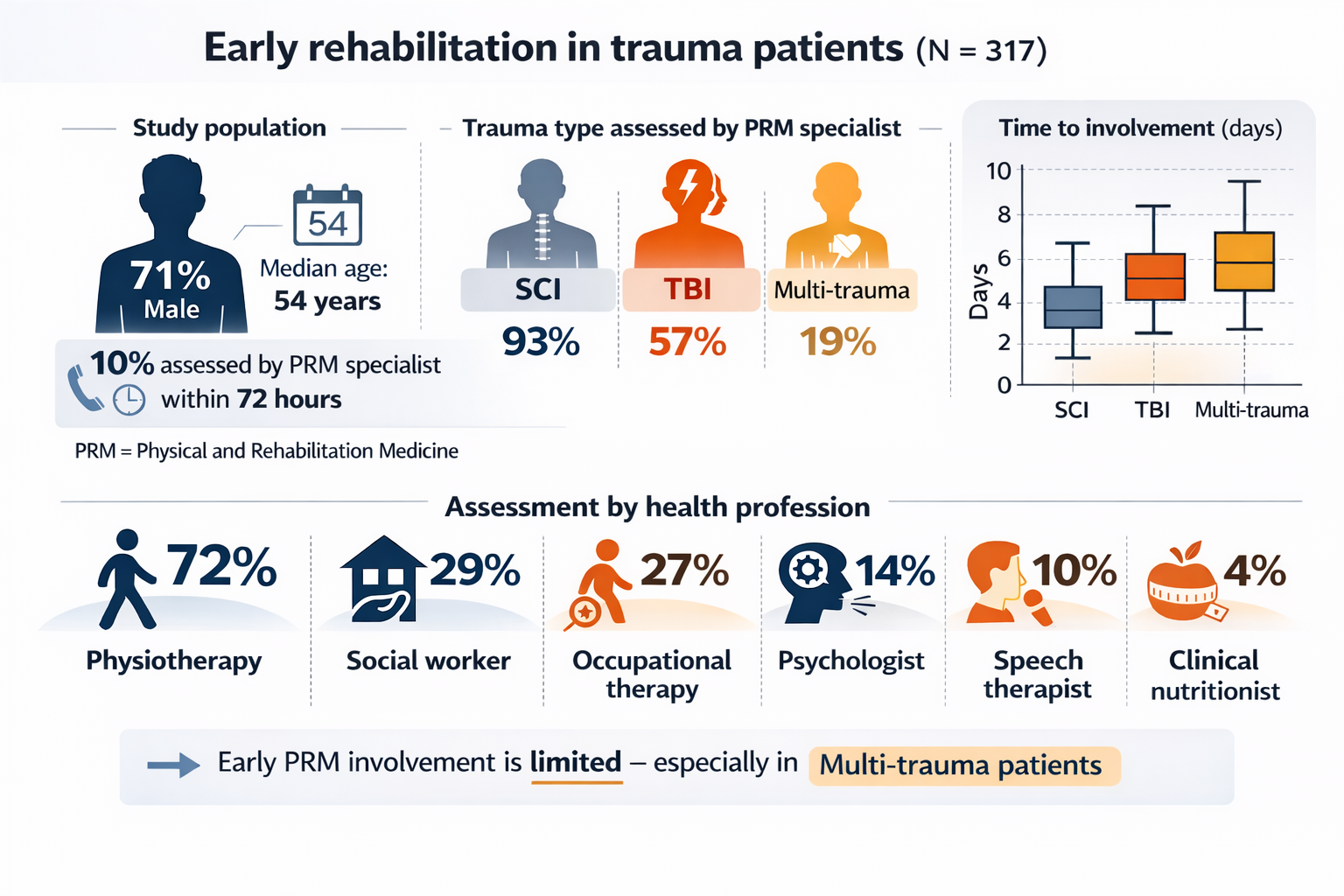
Results: Among 317 patients, 10% received assessment by a physical and rehabilitation medicine specialist within 72 h. Early assessment occurred in 43% (n = 6) of patients with spinal cord injury, 12% (n = 8) with traumatic brain injury, and 7% (n = 17) with multitrauma. Overall, 31% (n = 99) of all patients were assessed by a physical and rehabilitation medicine specialist, including 93% (n = 13) of spinal cord injury patients, 57% (n = 39) with traumatic brain injury, and 19% (n = 43) with multitrauma. Physiotherapists assessed 72% of patients, while involvement from other rehabilitation professionals was limited.
Conclusion: Despite recommendations, only one-third of patients were assessed by a physical and rehabilitation medicine specialist, and 10% within 72 h. Physiotherapy was common, but other rehabilitation input was limited. Patients with spinal cord injury received more comprehensive care than those with traumatic brain injury or multitrauma.
Downloads
References
World Health Organization. Injuries and violence fact sheet. Geneva: World Health Organization; 2024. Available from: https://www.who.int/news-room/fact-sheets/detail/injuries-and-violence.
Mock C, Lormand JD, Goosen J, Joshipura M, Peden M. Guidelines for essential trauma care. Geneva: World Health Organization; 2004. Available from: https://www.who.int/publications/i/item/guidelines-for-essential-trauma-care
Haagsma JA, Graetz N, Bolliger I, Naghavi M, Higashi H, Mullany EC, et al. The global burden of injury: incidence, mortality, disability-adjusted life years and time trends from the Global Burden of Disease study 2013. Inj Prev 2016; 22: 3–18. DOI: https://doi.org/10.1136/injuryprev-2015-041616
Gabbe BJ, Beck B. Trauma systems save lives: is that enough? Injury 2021; 52: 125–126. DOI: https://doi.org/10.1016/j.injury.2021.01.024
Moksnes HO, Schafer C, Rasmussen MS, Soberg HL, Roise O, Anke A, et al. Functional outcomes at 6 and 12 months post-injury in a trauma centre population with moderate-to-severe traumatic injuries. J Clin Med 2023; 12: 5300. DOI: https://doi.org/10.3390/jcm12165300
Polinder S, van Beeck EF, Essink-Bot ML, Toet H, Looman CWN, Mulder S, et al. Functional outcome at 2.5, 5, 9, and 24 months after injury in the Netherlands. J Trauma 2007; 62: 133–141. DOI: https://doi.org/10.1097/TA.0b013e31802b71c9
Meakes S, Enninghorst N, Weaver N, Hardy BM, Balogh ZJ. Long-term functional outcomes in polytrauma: a fundamentally new approach is needed in prediction. Eur J Trauma Emerg Surg 2024; 50: 1439–1452. DOI: https://doi.org/10.1007/s00068-023-02430-6
Norwegian Trauma Plan; 2025. Available from: https://metodebok.no/book/traumeplan
National Institute for Health and Care Excellence (NICE); 2022. Rehabilitation after traumatic injury. Available from: https://www.ncbi.nlm.nih.gov/books/NBK579697/
Gabbe BJ, Simpson PM, Cameron PA, Ponsford J, Lyons RA, Collie A, et al. Long-term health status and trajectories of seriously injured patients: a population-based longitudinal study. PLoS Med 2017; 14: e1002322. DOI: https://doi.org/10.1371/journal.pmed.1002322
Wisborg T, Manskow US, Jeppesen E. Trauma outcome research: more is needed. Acta Anaesthesiol Scand 2017; 61: 362–364. DOI: https://doi.org/10.1111/aas.12875
Moksnes HO, Andelic N, Schafer C, Anke A, Soberg HL, Roe C, et al. Unmet rehabilitation needs in the first 6 months post-injury in a trauma centre population with moderate-to-severe traumatic injuries. J Rehabil Med 2024; 56: jrm40078.
Alvsaker K, Hanoa R, Gran JM, Hogvall LM, Sogn CJF, Bech HC, et al. Impact of rehabilitation in the neurointensive care unit on long-term survival in patients with traumatic brain injury. Acta Anaesthesiol Scand 2025; 69: e70026.
Finstad J, Roise O, Rosseland LA, Clausen T, Havnes IA. Discharge from the trauma centre: exposure to opioids, unmet information needs and lack of follow up – a qualitative study among physical trauma survivors. Scand J Trauma Resusc Emerg Med 2021; 29: 121. DOI: https://doi.org/10.1186/s13049-021-00938-7
Bouman AIE, Hemmen B, Evers SMAA, van de Meent H, Ambergen T, Vos PE, et al. Effects of an integrated ‘fast track’ rehabilitation service for multi-trauma patients: a non-randomized clinical trial in the Netherlands. PLoS One 2017; 12: e0170047. DOI: https://doi.org/10.1371/journal.pone.0170047
Selj JN, Perrin PB, Hauger SL, Roe C, Moksnes HO, Schafer C, et al. Health-related quality of life and unmet healthcare needs in the first year following moderate-to-severe traumatic injuries: an observational study. J Clin Med 2025; 14: 4213. DOI: https://doi.org/10.3390/jcm14124213
Ward AB, Gutenbrunner C, Damjan H, Giustini A, Delarque A. European Union of Medical Specialists (UEMS) section of Physical & Rehabilitation Medicine: a position paper on physical and rehabilitation medicine in acute settings. J Rehabil Med 2010; 42: 417–424. DOI: https://doi.org/10.2340/16501977-0565
World Health Organization. Rehabilitation 2030 – A call for action; 2017. Available from: https://www.who.int/initiatives/rehabilitation-2030
Andelic N, Bautz-Holter E, Ronning P, Olafsen K, Sigurdardottir S, Schanke AK, et al. Does an early onset and continuous chain of rehabilitation improve the long-term functional outcome of patients with severe traumatic brain injury? J Neurotrauma 2012; 29: 66–74. DOI: https://doi.org/10.1089/neu.2011.1811
Strom V, Manum G, Leiulfsrud A, Wedege P, Rekand T, Halvorsen A, et al. People with spinal cord injury in Norway. Am J Phys Med Rehabil 2017; 96: S99–S101. DOI: https://doi.org/10.1097/PHM.0000000000000572
Andelic N, Ye J, Tornas S, Roe C, Lu J, Bautz-Holter E, et al. Cost-effectiveness analysis of an early-initiated, continuous chain of rehabilitation after severe traumatic brain injury. J Neurotrauma 2014; 31: 1313–1320. DOI: https://doi.org/10.1089/neu.2013.3292
Oslo Economics; 2020. Socio-economic value of rehabilitation. Available from: https://www.spekter.no/getfile.php/133232-1643960650/Dokumenter/Rapporter%20og%20analyser/Rapporter/Oslo%20Economics%3A%20Samfunns%C3%B8konomisk%20verdi%20av%20rehabilitering%20%282020%29.pdf
Naess HL, Vikane E, Wehling EI, Skouen JS, Bell RF, Johnsen LG. Effect of early interdisciplinary rehabilitation for trauma patients: a systematic review. Arch Rehabil Res Clin Transl 2020;2:100070. DOI: https://doi.org/10.1016/j.arrct.2020.100070
Schäfer C, Moksnes HO, Rasmussen MS, Hellstrom T, Soberg HL, Roise O, et al. Adherence to Guidelines for Acute Rehabilitation in the Norwegian Trauma Plan. J Rehabil Med 2023; 55: jrm6552. DOI: https://doi.org/10.2340/jrm.v55.6552
Nordset VIM, Holm KT, Azulay N, Røise O, Schrøder-Åsen T. Norwegian Trauma Registry: annual report 2024; 2024. Available from: https://nkt-traume.no/wp-content/uploads/2025/09/Arsrapport-for-2024-01.09.2025.pdf
von Elm E, Altman DG, Egger M, Pocock SJ, Gotzsche PC, Vandenbroucke JP, et al. The Strengthening the Reporting of Observational Studies in Epidemiology (STROBE) statement: guidelines for reporting observational studies. J Clin Epidemiol 2008; 61: 344–349. DOI: https://doi.org/10.1016/j.jclinepi.2007.11.008
Lavoie A, Moore L, LeSage N, Liberman M, Samplais JS. The New Injury Severity Score: a more accurate predictor of in-hospital mortality than the Injury Severity Score. J Trauma 2004; 56: 1312–1320. DOI: https://doi.org/10.1097/01.TA.0000075342.36072.EF
Palmer CS, Gabbe BJ, Cameron PA. Defining major trauma using the 2008 Abbreviated Injury Scale. Injury 2016; 47: 109–115. DOI: https://doi.org/10.1016/j.injury.2015.07.003
Osler T, Baker SP, Long W. A modification of the Injury Severity Score that both improves accuracy and simplifies scoring. J Trauma 1997; 43: 922–925; discussion 925–926. DOI: https://doi.org/10.1097/00005373-199712000-00009
British Society of Physical and Rehabilitation Medicine; 2018. Specialist Rehabilitation in the Trauma pathway: BSRM core standards. Available from: https://www.bsprm.org.uk/resources/guideline-documents/
Colonna AL, Meredith, JW. American College of Surgeons Resources Document. In: Vincent JL, Hall JB, editors. Encyclopedia of Intensive care medicine. Berlin, Heidelberg: Springer; 2012. Available from: https://doi.org/10.1007/978-3-642-00418-6_362 DOI: https://doi.org/10.1007/978-3-642-00418-6_362
Wagner AK, Fabio T, Zafonte RD, Goldberg G, Marion DW, Peitzman AB. Physical medicine and rehabilitation consultation: relationships with acute functional outcome, length of stay, and discharge planning after traumatic brain injury. Am J Phys Med Rehabil 2003; 82: 526–536. DOI: https://doi.org/10.1097/01.PHM.0000073825.09942.8F
Norwegian Directorate of Health. A saved life must also be lived – on the rehabilitation services for people with severe brain injury. IS-1279. Oslo: Norwegian Directorate of Health; 2005.
Mendel T, Marzi I, Anke C. Rehabilitation of severely injured patients. Eur J Trauma Emerg Surg 2025; 51: 149. DOI: https://doi.org/10.1007/s00068-025-02830-w
Klingebiel FKL, Landre V, Hasegawa M, Kalbas Y, Hanschen M, Sawauchi K, et al. The three stages of polytrauma rehabilitation: a recommendation and a systematic literature review on behalf of SICOT. Int Orthop 2025; 49: 365–374. DOI: https://doi.org/10.1007/s00264-024-06385-0
Scott J, Kandala NB, Fearon P, Robinson L. Embedded rehabilitation in major trauma: retrospective pre–post observational study of service and patient outcomes. Injury 2021; 52: 160–166. DOI: https://doi.org/10.1016/j.injury.2020.11.009
World Health Organization. Rehabilitation. Available from: https://www.who.int/health-topics/rehabilitation#tab=tab_1.
Finstad J, Roise O, Clausen T, Rosseland LA, Havnes IA. A qualitative longitudinal study of traumatic orthopaedic injury survivors’ experiences with pain and the long-term recovery trajectory. BMJ Open 2024; 14: e079161.
Rasmussen MS, Zhang Y, Andelic N, Aas E. Health care costs and service utilization in the first year following moderate to severe traumatic injury. BMC Health Serv Res 2024; 24: 1535. DOI: https://doi.org/10.1186/s12913-024-12016-6
Downloads
Additional Files
Published
How to Cite
Issue
Section
Categories
License
Copyright (c) 2026 Ingri G. Olsen, Marianne Wesnes, Hanne Næss, Eike Wehling, Eirik Vikane, Geir Arne Sunde, Oddvar Uleberg, Lars Gunnar Johnsen

This work is licensed under a Creative Commons Attribution 4.0 International License.
All digitalized JRM contents is available freely online. The Foundation for Rehabilitation Medicine owns the copyright for all material published until volume 40 (2008), as from volume 41 (2009) authors retain copyright to their work and as from volume 49 (2017) the journal has been published Open Access, under CC-BY-NC licences (unless otherwise specified). The CC-BY-NC licenses allow third parties to copy and redistribute the material in any medium or format and to remix, transform, and build upon the material for non-commercial purposes, provided proper attribution to the original work.
From 2024, articles are published under the CC-BY licence. This license permits sharing, adapting, and using the material for any purpose, including commercial use, with the condition of providing full attribution to the original publication.






