Rhythm-centred music interventions for motor coordination and rehabilitation: a scoping review of mechanisms, design principles, and technology-assisted assessment
DOI:
https://doi.org/10.2340/jrm.v58.46015Keywords:
rhythm-centred music intervention, rhythmic auditory cueing, movement quality, motor rehabilitation, technology-assisted assessment, sensorimotor integrationAbstract
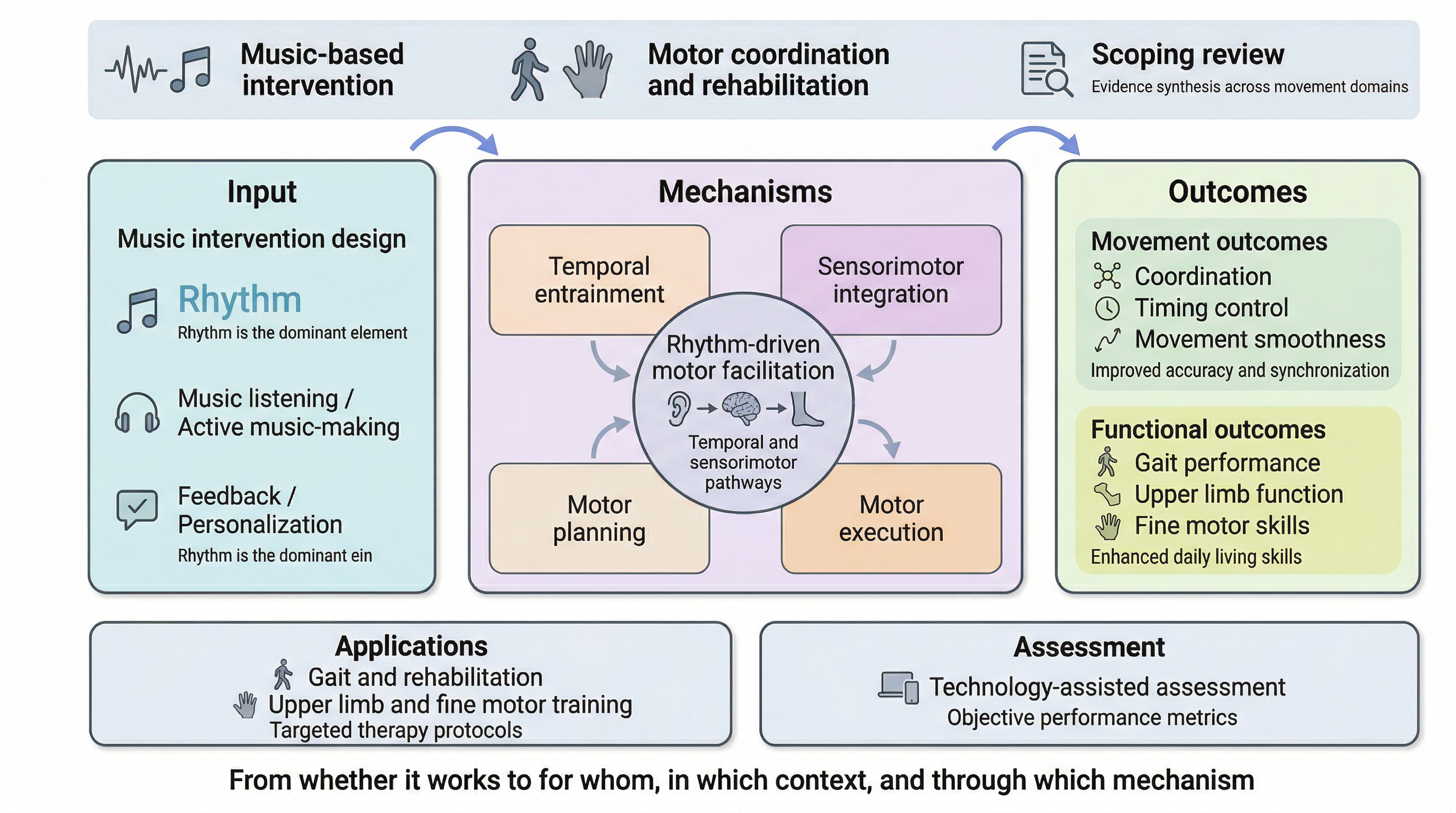
Objective: To map the evidence on rhythm-centred music interventions and movement-directed music-based strategies for motor coordination and rehabilitation, and to summarize their mechanisms, design principles, and technology-assisted assessment approaches.
Methods: This scoping review followed the Joanna Briggs Institute framework and was reported in accordance with PRISMA-ScR. PubMed, Scopus, Web of Science, and PsycINFO were searched for English-language empirical studies published from January 2013 to December 2024. Studies were eligible if music or rhythmically structured auditory input was used as a movement-directed intervention and at least one motor, coordination, functional, or movement-quality outcome was reported.
Results: Sixty-three studies were included. Coordination-related tasks were the most common targets, while lower-limb/gait function and fine-motor skills formed the largest movement categories. Rhythm was the most frequently used musical element, whereas melody, pitch, motivational music, active music making, and interactive digital systems served more context-dependent functions. Technology-assisted assessment, including sensors, motion capture, gait-analysis platforms, and music-interactive software, was the most common measurement approach.
Conclusion: Rhythm-centred and music-based motor interventions are heterogeneous and should be interpreted as descriptive evidence patterns rather than definitive estimates of therapeutic efficacy. Future studies should improve terminology, intervention parameterization, population-specific interpretation, methodological transparency, and multimodal mechanistic validation.
Downloads
References
Emmery L, Hackney ME, Kesar T, McKay JL, Rosenberg MC. An integrated review of music cognition and rhythmic stimuli in sensorimotor neurocognition and neurorehabilitation. Ann N Y Acad Sci 2023; 1530: 74–86. DOI: https://doi.org/10.1111/nyas.15079
Braun Janzen T, Koshimori Y, Richard NM, Thaut MH. Rhythm and music-based interventions in motor rehabilitation: current evidence and future perspectives. Front Hum Neurosci 2021; 15: 789467. DOI: https://doi.org/10.3389/fnhum.2021.789467
Dalla Bella S. Music and movement: towards a translational approach. Neurophysiol Clin 2018; 48: 377–386. DOI: https://doi.org/10.1016/j.neucli.2018.10.067
Ross JM, Iversen JR, Balasubramaniam R. Motor simulation theories of musical beat perception. Neurocase 2016; 22: 558–565. DOI: https://doi.org/10.1080/13554794.2016.1242756
Florio TM. Emergent aspects of the integration of sensory and motor functions. Brain Sci 2025; 15. DOI: https://doi.org/10.20944/preprints202501.0335.v1
Terry PC, Karageorghis CI, Curran ML, Martin OV, Parsons-Smith RL. Effects of music in exercise and sport: a meta-analytic review. Psychol Bull 2020; 146: 91–117. DOI: https://doi.org/10.1037/bul0000216
Dimitriadis T, Della Porta D, Perschl J, Evers AWM, Magee WL, Schaefer RS. Motivation and music interventions in adults: a systematic review. Neuropsychol Rehabil 2024; 34: 649–678. DOI: https://doi.org/10.1080/09602011.2023.2224033
Peters MDJ, Marnie C, Tricco AC, Pollock D, Munn Z, Alexander L, et al. Updated methodological guidance for the conduct of scoping reviews. JBI Evid Synth 2020; 18: 2119–2126. DOI: https://doi.org/10.11124/JBIES-20-00167
Munn Z, Pollock D, Khalil H, Alexander L, Mclnerney P, Godfrey CM, et al. What are scoping reviews? Providing a formal definition of scoping reviews as a type of evidence synthesis. JBI Evid Synth 2022; 20: 950–952. DOI: https://doi.org/10.11124/JBIES-21-00483
Tricco AC, Lillie E, Zarin W, O’Brien KK, Colquhoun H, Levac D, et al. PRISMA Extension for Scoping Reviews (PRISMA-ScR): checklist and explanation. Ann Intern Med 2018; 169: 467–473. DOI: https://doi.org/10.7326/M18-0850
Pollock D, Peters MDJ, Khalil H, McInerney P, Alexander L, Tricco AC, et al. Recommendations for the extraction, analysis, and presentation of results in scoping reviews. JBI Evid Synth 2023; 21: 520–532. DOI: https://doi.org/10.11124/JBIES-22-00123
Awad LN, Jayaraman A, Nolan KJ, Lewek MD, Bonato P, Newman M, et al. Efficacy and safety of using auditory-motor entrainment to improve walking after stroke: a multi-site randomized controlled trial of InTandem(TM). Nat Commun 2024; 15: 1081. DOI: https://doi.org/10.1038/s41467-024-44791-5
Porciuncula F, Cavanaugh JT, Zajac J, Wendel N, Baker T, Arumukhom Revi D, et al. Amplifying walking activity in Parkinson’s disease through autonomous music-based rhythmic auditory stimulation: randomized controlled trial. NPJ Parkinsons Dis 2025; 11: 100. DOI: https://doi.org/10.1038/s41531-025-00952-x
Cavanaugh JT, Porciuncula F, Zajac JA, Baker T, Wendel N, Awad LN, et al. Gait responses in people with Parkinson disease during autonomous closed-loop rhythmic auditory stimulation: an exploratory analysis. Neurorehabil Neural Repair 2025; 39: 666–676. DOI: https://doi.org/10.1177/15459683251340910
Ye X, Li L, He R, Jia Y, Poon W. Rhythmic auditory stimulation promotes gait recovery in Parkinson’s patients: a systematic review and meta-analysis. Front Neurol 2022; 13: 940419. DOI: https://doi.org/10.3389/fneur.2022.940419
Lee Y, Shin S. Improvement of gait in patients with stroke using rhythmic sensory stimulation: a case-control study. J Clin Med 2022; 11. DOI: https://doi.org/10.3390/jcm11020425
Grau-Sánchez J, Münte TF, Altenmüller E, Duarte E, Rodríguez-Fornells A. Potential benefits of music playing in stroke upper limb motor rehabilitation. Neurosci Biobehav Rev 2020; 112: 585–599. DOI: https://doi.org/10.1016/j.neubiorev.2020.02.027
Downloads
Additional Files
Published
How to Cite
License
Copyright (c) 2026 Yongfan Song, Yaming Wei

This work is licensed under a Creative Commons Attribution 4.0 International License.
All digitalized JRM contents is available freely online. The Foundation for Rehabilitation Medicine owns the copyright for all material published until volume 40 (2008), as from volume 41 (2009) authors retain copyright to their work and as from volume 49 (2017) the journal has been published Open Access, under CC-BY-NC licences (unless otherwise specified). The CC-BY-NC licenses allow third parties to copy and redistribute the material in any medium or format and to remix, transform, and build upon the material for non-commercial purposes, provided proper attribution to the original work.
From 2024, articles are published under the CC-BY licence. This license permits sharing, adapting, and using the material for any purpose, including commercial use, with the condition of providing full attribution to the original publication.